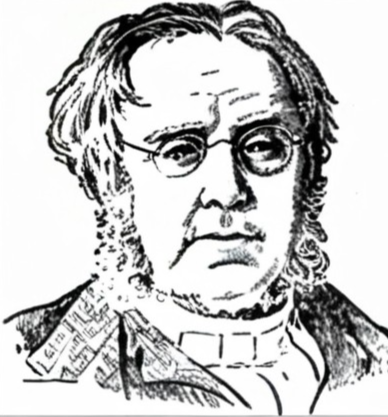
Report of a Speech on the Use of Instrumental Music in Public Worship,
James Dodson
DELIVERED IN THE GENERAL ASSEMBLY OF THE
CHURCH OF SCOTLAND, ON FRIDAY, MAY 26, 1871,
BY
THE REV. W. R. PIRIE, D.D.,
PROFESSOR OF DIVINITY AND CHURCH HISTORY IN THE UNIVERSITY
OF ABERDEEN.
Revised by the Speaker and, with his consent, Published by certain Members of the late General Assembly.
EDINBURGH:
PRINTED BY THOMAS PATON & SON, GEORGE STREET.
NOTICE.
THIS speech is published, in so far as I can recollect, as nearly as possible in the same terms as it was spoken, with two exceptions. I have, in the first place, interwoven some explanation of the complaint as brought up from the Presbytery of Chirnside, without which, parts of it would hardly have been intelligible to those who had not seen the Record. Secondly, I have arranged the arguments in a somewhat more regular and logical sequence than they were put forward in the speech, which, having been a reply, necessarily adverted to the special points as they had been urged by the successive preceding speakers, and therefore without any particular reference to their bearing on each other. I have willingly agreed to its publication, because, whatever may be its direct effects, it may at least be the means of enabling us to discover, whether there really be any argument worthy of the name, for such a singular innovation on our simple worship, as the introduction of instrumental music, except the mere æsthetic gratification of the audience.
W. R. PIRIE.
[Page 5]
SPEECH.
MODERATOR,—Under the aspect in which I regard the subject, this complaint raises the whole question as to the use of instrumental music in public worship. Keeping in view the probability of public opinion being soon brought to bear more effectively on it, I should not have been sorry had the discussion, therefore, been deferred. At the same time, in some respects it is most desirable that the matter should be settled, for as it appears to me, many of the Church Courts have been acting, during several years past, under an entire misapprehension of the law. I should be unwilling to say that this misapprehension and consequent perversion of the law was intentionally fostered by office-bearers in the Church, for nothing save irresistible evidence could warrant such an assumption; but I do say that nothing else except the existence of the strongest possible prejudice can account for it, since I trust to be able to show that not even a plausible pretence for the introduction of instrumental music in public worship, is to be found either in the language of the statutes, or in the usage of the Church.
This indeed would be manifest, were there no other proof than the utter vagueness of opinion upon the subject, and the doubts entertained, both by individual office-bearers and Church Courts, as to what they are entitled and what they are not entitled to do, which indeed is strikingly illustrated in the very case now before us. From the minute, the minister would appear to have thought that any one who pleased might introduce an organ into public worship, if it were with what he terms the “unanimous consent of the congregation.” The heritors, on the contrary, deemed it necessary that “the sanction of the Presbytery should be procured for the use of the organ.” The Presbytery thought, “that as no
[Page 6]
one connected with the congregation had objected to the use of the organ, there was no case calling for their interference,” and had they stopped at this point, I should have been prepared to support their decision; but when they added, “And further, that under the Declaratory Act of 1866, the present application is quite unnecessary,” they evidently implied that the Act of 1866 meant something more than was involved in the previous clause, and authorised the introduction of instrumental music into public worship as a legal proceeding, if the congregation did not object to it. The Synod confirmed this finding on a division, although the counter-motion seems to have been even more objectionable than that which was carried. All this demonstrates that there is no ascertained principle upon the subject; so that if we leave matters in their present state, we shall not only have a most anomalous system of worship, but a positive contradiction between the worship allowed in one Presbytery and that allowed in another—so that the worship of our Church will be in a state of perfect confusion. If we are to have instrumental music in public worship, the appellant in this case is assuredly right in demanding of us that we shall explain who is to select it? Whether Minister, or Kirk-Session, or Presbytery, or Congregation? and what is to be its character? Whether it is to be limited to an organ only, or is to include a harmonium, a fiddle, a flute, a flageolet,* or any other instrument of music whatsoever? For my own part, although I by no means wish to push matters to any extreme, I am decidedly of opinion that we should, as soon as possible, get quit of instrumental music altogether, and forbid it, as injurious to real devotion rather than otherwise, and inconsistent with the spirit, usage, and constitution of the Church of Scotland.
Yet, strong as these terms are, Moderator, the very form of them will show you that I have no superstition on the subject, that I attach no importance to externals in religion merely as externals, nor consider the use of instrumental music in worship as
_____
* Such instruments are, we believe, occasionally made available in churches where instrumental music is in use, and organs cannot be procured. I have heard it said that the use of instrumental music in church worship, is to keep up the voices of the singers to the proper key. This seems a little like nonsense, when applied to a few verses of a Psalm, but it is the only argument having even a shadow of plausibility which I ever heard on the subject. This, however, would be effected quite as well by some of the other instruments as by the organ.
[Page 7]
in itself a sin. I admit, indeed, that there is something in the argument which maintains instrumental music to be, not only ignored in the New Testament, but that praise seems limited to “the fruit of the lips;” I admit that there is much in the argument which maintains all kinds of indirect worship to be not only ignored in the New Testament, but to be adverse to its spirit and its theory: still, all this is not equivalent to an absolute prohibition,* but seems rather a warning or caution to avoid indirect worship, in all cases, where with a due consideration of the circumstances of society it can be avoided without leading to greater evils. In this we have a manifestation of the perfect wisdom of the Christian system, even in its details. It never outrages even prejudices which do not involve absolute sin, but it certainly forbids us to generate or to cherish them, and therefore never encourages the introduction of any rite or ceremony, or still more, sensational appeal productive of any emotion not directly religious, because every such rite or ceremony, or still more, sensational appeal, will assuredly, in the end, generate and cherish prejudices, and even errors, with respect to what is truly religion and what is not, and that from the very essential constitution of the human mind. No rite, or ceremony, or appeal, therefore, ought, in the first instance, to be admitted in worship, except such as tends directly to sanctify the human heart, for the only object of real worship is to strengthen our trust in God through Christ, manifesting itself in love displayed towards each other. If I thought that instrumental music would tend to augment a man’s love for his fellow creatures under trust in God through Christ, no man would more strenuously urge than I would do, its immediate introduction into all our churches.
But it is just because I think that, under present circumstances, instrumental music is not only not calculated to produce any approach to real devotion, but tends in many instances to the opposite result, that I object to its being admitted into the worship of the Church of Scotland. I dwell on this matter the more, because I am convinced that the real objection to instrumental music in public worship is entirely misunderstood. I do not deny that fine instrumental music generates profound emotion in
_____
* Symbolical worship may be absolutely necessary in the case of the deaf and dumb, as well as sometimes in the case of those whose language is only imperfectly understood by the teacher.
[Page 8]
those who thoroughly appreciate it, nor that it produces such an effect to a certain extent even on others. But it can do no kind of good, because it makes no appeal to the understanding, nor, therefore, generates any emotion which might tend to unite man with God. It generates only a mere sensational or it may be sentimental emotion, which not only implies nothing devotional, but must be partially detrimental to true devotion. I speak so decidedly upon the subject, because I have made experiments on it, and induced others to do so too. I admit that such emotion may be enthusiastic and rapturous; but, I say, the more rapturous the worse! For it is neither more nor less than the rapture which is induced by the magnificent swells of the oratorio. Wherever men worship in spirit and in truth, with the understanding as well as the feelings, or rather with the understanding generating the feelings, the introduction of sensuous or sentimental emotion necessarily bears the mind away into another region, and the understanding is proportionally distracted from the sense of the passages which are sung. I challenge any one to say that he has sat in a church or anywhere else, listening to the splendid peals of the organ, without having his mind withdrawn from the sense of the verses which were given him to sing. Only a short time ago, I was present at a church in this very city, where I heard a Psalm chanted, I believe they call it, and though I tried with all my might to discover the passages which they were chanting, I could not do so. And when I asked some of my friends what it was which they were chanting, and what were the passages they were chanting which were to produce devotional effects, one of them said: “Well, we don’t know; we rather think they are taking bits here and there.” If that were the case with regard to chanting, it would be ten times worse if you introduce instrumental music. The richest peals of the organ, or the grandest swells of the music of the oratorio, exciting feelings perhaps of the most rapturous emotion, do not in the slightest degree make men more holy. These may originate a mental state of a kind so soothing and engrossing that it is readily enough confused with holiness, for all such feelings run into each other; but we are not in the slightest degree imbued through them with a firmer trust in God, or a warmer love towards our fellow creatures. Nay, such as the feeling is, it does not last. It is a merely temporary sensation, which passes away like the visions of a
[Page 9]
dream. But though the half-sensuous, half-sensational tone of feeling passes away, the delusive ideas which it has generated too often remain, and most mischievously operate. For the confusion which is thus made of a temporary sensation with holiness, deludes those who only imperfectly know their own spiritual state, with an impression that they have actually been realising holiness and been actuated by a spirit of devotion. They confound the solemn, sensational, and sentimental feelings produced by the music with religious feeling, and are thus borne away and blinded to a sense of their true condition, as at the very moment subject to sin, “wretched, and miserable, and poor, and blind, and naked.” Ready at all times to trust in external forms and sensational feelings rather than under a sense of weakness and wickedness to turn through Christ to God, this kind of external worship has manifestly a special power to deceive us. We have been affected by deep emotion in the church, and imagining all solemnising emotion felt there to be religious emotion, we naturally suppose ourselves to have realised religious convictions, because we rarely think in such cases of analysing the character of our mental states. This sort of self-deception is by no means limited to the emotions produced by instrumental music, but is common to all external forms and sensational appeals which can be used in worship. Every one accustomed in the slightest degree to analyse his own feelings, must in such cases have felt that he was under the influence of a species of emotion that had nothing whatever to do with devotion; or, in other words, which, while it soothed and solemnised the mind, yet neither implied trust in God nor augmented love to man. As it is merely sensuous gratification, it of course really though unconsciously draws us away for the time, from the realisation either of the one or the other.
From these remarks, if they be just, it will at once be perceived that we have now really a far wider question than that which regards the admittance of instrumental music into our public worship. For that is only the indication of and prelude to other changes. The very argument made use of in favour of the introduction of instrumental music into worship, would to a great extent apply to the introduction of pictures. How many people complain of the dryness and other evils of the forms of our prayers in the Presbyterian Church? What could be more effective, it might be argued, than, in supplement of such prayers, to have a
[Page 10]
picture of Christ before the eyes of the worshipper, stretching forth his arms to those who desire to come unto Him and live? These dry prayers are intolerable to people of taste. We cannot listen to such prayers in spirit and in truth. Pictures, especially such lovely, glowing pictures as a Titian or a Raphael knew so well to delineate, are the very means necessary to give such prayers meaning and enable the worshipper to join in them with earnestness and heart. Away with such bald worship. Give us pictures by which to worship. This would assure in prayer all that emotion which instrumental music generates in praise, for the admirer of pictures is even more enthusiastic than the lover of music. How admirably, too, would the use of pictures in worship tell on the uneducated, for they can appreciate what they see full well, when the sense of the language which they hear escapes them. But, Moderator, I must stop, for I suspect I am making a stronger case for the introduction of pictures into worship, than can be made for the introduction of instrumental music! I know, however, that it is proposed, in place of extempore prayer, to introduce a liturgy, which is just a manifestation of the same tendency to substitute forms instead of vital feeling in religion. But a liturgy would not in the least serve the purpose. The perpetual repetition of a liturgy is, indeed, more offensive and tedious than what is called the dryness of extempore prayer. Where there are the richest and fullest liturgies, pictures are in the highest favour. But I may be told that, however much may be said for the introduction of pictures into worship, the tendency of our Church is so strong against it as to prevent any chance of such a thing. That is very doubtful. The feeling against the introduction of instrumental music into worship seemed just as strong a few years ago. All indirect worship grows, necessarily, as being the worship suited to indifferentism, for it demands no effort at self-control, nor any struggle after divine influence, unless indeed there exist some counteracting causes. This process was at first checked in the Church of England, because it had to contend against the Roman Catholics. But a latent tendency to ritualism has ever existed in the Church of England, from their retaining the germs of it, and hence has now grown to such a pitch, that in the High Church party, the love of ritualism is nearly as great as ever it was in the Church of Rome.
The fact is, that the tendency to introduce instrumental music
[Page 11]
into public worship, is just a manifestation of that growing indifferentism in religion, which forms, and all kinds of indirect worship arise from, and strengthen by a reflex action. Hence, it is not confined merely to the introduction of musical instruments into public worship, but is beginning to exhibit itself in a variety of ways.*
Some of these indications of formalism are notorious, and others are openly spoken of and criticised in the public prints. But granting some of these things spoken of and written of to be untrue, and I earnestly trust they are, yet the very universality of the rumour shows what is the belief of the public as to the tendency of Church office-bearers; and enough certainly is true, to show, though it may be in a lesser degree, what that tendency in some cases actually is, and what must be the consequences if we allow innovations of a serious character to be slowly and gradually introduced, contrary to the spirit of the principles of our Church, and contrary to the usage of all her history. And let it be observed, that these things are occurring at a time when High Church Episcopacy is rearing its head as it has never done in Scotland for two hundred years. Nor, when I say High Church Episcopacy, do I speak of the form of government, which under some aspects may have much to recommend it, but of the formalism and ritualism of High Church Episcopacy, which, though it may be the religion of
_____
* We have chants which the mass of the people cannot follow, and in which they take no share, except perhaps to enjoy a momentary sensuous gratification from them. Instead of the old “Hymn Books,” we have “Hymnals;”—instead of “Books of Prayer,” we have “Euchologions.” Then, as part of this formalism, for the purpose of drawing a precise line of discrimination between the clergy and the laity, which is a special characteristic of Romanism, we have ministers of the Church of Scotland mimicking the dress of priests, occasionally fashioned, it is said, by the most eminent High Church tailors of London. In some churches it is openly reported that there are desks which the uninitiated at all events, sometimes mistake for imitations of altars. I have even heard of cloths covering these desks, and having worked into them Popish or High Church symbols. We may be told that these things are contemptible. It may be so. All superstition is more or less contemptible. But these things are only the beginning of evils. They turn away men’s minds from vital religion, foster indifferentism, and through indifferentism, rationalism and infidelity, and will grow inevitably with the indifferentism and rationalism and infidelity which they foster. A friend on whom I can depend, told me the other day, that in the church where he attended, they were getting the Church of England prayers, and occasionally the Athanasian Creed. He thought that he would go to the Church of England, as he preferred to have the original rather than an imitation.
[Page 12]
bigotry in some cases, must, in a church professing the pure spirituality which distinguishes our standards, become in a great measure among us the so-called devotion of indifferentism and irreligion. I repeat, therefore, that in my judgment, you have really a far wider question than merely the admission of instrumental music into worship to determine. Admit this with the sanction of the General Assembly, and you open the sluices. Other changes will gradually creep on, and I know not how you are to prevent them. You have settled the principle; and though resistance from time to time may be made to details, yet, when you have settled the principle, the admission of further changes can only be a matter of time.
It was this conviction, there can be no doubt, which induced our wise forefathers to exclude all sorts of ostentatious and emotional forms and exercises, or in other words, all sorts of indirect worship from the public services of devotion. And I have no hesitation in saying, that experience has proved them to be right. Such kinds of so-called devotion, as matter of fact, usually develop just as a sense of vital religion diminishes; they are introduced as substitutes for real devotion, when, from the indifference of the hearers, or the coldness and incapacity of the clergy, the people tire of simple services, and preaching produces little effect. The clergy, when they feel that the audience yawn at their prayers, or weary at their sermons, desire to keep their congregations by substituting something more interesting for both. Their sermons dwindle down to twenty minutes, and fifteen minutes, and ten minutes—during which it is impossible really to discuss almost any subject whatever—just as chants and pieces of oratorios on organs are multiplied. Wherever deep attention is manifested to sermons, and crowds hurry to hear them, we rarely find the clergy introducing these manifestations of indirect or will-worship.
But however this may be, we know, at all events, as has been said, that for centuries any kind of indirect or will-worship, and specially the use of instrumental music, was excluded from the devotions of our Presbyterian Church most rigidly; so strong, indeed, was the feeling against it, that it was looked upon with a sort of abhorrence, and up to a very recent period, instrumental music, in a Scottish Presbyterian Church, would not have been tolerated for a moment. At the same time, it must be admitted that of late years this abhorrence of instrumental music in
[Page 13]
churches has been diminishing. This is owing, no doubt, to the number of our people, especially of the higher classes, who occasionally visit or reside in England, to the growth of indifferentism, arising from a variety of causes on which I need not now dwell, and to the consequent ignorance which prevails as to the true nature of spiritual worship. It was owing to these causes, though the dislike to indirect worship had by no means disappeared in Scotland, that the country was astounded a very few years ago by reports of various innovations, and amongst the rest, of the use of instrumental music having been introduced into one at least of our churches. This was objected to, even by many who did not appreciate the strong spiritual and evangelical argument against indirect worship, because the right of making such changes was rested on a claim of independency on the part of Ministers and Kirk-Sessions, as if entitled to introduce any innovation into public worship which was not absolutely forbidden by statute. It was looked upon, consequently, as a defiance of Church Courts, and thence as a proceeding which must ring the knell of our Establishment as a system of Presbytery. Nor was this opinion to be wondered at, for at that time, in consequence of the unsettled state of the Church originating in the large Secession of 1843, there was a general tendency to looseness of discipline, and to an independent action on the part of Ministers and Kirk-Sessions, under the impression that the higher courts had not strength to resist it. It seemed to many of us to be the beginning, as has been said, of a break-up of the Presbyterian system, and we resolved that it was to be checked at all hazards. Such was the origin of the Act 1865, which was only indirectly aimed at innovations, its main object being to check independency, from which these innovations flowed. Hence, it never alludes to innovations in public worship, except to declare that there is no independent power in Ministers or Kirk-Sessions with regard to them, but on the contrary, that they are all subject to review by the Superior Church Courts. There was an immense outcry against this Act, and on the singular ground, so far as the parties offering it were concerned, that by throwing the ultimate decision of this matter on the Superior Church Courts, it made the Church responsible for changes which had previously been the isolated act of particular Kirk-Sessions, and therefore, had no ecclesiastical authority. There was not the slightest ground for such an outcry, since the
[Page 14]
Act gave no power to the Presbyteries which they had not before; but at the time, the Church was very unsettled, and in order to satisfy every one that would be satisfied, the Act 1866 was introduced, making no real change whatever on the Act 1865, but simply indicating what was evidently implied in the Act 1865, that Presbyteries were not entitled to force innovations in public worship even on minorities of congregations, but only to review and superintend the actings of Ministers and Kirk-Sessions in such matters, and to keep them right. It was again simply an Act against independency exhibited under a particular form, and there can be no doubt that, in so far, these Acts served their purpose, for they crushed the tendency which had previously existed towards independent action. But, most strangely, this Act, which says not one word about what innovations are or are not to be allowed, but in this respect leaves matters precisely as they were, was held to permit Presbyteries to sanction instrumental music in worship! No doubt, it would have allowed them to sanction such music, provided they considered it previously authorised by the laws and usage and principles of the Church. But observe, sir, so far was the Assembly from considering this to be the case, that they held the very opposite opinion, and considered, that if any case of the use of instrumental music was brought before a Presbytery, it had a right to prohibit, but not to sanction it. I am convinced that it never entered into the mind of a single individual, in Assembly 1866, that instrumental music in public worship was consistent with the laws, usages, and principles of the Church. And still less, that the Act of that year permitted Presbyteries to sanction it.*
No doubt we were then told, as we have this day been told from the bar, that there is no law against it. We are still asked to point out a statute which forbids it, and we are gravely informed that any minister is entitled to introduce any innovation in worship that he pleases, unless there be a special statute condemning it. Why, sir, what a strange and monstrous medley our worship would
_____
* The great evil arising from this misconception consists in its apparently justifying ministers in introducing innovations, they being bound by the most solemn declaration at ordination “to follow no divisive courses from the present established worship of this Church.” Of course, if any innovation were held as sanctioned by the Ecclesiastical Courts, this would, in so far, seem to diminish the strength of the obligation. That I have given the true meaning of those Acts will be manifest to any one who chooses to read them. They will not admit of any other interpretation.
[Page 15]
be, were every one entitled to make it whatever his own caprice might dictate, because there was no formal statute forbidding it! Will any one have the kindness to put his finger on a statute forbidding us to introduce into worship the doctrine of the Immaculate Conception of the Virgin? Will any one lay his hand on a statute forbidding a minister to hang bells to his gown tails when he enters the pulpit? Are the copes, stoles, and maniples, or by whatever name they may be called, used in the Roman Catholic and aped in the High Church ritual, are these specially forbidden? It may be so, but I have no recollection of it.* Thousands and thousands of similar cases might be given.† The horror with which our forefathers regarded the admission of musical instruments into worship, and indeed indirect worship of all kinds, was such, that they never dreamed of introducing a clause against it into the Confession of Faith, nor even of passing an Act to forbid it. The thing is so obviously inconsistent with the genius of our simple worship, and indeed with the constitution, spirit, and character of our faith, that it condemns itself. Hence it is specially condemned by non-usage, which, in such a case and under such an aspect, is the strongest of all laws.
Now, sir, it is obvious, that if there is to be anything like regularity in worship, if we are to maintain the simple and spiritual devotions of our Church in their purity, if we are to cherish any hope of conciliating our dissenting brethren, who still, thank God, are sound in this matter, we must discourage, and as quickly as possible put an end to, this most anomalous state of things. I admit that there may be difficulty in taking strong measures immediately and at once, nor are we at present in a position to do so.‡
_____
* A reverend gentleman said in reply to this, that “certain old Acts of the Assembly regulated the dresses both of ministers and their wives.” Now this evidently has nothing whatever to do with the subject. That enactment, the reverend gentleman would have seen, had he had time for consideration, regarded social proprieties, and had nothing whatever to do with religious rites.
† A good many years ago, the minister of a quoad sacra church, having had a quarrel with his managers, who had guaranteed him a certain stipend, and having determined to punish them by emptying his church, is said to have preached with his back to the people, and pled that there was no law against it! There is no end of the extravagances that might be defended on such a plea.
‡ The case before the Assembly did not involve directly the question of the legality of instrumental music in worship. It was a complaint as to the right of the Presbytery to sanction it under the Act 1866, and this was negatived by an overwhelming majority.
[Page 16]
There was certainly a feeling of satisfaction that the Act 1866 implied that innovations were not to be hunted after. It was the impression that great deference ought to be paid to unanimous congregations; for the feeling was, that in such circumstances, the Church at the time could not afford to engage in a contention which would possibly be of an embittered character, and certainly she did not desire it. The hope was, that as the inconsistency of the changes then proposed with spiritual worship, and with the character and genius of the Church of Scotland, became appreciated, the tendency would die away; and this the more that we trusted religious indifferentism would diminish and bear devotional formalism away with it. I am still of this mind. I am equally against “needless interference with the government of particular kirks.” But I am equally of opinion that this gross misapprehension of Presbyteries, under which they imagine that if congregations be unanimous, they are entitled to sanction instrumental music in public worship, ought to be put a stop to. Congregations in such cases generally, I believe, do not interfere. The work is done by a few individuals, who assume silence for consent. The Church, I think, in the meantime, is hardly prepared to go farther, for the mischievous principle involved in those proceedings had long been forgotten, and has not of late been sufficiently ventilated; and, therefore, I support Mr Swinton’s amended motion, which, if carried, will give at all events a check to the system in operation, will prepare for its final abrogation, and will let Presbyteries understand, that when they give their formal sanction to the introduction of instrumental music into church worship, they have no authority from the General Assembly, and that their resolution is just so much waste paper.
THOMAS PATON AND SON, GEORGE STREET, EDINBURGH.