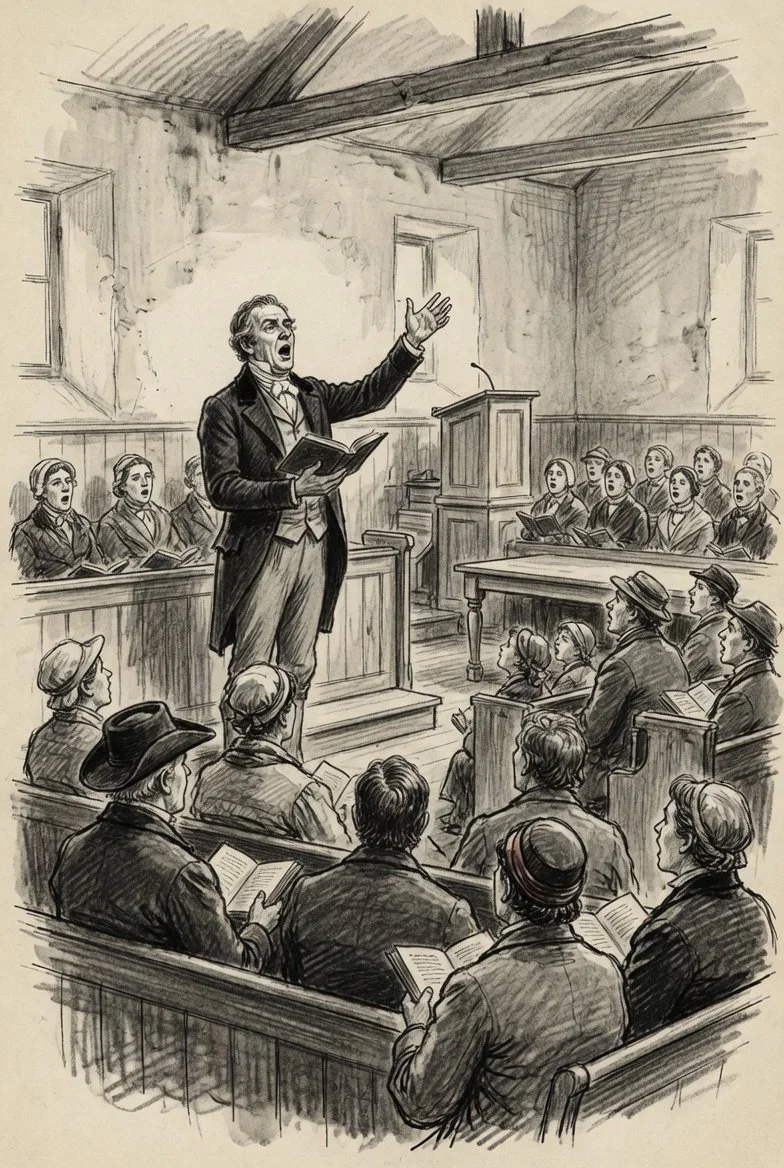
The Divine Institution of David’s Psalms:
James Dodson
AND
THE UNLAWFULNESS OF USING
UNINSPIRED HYMNS IN DIVINE WORSHIP
WITH
Occasional Hints on Church Music.
BY
A LOVER OF PURITY IN RELIGIOUS WORSHIP.
MATT. xv. 9.—“In vain do they worship me, teaching
the Commandments of Men.”
GLASGOW:
PRINTED BY D. M‘KENZIE FOR THE EDITOR.
1806.
PREFACE.
AT a time when levity and infidelity prevails, it was judged necessary to put the following sheets to the press, especially on the introduction of novelties, of which people can have very inadequate conceptions, if any at all. To what tendency these plans or purposes may answer, whether they may be agreeable with the Christian liberty wherewith these lands of ours have been highly privileged or favoured, it is the desire of the Editor to lay before the reader a view concerning these holy ordinances, constituted among us as a means appointed of God, for the continuance of religious exercise in his church. Seeing, then, that these ordinances are appointed for the good of the people of God, it becomes every one to examine strictly what is instituted an ordinance of God, and what is not appointed by him. The former edition not having free access in this country, and what had arrived amongst us seemed to have a high demand; and if this piece be useful to the Public, by giving a just view of what tends to duty and knowledge, the Editor thinks himself rewarded for his labour.
A. H.
INTRODUCTION.
SINGING of psalms had been instituted at a very early period in the church. The 90th was the first which was wrote by Moses, as directed to him according to the Hebrew manner. The form of worship in the time of the Fathers we have it not recorded. It appears to have been the form to pray after sacrificing (See 1 Sam. i. 10. Luke i. 10.) which had been the manner of worship from the beginning, Gen. xii. 8. when God instituted a church in the wilderness, that is, a visible church, the ordinance of singing of psalms was instituted an ordinance of God, as related above. There seems to have been many of the people of God, in various countries, as Job’s friends (See Job ii. 11.) The sufferings of Job appears to have been twenty years prior to the Children of Israel going into the wilderness, from the margin account, the church continuing in the same form of worship until David’s time, when it received several enlargements in its ordinances and form of worship; as first the singing of psalms by Moses, as all the constituted ceremonies except that of sacrificing, which was more enlarged in the wilderness. The Psalms being begun, or first instituted an ordinance of God by Moses, was greatly enlarged by David and other prophets contemporary, or rather companions of him; as the 76th Psalm, wrote by Asaph, was fulfilled in Hezekias’ time. (See Psalm lxxvi. 8. agreeable with Isaiah ix. 5. and xxix. 6. and xxx. 30. 31. 32. xxxvi. 36.) The Psalms being constituted an ordinance of God, to continue an exercise for the people of God in their religious assemblies or worship, by divine inspiration, which our Lord and his apostles often cites in many places, speaking plainly of our Redeemer; as also the apostle Paul, admonishing the Colossians, or religious Greeks, to admonish one another in psalms, and hymns, and spiritual songs, making melody to the Lord. Psalms, and hymns, and spiritual songs are the several characters the Psalms are called by in the Hebrew, which the proselyte Greeks were acquainted with. (See Acts xvii. 4.) Devout, or proselyte Greeks, when
iv
the Arian apostacy set up under Constantine the Great, after the establishment of the Christian religion, they began to supplant the book of Psalms, by appointing the Bible to be sung in place thereof, well knowing the Psalms opposed their system of apostacy, they speaking very plain concerning our Lord in many places, as also speaking more immediately against them, as they had evidenced themselves to be the enemies of God. These new forms, then, or plans of psalmody, being disapproved of as not according to divine appointment at the then reformation, or rather restoration, and the true religion established, this ordinance of God seems to have continued, to wit, singing of psalms in divine worship through all the persecution, until popish darkness overspread the Christian hemisphere, at which time singing of psalms was set aside, and their manner of forms put in place; such as poems, having the character of psalters and hymns, according as their humour or opinions may vary. Those of the true religion were named Lolards, on account of their singing of psalms in divine worship, and Hugonets, because of the low appearance their system of religion made in comparison of the then apostatized system. The reformed English were called by that name in the time of Henry VIII. until the reformation, when the true worship became more general. Thus it continued under the various attacks and persecutions, until about the beginning of the 18th century, when Mr Simpson, an Arian, or rather Socinian, a minister of the church of Scotland, who was mightily opposed by the famous and learned Thomas Boston of Ettrick, about 13 years after, they having put out those ministers who seemed to be most faithful, they again set up their system, by adopting Isaac Wat’s system, who was a paraphrast, by introducing paraphrases, or a new psalmody; but could not establish them, until, being more uniform in their indulgence, and having several Socinians in their number, they by degrees introduced their poems, on purpose to lay aside the book of Psalms. Thus, then, was the ordinance of God set aside in part, putting the ordinance of man in place, or a human appointment in place thereof.
THE UNLAWFULNESS
OF
SINGING HYMNS.
THE preservation of the purity of God’s Worship ought to be the deep concern of all who love his Ordinances and Institutions; because it is only thus that we are warranted to expect his blessing and gracious presence. Nothing brings wrath more readily upon a person or people, than will-worship; as is manifest from the reason annexed to the Second Commandment, from the destruction of Nadab and Abihu, and from the account of God’s controversy with the People of Israel. Hence, we cannot be too much on our guard against the introduction of human devices into the Worship of God; and therefore it behoves us to be diligent in the use of means to obtain a just view of the nature and tendency of the scheme, which is now so much extolled, of laying aside the Book of Psalms as unsuitable to New Testament worship, and of substituting in its place Hymns of human composition.
The attempts of men to supersede, or alter the Book of Psalms, are too frequent and open, to be either denied or palliated. But might we not ask the bold Innovators, by what authority they do these things? Is it of men, or from Heaven? What charter or commission have they from Jesus Christ? Are there any spiritual gifts promised by the exalted Head of the Church, to enable them to compose Hymns,
2
which he commanded not, and which never come into his mind? And where is the promise of the Holy Spirit to enable Christians to sing them? Or do they venture on the arduous task in their own strength? Can these hymn-makers not only give hymns unto the Church, but also give spiritual gifts, so that people may sing them with grace in the heart, making melody unto the Lord? There is no such thing in all the New Covenant as gifts promised to uninspired persons to enable them to compose hymns, more than Forms of Prayer or Liturgies, for the Church: and as for inspiration, they do not pretend it. Is it not forsaking the fountain of living waters, and fleeing to a broken cistern, to prefer uninspired to inspired songs of praise? Once more; may we not ask the hymn-singers, What profit have ye in these things? And whose blessing do ye expect upon them? Has the great God any where engaged his blessing to succeed the inventions of men? Does not he pronounce them vanity, especially when they stand in competition with his own institutions? Should any one tell me, their poetical fire is a spark of God’s kindling, and therefore should be consecrated to the service of his Temple. So thought Nadab and Abihu, as to common fire; but how gross their infatuation! How dangerous are innovations in the worship of Him who is always to prescribe the means and manner of his own service; who is ever jealous of his authority and glory! The difference is not so great between common and heavenly fire, nor the danger so imminent in the ordinance of sacrifices, as between uninspired and inspired hymns, in the ordinance of singing. That deviation from the institution was palpable and perspicuous; but this specious and covered. Under the blandishments of poetry, the poison of error is more artfully instilled into the heart, especially the hearts of the simple.
3
The psalms, hymns, and spiritual songs, contained in the Book of Psalms, were all written under the influence of the Holy Ghost, as a Spirit of inspiration. They are a stream flowing from the same fountain of goodness, with the other parts of divine revelation; a stream which for many ages has been running for the refreshment of the Lord’s vineyard. They bear the same signatures of divine revelation which are stamped on all the parts of Sacred Scripture. Yea, though all the parts of God’s Word are so very illustrious, like the rays of the Sun, that it would be dangerous to attempt drawing a line of distinction between them; yet such excellency and sweetness has the Book of Psalms, that Luther used to call it “The Little Bible, and summary of the Old Testament.” How excellent and sweet is this book, which draws us from converse with men and things, by directing us to communion with God in his Sanctuary, and to solace our souls in himself! This is to be in the mount with God; and we do not understand ourselves aright if we do not say with the disciples, “Lord it is good for us to be here.” Matt. xvii. 4. No book of scripture is more helpful to the devotion of saints than this, it has been so in all ages ever since it was written, and the several parts of it are addressed to the chief musician for the service of the Church. Instead of excluding any part of David’s Psalms from the worship of God, we should rather, with pleasure, reflect that in singing them, we offer to God the same praises which were offered to him in the days of David, and other godly Kings of Judah. Yea, such perfection is in these sacred poems, that they never will turn threadbare; and so replete are they with comfort, that they can never be exhausted.
That the Psalms of David should be sung under the New Testament dispensation, without any altera-
4
tion whatever, appears evident, if we consider the authority impressed on them, when given out at first to be sung in the church. David was but the penman of some of them; the Holy Ghost is their author; and he gave them not merely to furnish the Church with praises under the Old Testament dispensation, but also that Gentiles should praise the Lord. This he expressly testifies; this, said he, “shall be written for the generation to come, and the people (or Gentiles), which shall be created, shall praise the Lord; i. e. to all generations, while Sun and Moon endure. Now, as these inspired songs were once placed in the worship of the Church by Divine authority, nothing could displace them but the same authority. An eminent author observes,† “That Christ, as Lord of the Church, hath power to appoint institutions, and none but he hath power to remove them, by any act but that of his coming. Christ hath settled his ordinances till he comes to judgment; since his word is past, nothing but his coming can repeal it. It is in no man’s power to add to, or detract from, Christ’s institutions; not a pin in the Temple he will have altered till he gives orders. God is a jealous God, and careful of his sovereignty; none can coin ordinances but Christ, and till he call them in, they ought to be current among us.”
We have no command in the New Testament for altering the Psalms of David, under the pretence of making them suitable to Christian worship; or to compose others to be put in their place. To turn the Psalms into metre is not altering their meaning, more than a just translation of the Old and New Testament is a new Bible. We may presume to say, That had Christ, the alone King and Head of his Church, deemed the Psalms of David unsuitable to that wor-
______
† Mr. Charnock, 2 Vol. page 772.
5
ship which he has instituted, he would have directed his Apostles to accommodate these unto her spiritual nature, or inspired those men to write in their stead other Psalms which breathe more of the spirit of the Gospel; and they, in writing so much against retaining ritual observances, would have hinted something about the impropriety of singing these Psalms.—But so far is it from any of these being the case, that we find the Apostles highly esteemed, and frequently quoted, the Psalms as the Oracles of God. And nothing is to be admitted into his worship but what has the sanction of his authority. “But in vain they do worship me, teaching for doctrine the commandments of men,” Matt. xv. 9. As Moses was admonished of God, when he was about to make the tabernacle; “For see, saith he, that thou make all things according to the pattern shewed to thee in the Mount.” Heb. viii. 3.
The Psalms of David are a blessed mean of edification to the Church of Christ; and therefore it is dangerous to attempt making alterations in them. We may expect the blessing of God on what his Spirit has indited, and none can tell the number of sinners and saints, to whom the Lord has blessed this part of his word for their edification. The Psalms have been sung and read with great devotion in all ages of the Church. The words of the Psalmist have, to some, been like fiery darts, which wound the soul; and then, like balm, which communicates a divine sweetness and healing virtue. They have been a mean of comforting the people of God in their greatest discouragements. When the good, but timorous Melancthon was cast down with the gloomy aspect of things at the dawn of the reformation, the renowned and heroic Luther used to cheer him up, and said, “Come, let us sing the forty sixth Psalm, and let earth and hell do their worst.” They have
6
been sung with the greatest emotion of spirit by the Martyrs, when encountering death in all its horrors. These heroes of our religion, like the dying swan, did sing in the most melodious manner at their death; and their triumphant singing the Psalms of David, was immediately succeeded by the song of Moses and the Lamb—But it is objected, that the Old Testament Psalms and Hymns are unsuitable to the situation of the Gospel-Church in general, as well as to that of individuals. To which, it may be justly replied, they are not more unsuitable than the rest of the writings of the Prophets upon which the Gospel-Church is built, in common with the Apostles: and, if we may strike off one part of the Sacred Canon, why not the whole? Now, if they are to be read and received with a divine faith, why may they not likewise be sung in the worship of God, rather than hymns, which are not to be received with a divine faith? As to the supposed unsuitableness of the Psalms to the condition of individuals, it may be answered, that it was never the intention of God, that the matter of his praise should describe nothing but the present condition, frame, or attainments of the worshippers? for this is impossible, such is the vast variety that obtains among them. The children of God, however, may be very properly exercised in the duty of singing, though the praises do not describe their own case exactly. Do they sing of a condition more deplorable than their own, their songs should be accompanied with thankfulness, for keeping, or bringing them out of it. Do their praises describe a state and exercise vastly preferable to any thing they have ever yet attained, their songs should be accompanied with intense desires, and ejaculatory prayers, that they also may be advanced to it, in God’s time and way; and at any rate, with gratitude, that ever God showed such kindness and com-
7
passion to any. Should any still plead, that the Old Testament Psalmody is unsuitable to the genius of the New Testament Church, in respect of the prayers of David against his enemies; because they savour of a spirit of revenge, expressly prohibited by our Lord Jesus Christ—I answer, that this objection seems to originate in a mistake about the Holy Oracles. Were persons aware, that David was at once a prophet and a type of Christ, they would soon find, that those things which they construe to be curses and prayers against David’s personal foes, were, in fact, predictions, threatenings, and denunciations of the curse against the enemies of Christ; even such enemies as continue in the state and way of sin. Now it is a part of the nature, infused in the moment of regeneration, to approve as heartily of the severity of God’s justice, expressed in the threatenings, as of the riches of his mercy, expressed in the promise. That the most awful of David’s Psalms is to be taken in this sense, is abundantly plain, from the infallible exposition of it given by the Holy Ghost*. Persons therefore, who make this objection, ought to take heed what manner of spirit they are of, when they insinuate, that the Psalms are opposite to a Gospel spirit. They should beware of betraying a Deistical, or Socinian spirit, which errs, neither knowing the Scriptures, nor the immutable holiness of the nature and law of God. The Socinians dream, that the Old Testament tolerated revenge; while the New Testament Lawgiver expressly prohibits it, and enjoins forgiveness to our inveterate enemies. But the truth is, the Old Testament Lawgiver is the same with that of the New: and it was as much the duty of Old Testament Saints to forgive injuries,† as it is the duty of those under the New Testament to pray for the
_____
* Ps. cix. 8. compared with Acts i. 20.
† Ps. vii. 4.
8
destruction of the final and implacable foes of God*. We must carefully distinguish betwixt the enemies of God’s glory, and our own personal enemies. These we are to forgive agreeably to the directions which we have in both Testaments; but those we are not, for they stand accursed by the Divine law for their open Rebellion. To say we forgive rebels against our rightful sovereign, would argue disloyalty, as well as an usurpation of his prerogative. If we do not attend to this distinction we shall not be able to reconcile even some parts of the New Testament with others: for our Lord has said, “Love your enemies; bless them that curse you; do good to them that hate you; and pray for them which despitefully use you and persecute you.” Matt. v. 44. It is also written, “If any man love not the Lord Jesus Christ, let him be Anathema Maranatha.” 1 Cor. xvi. 22. See likewise 2 Tim. iv. 14. Rev. vi. 10. To remove this difficulty, we must view the persons whom the Lord enjoins us to forgive, as personal enemies; and while we are to forgive such enemies, we may warrantably pray for judgments on the beast and the false prophet, being the avowed enemies of God’s declarative glory. Rev. xix. 20. To all such presumptuous persons as arraign the words of the blessed Spirit at the bar of their judgment, and charge him with inspiring the Psalmist with revengeful expressions, we would say with the Apostle, “Nay, but O man, who art thou that repliest against God.” Rom. ix. 20. As the Scriptures are a Revelation from heaven, it is our duty to submit to their determination, and heartily acquiesce in what is written†.
_____
* Rev. vi. 10.
† The judicious Durham mentions this as one of the sins we commit in praising God. “Not assenting to, and giving the glory in the acknowledgment of the justness of his severest threatenings, and the most fearful Scripture imprecations.”—See his Exposition of the Ten Commandments, p. 81.
9
But should any urge, That the Psalms of David were penned to suit the Old Testament Church in her distinguishing peculiarities; and therefore they are not fit to be sung in Gospel worship. To such objectors we would say, “That whatsoever things were written aforetime, were written for our learning; that we, through patience and comfort of the Scriptures, might have hope.” As the same devout affections are necessary for reading the Scriptures, as for singing Psalms, this objection strikes against that as well as this. Moreover, if it has any force with it, this must fall on reading the writings of Moses and the prophets, in God’s worship, because they were adapted to the Old Testament Church, and her peculiarities. But in order to dispel the mist raised by this objection, let us attentively consider the peculiarities of the Jewish Church. They may be arranged under two general heads. Some of them were prefigurations of the peculiar glories of the Christian Church economy; while others, having no typical reference, served only to distinguish the Jewish Church from neighbouring nations; or to display the divine condescension towards her in that imperfect state. The peculiarities of both kinds are undoubtedly abrogated. But it is strange from hence to infer, that there is an impropriety in using such words and phrases in our Psalms as have a reference to them. The objection proceeds upon this false hypothesis, that the words and phrases in the Psalms, which express these abrogated peculiarities, signify nothing more. The peculiarities of the first class not only express the type, but include the anti type, within the compass of their meaning: and it was owing to this that they had such a noble tendency to animate the hearts, and establish the faith and hopes of the fathers. This observation being admitted, it needs but a
10
short process of reasoning to display the propriety of using them judiciously in evangelical worship, since, in several important respects, they belong to the New Testament Church.
Neither is it just to allege the impropriety of using in our Psalms the words and phrases which signify them. Christians are surely bound, not only to celebrate the goodness of God to themselves, but his kindness to his ancient people; and this cannot be done in more proper words than those which the believing Jews used. Shall the sacred hymns of antiquity be laid aside by Christians, because they abound in phrases which signify peculiarities now superseded? Should they not rather be used with gratitude, and these very phrases be deemed graceful beauties in our Gospel worship, when we celebrate the display of God’s love in those periods in which the peculiarities expressed by them were sanctified by divine institution? The ancient instances of God’s love are most happily expressed in the Old Testament style; and more striking words to celebrate them cannot be found than those used by the Lord’s people who were favoured with them, and in which they gave vent to their enraptured heart. Unskilled they are in sacred music, who do not know how to use King David’s lyre in singing the honours of divine love in its brightest display to the Christian Church. Though we do not admit of instrumental music in our Churches, yet we see no impropriety in making use of the words, psaltery, harp, cymbals, &c. in our psalmody, when it is known they are used in an accommodated senses which can well be supported by Scripture precedents, and the allowed practice of the Church in other cases. Yea, some have thought that these typified not only the joy and exultation of hearts with which God is to be praised in New Testament worship; but also shadowed forth
11
the manner of it by vocal music. To banish the style of Moses and the prophets from Christian assemblies, is a very awful attempt; it is no less daring to exclude the Psalms of David, or any part of them, from the worship of God. The practice of the Apostles in applying many passages of the Psalms to the times in which they lived, in expressing many Gospel truths in Old Testament style; and the book of the Revelations being almost entirely written in the Old Testament style, are a sufficient vindication of David in the account he gives us of the worship of New Testament Saints. See Revelations, xiv. 1, 2. compared with Ps. lxviii. 25, 26. Does not Paul, in several of his Epistles, particularly that to the Hebrews, describe both the doctrines and duties of Christianity, in language borrowed from the Jewish forms of worship? So that there must be the same reason for changing the language of the New Testament, that there is for changing the language of the Old; nor can one argument be adduced for altering the phrase of the Book of Psalms, and adapting it to the present dispensation, that will not hold equally good for altering the phrase in other parts of Scripture; and by this means, in a short time, we might have no part of the Word of God as it was first given. But if the Book of Psalms be too dark and obscure to be psalmody to the New Testament Church, it must have been much more so to the church under the Old; a great part of it describes the state, privileges, blessings, and glory of the Kingdom of Christ, under the Gospel Dispensation, of which the Jews had very obscure apprehensions while under the veil of Temple ordinances; but the things peculiar to their dispensation are made clear to us; the veil being done away in Christ. And it cannot on any pretence be alledged, that the Psalms of David are more obscure than other parts of Scripture; they contain
12
very little of the ceremonial law; for though sacrifices and offerings were to continue for several ages after they were written, yet they are represented in them as things which God did not require, and which in due time should vanish away, while the moral law, in all its duties, is represented as enduring for ever. And the Psalms also, in the clearest manner, exhibit Jesus Christ the sum and substance of all religion, as the foundation and corner stone of the Church in his undertaking, substitution, sufferings and death, and the glory that should follow. In this book we have such an enriching treasure of gospel grace, both in doctrinal truths and precious promises, as can never be exhausted; and in such amazing variety as to be suitable to every state and condition that the church and people of God can be in; so that we are under no necessity at any time to go beyond the Psalms of David for hymns and spiritual songs; and Christians never can do so till they become like the full soul that loaths the honey-comb.—Our best hymns and paraphrases abstracting from many things exceptionable in them, will, upon the least comparison with David’s Psalms, be unsavoury and insipid to those who have their spiritual senses exercised to discern both good and evil, “for no man having drunk old wine straightway desireth new, for he saith the older is better; all attempts to mend them have been but mangling and confounding them; varying the phrase has always been at the expence of sinking the sense, and losing both its solemnity and sweetness. The words which the Holy Ghost teaches have an elegance and energy in them above all the alterations that are or can be brought in by art or man’s device. Human inventions are bad in doctrine, and no better in devotion; and a carnal ordinance is but the counter part of a fleshly mind. Though men can never be wise above what is written,
13
yet they ought to be cautioned against the vanity of thinking that they either are, or may be so; and taught, that they can never admonish one another in psalms, and hymns, and spiritual songs with so much advantage to the glory of God, their own comfort, and mutual edification, as when the word of Christ dwells richly in them,” and when, from the abundance of the heart the mouth speaketh.
Having assigned some reasons why the Psalms of David ought to be continued in the gospel-church, we shall give more direct warrant from the Scriptures. And, as Dr Goodwin well observes,† “The institutions and ordinances flow from Christ, not as the Author of Nature, but as the Author of Grace, as Lord and King of his Church, and so depend upon his will; if, therefore, he by his will have made one institution, the laws of nature cannot make a parallel to it;” nor ought men to attempt to make an image or the likeness of any of God’s institutions, which is forbidden in the second commandment, when God hath once stamped his institution on a thing about his worship, man is not to stamp his. It was expressly forbidden for man to make any thing of his invention like unto God’s, not like oil, not like days, not like posts to God’s; and therefore much more it is prohibited that men should frame hymns in God’s worship, and set up their inventions in opposition to his institutions. God hath expressly commanded, 1 Chron. xvi. 9. “Sing unto him, sing psalms unto him.” Psalm xcv. 2. “Let us come before his presence with thanksgiving, and make a joyful noise unto him with psalms.” Ps. cv. “Sing unto him, sing psalms unto him, talk ye of all his wonderful works.” Ps. cxlix. 1. “Sing unto the Lord a new song, and his praise in the congregation of saints.” Eph. v. 19. “Speaking to yourselves
______
† Dr Goodwin on the Government of the Church of Christ, p. 7.
14
in psalms and hymns, and spiritual songs, singing and making melody in your heart to the Lord. Col. iii. 16. Let the word of Christ dwell in you richly in all wisdom; teaching and admonishing one another in psalms, and hymns, and spiritual songs, singing with grace in your hearts to the Lord. Jam. v. 13. Let them sing Psalms. Here we are taught, that in the Book of Psalms there are songs adapted to new occasions; adapted to what was to take place under the New Testament dispensation: and that the collection of psalms which we have in the Old Testament, is not only called the Book of Psalms, Luke xx. 42. Acts i. 20. but the psalms, Luke xxiv. 44. And on occasion a reference to a particular passage, the Second Psalm, Acts xiii. 33. and another psalm, verse xxxv. intimating that they are still to be known and acknowledged in the church, as they had been under the Old Testament, to be the psalms, that is, the system of songs to be used by the church in her solemn worship. That the singing of the Book of Psalms was none of those things which were abrogated when the New Testament dispensation took place, may be argued from the nature of it. Whatever was abrogated upon the commencement of that dispensation, belonged either to the judicial or ceremonial law. But the singing of the Book of Psalms belong neither to the one nor to the other. It did not belong to the judicial law, because that prescribed the civil policy and government of the Israelites, and not matters of religious worship. Nor did it belong to the ceremonial law; because it wants the characters of what was duty merely by virtue of that law; for the things themselves that were enjoined by the ceremonial law, abstracting from what they prefigured, were carnal and unprofitable. Hence the ceremonial law is said to consist of “carnal ordinances imposed on the Israelites, till the time of
15
reformation.” But it would be horrible impiety to speak in this manner of the singing of Psalms. Surely, the reading of the word of God is, in its own nature, a spiritual and profitable exercise: and the singing of such parts of that word as God has appointed to be sung, is an exercise which in its own nature could not be less profitable or spiritual, than the reading of it. There is not one of the Psalms, but the singing of it, according to its true scope and meaning, is profitable for doctrine, for reproof, for correction, or instruction in righteousness: these being the purposes for which all the parts of Scriptures, and more especially the songs of it, are, in their own nature, profitable. But nothing that peculiarly belonged to the ceremonial law, and was to be abolished, was, in its own nature, spiritual or profitable to the soul. The warrant for reading the whole Scriptures, and the warrant for singing the Psalms thereof, go together; nor will the one cease to be a duty, till the other likewise cease to be so.
That the Scripture songs are the only forms of psalmody to be used in the public and solemn worship of the Church, is evident from the silence of Scripture, with respect to the use of any other than the Scripture-songs in the ordinary solemn worship of the Church. We have seen that there is a divine appointment of the Book of Psalms to be sung in that worship; but in vain do we look into any other book, either of the Old or New Testament, for such a divine appointment of uninspired hymns.—Some passages, however, have been adduced, as countenancing the practice of singing such hymns in solemn worship. One of these passages which has been much insisted on, is Col. iii. 16. “Teaching and admonishing one another in psalms and hymns, and spiritual songs, singing with grace in your hearts to the Lord.” With respect to the three names three
16
given to such compositions as are proper to be sung, namely, psalms, and hymns, and spiritual songs, it may be observed, that there is no reason to infer from these names that any part of the Book of Psalms is unfit to be sung in the solemn worship of the New Testament Church, or that it is not a sufficient system for that worship. There might be some pretence for such an inference, if the Apostle had mentioned a sort of songs quite different from any that are to be found in the Book of Psalms. But there are many of each kind mentioned in that Book: as to the name, there can be no dispute. There can be as little about the propriety of calling the Psalms Hymns; many of them are eminently Hymns or Songs of praise, such as the cxlv, and following Psalms. As to the name Songs, it is found in the titles of the Psalms: and the Greek word here used by the Apostle is the same which is used by the Septuagint, in rendering these titles. And they may well be called spiritual Songs, whether we consider the author of them, the Holy Spirit; the subject of them, namely, what respects the case of the soul; or the use of them, which is to promote our spiritual good.
But we have no warrant in this text for singing any other psalms, and Hymns, and spiritual songs, than those which we have in the Scriptures. It is a good rule for the understanding of Scripture, that what is wanting in one place, is supplied by another. We are here taught by the Apostle, that we are to sing Psalms, Hymns, and Spiritual Songs. But if it be further enquired, whether the psalms, hymns, and spiritual songs, we are to sing in solemn worship, be such as are of human composure, or such as are contained in Scripture; we have a sufficient answer in the Lord’s giving us a body of them, expressly bearing these very denominations, as has been shewn:
17
also, in the divinely recorded and approved example of his Church, which, as hath been shewn, is not an example of what was to be abrogated at the commencement of the New Testament dispensation, but of what is to continue till the end of time. With regard to what we are to sing in solemn worship, nothing more can be required by this text, than that what we sing agrees with the import of these three names, Psalms, and Hymns, and Spiritual Songs, and that we adhere to the more particular direction which the Lord has given us in other parts of his word. But we do so, when we sing the Scripture Songs. Therefore the conscience has a solid ground of satisfaction in the singing of them, as the whole of what is here enjoined, with respect to the form of Psalmody, is to be used in solemn worship.
If David’s Psalms are to be sung, only as mangled according to the pleasure of men; or if they are to be altogether excluded, and human compositions put in their room; none can tell what will be at last sung “in worshipping assemblies.” I speak of those Churches in which these things are looked on as matters of indifference, where people are allowed to use what psalms or hymns they please; so that after all the members that are severed from the body of the psalms, some new refiners may be for cutting away part of the remainder, on pretence of their being also unsuitable for gospel worship. Considering the many poets and poetasters in the world, we know not what will be sung in the place of David’s Psalms, if once excluded*. The practice already introduced of ministers composing Hymns, which comprise the heads of their sermons, will more generally spread. Many of us are but poor
_____
* Now it is neither our own fancies nor the will of men, but the Word of God, that is a competent declaration of what will please our Creator. God having given no rule to direct us in excogitating and imposing new worship. Alsop’s Sober Enquiry, p. 148.
18
preachers, but would make worse poets. In one Church we shall have one set of such songs; a different one in another: our psalms and anthems will at last become more voluminous than our Bibles, and more frequently read, which is already become lamentably true with respect to some deluded Sectaries. Such disorders began even in the apostolic age, and were corrected by the Apostle Paul, 1 Cor. xiv. 26. This has tendency to introduce error into the worship of God. The Second Commandment requireth us to keep the ordinances of God pure and entire.—While we abide by David’s psalms, we shall effectually secure purity of worship in respect of praising God; but if once we begin to use human composures in God’s worship, we are in imminent danger of being gradually led to sing mere jargon, or men’s opinions, instead of the sacred truths of the Spirit’s inditing. This is already verified in the case of some deluded enthusiasts, who, instead of reading the Scriptures, or singing the Psalms of David with gravity, always sing such hymns as breathe their own notions, and are enflamed with their own wild fire.
Could it be made appear that David’s Psalms are not suitable for every person, we would not think it so strange to see men so fond of other composures. But this is so far from being the case, that, to use the warm expressions of Gerhard concerning them, “They are a jewel made up of the gold of doctrine; of the pearls of comfort; of the gems of prayer. This Book is a theatre of God’s Works, a sweet field and rosary of promises; a paradise of sweet fruits, and heavenly delights: an ample sea, wherein tempest-tossed souls find richest pearls of consolation; an heavenly school, wherein God himself is chief instructor; the abridgement, flower, and quintessence of Scriptures. A glass of divine grace, representing to us the sweetest
19
smiling countenance of God in Christ; and a most accurate anatomy of a Christian soul, delineating all its afflictions, notions, temptations, and plunges, with their proper remedies.”* “What is it,” says Basil, “what is it, I pray you, which you cannot learn from the Book of Psalms? Do they not teach you the most honourable fortitude, the most exact justice, a grave temperance, a discerning prudence, the right manner of repentance, the rules of patience, and every good thing that can be mentioned? Here is a perfect theology or system of divine knowledge: the declaration of Christ who was to come in the flesh, the threatening of judgment, the common hope of a blessed resurrection, the fear of punishment, the promise of glory, the revelation of mysteries. There are treasures of all things brought into, and laid up, in the Book of Psalms, as in a great and common store-house, or magazine.” And Junius says, “This Book of Psalms is an epitome of the Old Testament, a looking glass of the grace of God, a complete anatomy of human nature: it abounds with instructions concerning the promises of God, concerning his works, that are gracious towards his own people, severe towards his adversaries, and faithful towards all; concerning our faith in his promises; concerning our obedience; concerning our infirmities, patience, constancy, and deliverance in adversity; concerning the right use of benefits and thanksgiving in prosperity; and, in general, concerning the whole of our duty towards God, and his faithfulness towards us in Christ; of whom the most elegant and illustrious prophecies are here every where interspersed for the consolation of the Church.” Luther, as we have said,
_____
* This is quoted in that part of Robert’s Key of the Bible which treats of the Psalms.
20
used to call the Psalms his Little Bible. Such was the judgment of these eminent lights of the Church, concerning the Book of Psalms, resulting from a most accurate study of them, and from a solid experience of the use and application of them in the various trying situations in which the Lord was pleased to exercise their faith and patience.
Another argument against singing any other than Scripture songs in solemn worship, is, that in respect of the qualities of the Scripture Songs, their infinite excellencies forbid any other to be brought into competition with them, or to possess the same place with them in the solemn worship of the Church, for no other Songs have the authority of Scripture Songs. No other has the Holy Spirit given forth under the form and designation of his Songs. They alone bear the stamp of “thus saith the Lord.” Of some other poems on divine subjects, it may be said, that they are agreeable to the Word of God, and serve to illustrate some truths contained in it; but it can be said of none but the Scripture Songs, that they are formally his word. No other have the majesty of the Scripture Songs—what is said in Psalm xxix. 4. “The voice of the Lord is full of majesty,” is undoubtedly applicable to his voice in his Word. This majesty of the word arise from the wonderful greatness and sublimity of the things set forth in the name of God, and in words chosen by himself to express these things. The words of scripture have a pregnance and fulness of meaning, which is not to be expected in any other words. Though the sense of Scripture is always but one determinate sense, yet it is so large and comprehensive, that, though the weakest Christian may come to know that such an opinion is not contained in such a particular text, and that another doctrine, reproof, or institution, is truly contained in it; yet is there a proficient in
21
scriptural knowledge who will venture to say, that he has learned all that is to be learned, even from a text that is accounted one of the plainest? Hence other Songs must be insipid to a person of scriptural discernment, when they are compared with the Scripture Songs.—No other songs can justly be accounted so pure and holy, so absolutely faultless, so free from all the effects of human vanity, as the Scripture Songs. Prov. xxx. 5. “Every word of God is pure.” Psal. xii. 6. “The words of the Lord are pure words; as silver tried in a furnace of earth purified seven times. This purity makes the Lord’s people prefer the Scripture Songs unspeakably to all others. Psal. cxix. 140. “Thy word is very pure; therefore thy servant loveth it.” Hence it is evident, that the Scripture Songs are adapted to the use of the Church in her solemn worship, in such a manner as no other songs are or can be. Therefore the tendency of the scheme of singing human composures in the solemn worship of the Church, instead of the Scripture, ought to be carefully examined.
1. This scheme, then, cannot be vindicated from a tendency to disparage the Scripture Songs. This is particularly the case with the Book of Psalms, when it is represented as proper for the worship of the Jewish Church, not for ours. It will be vain to say, it is only for singing that it is improper; for it is given to us under the title of the book of Psalms or Songs: and what shall we think of a Book of Songs that are improper to be sung? And what views can we have of the mercy, wisdom, and faithfulness of God, in giving us such a book; a book under that particular denomination?
2. This scheme cannot be vindicated from a tendency to gross error about the Old Testament dispensation. Here we are not left to draw inferences. This is done to our hand by such as tells us, “That
22
what we have written in the Old Testament, as well as that we have in the New, was not dictated to be a perpetual rule to the Church of God on earth,” which is directly contrary to the doctrine taught in our Westminster confession of faith, and the Assembly’s Catechism, agreeably to the Holy Scriptures. “The Word of God, which is contained in the Scriptures of the Old and New Testament, is the only rule to direct us how we may glorify and enjoy him;” here we are taught, that the elect, under the Old Testament, had faith in the promised Messiah; consequently, they knew the medium through which mercy was communicated to them; for surely the knowledge of Christ essentially belonged to their faith in him. Christ was revealed to them by the prophecies and types; for by these they were instructed in the faith of the promised Messiah. In a word, the gospel of the Old Testament was for substance, that is, as to all the articles of it, one and the same under the Old Testament that it is now under the New: the same covenant of grace, which includes the whole gospel, being administered under both dispensations; and the difference between them being wholly and only in the manner of administering that covenant.
3. This scheme cannot be vindicated from a tendency to Deism. In support of this scheme we have been taught, “That the words of the Scriptures in a translation, are no more the words of the Holy Ghost, or the inspired form of Scripture than English is Hebrew or Greek;” that is, not at all. Consequently, such as read the Scriptures in a translation, have none of the words, nothing of the form of that revelation which God hath given us.—If it be said that the worst that can be made of the scheme in question is, that it denies the divinity of the form of the Scriptures, as exhibited in a translation; we answer, that this is bad enough, as it deprives more
23
than ninety nine hundredth parts of professing Christians of divine Revelation, as such, making it no better to them, in point of authority, than the writings of Heathens; for it was our duty to receive the truths contained in Scriptures, because they are truths. And our duty, with respect to the Bible, when divested of its inspired form, (which lies in the words of it being the very Words of God) can be no more. But this is not all: for the form of the Bible, which we have in our translation, and which the new scheme denies to have been given by inspiration, and accordingly treats as a thing which there is no harm in changing or diminishing at men’s pleasure, and as a thing to be received only so far as is thought proper or suitable, includes in it the particular sort of discourse that is employed, the connection, the metaphors, and similes, which cannot be altered to be the same in a just translation that they in the original; whoever is the author of the original is the author of these: so that when the abettors of the new scheme of psalmody represent these particulars (which undoubtedly belong to the form of the Scriptures) as not given by inspiration; they deny that the original was given by inspiration, or that we have any divine revelation at all. Many of the abettors of the new scheme of psalmody, it is allowed, have no such thought; but nothing is more common than for persons to be blind to the nature and tendency of the snare in which they are entangled. In the whole enquiry, we proceed upon the supposition, that the words of the text are formally divine, and in that respect altogether different from the words that we make use of to express what we apprehend to be the sense of the text. If Christians, who are unacquainted with the original languages, have not the words of the Holy Ghost; if they have nothing but the sense of the translators, then have they no standard by which to judge of doctrines: they
24
may, indeed, judge whether one human sense or interpretation be agreeable to another: but they know not whether any of them be agreeable to an infallible standard; because, upon this supposition, they have no such standard, there being no other than the words of the Holy Spirit in the Scriptures. But the words of the Holy Spirit in Scripture, which, translate them into what language you please, still manifest themselves to be his own words, constitute one common infallible standard, by which the unlearned, as well as the learned, may distinguish the truth from the plausible errors which the wit of man, or the craft of Satan, can devise.
A pious author of the last century writes to this purpose. “Be well satisfied also in singing David’s Psalms, as they are turned in English metre—Englishmen ought to study the Scriptures, and read them, it is necessary they be translated into a language they understand. If David’s Psalms may, and ought to be sung by Englishmen, they are to be translated into English, or how can we sing with the understanding? And why should it not be sung in the English manner; which is, when it is fitted with apt measure, syllables, and metre, as Englishmen use in their songs; and not only they, but also other nations. If it be lawful to translate the Hebrew Bible into prose, in reference to reading, why not into metre, in reference to singing? As for the former, I know none but the Papists that deny it; who would thereby keep the people in ignorance, that their own juggling should not be spied: but, doubtless, if this command of searching the Scripture, and letting the word of God dwell plentifully in us, &c. belong to Englishmen, they must be translated into the English tongue, that they may be able to do it, which not one of a thousand could do in the original language.
25
Now God commands us to sing psalms, as well as read the Scriptures; which very few can do so long as they are locked up in the original Hebrew, and therefore the translation is necessary, and that they should be fitted with such measures, and quantity of syllables, as is necessary to make them fit to be sung the more melodiously by Englishmen. I know not why any should deny this; for why may not Hebrew verse and metre be turned into English verse and metre, I see not; as well as Hebrew prose into English prose? In the Hebrew they are fitted to be sung, and poetically compiled; and many verses in some Psalms are in metre. And why should not the English have their manner of singing as well as the Hebrews and other nations? And why should not the translators preserve the elegancy of the original language? which they cannot do, if they let slip and neglect those poetical accents which the Hebrews kept; and with which the Psalms, and other poetical parts of Scripture, are penned: and therefore poetry is no human invention, but used by the Holy Ghost himself in the penning of the Scripture; and may, no doubt, be used lawfully by the translator also. But those, that by a common and ordinary gift, compose Psalms and Hymns, both for matter and manner, this is a human invention; especially if imposed upon the Church, or read suddenly before consideration be had before, by the church; whether they are according to the Scriptures, yea or no.—But some will say, the translation is full of errors, and therefore we cannot join in the duty: alas! what can be done of man, but it will appear to be done by man? The best translation of the Scriptures is not without faults; and shall we therefore use none? When men do their endeavours, God takes
26
the will for the deed. The Septuagint translation is abundantly faulty, as the learned know; and often varies from the Hebrew text; yet Christ and his apostles make use of it. God hath, it is true, promised to keep his word to a tittle, but not in this or that copy or translation, but in the whole.—And therefore, seeing that he hath given us a language different from theirs, he hath suffered us to serve him with words different from the words they served him with.—Every nation and language hath some proper and peculiar dialect of their own, and yet God accepts of all where the heart is right; and as he hath given us liberty to pray to him in our own words, which we may gather from the answers and returns which many have of their prayers, so likewise, no doubt, he will accept of our praises; which appears also by the refreshing which many have found in this duty.”*
How careful we ought to be to preserve the worship of God in purity; for the sin of corrupting this, God threatens to “visit the iniquities of the fathers upon the children to the third and fourth generation.” He hath set down the right way of worshiping himself in his word, and has not left this to the wisdom and pleasure of men. Ezek. xliii. 11. His care about his worship appears in his providing a Book of Psalms suitable for his Church and people in all ages. Men indeed manifest much arrogance in prescribing other ways of worshiping God than those which he has appointed; and hereby they highly provoke the Divine Majesty; “In their setting up their thresholds by my threshold, and their posts by my posts. Ezek. xliii. 8. Some indeed tell us, that it is a matter of indifference to them, whether the Psalms of David, or human composures
_____
* Mr Bury’s Help to Holy Walking, p. 132.
27
are sung in our worshiping assemblies; yet they shew a partiality in favour of these; and therefore this seems only an artifice to pave the way for their introduction. But God is highly displeased with indifference in any thing pertaining to his worship. “So then, because thou art lukewarm, and neither cold nor hot, I will spue thee out of my mouth.” Rev. iii. 16.
Singing of David’s Psalms is one of those Institutions which we are commanded to observe, keep pure, and entire. We live in an age in which men of corrupt minds are but too successful in introducing divers and strange doctrines: and to make way for these, are also for bringing in divers and strange songs. What though the authors of them seem to be somewhat? What though they have a shew of wisdom in will-worship? What though these songs come to us with all the authority of the commandments of men; of doctors, or assemblies of ministers? should we not boldly withstand them in these things in which they are to be blamed? Yes, verily; as ever we would not say a confederacy to all them to whom the hymn-singers say a confederacy; as ever we would not betray our cowardice by a timid silence, when we should not hold our peace: but hold fast the institutions of Christ, and transmit them in purity to posterity. This is a duty incumbent on every generation of religious professors: we should hold fast the Scripture Psalms, and hand these down to the rising generation. “We will not hide them from their children, shewing to the generation to come the praises of the Lord.” Psal. lxxviii. 4. The vigorous struggles of our religious ancestors to maintain the whole system of divine truth in purity, will greatly aggravate our sin in letting any of Christ’s truths slip. And let us beware of counting any of Christ’s ordinances as little matters. God will ho-
28
nour them who make a bold stand for what is counted little. Every step of degeneracy in a church appears at first as a little matter. A grave divine compares these evils in their first beginnings to the point of a needle, which, however small, has a long thread after it. So those draw a train of dismal consequences after them. Innovations in the Church at first wear something of an innocent, and even of an attractive aspect, and the direful consequences are seldom adverted to, but by few. Indeed it seems to be a new religion which some are taken up with; a religion which causeth people to treat the principles solemnly espoused by the Reformation as matters of indifference, or rather filleth them with enmity against them altogether. A new religion must have new modes of worship; and hence it is, that the Psalms of David, which have been sung in the Churches of Christ seventeen hundred years with so much heavenly delight, are now reckoned by many as quite improper for Gospel worship. When a people depart from God, and despise the methods he takes to reclaim them, he is provoked to chuse their delusions. Isa. lxvi. 4.
The Psalms of David were universally sung in all the Protestant Churches in Europe, till they began to decline from their original purity; and in such of them as human composures are admitted to be sung in public worship, it is not on this foot that David’s Psalms are unsuitable for New Testament times. The advocates for massacring David’s Psalms when it serves a purpose, give them many fine appellations, and declare that they read them as a sacred treasure of instruction, more than any book in the Old Testament; but this only resembles the crocodile’s tears. Severing from David’s Psalms such parts as the variable humours of men shall deem unsuitable for gospel worship, is the way to give the whole a deadly
29
blow. The words of a learned and ancient commentator are, “David, by manifold Psalms and Hymns, and Spiritual Songs, set forth the praises of God; his own faith in his word, exercise and delight in his law, with narrations of God’s former and present mercies, and promises of future grace, to be fulfilled in Christ; whom he (being a Prophet), knew that he should be of the fruit of his loins, concerning the flesh, and should sit upon his throne; whose incarnation, afflictions, death, resurrection, ascension, and eternal glorious kingdom and priesthood, he sang by the spirit, with such heavenly melody, as may not only delight, but draw into admiration every understanding heart, and comfort the afflicted soul, with such consolation, as David himself was comforted of the Lord. And these his Psalms have ever since by the Church of Israel, and by Christ and his Apostles, and by the Saints in all ages, been received and honoured as the oracles of God, cited for confirmation of true religion, and sung in the public assemblies, where they sang unto the Lord with the words of David and of Asaph the Seer.”*
The divinely approved example of the Church and people of God, warrants our singing the Book of Psalms in solemn worship. This is evident from the passages of Scripture quoted, proving, that singing praise with the words of David and of Asaph, is neither an observance of any ceremonial or judicial law; nor is it of a miraculous or local nature; but an example of the acceptable manner of performing what cannot be denied to be a moral duty, in the ordinary exercise of God’s worship.
The singing of David’s Psalms was an acceptable service unto God; and we read not where ever God disclaimed them: they were used and sung, not only by
_____
* Ainsworth’s Annotations on the Book of Psalms.
30
David himself, but others; not only in his own time, but in succeeding generations, and they praised God with David’s words: as we find in Solomon’s time, 2 Chron. v. 13. In Jehoshaphat’s, 2 Chron. xx. 21. In Hezekiah’s time, 2 Chron. xxix. 20. In Ezra’s time, Ezra iii. 10, 11. In the two former places, we find David’s words used; in the two latter, we have an express command, and example of praising God with David’s words, and with the words of Asaph: so that you see the estimate the Church of God put upon them; yea, as may be clearly proved they were thus in use even to Christ’s time.—I have already proved that we ought to sing Psalms, Hymns, and Spiritual Songs, the very name given unto David’s Psalms. Nay, there is strong probability that Christ himself, when he was upon the earth, sang David’s Psalms at the close of the passover. What ground have we to think he did not conform to them in singing the same Hymns which they were wont to do; which was, as hath been said, David’s Hymns; for the Scripture makes mention of no other. We find also the Apostle quoted good part of the second Psalm, Acts iv. 25. and why not sing it? And if Christ and his Apostles had had any other Hymns, they would have been left upon record, as some of their Prayers are; but no such thing is to be found. Nay, we read that the Angels themselves, in their celestial harmony, conforming themselves to the words of David, and allude unto the song of Moses the servant of the Lord; and therefore, doubtless, it is not unlawful for us to do thus. Indeed, in the Apostles days, when extraordinary gifts were given, some such thing might be, which now cannot be expected, any more than the gift of healing; and seeing that David and Moses, men endued with the Spirit, pen their songs for the public good, let us be contented to see by their light,
31
and not presume to compare with them, much less to exceed them, and even supplant them. We may find special psalms appointed upon special occasions; as for the Sabbath-day, &c. and the Book of Psalms is so perfect, that there needs no addition; and if it did, doubtless God would have directed some to have perfected the work. It is a great boldness for any man, not endued with the Spirit of God, to thrust upon the church an Hymn of his own composing, and lay aside those indited by the spirit; if we must sing, it must be David’s Psalms, or worse. I think no humble man will compare the beats of his own brain with the immediate impulses of the Spirit: I know not what warrant we have to leave the one to use the other.
As concerning the tune wherein those Scripture Psalms are to be sung; to this I shall say thus much: That seeing God hath commanded us to sing with the understanding, which must needs be, not in the Hebrew, but in the English tongue; and he gives us no direction concerning the tune wherein we sing; it is apparent that it is left to our own choice; provided we transgress not that general direction given in the word, “Let all things be done decently, and in order.” An English psalm may, doubtless, have an English tune,† so that it be grave, decent, and comely; not wanton, or frothy; but such as becomes so holy a Majesty, and is suitable to so grave a matter. No one church tune has more of divine authority in it than another. They all fall under that general rule, “Do all things decently and in order.” But as it is a natural dictate, and an eternal truth, that we
_____
† At a time when strange songs are brought into the worship of God, there are also strange tunes brought in; tunes fitter for the theatre, oratorios, or Handel’s jubilees, than Dissenting congregations. These tunes are brought in under the specious pretence of an improvement in singing.
32
all should serve God with the best, so by consequence we should sing to the praise and glory of God with those which are most decent and melodious. There may be harmony between sweet melody with the voice and melody with the heart. But on the other hand, while persons are nice to a degree in keeping the tune; while at the same time, they understand not the song, or though they understand it in some measure, yet have no gracious affections and dispositions corresponding to it, such persons sing to themselves, not to the Lord in the duty of praise. This rule is sacred and permanent—Keep thy heart with all diligence; for out of it are the issues of life. But graceless songs are as the howlings of a dog, instead of acceptable worship in the ears of Jehovah.
It is observed by a worthy author, That in the public praises of the church, the outward part ought to be conducted with decency and simplicity; but the spiritual part ought chiefly to be regarded. The decency which ought to be studied by worshiping families and congregations, is an agreement of minds in understanding and believing what is sung, and in the exercise of suitable gracious affections. Social worship is undoubtedly so. Thus, joint prayer is represented as “our agreeing together touching what we ask.” Matt. xviii. 19. Surely an agreement of mind is represented by singing together with the voice; in Isai. lii. 8. “The watchmen shall lift up the voice; with the voice together shall they sing: for they shall see eye to eye.” It is true, there may, and always will be, in the visible church on earth, some diversity in the views and exercise of worshippers; yet what is becoming and fit to be expressed in the outward part of social worship, and what the worshippers should study to attain, is agreement, or “that they may with one mind and one mouth, glorify God.” Poetry and music should be used to express suitable
33
affections in the worship of the Supreme Being. Singing is a natural and proper expression of our affections; and is a mean which God makes effectual in promoting gracious affections: and yet, though music, as an art, serves to excite natural affections, it is a delusion to suppose that it will in like manner excite those that are supernatural and heavenly.
It is necessary to distinguish between natural affections, and those that are supernatural and spiritual. It is allowed that music is a proper mean of exciting the former, but not in like manner of exciting the latter. It is likewise necessary to distinguish between the divine ordinance of singing of Psalms, and the art of music. Many observe the singing of Psalms as God’s ordinance, and have their spiritual affections thereby promoted, who are altogether ignorant of music as an art. Upon a candid consideration of these distinctions, one should think, that it might be allowed, that to endeavour to express the truth with precision, and to guard against dangerous extremes, very little music, as an art, is necessary for promoting our attention to the Lord’s word, and for expressing our joint adherence to it. Perhaps greater improvements in the art of music may not always do harm; but it is a delusion to imagine, that they contribute to render our exercise more suitable, or our affections more pious. For it is dangerous to represent the word and music as means of the same order or nature for promoting gracious affections. The word cannot be received according to its genuine nature, without exciting spiritual affections: but music may not only affect the outward senses, but also raise the natural passions to the highest pitch, while the soul remains utterly estranged from spiritual affections. Supposing the natural affections to be ever so much moved by musical sounds, such affections have, at best, no religion in them, nor are
34
of any farther use in religious singing, than as they are means of preventing distraction, and engaging the attention to the words that are sung; which words, according to their true meaning, are the nearest outward mean of divine appointment for exciting spiritual affections. To suppose that singing is a more proper mean of promoting spiritual affections, in proportion as the music is better adapted to the animal part of our nature, is enthusiastic and delusive in itself, and opens the door to an inundation of enthusiasm and superstition; for as the supposition that a thing is a mean of good to our souls, because it is adapted to the animal part of our nature, is superstitious and enthusiastic; so when the introduction of such observances into religious worship is once begun, there is no end of it. One will find one contrivance well adopted to human nature; another will find something else better adapted, and so forth. There is some analogy between the sensations produced by musical sounds and our natural affections; but where is it revealed that one mode of singing is a more proper mean of exciting Spiritual affections than another; singing the parts, for example, than singing otherwise? If it were so, it would be the duty of every Christian to learn that particular mode of singing, and the most expert in it might be expected to be the most lively Christians.
Modes of singing are indifferent in themselves; but the representing of a particular mode of singing as necessary, or a better mean of promoting spiritual affections than another, is to be rejected as an attempt to introduce superstition, and to entangle the consciences of men. With regard to outward order, two extremes are to be avoided; a rude confusion of voices, on the one hand; and, on the other, a manner of singing which is too complex and artificial;
35
the attainment of which would require time and attention. For it is but idleness and folly for church members, and especially the rising generation, to throw away their time upon the nice acquisition of music, time, which ought to be employed in the use of means for acquainting themselves with the principles of our holy religion; and for establishing themselves in the truth, in opposition to the prevailing errors and corruptions of our times. If church-members were concerned to know the present duty and danger of the Church, and of particular Christians, they would have little time to spare for the learning of new modes of music.
This may be concluded in the words of a late valuable publication, intituled, The Christian Remembrancer. “I cannot,” says the Author of that performance, “but shake my head, when I hear an Officer of the Church calling upon the people to sing to the praise and glory of God, and immediately half a dozen merry men in a high place, shall take up the matter, and most loudly chaunt it away to the praise and glory of themselves. The tune, perhaps, shall be too difficult for the most part of the congregation, who have no leisure to study crotchets and quavers; and so the most delightful of all public worship shall be wrested from them, and the praises of God taken out of their mouths. It is no matter whence the custom rose; in itself it is neither holy, decent, nor useful; and therefore ought to be banished entirely from the Churches of God—I am no enemy to music as an human art; but let all things be in their place. The pleasures of the ear are not the gracious acts of God’s Spirit on the soul; but the effects of vibrated matter on an outward sense. This may be indulged as an innocent and ingenious amusement; but what have
36
our amusements to do with the solemn and sacred adorations of God? Would not this be carnal and after the modes of the world, and not after Christ?”
Thus, in the present case, there is no plain Scripture warrant offered for setting aside the Scripture Songs from the solemn praises of the church, and for substituting human compositions in their place. We are told a great deal, indeed, about the superior advantages and suitableness of these human compositions; and about the disadvantages of continuing to sing the Scripture Songs. But is this written? Does the Scripture say, that it is such a disadvantage to sing any part of the Psalms? Is their position to be found either in the express words of the Scripture, or in the necessary consequences of the word? Is it not rather a grievous error, which a great many other errors are employed to support; such as, that we may not sing the Psalms as the words of David and Asaph, describing their own frames and exercises, and recorded for our instruction; that the Old Testament Saints did not view Christ as God’s way of mercy to them, and their way of access to God; and that the words which we sing in the Psalms, are not the words of the Holy Spirit. Light is said to be rising on the Church. Hence the opinion that the singing of the Book of Psalms is wholly, or partly to be laid aside from the solemn worship of the Church of God, as unsuitable to the New Testament dispensation; and that Christians are now warranted to make Psalms for themselves, and for the public worship of the Church.
It is granted, that the Church may receive an increase of light with respect to truth and duty; but there is a true and a false light. It behoves us carefully to distinguish the one from the other; for the latter is gross darkness.
37
The true light carries conviction to the consciences of men, as being no other than the light of God’s word. Whatever the true light discovers as truth or duty, has, thus saith the Lord; or, thus it is written, for its warrant. But false light always tend to bring us under some other influence or authority than that of God speaking in his word. The true never shews us one truth or duty without shewing us its agreement and connection with other truths and duties of God’s word. The increase of true light, with respect to some of these, tends to establish us in the rest. False light, on the contrary, leads to sacrifice many truths to one favourite opinion. Thus, for the sake of this idol of the necessity of singing other than the Scripture Songs in solemn worship, the Old Testament Church is given up to ignorance of the meaning of their own types, and of Christ himself, as the channel of the communication of spiritual blessings to their souls. For the sake of this idol, the words of Scripture are denied to be the word of the Holy Ghost—Our reforming ancestors in Britain and Ireland, about the middle of the last century, were favoured with a very signal outpouring of the influence of the Holy Spirit, giving them remarkably clear views, not only of particular articles of revealed truth, but of the system of it in general. We cannot fix upon any period, since the times of the Apostles, in which the Church gave a more accurate testimony against error and corruption in doctrine and worship, than at that time. We are far from looking upon our ancestors as infallible, yet we should not lightly charge them with actual error. And either they who took the singing of the Book of Psalms for suitable New Testament worship, or our opponents who reckon it ceremonial and antiquated, must be chargeable with error and delusion. With whom the delusion is, we may know by a
38
diligent and impartial attention to the Lord’s word, and by prayer.
No superiority of knowledge, attainable in this life, can set church members above the use of any part of the Scriptures. Real spiritual attainments will make persons more sensible of the necessity and usefulness of every part of Scripture, and especially of the Songs of it. Whatever may be the attainments of church members in our times, it is still impiety and blasphemy to represent their gifts, words, or compositions, without inspiration, as equal, or even comparable, to those of the inspired Prophets and Apostles. In fine, the greater the light and usefulness of a gospel ministry, church-members will be still farther from thinking themselves above the use of the Songs, or any other part of Scripture, because that light will be poured on the church from the books of the Old and New Testament, and from the Book of Psalms as well as from any other.—It may be observed farther, that there are no dispensations of Providence, but we may find a form and words in some of the Scripture Songs, suitable to express our sense of the Lord’s doings therein. It is also worthy of notice, that the songs which the Jewish Church used in her ordinary solemn worship, after the times of David and Solomon, were not such as were newly composed on the occasion on which they were used. In Hezekiah’s time, the songs that were used in solemn worship, were those of David and Asaph, which had been delivered to the church nearly three hundred years before. It may be added, in the words of Bishop Butler’s Analogy, with respect to the truth of Christianity in general, “The only question is, whether it be a real revelation; not whether it be attended with such advantages as we should have looked for beforehand; for of these, in revelation, as well as in the acknowledged
39
constitution and course of nature, we are incompetent judges.” So we may observe with respect to the singing of any other than the Scripture Songs in our solemn worship, the only question is, whether it be a real institution of Christ; not whether it be agreeable to our pre-conceived opinions about what is best adapted to the end. We should never forget, that man’s wisdom in these matters is foolishness.
An author of the last century says, “Scripture Psalms not only may be sung, but are fittest to be used in the Church, as being indited by an infallible and unerring Spirit, and are of a more diffuse and unlimited concernment than the private dictates of any particular person or spirit in the church. It is impossible any should be of such a large heart as the penmen of the Word, to whom God vouchsafed such a public, high, and infallible conduct; and therefore their excellent composures and addresses to God being recorded and consigned to the use of the church forever, it seemeth to be a wonderful arrogance and presumption in any to pretend to make better, or that their private and rash effusions will be more edifying. Certainly, if we consult with our own experience, we have little cause to grow weary of David’s Psalms: those that pretend to the gift of psalmody, venting such wild and undigested stuff, belching out revenge and passion, and mingling their private quarrels and interest with the public worship of God. But suppose men of known holiness and ability should be called to this task and the matter propounded to be sung, be good and holy, yet certainly then men are like to suffer loss in their reverence and affection, it being impossible that they should have such absolute assurance and high esteem of persons ordinarily gifted, as of those infallibly assisted; therefore, upon the whole matter,
40
I should pronounce, that so much as an infallible gift doth excel a commonly gift, so much do scriptural psalms excel those that are of a private composure.”*
Some scruple the translation of the Book of Psalms as coming far short of David’s original; but as the Martyrs used the first translation of the Bible, which in many places was faulty and defective, it is far better to sing the Psalms as now translated, than to join in the raw and indigested stuff of our modern psalmists. Besides, the Lord hath provided some help by the more excellent translation, called the Assembly’s Version; (as it cannot now be called Rouse’s Version) in regard it has the same human authority with our confession of faith: we shall not say that it is the most elegant in respect of style, yet it is acknowledged to excel in what is far more momentous, to wit, in expressing the mind of the Spirit. And while our religious ancestors discovered about this a flaming zeal for purity of worship, they proceeded with the greatest regularity and deliberation. It was carefully corrected and amended by the Assembly of Divines which met at Westminster; an assembly, the gravest and most learned that ever sat in the English nation. Complaint being made of the obsolete version of Psalms by Hopkins and Sternhold, the Parliament desired this assembly to recommend some others to be used in Churches; accordingly they read over Rouse’s Version, and after several amendments, sent it to the House, Nov. 14, 1645, recommended. “Whereas the honourable House of Commons, by an order, bearing date November 20, 1643, have recommended the Psalms published by Mr. Rouse to the consideration of the Assembly of Divines: the assembly has caused them to be carefully perused, and as they are
_____
* Manton, on James, p. 573, 574.
41
now altered and amended, do now approve them; and humbly conceive, that they may be useful and profitable to the Church, if they are permitted to be publicly sung.” Accordingly, they were authorized by the two Houses. But this version comes with the additional authority of the general assemblies of the Church of Scotland. It was sent from the Westminster assembly to them for their approbation, as it was a part of that uniformity in worship which was then intended in Great Britain and Ireland. After being under their serious consideration for several years, as is evident from their several acts relative to it, then it was approved of by them, and appointed to be sung in all their churches, as appears from the following act of their commission.
The commission of the General Assembly having, with great diligence, considered the paraphrase of the Psalms in metre, sent from the Assembly of divines in England, by our commissioners whilst they were there, as it is corrected by former general assemblies; committees from them, and now at last by the brethren deputed from the late assembly for that purpose; and having examined the same, do approve the said paraphrase, as it is now compiled; and therefore according to the powers given them by the said assembly, do appoint it to be printed and published for public use; hereby authorizing the same to be the only paraphrase of the Psalms of David to be sung in the Church of Scotland; and discharging the old paraphrase, to be made use of in any congregation or family after the First of May in the year 1650: and for uniformity in this part of the worship of God, do seriously recommend to Presbyteries to cause to make publication of this act, and to take special care that the same be timeously put in execution,
42
“and duly observed.”* The uncommon pains that were taken by these venerable reformers, in the introduction of this version into the churches, must set in a stronger light the evil of a precipitant exclusion of it. The psalms, which many contend for, are not a version, but only an imitation of David’s psalms, and seem as far from being like them, as what Michael put into his bed, when Saul sought to kill him, even an image with a pillow of goat’s hair, and covered with a cloth, 1 Sam. xix. Thus the Assembly’s Version came forth with the title of being newly translated, and diligently compared with the original text, and former translations—more plain, smooth, and agreeable to the text, than any heretofore.—And Dr. Owen, and five and twenty other divines†, wrote a preface recommending it to be used; it was printed in the year 1673. They write thus: “Surely singing of psalms is a duty of such comfort and profit, that it needeth not our recommendation: the new nature is instead of all arguments, which cannot be without thy spiritual solace. Our devotion is best secured, where the matter and words are of immediately divine inspiration; and to us David’s Psalms seem plainly intended by those terms of Psalms, and Hymns, and Spiritual Songs, which the apostle useth, Ephes. v. 19. Col. iii. 16. But then it is meet that these divine
_____
* This act is intituled, “An act of the Commission of the General Assembly, approving the New Paraphrase of the Psalms in metre, and appointing them to be made use of in congregations and families;” it passed at Edinburgh, Nov. 23, 1649.
† John Owen, D. D. Thomas Manton, D. D. Henry Langly, D. D. William Jenkyns, James Innes, Thomas Watson, Thomas Lye, Matthew Pool, John Milward, John Chester, George Cokayn, Matthew Mead, Robert Franklin, Thomas Doolittle, Thomas Vincent, Nathaniel Vincent, John Ryther, William Thomson, Nicolas Blakie, Charles Morton, Edmund Calamy, William Carslake, James Janeway, John Hicks, John Baker, Richard Mayo.
43
composures should be represented to us in a fit translation, lest we want David, in David; while his holy extasies are delivered in a flat and bald expression. The translation which is now put into thy hand cometh nearest to the original of any that we have seen, and runneth with such a fluent sweetness, that we thought fit to recommend it to thy Christian acceptance; some of us having used it already, with great comfort and satisfaction.”
It appears, that singing praise to God is his ordinance in the New Testament Church, as well as it was in the Jewish. This ordinance seems evident from the very light of nature, and hence it was performed by Heathens to their deities. Such Heathens will rise up in the judgment with the men of this generation, who refuse this piece of adoration to the Lord. This ordinance belonged not to the ceremonial law, for it was celebrated by Moses and the Israelites at their Red Sea deliverance, (Exod. 15.) before the promulgation of this law, and esteemed more excellent than any of the ritual institutions: hence saith the Psalmist, “I will praise the name of God with a Song, and will magnify him with thanksgiving. This also shall please the Lord better than an ox or bullock that hath horns and hoofs.” Ps. lxix. 30. By this ordinance we profess our love to, and confidence in God; yea, we acknowledge him as worthy of all adoration; these are duties of the moral law, and therefore must have a place in the Christian church as well as in the Jewish. But though singing be, in itself, a branch of natural religion, yet, as the matter of it is supernatural and divine, the duty is expressly enjoined in the Holy Scriptures, both of the Old and New Testament. It is a duty exemplified in the Holy Scriptures, not only by Moses and David, but also by Christ and the
44
Apostles. The horrors of prison could not damp the joy, nor spoil the song, of Paul and Silas. “And at midnight Paul and Silas sang praises unto God: And the prisoners heard them.” Acts xvi. 25. Though they chose the silent watches of the night to avoid ostentation, yet they glorified God socially, with a voice; far from being deterred by that which the world falsely calls prudence, or even by their own fears or shame. The joys of the gospel far overbalanced the smart of their stripes; and singing made them for a time to forget them. This, also, is an institution observed by our Lord Jesus Christ, even in the near prospect of his sufferings. Says the inspired historian, “And when they had sung an hymn, they went into the Mount of Olives.” This Hymn, which was sung at this time, is generally allowed to be that which the Jews call Hallel, which was usually sung at the passover†. In this, our Lord gave the sanction of his example for using the Psalms of David in the most solemn ordinance of gospel worship. All expositors grant this; and there can be no reason to the contrary; for Christ complied with all the rites of the passover, and started not aside from them in this. He that gave the Spirit to compose, sings what he composed. That all-blessed copy of peace and order, could have indited a hymn himself, or could have inspired every disciple to have been a David; but he submits to the order which God had appointed, regards the peace of the church, and sings the Psalms of David. When it is said, that David appointed singers, we are to understand it in the sense in which it was said that Moses commanded such and such usages; for the appointment of the singers to their office in the Temple was by the express command of God—a command no less so, than
_____
† Dr. Lightfoot, vol. II. p. 1160. Dr. Gill, on Matt. xxvi. 30.
45
that by which the High Priest was appointed to his office.
None of our modern hymn-makers can pretend to speak as the sweet psalmist of Israel, who said, “The spirit of the Lord spake by me, and his word was in my tongue,” 2 Sam. xxiii. 2. And when speaking of the pattern of the temple, says, “All this the Lord made me understand in writing, by his hand upon me, even all the works of this pattern.” 1 Chron. xxviii. 19. And as David had special direction from the Lord thus to distribute the Levites, singers, & porters, for the conveniency of their ministration, so was he to make particular application to God, for the determination of the most minute circumstances: and David used even in this great and solemn ordinance of God, to wit, the Lot, wherein the All-seeing and All-ruling God controls the contingency of creatures, “for when the Lot is cast into the lap, the whole disposing thereof is of the Lord.” Prov. xvi. 33. So that the porters and singers were chosen as solemnly, and with respect to God’s determination, to the order of their courses, as Matthias was chosen to be an Apostle, and preferred to Barnabas by the decision of the true God. It may be added, that it appears that this determination of David was not made as king, but as prophet and divine; because when that holy prince Josiah set about reformation, he regulates the priests and Levites according to the order of David. 2 Chron. xxxv. 3. “And he said unto the Levites, prepare yourselves by the houses of your fathers after your courses—according to the writing of David, king of Israel:” which was that writing, no doubt, which he mentions, 1 Chron. xxviii. 19. by which God made him understand all those things; and we may observe, that what David, the man of God, commanded herein, was not as king, but as the man of God, a prophet, or one commissioned by God for
46
that service; and that David could not bind his successors by any determination of his own merely as a prince, and therefore their obligation to follow that pattern, arose from the authority of God.
The titles of the Psalms of David appear to be of divine inspiration, as really as the matter of them; and they bear, that they were inscribed to the chief musician, or, more literally, to the master of music; by which may be understood the chief singer, rather than the player on instruments. By the bye, as they are inscribed to the master of the music, this cannot imply less, than that we should sing them with music; which includes harmony in the very nature of it.
It may be proper here to observe, that the chief author of hymns and paraphrases, he who most strenuously contended that David’s Psalms should be set aside, and considered as obsolete, at least in their present form, was Dr. Watts; who, in the preface to his different works of that kind, besides the bold and unhallowed freedom he uses with that part of holy Scripture, discovers so much of a fulsome vanity, arrogance, and self-admiration, as I have never seen equalled in any other author.
His calling them Jewish Psalms, and blasphemously denominating them as David’s cursing Psalms—Psalms which express only the language of a fugitive shepherd, captain, a Jewish king and musician; psalms which lead blindfold over the river Jordan, through the land of Gebel, Ammon, and Amalek, unto the strong city, and thence unto Edom, through the valley of Baca, and into Jerusalem; there wait on the court of burnt offerings; confined to the drudgery of binding sacrifices with cords to the horns of the altar; Psalms foreign to any person but David, and could not even be designed for the stated
47
worship of the Jews—yea, they are called weak and beggarly elements—Such language from the mouths of them who profess to believe the Scriptures of the Old and New Testaments to be the only rule of faith and obedience, must appear very strange, and deserves the thanks of Deists. Such language has a tendency to weaken the authority of the Psalms of David. It is natural for people to have a light opinion of the Psalms, when they hear them branded with a number of contemptuous epithets. Will any be much awed by what is opposite to the spirit of the gospel? But objections of this sort equally strike against all the Old Testament, and have a native tendency to strengthen Deism. What is said against the Psalms of David, is spoken against the Holy Ghost, who spake by the mouth of David, Acts i. 16. Doubtless, it would be employing time and talents to better purpose, in attempting a reformation of many things in the church, rather than in the Psalms of the Spirit’s inditing. “The law of the Lord is perfect, converting the soul; the testimony of the Lord is sure, making wise the simple.” Psal. xix. 7.
It may be observed, that, among the numerous verses of the original Psalms omitted in the imitation of Dr. Watts, there are many so far from being founded on the ceremonial institutions, that they do not so much as allude to them. For example, the first twelve verses of the 17th Psalm, and the first six verses of the 88th Psalm; but not to mention verses, he has set aside whole psalms, the 28th, 43d, 52d, 54th, 55th, 64th, 70th, 88th, 108th, 137th, 140th. Eleven psalms are abrogated and expunged in Dr. Watt’s imitation, and the remaining psalms are so mangled by his flights of poetry, and the different kinds of metre, that they are not like the Scripture Psalms. It is an awful declaration, “If any man shall take away from the words of the book of this
48
prophecy, God shall take away his part out of the book of life, and out of the holy city, and from the things which are written in this book.”
A modern writer speaks thus of Dr. Watts’s sentiments on this subject:—“And having, in these prefaces vilified the character of David as a most improper psalmist for the Church of God, he soon after, with a daring outrage, made an attack upon the character of other Old Testament Saints, whom the Apostle mentions in the same catalogue with David;* calling them rash champions of Heaven, the rude and bloody ministers of Providence, and then supposes it very doubtful if ever they get to glory at all.† In about a year after this, speaking of Samson and Jephthah, he calls them those rude heroes who spent their days in bloody work, hewing down the Philistines and Ammonites. Men should never pretend a value for any part of Scripture, New Testament or Old, when they can allow themselves to give a bad report of those to whom it has given a good one: and there never was an author more inconsistent, or that varied more from himself; for though in the above prefaces he contends with great warmth for a liberty to publish hymns for the use of the church, without being confined to the language of the Scripture; yet, in a short time after, he contended with no less zeal against Christians making any confession of their faith, but in the very words of the Bible; and his violent opposition to the Westminster confession of faith and catechisms, as standards of orthodoxy, brought in strife, and debate, and division, among the dissenting ministers and people, and a desolation on the dissenting interest in Eng-
______
* Heb. xi. 2. xxxiii. 34.
† Watts, 1 vol. of Sermons, p. 384. Watts’s Funeral Sermons on Sir John Hartopp, p. 126.
49
land, which it is languishing under to this day. And after all this, he soon made a woeful shipwreck of the faith which he had often before both taught and sung, by his sapping the very foundations of Christianity, the doctrine of Three Persons in the divine nature, which is properly the main article in the Christian faith. The first and chief of those things that we are taught by Revelation, was represented by him as a mere figure, an Eastern form of speech, and upon this footing he explained away the proper personality of the Son and Holy Spirit; nor could he satisfy himself with denying the divine nature of him who is JEHOVAH OUR RIGHTEOUSNESS, without mangling his human nature, by teaching, that it was only a human body animated by an angelic spirit. And is this the man who was to furnish the Christian Church with a psalmody preferable to that of the Sweet Singer of Israel? He who was taught of God from his youth to declare his wondrous works when old and grey headed, was not forsaken till he had shewn his strength and power to the generations that were to come;* and especially if we consider that his psalms were all dictated to him by the Spirit of God, for he was only the penman and not the author of them, as Dr. Watts, in his preface, denominates him with a nauseous repetition.”†—“Poets may find abundant scope for their talents, though their poems be not suffered to usurp the place of inspired songs in the praises of Jehovah. Milton and Young did excellent service to the church, though their poems were never substituted in the place of David’s Psalms; nor composed for such a purpose. But the reason some assign for singing hymns, is,
_____
* Psalms lxxi. 17, 18.
† Mr. Gray’s Preface to Mr. Muirhead’s Sermons on the Divine Institution of singing David’s Psalms.
50
that hymns are more suitable to their sermons than any inspired songs; that they cannot find out psalms especially accommodated to their doctrines. There may be some truth in what they aver; but it is not much to their credit. It amounts to a tacit acknowledgement, that their doctrines are inconsistent with the dictates of inspiration. Now seeing a change must take place some where, if there be an agreement between the inspired psalmody and their doctrine, may we not ask, Where should this change be? whether is it fittest to change the inspired songs for accommodating them to the doctrines of these gentlemen, delivered in their sermons, or is it best to change the doctrines, so that they may harmonize with the dictates of inspiration? But the truth is, that those itching ears, which long for alterations in the holy oracles, are nothing else than an evidence of itching after divers and strange doctrines; an evidence, that such persons cannot endure sound doctrines, because they have already devised another gospel, after their own hearts. For example; Mr. Glass has brought us his gospel, and it was fit he should give us hymns in accommodation to it. Likewise Mr. Wesley has brought us his gospel, and it was equally proper to provide hymns accommodated to it in like manner, as his doctrine is the law of work from Sinai, rather than the law of faith from Sion. The famous Doctor Watts, too, had his gospel, and laboured more abundantly than all who went before him, or have yet succeeded him, in the business of accommodation. He not only accommodated hymns of his own composition to his own system of doctrine, but what was an infinitely more arduous task, he undertook to make the Psalms of David more agreeable to the gospel dispensation, than the
51
Spirit of God had done. How did he succeed in this immense undertaking? Even as men usually do who take on them to mend or improve God’s works. Instead of bringing the Psalms of David nearer the gospel economy, he brought forth something very near the gospel of Socinus. For example, his confining the day of Christ’s generation, mentioned in the Second Psalm, verse 7, unto his resurrection.* Some parts of the Psalms he cashiered and exploded altogether; notwithstanding that warning we have, Rev. xxii. 16. His accommodation was not confined unto the word of Christ. He made an attempt on the person of Christ; and trying to accommodate the mystery of the Trinity to the reason of man, he framed in his imagination a Christ, who was a divine power, not a divine person. He was a setter forth of new gods as well as new hymns.”† The attempt to thrust any one of these psalms or verses out of the place which it possessed in the public and solemn worship of the church, needs a solid and weighty reason to justify it; and the question comes home to the conscience of every follower of the new scheme of psalmody: Why dost thou refuse to sing such a psalm, or verse of a song, that the Spirit of God has been pleased to give thee in his word?
It is of great importance with respect to the matter in dispute, concerning the use of this imitation‡
_____
* See Watts on the Trinity, vol. II. throughout.
† Mr. Muirhead’s Sermon, p. 10.
‡ Dr. Watts’s imitation has produced a great many imitators, a great number of hymn-makers have followed his pattern and example, and supplied the world with a vast variety, collection upon collection; such as Doddrige’s Hymns, Whitfield’s and Wesley’s Hymns, Hart’s and Toplady’s Hymns, Huntington’s and Peckwell’s Hymns, Rippon’s, Lindsay’s, and Rees’ Hymns, &c. Thus we have hymns suiting every sentiment, Socinian hymns, Arminian hymns, Moravian hymns, Methodist hymns &c.
52
in solemn worship. For it cannot be vindicated unless the particular mode of speaking and arrangement of matter which Dr. Watts hath chosen, be shewn to be preferable or more suitable to the New Testament worship, than the particular mode of speaking and arrangement of matter which the Holy Spirit had made choice of; and unless, with respect to the metaphors and verses omitted, it be shewn that the omission is preferable to the retaining of them, each of them being unfit to have a place in the psalmody of the New Testament Church. After all, it will be necessary to shew, that the preference of the alterations made by Dr. Watts in the form of discourse, in method, in metaphors, is consistent with a due esteem of the Holy Scriptures; that is, with an esteem of them as the word of God, with which we cannot suppose any writings of men to be equal or even comparable—without profanity and blasphemy. It has been observed, that the Psalms of David have been universally sung in all the Protestant Churches in Europe, till they began to decline from their original purity, and have continued to be sung in the Christian Church upwards of seventeen hundred years, to the great comfort of the godly. And now a spirit of innovation is taking place, and if men mutilate and mangle the blessed word of God according to their own pleasure, and the Psalms be excluded altogether, and human composures put in their room, who can tell what will be at last sung in worshipping assemblies? And if man’s wisdom be once allowed to alter or add any thing in divine worship, it will never be easy or at rest without the whole tabernacle be new modelled according to the pattern in his own head. And one cannot tell what may be the consequences of, nor how much the Lord may be displeased with, a very small variation from the pattern shewed in the Mount; nor
53
will good meanings and designs be sustained as any whit of an apology for such officious services: it is but a cold reception they get, namely, “Who hath required these things at your hands?”
How careful we ought to be to preserve the worship of God in purity. For the sin of corrupting this, God threatens to visit the iniquities of the fathers upon the children, to the third and fourth generations. How careful ought we to be of all God’s ordinances, to preserve them in their purity, when the last command of the Old Testament is, “Remember the law of Moses my servant, with the statutes and judgments.” Mal. iv. 4. And Christ’s last orders to his disciples were, “Teaching them to observe all things whatsoever I have commanded you.” Matt. xxviii. 20. It ought not to be a matter of indifference whether we walk according to the word of God, or the notions of men. The waters of Abana and Pharpar, rivers of Damascus, might have been as good for washing away the filth of Naaman’s flesh, as those of Jordan, yet they wanted the word of divine institution; therefore they could not be used in faith in order to healing, nor could God’s blessing be expected on them.
It is awful to reflect on that open contempt which is poured on the word of Christ by some, and the indifference with which it is treated by others. Some, indeed, tell us, that it is a matter of indifference to them whether the Psalms of David or human composures are sung in our worshipping assemblies; yet they shew a partiality in favour of these: but how dangerous are innovations in the worship of God, of him who is all wise to prescribe for his own service; who is ever jealous of his legislative power.
To worship God in our families seems evident from the light of nature; hence the Heathens had their household gods. It is founded in equity, that for
54
family mercies, we have family thanksgivings. The Psalmist seems to mark the religious man’s door with this inscription: “The voice of rejoicing and salvation is in the tabernacle of the righteous; the right hand of the Lord doth valiantly.” Ps. cxviii. 15. The singing of David’s Psalms made up a great part of the devotions of the primitive Christians in the public assemblies, and privately in their families. What pity is it that family religion should be so much neglected in this age? How beautiful is it for a family to join in the acts of divine worship; the master leading the devotion, and singing the praises of God, and the servants heightening the harmony, and the children, like birds, sweetening the whole with their more shrill voice! A man of God used to say, “This is the way to hold forth godliness, like Rachab’s scarlet thread, to such as pass by our windows.” And he further adds, “They do well who pray morning and evening in their families, but they do better who pray and read the Scriptures; but they do best of all who pray and read, and sing psalms.” It was the uniform practice among the members of the reformed church of France, to worship God in their houses by singing praise. As an ingenious writer informs us, “That all ranks sung psalms, not only in the churches, but in their families; and no gentleman, professing the reformed religion, would sit down at his table without praising God by singing; yea, it was a special part of their morning and evening worship in their several houses to sing God’s praise.”* It is not sufficient for heads of families to worship God for themselves in their closets, but they are to perform it in their private capacity in their families, after the example of Abraham, who commanded his children and household to keep the way of the Lord.
_____
* Quick’s Synodicon, Vol. I. p. 8.
55
By inserting a few quotations of the Ancient Fathers, and Divines of the last and present century, we shall conclude this Essay.
ATHANASIUS, who lived in the fourth century, wrote of them, “That this Book refers to all the histories of the Old Testament; that it includes all the prophecies of Jesus Christ; that it expresses all the opinions we ought to have; that it contains the prayers that should be made; that it compriseth all the precepts of morality; that there are some Psalms historical, some moral, some prophetical, besides those which consist of prayers and praises; that the Psalms represent to every one of the faithful the state of his own soul; that every one may see himself there represented, and may observe, from the different passions there expressed, what he feels in his own heart, and that in whatever state any one is, there he may find words suitable to his present disposition, rules for his conduct, and remedies for his troubles.” He would not have any of the words of the Psalms changed, under pretence of making them more elegant.*
Another of the Fathers, who was a contemporary with Athanasius, thus expresseth himself:—“The Book of Psalms is a compendium of all divinity, a common shop of medicines for the soul, an universal store-house of good doctrines, profitable to every one in all conditions. Here is a perfect theology, or system of divine knowledge; the declarations of Christ who was to come in the flesh, the threatening of judgments, the common hope of a blessed resurrection, the fear of punishment, the promise of glory, the revelation of mysteries: there are treasures of all things brought into and laid up in the Book of Psalms.”
_____
* Dupin’s History of Ecclesiastical Writers, vol. II. p. 45, 46.
56
Dr. OWEN,* on Spiritual Mindedness, 223, says, (Austin tells us)—“That singing in the Church was laid aside by Athanasius at Alexandria; not the people’s singing of Psalms, but a kind of singing in the reading of the Scriptures, and some offices of worship which began then to be introduced into the Church. And the reason he gave why he did it was, that the modulation of the voice and musical tune might not divert the minds of men from that spiritual affection which is required of them in sacred duty.”
That eminent Reformer, JOHN CALVIN, whose memory and judgment we ought to revere, gives us his opinion in words to this effect: “Psalms are that, in the singing of which a musical instrument besides the tongue was used. Hymns are songs of praise, whether sung with a high voice or otherwise. Spiritual songs are such psalms as not only contain praises, but exhortations, and other arguments.”†
The venerable Assembly of Divines in their Directory, say, “It is the duty of Christians to praise God publicly, by singing psalms together in the congregation, and also privately in the family. And because singing of psalms is of all other the most proper ordinance for expressing of joy and thanksgiving, in singing of psalms, the voice is to be tunable and gravely ordered; but the chief care must be, to sing with understanding, and with grace in the heart, making melody unto the Lord.”
Dr. THOMAS GOODWIN.—“Now if you consult David’s Psalms, in which we have his spirit and his heart expressed, (the Holy Ghost being witness thereof, in that through him and his grace he penned them) we find he was raised to
_____
* Basil, on Psalm 1.
† Calvin’s Latin Commentary on the Epistles, p. 709.
57
this elevation, in multitudes of passages in his Psalms, in which he doth abstractly consider God in his greatness, power, and wisdom, &c. And then his works in all the world, and towards his creatures; then his Revelations to his Church, gracious dealings with all his saints, and his glory that ariseth from all these, and upon these accounts gives glory and praise, &c. to him; and provokes all others to do so. That his heart was filled with a suitable frame of spirit, triumphantly, and from his whole soul to do this, appears in these very passages abundantly. There do occur so many records of this, as I know not well where to begin, or which to insist on most†.”
Mr CHARNOCK.—“Human prudence is too low to parallel Divine Wisdom: what work will human Wisdom make with divine worship, when it will presume to be the director of it; whence will it take its measures, but from sense, humour, and fancy? Do not such tell the world, that they were of God’s cabinet council, since they will take upon them to judge, as well as God, what is well-pleasing to him? Where will it have the humility to stop, if it hath the presumption to add any one thing to revealed modes of worship? How did God tax the Israelites with making idols according to their own understanding? Hosea xiii. 2. Imagining their own understandings to be of a finer make, and a perfecter mould than their Creator; and that they had fetched more light from the chaos of the brains, than God had from eternity in his own nature? How slight will the excuse be, ‘God hath not forbidden this or that,’ when God shall silence men with the question, Where, or when did I command this or that?
_____
† Goodwin’s 2 vols. part ii. p. 25.
58
There was no addition to be made under the law to the meanest instrument God hath appointed in his service. The sacred perfume was not to have one ingredient more put into it, than what God had prescribed in the composition; nor was any man, upon pain of death, to imitate it; nor would God endure, that sacrifices should be consumed with any other fire than that which came down from heaven. So tender is God of any invasions of his wisdom and authority.* The praise of God is the choicest sacrifice and worship, under a dispensation of redeeming grace. This is the prime and eternal part of worship under the gospel. The Psalmist, Psalm cxlix. and cl. speaking of the gospel times, spurs on to this kind of worship: Sing to the Lord a new song; let the children of Zion be joyful in their king; let the saints be joyful in glory, and sing aloud upon their beds; let the high praises of God be in their mouths.” He begins and ends both psalms with “Praise ye the Lord.” That cannot be a spiritual and evangelical worship that hath nothing of the praises of God in the heart. “The consideration of God’s adorable perfections discovered in the gospel, will make us come to him with more seriousness; beg blessings of him with more confidence; fly to him with a winged faith and love, and more spiritually glorify him in our attendance upon him.”
Mr FLAVEL.—“In respect to that scriptural and heavenly duty of singing psalms, What is more commonly alleged against it than the abuse and ill effects of the precious ordinance? How often is nonsense and error of the common translation, the rudeness and dulness of the metre of some psalms, as also the cold formality with which that ordinance is performed by many; I
_____
* Charnock’s vol. I, p. 402; Charnock, on Spiritual Worship, p. 149.
59
say, how often are these things buzzed into the ears of the people, to alienate their hearts from so sweet and beneficial a duty? And very often we find it urged to the same end, how unwarrantable and dangerous a thing it is for carnal and unregenerate persons to appropriate to themselves in singing those praises and experiences which are peculiar to the saints; not understanding or considering, that the singing of psalms is an ordinance of Christ, appointed for teaching and admonishing, as well as praising. Col. iii. 16. “Teaching and admonishing one another in Psalms, and Hymns, and Spiritual Songs.” Thus Antinomianism took, if not its rise, yet its encouragement, from the too vigorous pressing of the law upon convinced sinners.”†
MARSHAL on Sanctification.—“We are to sing such psalms as speak in the first person, though we cannot apply them to ourselves as words uttered by ourselves concerning ourselves; and in this we do not lie. David speaks of Christ as of himself, as a pattern of affliction and virtue, to instruct others; and we sing such psalms, not as our words, but words for our instruction. And therein we do not lie any more than the Levites, the sons of Korah or Jeduthan, or other musicians, bound to sing them. Though it be good to personate all these that we can; yet we have so much liberty in the use of psalms, that though we cannot apply all to ourselves, as speaking and thinking the same, yet we shall answer the end, we sing for our instruction.”
Mr HENRY’S Preface to the Psalms.—“We have before us one of the choicest and most excellent parts of all the Old Testament; nay, so much is there in it of Christ and his Gospel, as well
_____
† Flavel’s Cause and Cure of Mental Errors, p. 415.
60
as of God and his Law, that it has been called the abstract or summary of both Testaments.—They are Spiritual Songs, words which the Holy Ghost teacheth: the penman of most of them was David, the son of Jesse, who is therefore called the Sweet Psalmist of Israel. 2 Sam. xxiii. 1. The far greater part of them were penned by David himself, whose genius lay towards poetry and music, and who was raised up, qualified, and spirited for the establishing of the ordinance of singing psalms in the Church of God, as Moses and Aaron were in their day for the settling of the ordinances of sacrifice; theirs is superseded, but his remain, and will to the end of time, when it shall be swallowed up in the songs of eternity. Herein David was a type of Christ, who descended from him, not from Moses, because he came to take away sacrifice, (the family of Moses was soon lost and extinct) but to establish and perpetuate joy and praise; for of the family of David in Christ there shall be no end.
All Scripture being given by inspiration of God, is profitable to convey divine light into our understandings; but this is of singular use with that to convey divine life and power, and a holy heat into our affections. There is no one book of Scripture that is more helpful to the saints than this; and it has been so in all ages of the church ever since it was written, and the several parts of it delivered to the chief musician, for the service of the church.—There is, indeed, little or nothing in all the Book of Psalms of the ceremonial law. Though sacrifice and offering were yet to continue many ages, yet they are here represented as things which God did not desire, Ps. xl. 6. things comparatively little, and which in time were to vanish away. But the word and law of God, those parts
61
of it which are moral, and of perpetual obligation, are here all along magnified and made honourable, no where more: and Christ, the crown and centre of revealed religion, the foundation, corner and top stone of that blessed building, is here clearly spoken of in type and prophecy; both his sufferings, and the glory that should follow, and the kingdom he should set up in the world, which God’s covenant with David concerning his kingdom, was to have its accomplishment in. What a high value doth this book put upon the word of God; his statutes and judgments, his covenant, and the great and precious promises of it, and it doth recommend them to us as our guide and stay, and our heritage for ever!”
Mr M‘EWEN’S Essays.—“And here can I forget to celebrate the fulness and variety of that Little Bible, composed by the Hebrew king and prophet? What attribute of God does he not describe in lofty numbers? What work suffers he to pass uncelebrated or unsung? What moral duty; what Christian grace, is not here emphatically recommended? What possible case is not here painted? To what distemper of the soul may we not find here a sovereign remedy? Here the secure may find what is proper for their awakening; the disconsolate for reviving; doubting for directing; the feeble for supporting, to make those be as David. What mortal pen can equal the sublimity of his thoughts; the liveliness of his metaphors; the majesty of his description? Which of his psalms may, not say, ‘I am fearfully and wonderfully made,’ when he displays the glory of the God of Israel, thousands of mighty Angels stand before; ‘God is in the midst of them, as in Mount Sinai. Now he flies on the wings of the wind, and rides on flying cherubims. His light-
62
nings lighten the world. The earth trembles at his approach. The mountains melt as the snow that covers them. The fountains of the world are discovered, the flood drive back their tides. The mountains skip like rams.—Now he sets him on a throne, of which justice and judgment are the foundation; and mercy, accompanied with truth, go before his face. Now he describes the fierceness of his anger; and rains down snares, fire, brimstone, and an horrible tempest. Darting his eye through distant ages, he brings down the Son of God to dwell in clay; a body is prepared for him. The Jews are filled with rage against the Lord’s anointed. He hears his melancholy groans: sees his heart melting like wax in the midst of his bowels. But he leaves not his soul in hell. Messiah lives; ascends on high; and leads captivity captive. Rejoice, ye world of blessedness. Be lifted up ye everlasting doors, and the King of Glory shall come in! His praising is his reasonable service; and though the subject sung should not exactly suit his own case; though it should be some dreadful imprecation, uttered by the spirit of prophecy—some high attainment, to which he is not arrived,—some deep distress, which himself is unacquainted with: yet, by ejaculatory prayers, and serious meditation, he can digest even these seemingly foreign subjects into the nourishment of his soul, and sing of them to the praise and glory of God. As far as in him lies, he wants to have those affections set a working, and those graces reduced into exercise, that are naturally required by the theme of which he sings, be they holy joy, fervent love, burning gratitude, reverential fear, or godly sorrow. But chiefly the grace of faith must never fail to be
_____
* Mr. M‘Ewen’s Essays, p. 159, 160.
63
acted, in this as in other parts of worship. Christ is the chief musician; Christ is his altar, by which he offers up this sacrifice of praise continually.”
BISHOP HORN’S Preface to the Psalms.—“The Psalms have advantages, which no fresh compositions, however finely executed, can possibly have; since, besides their incomparable fitness to express our sentiments, they are, at the same time, memorials of, and appeals to former mercies and deliverances; they are acknowledgements of prophecies accomplished; they point out the connection between the old and new dispensations, thereby teaching us to admire and adore the wisdom of God displayed in both, and furnishing, while we read or sing them, an inexhaustible variety of the noblest matter that can engage the contemplation of man. The offence taken at the supposed uncharitable and vindictive spirit of the imprecations which occur in some of the Psalms, ceases immediately, if we change the imperative for the future, and read, not let them be confounded, &c. of which the Hebrew is equally capable. Such passages will then have no more difficulty in them, than the other frequent predictions of divine vengeance in the writings of the prophets; or denunciations of it in the gospels, intended to warn, to alarm, and to lead sinners to repentance, that they may fly from the wrath to come. If the imprecatory form be still contended for, all that can be meant by it, whether uttered by the Prophet, by Messiah, or by ourselves, must be a solemn ratification of the just judgments of the Almighty against his impenitent enemies, like what we find ascribed to the blessed spirits in Heaven, when such judgments were executed. Rev. xi. 17, 18.
“The Psalms of David convey those comforts to
64
others, which they afforded to himself; composed upon particular occasions, yet designed for general use; delivered out as services for Israelites under the law, yet no less adapted to the circumstances of the Christians under the gospel; they present religion to us in the most engaging dress, communicating truths which philosophy could never investigate, in a style which poetry can never equal. Calculated alike to profit and to please, they inform the understanding, elevate the affections, and entertain the imagination. Indited under the influence of Him, to whom all hearts are known, and all events foreknown, they suit mankind in all situations, grateful as the manna which descended from above, and conformed itself to every palate. The fairest productions of human wit, after a few perusals, like gathered flowers, wither in our hands, and lose their fragrance; but these unfading plants of Paradise, become, as we are accustomed to them, still more beautiful; their blossom appears to be daily heightened; fresh odours are emitted, and new sweets extracted from them. He who hath once tasted their excellencies, will desire to taste them again; and he who tastes them oftenest will relish them best.”
Mr ROMAIN’S Essay on Psalmody, p. 110.—“There is another thing relating to the Psalms; I cannot call it an abuse; for it is a total neglect of them: they are quite rejected in many congregations, as if there were no such hymns given by the inspiration of God, and as if they were not left for the use of the church, and to be sung in the congregation. Human compositions are preferred to divine. Man’s poetry is exalted above the poetry of the Holy Ghost. Is this right? The hymns which he revealed for the use of the
65
church, that we might have words suitable to the praises of Immanuel, are quite set aside. By which means the word of man has got the preference in the church above the word of God; yea, so far as to exclude it entirely from public worship. It is not difficult to account for this strange practice. Our people had lost sight of the meaning of the Psalms: they did not see their relation to Jesus Christ. This happened when vital religion began to decay among us. In this situation the hymn-makers find the church, and they are suffered to thrust out the Psalms, to make way for their own compositions; of which they have supplied us with a vast variety, collection upon collection, and in use too, new hymns starting up daily—appendix added to appendix—sung in many congregations, yea, admired by very high professors to such a degree, that the Psalms are become quite obsolete, and the singing of them is now almost as despicable among the modern religious, as it was some time ago among the profane. I know this is a sore place, and I would touch it as gently as I can with any hope of doing good. The value of poems above psalms is become so great, and the singing of men’s words, so as quite to cast out the word of God, is become so universal (except in the church of England), that one scarce dare speak upon the subject: Neither would I, having already met with contempt enough for preferring God’s hymns to man’s hymns, if a high regards for God’s most blessed word did not require me to bear testimony; and if I did not verily believe that many real Christians have taken up this practice without thinking of the tendency of it, and come to consider the matter carefully, they will rather thank me, than censure me for freedom of speech. Let me
66
observe then, that I blame nobody for singing human compositions. My complaint is against preferring men’s poems to the good word of God, and preferring them to it in the church. I have no quarrel with Dr Watts, or any living or dead versifier; I would not wish all their poems burnt; my concern is to see Christian congregations shut out divinely inspired Psalms, and take in Dr Watts’s flights of fancy; as if the words of a poet were better than the words of a prophet, or as if the wit of a man was to be preferred to the wisdom of God. When the church is met together in one place, the Lord God has made a provision for their songs of praise—a large collection, and great variety, and should not these be used in the church according to God’s express appointment? Why should the provision which God has made be so far despised as to become quite out of use? Why should Dr Watts’s, or any hymn-maker, not only take the precedence of the Holy Ghost, but also entirely to thrust him out of the church? insomuch that the rhymes of a man are now magnified above the word of God, even to the annihilating of it in many congregations. If this be right, men and brethren judge: examine with candour the evidence which has determined my judgment—so far as it is conclusive, may it determine yours.”
“The Psalms are the Word of God, with which no work of man’s genius can be compared. His attributes are manifest in every page, and prove the author to be divine. His infinite wisdom shines throughout. His goodness appears to be matchless, his power almighty, to bless the hearing and singing his word. In this view of the Psalms, What is there to be put in competition with them? What is like their author? What
67
poetry is to be compared with the Psalms of God? Who can make the singing of any human verses an ordinance, or give a blessing to them, such as is promised, and is given to the singing of psalms? For what reason, then, are they set aside in the church? Why are the words of man’s genius preferred to the words of inspiration? Singing of psalms is commanded by divine authority, and commanded as a part of worship; not left to man’s wisdom how to provide for it, but it is expressly provided for in the good word of God. And is it not great contempt put upon this infinitely wise provision, when it is quite disused in the church, and man’s word is preferred to it? What would you think of them, who should throw aside all the Scriptures, and never read it at all in the congregation? And is it not an offence of the like nature, totally to neglect a part, a chief part of it, which was recorded for the use of the church, and in which its members were to sing the high praises of their God? It is hereby treated as useless and good for nothing. A very gross affront is put upon the love and wisdom which revealed this divine collection of hymns, and the church is deprived of the blessing promised to the singing of them, whereby it is robbed of one of its choicest treasures. If any thing be sacrilege, this is. The psalms are stolen out of the church, and thereby the members are deprived of the blessings promised to the singing of them; for God will not give you the end if you neglect the means. Frequent are his commands in the Old Testament to sing psalms, and we have several in the New; for instance, ‘Let the word of Christ dwell in you richly in all wisdom, teaching and admonishing one another in psalms, and hymns, and spiritual songs.’ These are not different things, but different names,
68
for the same collection of psalms, as they treat of different subjects. How poorly must it dwell in them who slight and despise the command, yea, so far as never to sing any at all.”
Let all the arguments which I have used, and the quotations made, be impartially weighed by the advocates for the use of human hymns in divine worship. May God restore scriptural order and purity in his service, throughout all the churches!
THE END.