Testimony-Bearing
James Dodson
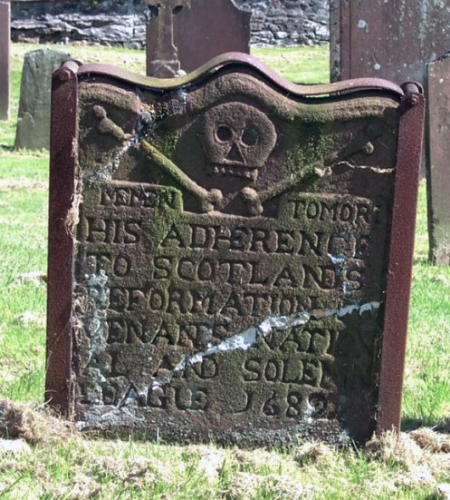
Testimony bearing for Christ's Crown and Covenant has often led men to an early grave.
TESTIMONY BEARING HOMEPAGE.
“[I]t is surely the duty of the church of God still to contend earnestly for the faith once delivered to the saints, without saying a confederacy with them, who have said a confederacy against Christ, his pure worship, and his public interest and glory, in the world, i.e., such as are guilty of popish idolatry, prelatic superstition, Erastian encroachments, patronage intrusions, and sectarian confusion, who have all united in a conspiracy, to rob Christ of some part of his mediatorial glory, in a way derogatory to some of his offices, as prophet, priest, or king, of his church.”—Thomas Henderson, Testimony-Bearing Exemplified. (1791).
WORKS ON TESTIMONY BEARING AND BEARING TESTIMONY:
A Testimony to the Truth of Jesus Christ, and to our Solemn League and Covenant;-1648-London Ministers (many of whom were Westminster Divines).-A somewhat lengthy testimony against the numerous heresies and errors which were circulating contrary to the doctrine of the Westminster Confession making these against the Solemn League and Covenant.
A Testimony of the Ministers in the Province of Salop, to the Truth of Jesus Christ and to the Solemn League and Covenant,-1648-Ministers of the Province of Salop.-One of many testimonies issued around this time in support of the Solemn League and Covenant, it was signed by many English ministers who opposed the toleration and heresies of the various Independents and Sectaries of their day.
A Solemn Testimony Against Toleration,-1649-Commissioners of the General Assembly of the Church of Scotland.-This is a testimony against the principles of toleration that were afoot in England at that time with arguments against it and a description of the divine doom such toleration incurs.
A Testimony to the Truth of Jesus Christ.-1659-Ministers of Perth and Fife.-A joint testimony against the various corruptions and defections plaguing the once reformed Church of Scotland by a group of Protester ministers.
An Informatory Vindication.-1687-James Renwick and Alexander Shields.-This is an extensive apologetic for the course of act taken by the United Societies during the latter end of the Killing Times. It explains their beliefs and their actions in the face of the prevailing currents of apostasy and the vicious persecution that ensued on the covenant keepers.
A Hind let loose; or An Historical Representation of the Testimonies of the Church of Scotland,-1687-Alexander Shields.-A thorough survey of the history of the Scottish church which contains many hints on church communion together with several chapters devoted to Covenanter controversies.
A Short Memorial of the Sufferings and Grievances Past and Present of the Presbyterians in Scotland:-1690-Alexander Shields.-This Short Memorial remains invaluable today as both a primary source of unflinching documentary evidence and a sustained legal argument against arbitrary power. Its meticulous catalog of thirty-three grievances—naming specific perpetrators, victims, fines, and extrajudicial killings—provides an irreplaceable record of the systematic dismantling of legal and ecclesiastical protections between 1660 and 1690, preserving details that official records often suppressed or sanitized. Beyond its historical testimony, the work’s enduring significance lies in its constitutional reasoning: Shields demonstrates that the Cameronians’ resistance was grounded not in sectarian anarchy but in the existing laws of Scotland, the conditions of the Coronation Oath, and the binding obligations of the National and Solemn League Covenants—arguing that allegiance is conditional upon the magistrate’s fidelity to these fundamental compacts. Crucially, by extending his indictment into the “present grievances” under William, Shields exposes the Revolution’s incomplete settlement and establishes the continuity of protest that would shape the Reformed Presbyterian tradition, making this document essential for understanding how a principled minority could maintain that they were the true defenders of the national church and covenant, not schismatics from it.
The Declaration of a Poor, wasted, misrepresented Remnant, of the suffering, Anti-popish, Anti-prelatic, Anti-erastian, Anti-sectarian, true Presbyterian church of Christ, in Scotland,-1692-The United Societies.-In this early declaration, the covenanting Societies lament the defection of the three ministers (Shields, Linning and Boyd) into the Revolution church but they pledge to maintain the cause of covenanted reformation to the best of their ability.
The Protestation & Apologetic Declaration, & Admonitory Vindication,-1695-The United Societies.-This paper decries the wicked confederacies and lamentable defections that had become wide spread in the Church of Scotland contrary to their covenant engagements.
The Protestation, Apologetic Declaration, & Admonitory Vindication.-1703-The United Societies.-A testimony issued against the unlawfulness of the present magistrate, the fruit of covenanting breaking, and a plea for a return to covenanted reformation.
A Protestation and Testimony Against the Incorporating Union with England.-1707-The United Societies.-A testimony against the prevailing evils of the day (1707) with a particular emphasis upon the wickedness of the political union of England and Scotland and its violation of the covenant engagements of both nations.
THE PROTESTATION, DECLINATUR and APPEAL OF Mr. John Mackmillan Minister of the Gospel at Balmaghie, and Mr. John Mackneil Probationer and Preacher of the Gospel, sent to the Commission of the Kirk at Edinburgh the 29 of September. 1708.-1708-John McMillan I.-A clear and earnest testimony by the Cameronian Apostle, John Macmillan, against the various defections amongst Presbyterians in Scotland together with his plain reasons for dissenting from the Revolution establishment of 1690. This contains the very valuable postscript, written by the United Societies concurring with MacMillan.
A Seasonable Advertisement, concerning the late publick FAST of the 25th of January, 1712, Publickly Read and affixed to several Church Doors; and now Printed to prevent Misinformation, whereunto are Subjoyned some Reasons of it’s Publication.-1712-United Societies.-This tract, found in a volume of covenant materials which once belonged to Mr. John MacMillan, shows the stance of the Covenanters toward the keeping of holy days was broadly construed to include not merely ecclesiastical but civil days appointed by the magistrate. They see a Romish angle and much harm in observing fast days and, by implication, feast days, appointed by a covenant breaking and covenant refusing magistrate and state.
A Short Survey of a Pamphlet, Entituled, A Friendly Conference betwixt a Countrey-Man and his Nephew. Wherein is discovered the Lameness and Falsehood of the Author’s Defences of the Backslidings of this Church; His pretended Differences betwixt the State and Management of the Testimony of the witnessing Remnant before, and since the Revolution, are reconciled; The Conduct of the Church anent the late Treaty of Union, is briefly discoursed, and shown to have been Unfaithful: Other incident Controversies are succinctly handled, And his Malicious Queries answered. Whereunto is prefixed a large PREFACE, containing Remarks upon the ACT for preventing the Disturbing those of the Episcopal Communion in the free Exercise of their Religious Worship, and in the Use of the Liturgy of the Church of England; together with some Reasons against the Oath of Abjuration thereby enjoined. As also Observations upon the Addresses and Representations of the Commission of the Kirk thereanent. With Animadversions upon the Bill for Restoring Patronages in Scotland.-ca. 1712-Anonymous.-This pamphlet is a vigorous rebuttal of a dialogue titled A Friendly Conference, which had criticized the dissenting Cameronian societies for withdrawing from the established Church of Scotland. The anonymous author defends the Dissenters’ separation, arguing that the post-Revolution settlement is fundamentally flawed due to its Erastian encroachments, its failure to renew the Solemn League and Covenant, and its incorporation of unrepentant malignants and toleration-accepters. He systematically refutes the dialogist’s charges, defending the Dissenters’ conduct in withdrawing, their refusal to pay the cess, and their disowning of uncovenanted magistrates. The latter half of the pamphlet vigorously defends Mr. John M’Millan and Mr. M’neil against personal calumnies, arguing that their testimony is consistent with that of the martyred Mr. James Renwick, and that the real schism lies with the established church’s defection from covenanted reformation.
A Modest Apology for the Conduct of Seceders, in refusing to join in Christian Communion with Sectarians, Latitudinarians, &c. who have departed from the purity of Reformation once attained to in these Kingdoms.-1773-Anonymous.-This pamphlet defends the Seceders’ refusal to commune with Independents and other sectarians who have abandoned Reformation attainments. The author argues that Christ has ordained Presbyterian church government as articulated in the Westminster Form of Church-Government and secured by the Solemn League and Covenant of 1643, and that all divine ordinances must be observed in their entirety—not treated as matters of indifference. Citing Ezekiel 43:10-11, Matthew 28:20, and 2 Thessalonians 3:6, he insists Scripture commands keeping “ALL the forms” and “ALL the ordinances” of God’s house. The Independents are charged with walking disorderly: their congregational scheme lacks the courts necessary to preserve the visible church’s unity and purity; their principles require tolerating dangerous errors; they oppose creeds as impositions on conscience; and they have broken the national covenants binding these kingdoms to maintain Reformation. While acknowledging many godly Christians among the Independents, the author maintains that love toward them requires—rather than contradicts—open testimony against their disorderly principles and refusal of communion, just as Paul withstood Peter at Antioch without breaching Christian charity.
Faithful Witness-Bearing Exemplified.-1783-John Howie.-In this volume, Mr. Howie has collected several notable works that pertain to the issue of toleration and pretended liberty of conscience. It is notable how he draws these issues together with entering into unlawful voluntary associations.
Testimony-Bearing Exemplified.-1791-Thomas Henderson (1757-1823).-This volume consists of a number of valuable documents holding forth the doctrine and practice of testimony-bearing and its contrary practice of entering into unlawful voluntary associations.
Testimony and Warning Against Socinian and Unitarian Errors.-1793-Reformed Presbytery, of Scotland.-This is a testimony, largely the work of Archibald Mason, designed to refute the errors of Socinians and Unitarians while giving a full exposition to the doctrine of the Holy Trinity in its several relations.
A Testimony and Warning Against Some Prevailing Sins and Immoralities: Addressed to Christians in General.-1805-Reformed Presbytery, of Scotland.-One of several occasional testimonies emitted by the Reformed Presbytery, this bears witness against the big three prevailing sins-theater attendance, dancing and dicing-as well as many other immoral practices which all Christians ought to shun.
A Short Account of the Old Presbyterian Dissenters.-1806-John Reid II.-This is a second work commissioned by the Reformed Presbytery, of Scotland, and intended to be introductory to the history and distinctive practice of Covenanters.
Remembrancer, Shewing That the state of the Testimony of the suffering Remnant, in the time of the persecution, and since the Revolution, to be the same, as maintained by the suffering remnant, or true non-hearers, who have owned and defended the Martyrs Testimony, and whose practice has not contradicted their profession; as it would entirely ruin the Martyrs Testimony, to account all non-hearers at this day to be maintainers of their principles.-1807-Robert Lawrie.-This work represents a right-hand refusal, emanating from a group of “non-hearers” of the Reformed Presbytery, in Scotland, to acquiesce in what they perceived to be defections within the presbytery from the Covenanted testimony of the martyrs. This has quite a bit to say on the subject of paying of taxes and other compromises with the immoral government. It has bearing on the proper historical reading of the Covenanters’ position on taxation generally.
The Essence of Old Light Principles Extracted:-1808-Robert Culbertson.-This text is a collection of letters written by Robert Culbertson of Leith in 1808, responding to criticisms from Rev. Mr. Chalmers. The work addresses theological disputes within the Secession Church, particularly regarding the “Old-Light” and “New-Light” principles. Culbertson defends his position against Chalmers’ accusations of blasphemy, misrepresentation, and other personal attacks. The letters also include appendices with additional observations and extracts from religious documents. The publication reflects the intense theological debates and personal rivalries within Scottish religious communities during this period, focusing on issues like the role of civil magistrates in religious matters, church discipline, and interpretations of covenants and testimonies.
Humble Pleadings; or, a Representation of Grievances for the Consideration of the Reformed Presbytery.-1809.-John Howie.-Published posthumously by John Calderwood (whose preface is exceptionally illuminating), this work shows the scruples Howie had concerning the Reformed Presbytery as it began to slip from its Reformational attainments. This is a very good example of Howie bearing testimony in which the doctrine of witness-bearing is shown to be definite, not nebulous. Howie enunciates his grievances (and that of others) with precision. This includes a letter in which Howie addresses several key doctrinal controversies which seem to be agitated until the present.
Memoir of William Orr, LATE FARMER, IN KILBIRNIE PLACE, Who departed this life, 25th Oct. 1814. AGED 85 YEARS. RELATED BY HIMSELF.-1814-William Orr [Preface by Thomas Henderson].-This spiritual autobiography, related by William Orr himself in his final years, chronicles his lifelong religious journey from the bondage of legalism to the liberty of the gospel of free grace. Born in 1729 and raised under a “legal ministry” that taught salvation by moral duty, Orr recounts his deep spiritual distress upon realizing the inadequacy of such doctrine to relieve a sin-burdened conscience, and his subsequent conversion upon hearing a dissenting minister clearly distinguish between the Law and the Gospel. Compelled by conscience, he separated from the Established Church—despite the cost to his social standing—and, after examining the various denominations, joined the Reformed Presbytery, the only body he found faithful to the Covenanted work of Reformation. The memoir also candidly details his providential transitions from affluence to poverty, his struggles with debt and failed farming ventures, and his determination to maintain integrity and faith through adversity. Concluding with a series of doctrinal testimonies, observations on the Christian life, and earnest counsels to his children, the pamphlet stands as both a personal narrative of divine grace and a polemical witness against the corruptions of the Established, Secession, and Relief churches.
BIBLARIDION, OR THE APOCALYPTICAL LITTLE BOOK. LECTURE X.-1814-Alexander McLeod.-This lecture explores the nature of witness bearing, its relation to the witnessing church and a thorough description of who and what constitutes the church of the two witnesses. Hint: they are the two sons of oil.
A Plea for the Covenanted Reformation in Britain and Ireland.-1822-George Stevenson.-In this treatise, Stevenson defends the doctrine of religious social covenants. The discussion has interesting and useful comments on the use of creeds and the need for testimony bearing. However, its most important component is its explanation and defense of the descending obligations of covenants. Originally written in 1822, this is the third edition expanded by some twenty pages of material.
Remarks On A Letter Addressed to the Members of the Old Church of Scotland.-1823-John Dow.-An historical account of the disturbance in the Scottish RP church and the removal of the Auchensaugh Renovation from the fourth term of communion.
The Cause of the Scottish Martyrs.-1832-William Symington.-In this short article, written for the American Christian Expositor, Symington sets forth the doctrine and practice of the Scottish martyrs. He calls attention to their fidelity and notes that they were living examples of the Reformed Presbyterian Church, of Scotland.
Truth. A Sermon on Steadfast Adherence to the Distinctive Doctrines of the Church.-1833-Samuel McConnell Willson.-This sermon, on what it means for the church to bear testimony to the truth, was delivered during the controversies which led to the Old Light/New Light division in the Reformed Presbyterian Church. It represents the view that it is not permissible for the church to decline from a more pointed testimony to one more loose and accommodating.
A Narrative of Recent Occurrences.-1834-Robert Gibson.-In this narrative, Gibson sets forth the course of events which led to the Old Light/New Light split. While demonstrating the duplicity of the New Light party, Gibson has reason to emphasize the need for historical testimony in maintaining the church’s witness faithfully.
Lectures on the Principles of the Second Reformation.-1841-The Reformed Presbyterian Church, of Scotland.-A course of lectures which seeks to take up every distinctive position maintained by the RP church. This volume represents a reasonable overview of doctrines related to the Mediatorial reign of Christ and public social covenanting.
Characteristics of the Witnessing Church.-1843-Robert Lusk.-In this extended essay, Lusk recounts the history of the witnessing church together with an account of its declining in numerous ways which made it necessary for the erection of a new presbytery concerned with keeping the principles of Covenanters alive.
Claims of the Divine Government Applied to the British Constitution and the Use of the Elective Franchise, Vindicating the Authority of Messiah Against the Encroachments of Antichristian Power.-1843-Reformed Presbyterian Synod, Scotland-During the first half of the 19th century, Reformed Presbyterians around the world were in foment over various attempts to revamp and reinterpret the Covenanter testimony. Despite slipping in their terms of communion, the Reformed Presbyterian Church of Scotland issued this excellent exposition of the claims of King Jesus over civil governments with particular emphasis on the use of the elective franchise. We see in this document that Covenanters do not vote or actively participate in immoral administrations of government. The section touching on objections is especially helpful.
Argumentative Testimony. According to the Resolution of the Reformed Presbyterian Synod. -1855-James McLeod Willson.-Two chapters for the proposed “Argumentative” portion of the RP Testimony; the first, discussing Testimony Bearing; the second, the Right of Dissent from Immoral Civil Constitutions.
Pastor Steele’s Printed Communications to the Editor of The Covenanter.-1855-1857-David Steele and James M. Willson.-A series of articles debating the so-called “Steelite” position on testimony bearing, history testimony and several other points of dispute. In this, David Steele represents the historic Covenanter position against the departures embodied in the preface of “Reformation Principles Exhibited.”
Historical Testimony.-1856-David Steele.-An article explaining what historical testimony is, how it is applicable to the church and why it needs to be part of the terms of communion of the Reformed Presbyterian, or Covenanter, church.
Principles and Position of the Reformed Presbyterian Church.-1858-John Graham.-This work outlines the foundational testimony of the Reformed Presbyterian Church, emphasizing its commitment to Scripture, evangelical doctrine, and Presbyterian polity as divinely instituted. It strongly protests against Popery and Prelacy while asserting that civil magistrates and nations are morally obligated to submit to Christ and the Word of God. A primary focus is the enduring, binding authority of the National Covenant of Scotland and the Solemn League and Covenant, which the authors argue were sinfully abandoned. Graham justifies the Covenanter’s position of dissent from the established church, arguing that the 1688 Revolution compromised the Reformation by re-establishing Episcopacy, allowing state supremacy over the church, and neglecting the covenant obligations sealed by the blood of martyrs. Ultimately, it presents these distinct principles not as narrow or unpatriotic, but as the essential groundwork for a future, comprehensive reformation of both church and society under the headship of Christ.
Editorial Notice Considered. [A Review of the Review of the “Two Witnesses.”]-1859-David Steele.-This is Steele’s review of the Reformed Presbyterian magazine’s notice of his short work entitled, “The Two Witnesses.” In it David Steele corrects and sets forth proper notions of what is meant by “historical testimony,” as well as clarifying points on terms of communion in the visible church.
The Law and the Testimony.-1860-David Steele.-An article explaining why making a distinction between the law and the testimony is needful to avoid legalism and how this distinction affects the witnessing church.
Declaration and Testimony for the Present Truth.-1864-David Steele.-An explanation of the nature and purpose of judicial testimonies together with several animadversions upon the course and defects taken by the RP Synod in its mangled attempts at testimony bearing.
The Testimony and the Law.-1866-David Steele.-An article from the London Scottish Reformed Presbyterian magazine discussing the difference between the testimony and the law and why the former takes precedence over the latter.
A Question Answered. [in a letter to Dr. John Cunningham]-1869-David Steele.-A short reply on the nature of judicial testimonies and their use of history and argument.
The Social Position of Reformed Presbyterians or Cameronians.-1869-William Sommerville.-This account traces the lines of historical Covenanters and asserts that principles without practice is dead. Additionally, there is included a defense of the practice of close communion in order to maintain the identity of the Covenanter church.
Our Banners Set Up.-1872-James W. Shaw.-A sermon preached after the administration of the Lord’s supper designed to impress upon the communicants the desirability and necessity of persevering in the covenanted faith of their forefathers. This contains many observations on testimony bearing and the nature of ecclesiastical communion.
A Short Vindication of our Covenanted Reformation.-1879-David Steele.-A second edition of the principles of the Scottish Second Reformation against the “American” RP “Covenant of 1871.”
The Attainments of the Church of the Second Reformation.-1896-James Kerr.-An address before the First International Reformed Presbyterian Convention, in which the Reformed Church of Scotland, at the time of the Second Reformation, is presented as Biblical, Calvinistic, covenanting and established.
A Word of Warning and the Opening of Covenanter Pulpits to Non-Covenanters.-1900-James Dick.-Irish Reformed Presbyterian professor explains why “open communion” is destructive of church discipline and how pulpit exchange amongst ministers of various ecclesiastical connections undermines the testimony of the RP church.
The Scottish Martyrs Defended.-1902-James Kerr.-This 1902 pamphlet records a public meeting held in St. George’s Hall, Dumfries, featuring a lecture by Rev. James Kerr, D.D., defending the Scottish Covenanters against strictures made by Professor James Cooper during the recent dedication of a memorial to the Covenanting minister John Blackadder at Troqueer. Kerr’s discourse systematically refutes Cooper’s characterization of the Covenanters as fanatics, persecutors, and rebels, vindicating their resistance to Stuart despotism and their commitment to civil and religious liberty through detailed historical argument and appeals to original sources.
A Call for a Public Fast.-2020-Presbytery of the Puritan Reformed Church in Brazil-What should the church’s response be to the demands of the state when, under pretext of plague, they call for the churches not to assemble? How should Christians response and why? The presbytery spells out both the Biblical and historical grounds for resisting such ungody commands.


