Instrumental Music in the Worship of God
James Dodson
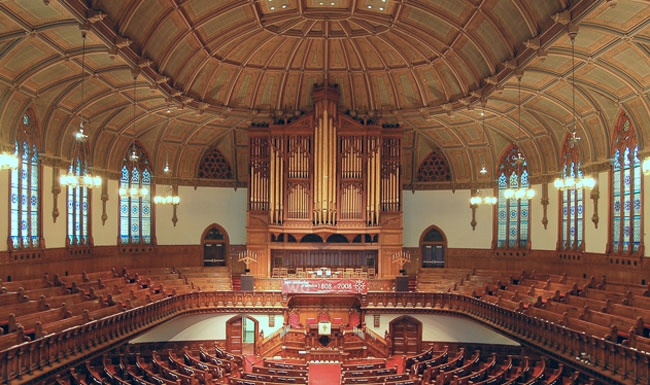
Organs and instrumental music belong to Papists. They are the “strange gifts” of Arminian revivalism smuggled into the Reformed churches.
ANTI-INSTRUMENTAL MUSIC IN THE WORSHIP OF GOD HOMEPAGE.
“While many who employ [the organ] consider themselves the very champions of Protestantism, it will be long, long indeed, before they uproot Popery by this regulator of choirs; and while nothing has ever proved more annoying to Papists than the singing of Psalms in a congregational manner, the playing of all the heretical organs in Christendom causes to them comparatively little sorrow. On the contrary, the cross surmounting a Protestant meeting house, and the swelling tones of the organ within, give to her sons the hope that “holy mother” may yet receive these errorists, who are, at least, so far rejoicing under her shadow, and becoming familiar with her “image and superscription.”—Alexander Blaikie, The Philosophy of Sectarianism (1854).
WORKS AGAINST INSTRUMENTAL MUSIC IN THE WORSHIP:
An Ordinance of the Lords and Commons Assembled in Parliament, for the further demolishing of Monuments of Idolatry and Superstition.-1644-The Parliament.-An Act authorizing the removal of all things which violate the Scriptural, or Regulative, principle of worship from all houses of worship throughout England. This included all the liturgical garb, furniture pictures of Jesus or the Trinity together with the removal of all musical instruments.
An Essay Upon the Sacred Use of Organs in Christian Assemblies.-1713-Anonymous.-A very instructive essay which explains the rise of the use of musical instruments and the reason their use was discontinued in the best Reformed churches.
A Catechism on Praise.-1849-Alexander Blaikie (1804-1885).-An Associate Reformed Presbyterian minister defends the practice of a cappella psalmody by way of catechetical exercises.
Protest Against the Use of Instrumental Music in the Stated Worship of God on the Lord’s Day.-1851-Robert J. Breckinridge (1800-1871).-A Southern Presbyterian decries the use of organs in Presbyterian churches and vows never to speak in a church that has one. He discusses the theological reasons for holding to a strict non-instrumentalist position.
The Worship of the LORD in His Sanctuary. A Discourse Delivered on Sabbath Evening, April 30th, 1854, at the Opening of the First Reformed Presbyterian Church, Broad Street, Philadelphia.-1854-Alexander Duff (1806-1878).-This discourse, delivered by Rev. Alexander Duff at the opening of the First Reformed Presbyterian Church in Philadelphia on April 30, 1854, expounds on the essential elements and proper nature of public worship according to Scripture. Drawing from Psalm 95, Duff identifies three constituent elements of worship—instruction, prayer, and praise—and warns against the distortions that arise when any is neglected or misapplied. He cautions against resting in mere intellectual knowledge of divine truth without heart transformation, using the vivid metaphor of a life-boat meant for rescue but instead carrying souls more gently to perdition. On prayer, he vehemently opposes the notion of “praying by proxy,” insisting that acceptable prayer must be the direct outflow of a regenerate soul, not a mechanical form uttered by a priestly substitute. Regarding praise, Duff distinguishes between the mere pleasure of musical sounds—which can delight even the ungodly at oratorios and festivals—and genuine spiritual worship that engages the understanding and affections. He advocates for congregational singing with grace in the heart rather than reliance upon instrumental accompaniment, which he fears becomes a substitute for personal devotion rather than an aid to it. The sermon closes with earnest prayers that this new sanctuary would serve as a birthplace of souls, a nursery for heaven, and a place where the gospel would be proclaimed in purity until faith gives way to vision in the eternal temple.
Liturgies, Instrumental Music and Architecture.-1855-Thomas E. Peck (1822-1893).-This article was written to explain why it is that Presbyterians reject pomp and circumstance in the worship of God. It is a helpful overview of the issue of liturgies, music instruments and the often little considered matter of church architecture.
General Principles Touching the Worship of God.-1855-Thomas E. Peck (1822-1893).-Another essay examining the Regulative principle of worship and addressing the issue of musical instruments in more detail.
Alexander Hislop’s Appendix on The Instrumental Music of Judaism.-1858-Alexander Hislop (1807-1865).-An appendix which discusses the use of musical instruments in the church with an eye toward Jewish usage.
Discourse on Scripture Psalmody in Praising God; and Against Instrumental Music in Public Worship.-1859-Hugh Brown.-Two discourse on purity of worship. The first examines and defends the exclusive use of the inspired Psalms in the praise of the church; the second explains why the use of instrumental music in the worship of God is not warranted under the New Testament.
The Use of Organs and Other Instruments of Music in Christian Worship Indefensible.-1866-James Begg.-This book contains an elaborate and well organized argument against the use of musical instruments in the worship of God. Some of the book is set against the backdrop of 19th century arguments in the Free Church and the Church of Scotland but this only adds historical interest to the work. Overall, this is a very complete rebuttal of the proponents of musical instruments in worship.
The Organ Question.-1868-W. Robertson.-This pamphlet is the substance of two lectures given in connection with the agitation by some in order to introduce an organ into the worship of God. In 1873, five years after these lectures, the pro-organ party carried the day and an organ was introduced into the worship of Coupland Street United Presbyterian Church, Manchester, England. Mr. Robertson’s work is a testimony against this outrage.
A Discourse on Instrumental Music in Public Worship.-1871-Robert Johnson (1810-1879).-A extremely well reasoned defense of the anti-instrumentalist position in which he engages several well known objections and examines the plausibility of the arguments of those who would introduce these instruments into the worship of God.
Report of a Speech on the Use of Instrumental Music in Public Worship, Delivered in the General Assembly of the Church of Scotland, on Friday, May 26, 1871.-1871-William Robinson Pirie (1804-1885).—Pirie views instrumental music not as inherently sinful but as “inconsistent with the spirit, usage, and constitution of the Church of Scotland”—a form of “indirect worship” that threatens the simplicity, spirituality, and intellectual rigor of true Presbyterian devotion.
Instrumental Music in Christian Worship. A Review.-1873-Robert Nevin.-A very full treatment on the issue of the use of musical instruments in the worship of God. Nevin is always textual and historical in his argumentation. He presents an excellent overview of musical instruments and shows they were typical and shadowy and do not belong in the worship of the NT church.
Instrumental Music in the Worship of God.-ca. 1875-Robert Nevin.-This tract condenses and focuses his larger work on instrumental music into a very concise defense of the spirituality of NT worship. This means that there is no place in NT worship for musical instruments. Nevin shows that the use under the OT was ceremonial and typical.
Purity of Worship in the Presbyterian Church, as Set Forth in the Westminster Standards, and Illustrated by our History Since the Reformation.-1876-James Begg.-This treatise argues that the Church of Scotland’s constitution, as established at the Reformation, confirmed by the Westminster Standards, and secured by the Revolution Settlement and Acts of Union, mandates a simple worship of prayer, preaching, psalm-singing, and sacraments—expressly excluding instrumental music and liturgies as unscriptural innovations. He demonstrates that this uniformity of worship was legally fixed by civil and ecclesiastical law, binding upon all office-bearers by solemn vow, and enforceable by the rights of heritors and parishioners. The recent toleration of organs and read prayers by Church courts therefore constitutes a subversion of the Presbyterian constitution, a violation of ordination engagements, and a dangerous drift toward Prelacy and Congregationalism that must be firmly resisted.
Musical Instruments—IN—Divine Worship Condemned by the Word of God.-1881-David Wallace Collins (1823-1898).-In this rigorous 1881 defense of a cappella worship, Rev. D. W. Collins confronts the United Presbyterian Church’s debate over instrumental music with scholarly precision and theological urgency. Collins argues that the proposed “permissive warrant” for organs and instruments not only lacks biblical foundation—having been ceremonial under the Old Testament and explicitly excluded from New Testament worship—but fundamentally undermines Presbyterian polity by transferring authority from Presbyteries to congregations. Through detailed examination of Scripture, covenant theology, and church history, he demonstrates that instrumental music introduces anarchy into worship, distracts from spiritual devotion, and violates the regulative principle that God alone prescribes how He is to be worshipped.
A Counterblast to the Organ; Or, the Lawfulness of Using Instrumental Music in Worship During the Present Dispensation Discussed and Denied.-1881-James Harper (1823-1913).-This work is a comprehensive theological polemic arguing that the use of musical instruments in public worship is unlawful under the New Testament dispensation. The author, writing from within the United Presbyterian Church of North America in 1881, structures his case by first establishing that instrumental music in the Old Testament was inherently ceremonial and typological, and therefore abrogated along with the Levitical system. He then systematically refutes two rival positions: the “Preceptive Theory” (that instruments are commanded) and the “Optional Theory” (that they are permitted but not required), dismissing common arguments such as the “circumstance plea” and the “tuning fork analogy.” Finally, he advocates for the “Prohibitory Theory,” grounding it in the New Testament’s silence on instruments, Christ’s example of singing without accompaniment at the Lord’s Supper, and extensive historical evidence showing the early church and the Reformers uniformly rejected instruments. The work concludes with an ecclesiastical-political argument that churches should explicitly prohibit rather than merely tolerate instruments, warning that permissiveness opens the door to ritualism and undermines the regulative principle of worship.
PSALLO.-1882-William Wishart (1821-1906).-An article from the Evangelical Repository examining the claims of proponents of musical instruments in worship taken from the meaning of the Greek word PSALLO. Dr. Wishart explains why PSALLO does not provide Biblical support for the use of mechanical instruments of worship.
Action of the United Presbyterian General Assembly on Instrumental Music in Worship.-1883-The article aggressively defends the regulative principle of worship (that “what is not commanded in worship is forbidden”) and argues that instrumental music cannot legitimately be reclassified as a “mere incident” (like tuning forks or musical notation), but must be regarded as an ordinance requiring explicit biblical warrant—a requirement the New Testament allegedly fails to provide.
Instrumental Music in the Public Worship of the Church.-1888-John L. Girardeau (1825-1898)-This is one of the more thorough discussions of the question of the use of musical instruments in the worship of God.
Girardeau’s “Instrumental Music in the Public Worship of the Church.”-1888-Robert L. Dabney (1820-1898).-A review wherein Dabney not only praises Girardeau’s book but he adds a number of keen observations and insights into why instrumental music should be kept out of the public worship of God.
Instrumental Music in the Worship of God.-ca. 1925-John S. Thompson (1858-1940).-Thompson addresses the matter of using musical instruments from the perspective of the Regulative principle and their actual usage throughout the Old Testament. He concludes against their use.