THE CLOSING YEARS OF THE EIGHTEENTH CENTURY.
James Dodson
CHAPTER V.
THE spring of 1783 was a season of great distress, and in February the Presbytery appointed a fast to be observed; and the people were exhorted to “pray that the Lord in mercy, for the relief of the poor, may bless the springing of the earth, and grant the return of a fruitful season.” A bountiful harvest seems to have followed, and in November, the people are called to observe a day of thanksgiving for the Lord’s goodness. A fast in those days was something more than a name, as we learn from a minute in November, 1793, when, on the occasion of the ordination of the Rev. John Fairley, at Sandhills, the Presbytery appointed the day to be observed by the Presbytery and the Congregation of Sandhills as a day of fasting “until the
62 THE CLOSING YEARS OF THE
public work be over.” The public work that day comprised both a forenoon and an afternoon service.
As the Church grew in numbers, it did not grow in liberality of feeling. It firmly maintained a position of dissent from both the civil and ecclesiastical establishments of the land. No official intercourse was held with other Churches, Established or dissenting, and in civil matters, the people were required to identify themselves as little as possible with the State. In August, 1783, Mr Alexander Hume, a member of the Kelso Congregation, was suspended from Church privileges, for having raised a law process before the civil courts. The Presbytery formally record that his conduct was contrary to dissenting principles. Other questions, bearing on the relation of the members to the Civil Government of the country, having arisen, the Presbytery in 1791 recorded a series of resolutions regarding these. The Presbytery, on the one hand, agreed that there was no material difference between taking out a license to carry on a lawful business, and holding property on the footing of stamped deeds, and that both of these acts were consistent with the principles of the Church. But, on the other hand, the Presbytery agreed that the five following things were
EIGHTEENTH CENTURY. 63
contrary to the testimony of the Church, and offensive and censurable actions:—
All swearing of oaths of allegiance to the present Government.
All enlisting in their service, and holding office under them.
Praying for God’s blessing upon them in their present constitution and courses.
Swearing oaths before them as the administrators of these oaths.
Brethren by their Christian profession going to law with one another before them.
Some further resolutions were proposed, but the Presbytery came to no decision regarding them.
The wave of excitement which followed the first French Revolution reached even the quiet Covenanters of the West of Scotland, and some of them became members of the well-known political organization, “The Friends of the People.” This having been brought under the notice of the Presbytery, they, at a meeting in November, 1793, advised the members to sever their connection with the Society for these reasons:—
64 THE CLOSING YEARS OF THE
(1.) The Church’s cause of dissension is not the same as that for which these Societies exist; and although their end were gained, it would bring the Church no nearer the object of her testimony.
(2.) It brings them into connection with people who are very corrupt both in their principles and practice.
(3.) These Societies have fixed no moral standard for their conduct.
(4.) These Societies have declared their approval of the present Erastian constitution.
(5.) It leads dissenters into the support of measures giving offence to brethren.
Sessions were instructed to deal with any members still continuing to associate with “The Friends of the People.”
The Presbytery was equally decided in expressing disapproval of anything which might be regarded as countenancing the Erastian Established Church. In 1796, a complaint was received from Glasgow that some members and elders had attended a sermon, preached by an Established Church minister, at a meeting of the Missionary Society of Glasgow. It was unanimously agreed that such conduct was sinful
EIGHTEENTH CENTURY. 65
and offensive. The persons whose conduct was so seriously condemned, did not all quietly acquiesce in the decision of the Presbytery, and some of them appeared at a subsequent meeting to defend their conduct. The Presbytery expressed approval of the object of the Missionary Society, but “cannot act officially with it,” and confirmed the former judgment. In consequence of this, six members withdrew from the fellowship of the Church. Forty years more were to pass before the Church would be honoured to take part as a Church in Foreign Missions. But long ere that time many of the members were deeply interested in the missionary cause, and were hearty supporters of more than one Foreign Missionary Society.
The Presbytery with impartial severity condemned the “occasional hearing” of certain members, who were reported to go to a distance to hear Mr M‘Millan, when Mr Fairley was preaching near their homes. This conduct is also declared to be “sinful and offensive,” and the offending members are ordered to be dealt with.
The difficulties which had attended the regular organization of the Church in its earlier stages were all overcome before 1780, and we find that during the last two decades of the century,
66 THE CLOSING YEARS OF THE
the progress of the Church was much more rapid than it had previously been.
On 11th August 1783, Mr Archibald Mason, although still a Probationer, was appointed Presbytery Clerk, and a great improvement in the manner in which the minutes were kept subsequent to that date, proved the wisdom of the choice.
Messrs Thomas Henderson and James King having delivered the usual trials, and having also been examined in Greek, Hebrew and Divinity, were licensed to preach the Gospel on 9th March, 1785. At the same meeting Mr John Reid, Jun., being recommended to the Presbytery by the Rev. Mr M‘Millan, Sen., was taken under inspection, and trials for license were prescribed to him. These were delivered before the Presbytery on 31st August and 23rd November, 1785, and he was licensed “by a Committee of Presbytery at Stirling, after the Communion was dispensed there on the second Sabbath of June,” 1786. The want of a “School of Divinity” was felt, and in 1785, Mr Thorburn was appointed to act as Divinity tutor. After his death in August, 1788, no successor was appointed, and many years elapsed before Mr John M‘Millan, Jun., minister in Stirling, was appointed first Professor of Divinity to the Reformed Pres-
EIGHTEENTH CENTURY. 67
byterian Church. Mr John Fairley, Jun., and Mr Thomas Rowatt were licensed in 1791, Mr James Thomson and Mr Robert Douglas were licensed in 1794, and Mr Adam Brown was licensed in 1799. Two other students were taken on trials along with Mr Brown, but one of them, Mr Westwater, after delivering some of his trial discourses, which were sustained, “having difficulties,” did not appear at the subsequent meeting of Presbytery. A considerable time elapsed before his difficulties were removed, and he saw his way to accept office in the Church. He was ultimately settled as minister in Colmonell, and long ministered there to an attached people. He was best known as Mr West, having dropped the latter part of his original name before his ordination. The fate of the third candidate was more sad. After having perseveringly delivered a number of trials, none of which were sustained, he was advised to desist from the presentation of any further trials, as he did not possess “gifts for the ministry,” and thereupon he disappears from history.
The licensing of these young men was immediately followed by applications for the formation of additional congregations in various parts of the country.
68 THE CLOSING YEARS OF THE
On 10th November, 1784, a disjunction was granted to “the east side” of the congregation of Stirling, thereafter called the Falkirk or Laurieston Congregation, and on 23rd July, 1788, Mr John Reid, Jun., was ordained first minister of that new charge.
The Congregation of Hamilton was disjoined from Sandhills Congregation in 1777, but it was not till ten years later that a minister was ordained over it. Mr Archibald Mason, afterwards Dr Mason, the first minister of the Church who attained the academical distinction of Doctor of Divinity, was ordained at Flemington on 2nd May, 1787. A tree on a piece of rising ground, about half way between Motherwell and Wishawton, was long afterwards pointed out as marking the spot where the tent stood on that occasion. It was at Wishaw, not at Hamilton that the church and manse were erected, and there Mr Mason long ministered to a large and attached flock. He was known far beyond the bounds of the Church, not only as a preacher but as an author, and strangers came from great distances to wait on his ministry.
In 1785 the Congregation of Ayr and Renfrew, which had for ten years been under the pastoral charge of Mr Steven, was divided into two Congregations. Mr Steven elected to be minister
EIGHTEENTH CENTURY. 69
in Ayrshire, and laboured there faithfully till his death on 22nd December, 1796. The Renfrew Congregation called Mr Thomas Henderson, and he was ordained their minister at Bridge of Weir on the last Thursday of April, 1787. A church was afterwards built at Kilmalcolm, which continued to be occupied by the Congregation till 1856, when a new church was built in Port-Glasgow, to which the Congregation removed. After Mr Steven’s death the Ayrshire Congregation was subdivided into the Congregations of Crookedholm near Kilmarnock, and Darvel; and in 1801 Mr Adam Brown accepted a call given him by the Crookedholm Congregation. It was not till 1810 that Mr Rogerson was ordained the first minister of the Darvel Congregation.
From 1763, Mr John M‘Millan, Sen., and Mr John Thorburn, had been colleagues in the ministry of the Northern Congregation. In 1786, much against the wish of the Pentland people, the charge was divided into the Sandhills Congregation, with Mr M‘Millan as minister; and the Pentland Congregation, with Mr Thorburn as minister. In 1792, old age had begun to tell on Mr M‘Millan, and the Congregation applied for permission to call a colleague. They seem to have been desirous to call one of the placed ministers, probably Mr M‘Millan’s son,
70 THE CLOSING YEARS OF THE
but they are warned that the Presbytery disapproved of their intention of enlarging their leet beyond the preachers. A unanimous call was in the following year given to Mr John Fairley, Jun., and he was ordained in the meeting house at Calton of Glasgow, on the second Tuesday of March, 1794. Six years afterwards Mr M‘Millan, in consequence of bodily infirmity, proposed to demit his charge, not his office as minister, but to this the Presbytery and the Congregation would not agree. Mr Thorburn continued to minister to the Pentland Congregation for two years after the disjunction from Sandhills, acting at the same time as Divinity tutor. He died on 14th August, 1788. Many years elapsed before a successor to Mr Thorburn was appointed. A call was given in 1792, but was not sustained; the votes for two candidates, who are not named, being so equal that the voice of Providence could not be discerned. In the following year a call was given by the Congregation, then called the Congregation of Edinburgh, to Mr Thomas Rowatt. This call was vehemently opposed by a small dissenting minority, who even threatened to oppose the settlement by violence if necessary. The Presbytery made great exertions, extending over nearly two years, to procure harmony, but
EIGHTEENTH CENTURY. 71
failing to effect this, Mr Rowatt on 26th August, 1795, declined the call. A new moderation was at the same time granted, the members of the violent minority who had not expressed regret for their conduct, not being allowed to take any part in the call. This call was also given to Mr Rowatt, but on account of the want of harmony in the Congregation it was declined, and in the following year, he was ordained as colleague to Mr Fairley, Sen., minister, of the Southern Congregation. Not till 1804 did the Edinburgh Congregation obtain a successor to Mr Thorburn. On the 13th December of that year the Rev. William Goold was ordained their minister. By him, and by his gifted son and successor, the Rev. W. H. Goold, D.D., the Reformed Presbyterian Church has ever since been worthily represented in the capital of the kingdom.
In 1784 a Congregation was organised at Perth, and elders ordained. Several of the probationers laboured there for lengthened periods, and calls were presented by the Congregation, first to Mr Mason, and afterwards to Mr John Reid, Jun. These calls were declined, and the Congregation seems shortly to have been dissolved. It is believed that some of the members were in after years connected with the Congregation of Strathmiglo.
72 THE CLOSING YEARS OF THE
Mr Grieve’s settlement in Inverkeithing did not prove a happy one. The Congregation, never strong, seems gradually to have become weaker; the stipend, although smaller than any other in the Church, fell greatly into arrears; dissensions arose in consequence; and in 1788, the Presbytery finding that for some years the people had not been able to support their minister, resolved unanimously to dissolve his connection with that Congregation, but to continue his relation to the Church in general as a minister. The pastorate was dissolved accordingly, and Mr Grieve for many years preached in the vacant Congregations of the Church.
In November, 1786, the Southern Congregation was divided into two separate charges, Mr Fairley, Sen., being settled over the Northern, and Mr Courtass over the Southern one. Mr Courtass died on 31st January, 1795, after forty years’ laborious service in the ministry, and on 15th September, 1796, Mr James Thomson was ordained his successor at Quarrelwood. On the previous day, Mr Thomas Rowatt had been ordained at Penpont, as Colleague to Mr Fairley.
In November, 1788, Mr James Reid had informed the Presbytery that he was unable to continue to minister to the whole of the Galloway
EIGHTEENTH CENTURY. 73
Congregation; but not for eight years longer was he relieved of any part of his onerous charge. On 17th August, 1796, it was reported that the Congregation of Galloway had agreed to divide into two; each to give the same stipend as the whole had done. Mr Reid had at first no clearness to say to which of the parts he would minister, but ultimately he chose the Congregation “in the low end of Galloway,” and was loosed from the pastoral oversight of the Congregation in “the high end of that country.” Mr Robert Douglas was ordained minister of the other charge at Stranraer, on 31st May, 1797. After a very short but useful ministry, he died on 22nd July, 1800.
Mr Reid, who so long exercised an almost Apostolic office in Galloway, was in many respects a remarkable man. He kept the flame of evangelical religion burning brightly at a time when the evangelical ministers in Galloway were very few indeed. He was universally respected and beloved, and large numbers waited on his ministry wherever he went. A story, still current, illustrates the esteem in which he was held. An old Irishman, who had long acted as a toll-keeper in Galloway, was retiring, and in giving instructions to his successor as to the way in which he was to act toward different people
74 THE CLOSING YEARS OF THE
in the neighbourhood, he wound up by saying, “And there’s an old man on a white pony, who comes this way very often, and he pays no toll.” “Why does he not pay?” “For sure, if you were to make him pay, Providence would frown on you.”
The stipend of the majority of the ministers settled during the eighteenth century was £40; in some cases a free house and garden being also provided. The houses of the ministers must have been of modest dimensions; as in one instance it is provided that the minister would have “a free house and garden, or £5 in lieu thereof.” Toward the end of the century the stipends became larger. In 1792 the Presbytery informed the Pentland Congregation that they “cannot grant a moderation unless the stipend be £50 and a free house”; and in 1794, when Mr Fairley was settled in Calton of Glasgow, as Colleague to Mr M‘Millan, it was intimated by the Commissioners, that the Congregation had resolved to give each of their ministers £60 for his support. Even the largest of these stipends would have proved totally inadequate for the support of a family, had it not been supplemented by gifts in kind. When the farmers ground their corn, a bag of meal was sure to be sent to the manse; when the potatoes were dug, several bags would be laid aside for the minister; and when
EIGHTEENTH CENTURY. 75
“the Mart” was killed, a goodly portion of salt meat was sent after the potatoes. Butter, eggs, and cheese were provided in the same kindly way; and at sacramental times, when the minister had many visitors staying in the manse, and was expected to keep open house for members of the Church from a distance, these gifts were especially numerous. Sometimes the gifts were in money. The descendants of one of the older ministers of the Church retained for several generations, and probably have still, a Spanish dollar presented to the minister by a forefather of the present writer, who had been unusually delighted with that minister’s share in some sacramental services which he had attended.
Although the Church had become divided into a number of Congregations, and the Church courts had long been regularly organized, there still remained traces of the time when the people were all regarded as “one Community” under charge of “the Societies.” The Communion was dispensed not in each Congregation under charge of the individual minister, but in central districts at times appointed by the Presbytery, when a large number of the ministers took part. The services were held in June, July and August, probably to secure as far as possible favourable weather, for many of the services were held in the open air.
76 THE CLOSING YEARS OF THE
It was only in 1792 that the Presbytery finally withdrew from the fellowship meetings—the Societies—the right to admit to the membership of the Church, and resolved that “the session is the only proper door of admission to all Church privileges; and in ordinary cases, where access to sessions can be obtained, before Societies take in persons to be full members with them, they should be regularly admitted by the Session into the full communion of the Church.” For many years longer, it was very common, if not an almost universal rule, for persons to be recommended to the Session by the fellowship Society which they attended. It is somewhat remarkable that deacons were not found among the office-bearers of the Reformed Presbyterian Church; for in 1785, a petition was sent from Chirnside, craving the Presbytery to ordain Deacons. The Presbytery approved of the proposal, and recommended it to all the Congregations. But down to the Union in 1876, the financial affairs of the Congregations continued almost invariably to be given in charge to Courts of managers elected annually.
The dying words of James Guthrie, “The Covenants, the Covenants will yet be Scotland’s reviving,” were not soon forgotten among the “Society people.” In 1784, several petitions were
EIGHTEENTH CENTURY. 77
presented, praying the Presbytery to take steps for “a renovation of the Covenants;” and in 1787, a Committee was appointed to draw up a bond of adherence to “our Solemn Covenants, which they may think proper to be sworn by the Church at present.” But the Committee was unable to carry out the instructions given; and in the following year, a meeting was appointed to be held at Newton of Wishaw, to consider the matter. “The first day to be spent in prayer, the second in consultation. (1) Whether the Covenants should be renovated at this time, and if this would be a means of edification. (2) If found expedient, whether our National Covenants should be renewed in the way in which the solemn work was performed at Auchensaugh, with some enlargement in the Confession of Sins, &c.” These meetings were duly held, and it was arranged that the Covenants should be renewed, “not as at Auchensaugh,” but by a bond of adhesion “with particular accommodation to our present times.”
Shortly afterwards, a Committee consisting of Messrs M‘Millan, Sen. and Jun., Thomas Henderson, and John Reid, Jun., was appointed to draw up an explanation of the terms of Communion. This was duly done, and the Statement approved by the Presbytery. The Church was ever anxious
78 CLOSING YEARS OF EIGHTEENTH CENTURY.
to show that while the Testimony of the Church was often expressed in antiquated language, or hidden away in documents belonging to a past generation, the principles animating these documents, and on which alone the enlightened members of the Church placed any value, were universally applicable, and of paramount importance.
At the close of the eighteenth century, the Reformed Presbyterian Church consisted of the following congregations and ministers:—
| Congregation | Minister | Ordained |
|---|---|---|
| Calton of Glasgow | Rev. John M'Millan, Sen. | 1750 |
| Calton of Glasgow | Rev. John Fairley | 1794 |
| Wishawtown | Rev. Archibald Mason | 1787 |
| Stirling | Rev. John M'Millan, Jun. | 1778 |
| Laurieston | Rev. John Reid, Jun. | 1788 |
| Renfrewshire | Rev. Thomas Henderson | 1787 |
| Ayrshire | Vacant | — |
| Inverkeithing | Vacant | — |
| Perth | Vacant | — |
| Pentland | Vacant | — |
| Lorn | Vacant | — |
| Southern | Rev. John Fairley, Sen. | 1763 |
| Southern | Rev. Thomas Rowatt | 1796 |
| Merse and Teviotdale | Rev. John Reid, Sen. | 1783 |
| Galloway, low end | Rev. James Reid | 1783 |
| Stranraer | Rev. Robert Douglas | 1797 |
| Quarrelwood | Rev. James Thomson | 1796 |
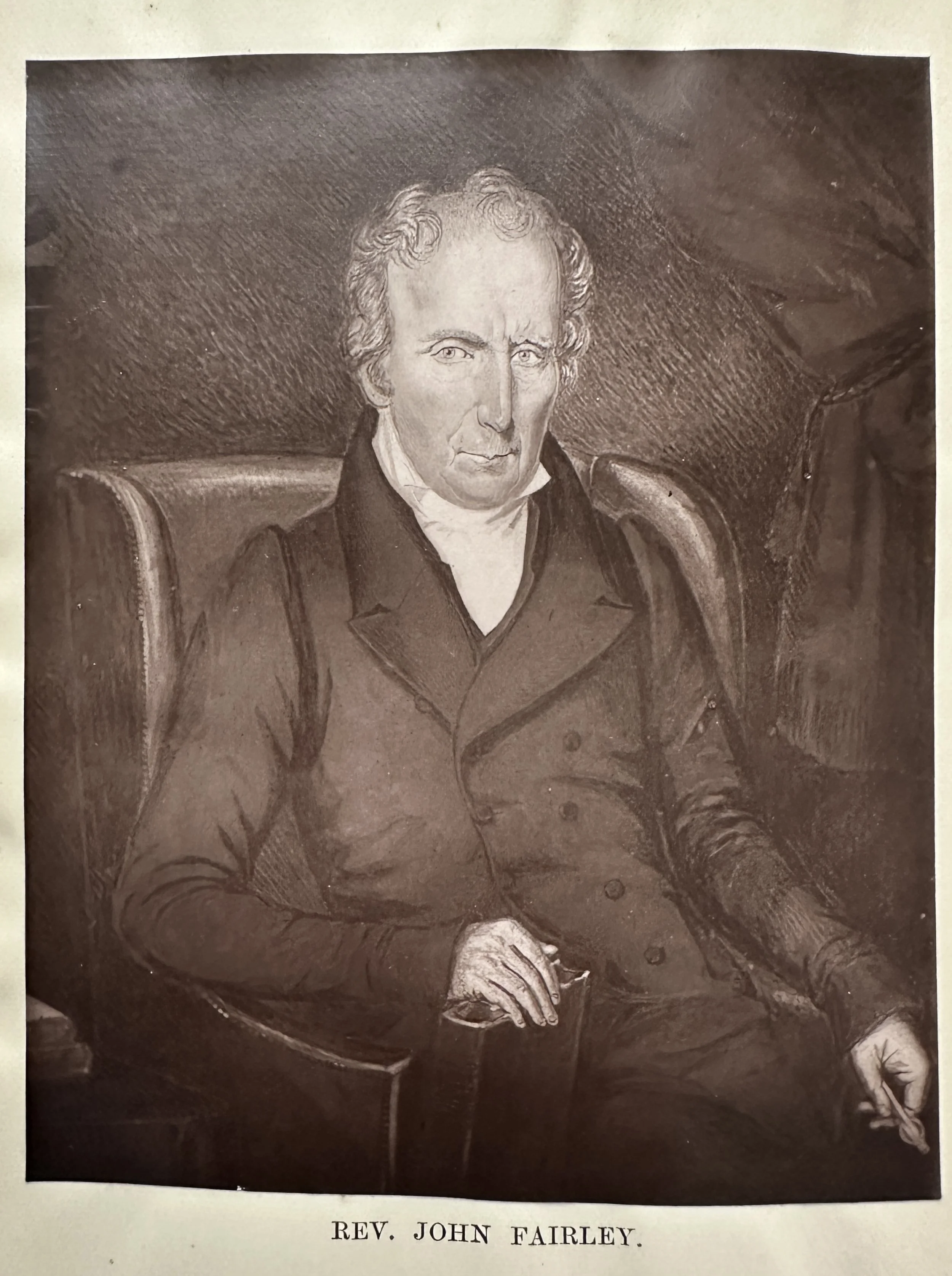
[Portrait.] REV. JOHN FAIRLEY.