Reid A Cameronian Apostle VIII.
James Dodson
CHAPTER VIII.
1703.
ADRIFT.
Macmillan “posed” at Balmaghie Place—A Libel served—The Visitation—“Scene” before it—Macmillan’s Sermon criticised—Queries to people—Proposed New Agreement—Composition of Court—Macmillan’s Response—The Trial begins—Dispute between Cameron and Macmillan—Protestation by the people—And by Macmillan—The Presbytery is “declined” by both—An adjournment to Crossmichael Church—The Court melting away—Macmillan deposed unanimously by 11 Ministers—Length of the sederunt—Scene at early dawn.
THE pace was quickening, and a few more strides bring us to the final scene. On 28th December, 1703, the Presbytery assembled at Balmaghie Church. This was a Tuesday, and the sittings were continued all day without any apparent intermission, from ten a.m. In the interval, the Presbytery’s Committee had hunted out Macmillan, and had run him to earth at “Balmaghie Place.” There they had “posed” him for many hours as to the alleged statements which were in question; but he was now on his guard, and demanded that proof should be led. The Committee had attempted to extract a pledge of submission, but in vain. At last, “it being very late in a gentleman’s house,” they had adjourned, after agreeing to draw up a libel, and entrusting Cameron and Monteith with the task. They had also cited Macmillan to the Visitation, and appointed him to preach. He had answered that he would certainly intimate the Visitation, but “knows not if he will preach.” All
122 A Cameronian Apostle.
this was duly reported on 28th December, and the libel was laid on the table.
Before the actual trial began, a curious scene took place at the manse. Cameron and Tod had arrived first, and Macmillan, probably not relishing their company, hurried out of the house to conduct service. Cameron hotly remonstrated against beginning before the brethren were assembled.* It was an hour before the usual time of sermon at such meetings. There appears to have been an established custom, as the Presbytery’s minute says:—“An hour sooner than ordinary on the Presbytery days, when the brethren met in the parish of Balmaghie, in which the Presbytery meets frequently, being the midest of the Presbytery bounds.” As Macmillan issued from the manse, he met his friend Reid of Carsphairn at the door, and noticed “several others within gunshot.” So he himself declares in his second defence, the “Examination tried and found false.”† A reference to the “Narrative” will show that he held the Presbytery to be convened before he began to preach. In any case, it is clear that he mounted the pulpit in some haste, leaving his reverend visitors to straggle in as best they could.
The church had been crowded long before the service began. Macmillan preached on the same text as he had chosen more than two years before, when he first occupied that pulpit as the ordained minister of Balmaghie. It was Psalm lxii. 8—“Pour out your hearts before him.” He had been “upon” this text for some Sundays, and in the snappish criticisms recorded in the Presbytery minutes it is complained that he did not give the
_____
* The minute of Presbytery says:—“But he (Macmillan) answered superciliously, that the people were met, and he would wait no longer upon them.”
† The Examination of the True Narrative tried and found false, 1706. Anonymous, but undoubtedly the work of the same hand as the “True Narrative.”
Adrift. 123
“heads” of his former sermons, nor “hold forth that which is principal and most essential in pouring out of the heart before God.” It is also complained that he “had no application,” and that in his prayers, first and last, he never once mentioned the Visitation, or asked for direction to the Presbytery, although he “prayed for direction to himself and the people.”
There is something positively astounding in the procedure at this point. Macmillan had been served with a libel by the Committee “timeously,” so as to be prepared to give answers that day. Monteith had been appointed by the Presbytery to preach, it being manifestly irregular to follow the usual custom of committing the religious service to the minister of the parish visited. For the minister of the parish was practically under discipline. Yet first the Committee, of which Monteith himself was chairman, upset this appointment, and permit or require Macmillan to preach. Then the Presbytery find fault with every part of his service. The sermon was an hour too soon; the brethren “heard little” of the service in consequence; he “had no application”; he did not pray for “direction” to the brethren in the work of visitation! Such complaints border on the ludicrous, when it is remembered that they are made by judges against an accused person. What sort of “application” could the criminal venture to make to the bench of judges? Was it reasonable to expect him to pray, that they might be “directed” how best to convict and punish him?
Macmillan deeply felt the unfair treatment which he received in this respect, and did not scruple to assert, in his anonymous tracts, that he had been entrapped. As we saw, the appointment to preach took him by surprise; at first he did not know if he would do so. The snare which he believed was laid for him was this—If he did not preach he was disobedient; if he did, he might be challenged as acting unlawfully.*
_____
* See Narrative.
124 A Cameronian Apostle.
sistent action of the Presbytery may well breed a doubt as to their fairness and fitness in the whole judicial proceedings.
After service, the people had flocked out for a little, while the Presbytery read over the minutes and papers, and elaborated the above remarkable criticisms. Macmillan also had retired, but was at length called in to hear the observations on his pulpit ministrations. As soon as the people saw their minister re-enter the church, they also came in “in a disorderly way, without being called.” The Presbytery were now face to face with the real offenders, for nothing is more certain than that Macmillan alone could not for a moment have withstood the Presbytery’s will.
It was an eventful hour in the parish history, and it is interesting to note the constitution of the Court assembled in the little parish church. Of the clergy, all at first were there but Bryden and Hay. Bryden was in poor health; Hay afterwards fell into disrepute, and perhaps already he was in evil odour. Boyd, who should have presided, begged to be excused on the ground of “indisposition”; and Ewart, whom we have supposed to be Macmillan’s former pastor in Kells, and who was no friend to the accused, was chosen to fill the Moderator’s chair. In accordance with the Synod’s Act, two “correspondents” from Wigtown Presbytery attended—viz., Mr. Rowan of Penninghame and Mr. Campbell of Minnigaff. Thus, the ministers from Macmillan’s parishes of boyhood and early manhood were all present. Twelve elders brought up the bench of judges to the total of 27, out of a possible attendance of 33. We exclude Macmillan, as being accused, but include his elder, Alexander Cairns of Garroch, as entitled to vote if he chose. The case had evidently roused the deepest interest, since so full an attendance was seen. Seldom had so many as 12 out of 16 ruling elders attended a meeting. Had they remained to the close, the result might have been different.
Adrift. 125
The Presbytery were, from the first, agitated and intimidated by the great gathering of parishioners, which packed every corner of the small building, and overflowed into the churchyard. They made a feeble attempt to go through the usual routine of a Visitation, by asking if the meeting had been “timeously intimated,” to which an affirmative answer was given. But the pretence was not further kept up at this stage; for they at once proposed terms of accommodation. Would Macmillan promise to adhere to the Agreement of Nov. 3, and in future submit to the Presbytery? He replied that it was “a matter of moment,” and craved half-an-hour to consider and consult. This was granted, and he retired.
In order to fill up the interval, some questions were put to the people without attempting to interrogate heritors, elders, and congregation separately, as the usual rule was. This elicited the facts that the church had “two communion cups and tables, but no cloaths, beinks (benches), nor tokens;” that there was about £23 Scots of “mortified money;” that they “led the minister’s peats;” and that the manse was in “good case.” Being next asked why the church was “in so ill case,” they replied that “they had agreed with a sclatter (slater), and he had cheated them, but they were agreeing with another.”
This perfunctory examination was now interrupted by Macmillan’s return, and a scene of great excitement followed. When asked once more if he would sign the proposed new agreement he “began to discourse, with this preface, That he blessed the Lord that had perfected praise out of the mouth of babes, as we have always reason to bless him. ‘And I may say’ (said he), ‘as great Rutherford said, that Christ can ride upon a windlestraw, and his horse not stumble!’ And then directly answered, that he could not answer it at all till he be excused from the Libel. To this, his answer, he added with a loud voice, turning his face to the people, and in a violent and flouting manner
126 A Cameronian Apostle.
said, ‘The parish of Balmaghie would have a bonnie bird of me to be their minister—a brave minister—a bonnie dearie indeed, if I subscribe this till I be excused from the Libel!’”
As it was afterwards asserted by Cameron and others, that at this stage Macmillan refused a “condescending accommodation,” it is only fair to set the facts in the clearest light. Macmillan was then an accused person, having been served with a libel. Suddenly, he is asked to sign a pledge of absolute submission to the Presbytery, his judges, and so to escape the trial and sentence. As an honest man he recoiled from the temptation. The submission demanded of him amounted to a betrayal of his own testimony in the “Grievances.” He was asked to bind himself, hand and foot, against any further action, such as he and his two older friends had already taken. If he agreed to this, he might as well for the future cut out his tongue, so far as he would be entitled to protest against any further encroachments by the State. He would become a “dumb dog that cannot bark,” or, as he himself put it in his native Doric, “a bonnie bird to be a minister!”
Moreover, he was morally and legally right in saying to his Presbytery: “You have accused me, now try me; but do not ask me to sign or say anything which may be used to my hurt.” That, surely, is a first principle of justice and fair-play.
The Presbytery now abandoned further parley and proceeded in due form to establish the legal service of the Libel on December 13, by the Presbytery officer, in presence of two witnesses, James Macmillan, the brother of the accused,* and David Clacharty, a deacon of the church. The copy thus served on Macmillan was now “collated” with the Presbytery’s original, found an exact one, and signed by the Clerk. The Libel was at once found relevant, i.e., legally worded, and con-
_____
* James Macmillan at Glenhead was born in 1692, hence, perhaps, too young for a legal witness.
Adrift. 127
taining matter inferring penalties; and it was resolved to deal first with those parts or “articles” which were to be proved by the people’s evidence.
In what now follows, the reader is requested to refer to the copy of the Libel in the appendix to this volume.
The sixth article referred to a synodical fast in May, and Macmillan admitted that he had not observed this fast on the day appointed, but had held it on another day. The tenth and 11th charges were met by an answer from the people, that they remembered no such statements being made by their minister. As to the 12th, which was to be proved by the testimony of an elder, George M‘Guffog, farmer in Drumlane; that individual refused to say anything till they gave up the name of the person to whom he was alleged to have made the incriminating statement. Doubtless it was a minister; in any case the Presbytery, “upon certain considerations,” decided to delay this point.
Here another “scene” took place, Macmillan insisting that the Presbytery minutes misrepresented him as to his alleged reunion to their number and abandonment of his position. Cameron now lost his temper, and roundly accused minister and people of perjury. At once Macmillan “took instruments,” and entered the unfailing protest. Cameron retorted by calling for a Confession of Faith with the Covenants bound up with it, and Macmillan handed him the volume. He proceeded to argue that, as Macmillan and his people had quite recently “renewed” the Covenants, and as the Covenants contained most solemn engagements to conformity with the Reformed Church; therefore, in separating themselves, they broke their oath, and were perjured.
While this curious argument was going on the people had not been idle. In a pause which succeeded, while their minister was elaborating his reasons of protest, the people on their own behalf presented a long “protestation,” signed by no less than 87 per-
128 A Cameronian Apostle.
sons, being practically the entire adult male parishioners. It is doubtful if this move was favourable to Macmillan’s cause. It could not be pleasant to the Presbytery to be told that Macmillan, now compearing as “ane delinquent,” was in their judgment “of more integrity than his accusers and prosecutors:” that the prosecution arose from Macmillan’s opposition to the “defections” of unfaithful ministers, “of whom, we fear, ye are a party:” that, whatever sentence the Presbytery pronounced against their “faithful pastor,” would by them be held null and void: that the people would adhere to him and “own him as their pastor under Christ Jesus the Chief Shepherd.” Four distinct reasons were added for disregarding the Presbytery’s authority:—(1), Macmillan was being pursued, because he stood for truth against compromise; (2), The Presbytery were both judge and party; (3), The authority of the Presbytery was questionable, since by their “Erastian Oaths” they seemed to have “given away the whole power of jurisdiction of this National Church into the hands of the Civil Magistrate;” and (4), Macmillan alone was being pursued, and the other two ministers were passed by.
It will be seen, what irritating matter this ably drawn and well-expressed protestation contained. Strictly speaking, the court might have refused to receive and engross it, since nothing could well be more disrespectful; but they did both, minuting that it was received as “a specimen of the people of Balmaghie . . . their disaffection towards the ministry, and of the effects of Mr. Macmillan’s ministry among them.” The “people’s paper,” as it was thenceforward styled, was so able, that the Presbytery asked Macmillan if he had prepared it. This he denied, but would not say that he had not seen it before. He then signed and gave in his own protestation, which embodied a refusal to accept further the jurisdiction of that court. After reciting various reasons, already discussed, he concluded thus:
Adrift. 129
—“The said Mr. John Macmillan declines this Presbytery, and appeals to the first free and rightly, lawfully constituted General Assembly of the Church of Scotland for remeid and redress . . .” He desired the appeal to be engrossed ad futuram rei memoriam, “for the remembrance of posterity.”
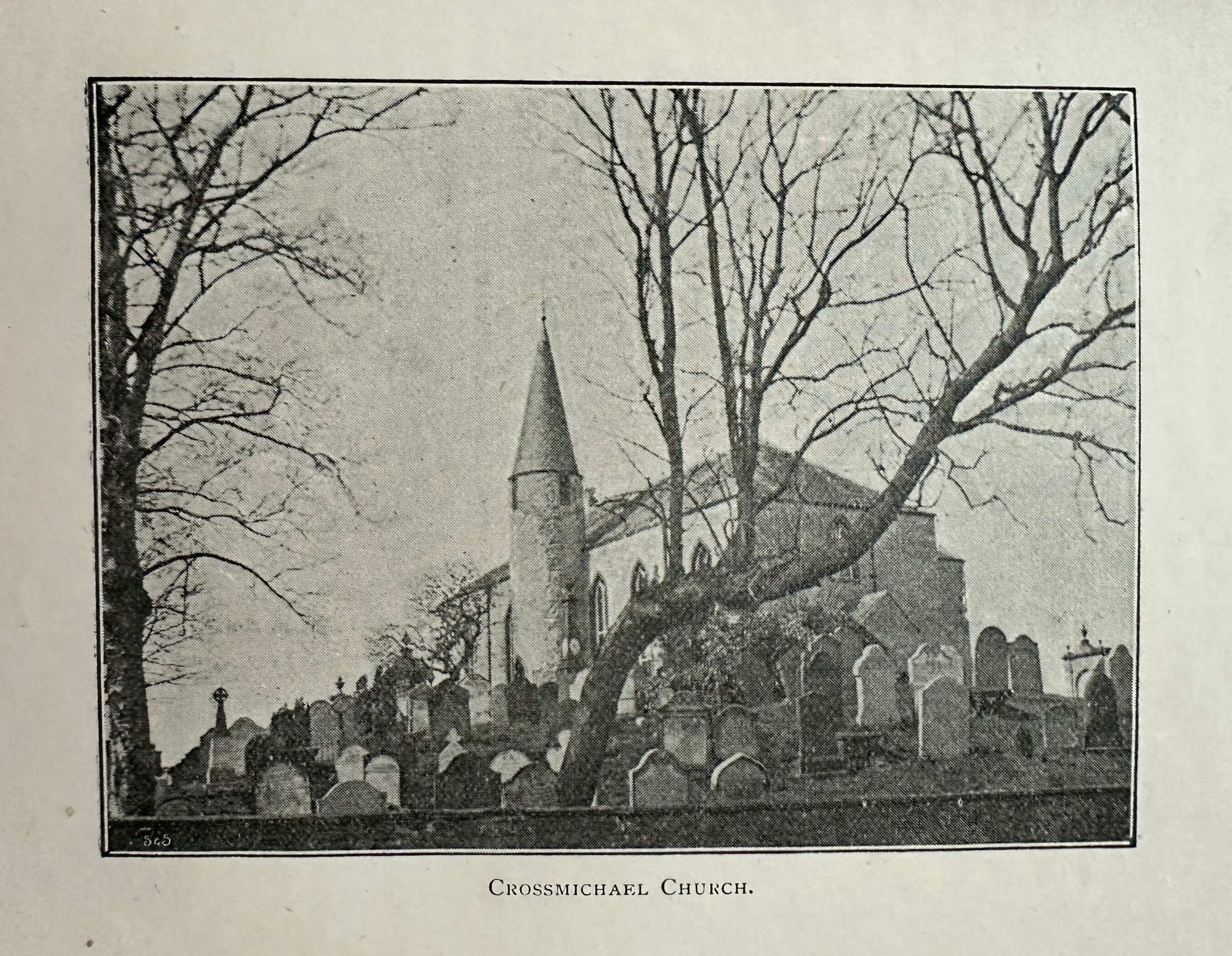
Thus deluged with protests, the Presbytery at last took refuge in an adjournment. “It being now very late, and the brethren and others present very long detained here already,” they agreed to meet next day at Crossmichael Church at 10 a.m. to adjust their “animadversions” on the two protests. They cited Macmillan, there and then, to be present at that place and hour; but he answered, that to do so would be inconsistent with his declinature of their authority. He was curtly told, that they should proceed, whether he came or not. The “Beddel” having announced the forthcoming meeting at the church-door, the worn-out presbyters rose at 9 p.m., having sat unintermittedly for about ten hours.
The position of affairs was now highly peculiar. Both people and pastor had “declined” the Presbytery, anticipating an adverse decision. For them, the subsequent proceedings were unmeaning. Although in the calmer mood of our time, we may feel a little surprised at this drastic course, yet we can partly understand the pent-up feelings of indignation and distrust which prompted it. The people were warmly attached to Macmillan. They spoke, in their paper, of “blessing” received from his pastoral labours among them, brief although these had been. They admired his steadfastness in a losing cause against such odds. They saw, how great a sacrifice he was ready to make in its defence, while so many eminent ministers proffered him a flattering peace. They knew enough of his accusers’ history to feel a certain contempt for their present policy of patching up the Church at any loss of principle. Macmillan, for his part, was well aware that he was doomed already. It was
130 A Cameronian Apostle.
expedient, in the view of the Church leaders, that an example should be made, to deter others from hampering the Church’s progress with protests and obstructive tactics. To take further part in the proceedings and to receive a sentence, would be to own the authority of a court, which had lost his respect and confidence. So, he joined his people in their repudiation of its further actings, and retired, no doubt sadly and seriously, to his manse.
On the other hand, the undignified flight of the Presbytery shewed how entirely they admitted their loss of influence in the parish. To finish in another place what they had begun at Balmaghie Church, was to adopt an unfair and unworthy change of venue. The result of this was that, when the 29th December dawned, and the court re-assembled in Crossmichael Church, there was hardly any representation of the people of Balmaghie. The court itself was melting away. Tod and Reid now retired. Of the 12 elders, only 4 reappeared. The total number of members, lay and clerical, fell from 27 to 17. It was destined to sink lower still, as the feeling of uneasiness increased.
This day, there were two sittings, the first lasting from 10 to 4, and being devoted to reading over the people’s protest and “animadverting” on it. The process was inordinately long, considering the brevity of the “people’s paper,” but it is likely enough, that the Presbytery felt that they were dealing with the most important part of the case, as regarded the future. For the real difficulty was not Macmillan, but Macmillan’s people. And they could not be deposed. At 4 p.m., there was an adjournment for an hour, during which Warner and Telfair went home. The court therefore re-assembled at 5 p.m. with 15 members, of whom 4 were elders. The “animadversions” on Macmillan’s paper were now prepared, after he had been vainly called for at the door of the church. These criticisms bear evidence of Cameron’s incisive mind and sharp temper, but
Adrift. 131
need no further description here, except as to their length. They cover, in the records, a space of 10½ folios, and shew how laboriously the brethren strove to prepare a case for posterity.
At the close of this work, the “probation” of the Libel began. This must have been a very formal and hurried affair, since the sederunt had begun at 5 p.m., and probably three or four hours had passed in “animadversions” on an absent man’s writings.
The minutes from this point were printed in the Examination, 1705, pp. 3–7. Briefly, the first five articles were proven from the Presbytery’s own records, as was also the eighth; while articles seven and thirteen were proven from the minutes of the committee at Balmaghie Place. The sixth and ninth were held proven from his own admissions. The tenth, eleventh, and twelfth were found not proven, although the eleventh (a charge of urging the people to “stick by him”) was regarded as proven “eventually,” i.e., from the action taken by the people and himself in protesting and “declining” at yesterday’s meeting. The reader will be able to follow the particular details as they are given in the reprint in the Appendix.
The foregoing bare statement is enough to shew how little the law of evidence was regarded on this occasion. Macmillan was found guilty either on the Presbytery’s ex parte narrative, to which he never subscribed, or on his own admissions, which surely ought not to have been used against him apart from substantial corroboration. As to “eventual” proof, this was a new and amazing invention, which no respectable modern court would adopt. It consisted in “proving” a charge by something done after the event, by the accused, and by other parties not accused at all!
Such “probation” proved only one thing, that the judges were already resolved to convict at any hazard and on any ground. Accordingly, the terrible formula was now pronounced by Boyd, who had evidently recovered from his “indisposition,”
132 A Cameronian Apostle.
and was acting as moderator:—“The Presbytery and corresponding Brethren did, and hereby do, in the name of the Lord Jesus Christ, the only King and Head of the Church, according to the ministerial power they have received from Him, simpliciter depose the said Mr. John Macmillan from the sacred office of the ministry.”
The ministers who took part in the final scene and “unanimous vote,” were Boyd, Spalding, Gordon, Falconer, Cameron, Clark, Monteith, Johnston, Ewart, with Rowan and Campbell, correspondents from Wigtown. The elders still present were John M‘Douall, Dalry; James Gordon of Auchendolly, Crossmichael; James Gordon, Borgue; and James Macmillan, Girthon. The court had dwindled from twenty-seven members to fifteen, less than one-half the members being thus present, a point which, we shall see, Macmillan was swift to note.
Monteith and Hay were appointed to proceed to Balmaghie church the Sunday following the next, viz., January 9, and to intimate the sentence. Johnston was charged with a letter containing the same intimation, to be delivered the same day to the deposed minister. As we know, there were ties of “auld acquaintance,” which probably suggested this arrangement.
The actual sentence was not pronounced till day had dawned on Thursday, the 30th December, 1703. The closing lines of the minute are so curious, that they must be quoted:—“The Presbytery and corresponding Brethren sat from five of the clock upon Wednesday [afternoon] till about seven upon Thursday morning, before they could finish this affair.” The church at Crossmichael was lit up with candles during the midnight debate, and the unaccustomed gleam would be seen by Macmillan from his own windows. There is an unintentional irony in the phrase “finishing this affair.” The affair was so far from being “finished,” that twenty-four chequered years were to pass ere the deposed pastor went forth from church and manse into
[Plate: CROSSMICHAEL CHURCH.]
Adrift. 133
exile. And that rash and even illegal sentence was not the termination of a troublesome controversy, but the first foundation stone of a religious dissension continued to this day.
The few remaining ministers of the Reformed Presbyterian body in Scotland may well come to gaze, with curiosity and reverence, on the remains of Macmillan’s church, where he stood up between his people and his judges, and across the changeless river, to the spot where, as the dull December day broke, a handful of wearied men took upon them to cast out a brother, whose chief fault was that he could not bend his conscience into shape with the prevailing mode in Church and State.