The Kirk Above Dee Water IX.
James Dodson
100 The Kirk above Dee Water.
IX.
“FACTOR JAMES.”
THE “Galloway Herds,” a poem occasionally scurrilous but often witty, is responsible for the familiar designation. James Henderson becoming minister in 1804, died at the end of 1838 or beginning of 1839; and for the greater part of his ministry he acted as factor on the Balmaghie estate. The union of two offices so dissimilar as that of pastor and factor, arose in his case in no discreditable way, but simply because Mr, afterwards Rear-Admiral Thomas Dempster Gordon, of Balmaghie, had in youth been Mr Henderson’s pupil. Long before Henderson dreamed of being minister at Balmaghie, he had become tutor at Balmaghie House, and something like domestic chaplain. It was indeed the common road to preferment, in these bygone days. In a like fashion, Macmillan had bowed his obstinate head at the table of Murray of Broughton, and Martin had been the valued and respected tutor at Houstoun. It may be true that such early connection with country magnates bred in a few cases a snobbish and servile spirit. It was not so with any of our own departed ministers. Henderson had “tutored” two young Gordons at the quaint old mansion-house of Balmaghie, whose proprietor was patron of the parish, and on the erection of the
“Factor James.” 101
present church in 1794, gave the Communion vessels at present in constant use. Old Mr Gordon had a distinguished cousin in the north, from whose politics indeed he differed widely, but whose blood and family he of course approved; and when this cousin, George Dempster of Dunnichen, M.P., recommended as tutor a young protégé, James Henderson, thus sponsored by one county gentleman, was promptly accepted as family Levite by another.
Henderson, we can imagine, travelled down by coach from Dunnichen to the wilds of Galloway, which then deserved such an appellation in a high degree. It was just at this time that agriculture was beginning to rouse itself, and survey the vast undertaking which lay before it. George Dempster of Dunnichen was in fact a pioneer in the great agricultural movement of the end of the 18th century, and probably his influence had already been felt in Galloway. But at the time of young Henderson’s journey, the fringe of this enormous enterprise had barely been touched. Everywhere he saw huge “peat-hags,” since converted into blooming fields. The roads over which he drove, or rode with strapped valise, were often mere tracks. After leaving Dumfries, he must have felt as if he had left civilisation behind. He drew near his future home, little dreaming that he was to lay his bones, forty years after, beside the broad, marshy river which he crossed by the old Dee Bridge. For Glenlochar Bridge was not yet. At Balmaghie House he found his charge to consist of two “stirring” boys. The elder entered the army, and died a Lieut.-Colonel, before succeeding to his paternal estate. The younger became a sailor;
102 The Kirk above Dee Water.
perhaps fought with Nelson at the Nile, and came home on his elder brother’s death to be “laird of Balmaghie.” In Henderson’s time, all knew and feared him as “Admiral Gordon.” Whatever talents Henderson may have had as a tutor, his pupil at all events emerged from the young minister’s hands without losing his native fire and imperious temper. These, a seafaring life had not tended to chasten; and the whole result, when he became a sort of little king in Balmaghie, was a character such as Smollett would have loved to paint—hot and hasty in speech, tyrannical even when most beneficent, not averse to a full round oath at times, walking the parish road like his own quarter-deck, yet full of deep hidden reverences and wayward pieties. The “auld Admiral’s” sailor-like piety made him an unfailing attender at the Sunday services in church. Tradition lingers, how he regularly went down to the manse of Sunday mornings towards twelve o’clock, and soon issued along with the minister, his old tutor, in friendly talk. The laird and the minister all over Galloway used to be seen in such decent comradeship on the Lord’s Day. But that is now an “auld sang.” Then, while the minister entered the pulpit, gravely hanging his cocked hat on a nail in the panel behind him, the laird proceeded to the Balmaghie square pew, and took his seat, surveying with stern observance his own tenants and servants around. Woe to the careless farmer, hind, or keeper who was absent without a satisfactory excuse! The wig-crowned head of the minister at length made its customary and courtly bow to the “patron,” who duly responded, and so the simple orisons began.
“Factor James.” 103
The office of factor held by James Henderson, and his lifelong friendship with Admiral Gordon, the chief heritor, enabled him to confer on the parish one lasting benefit at least, that of a new manse. The older one had been erected on a bad site in 1764, and fifty years exhausted its comfortable use. It had an evil record, since in it died David Blenchell after only five years’ pastorate, and John Morison the youthful and promising son of Philip Morison, successor of Martin. The present manse, and a simple inexpensive cross in the churchyard, are Henderson’s memorials to our generation. Apart from his influence in the Church’s favour, as a friend of the laird and a persona grata to the county gentlemen generally, Henderson’s factorship won him only unpopularity. There is a hint, in the “Galloway Herds,” that even the Presbytery passed a mild censure on the pluralist, who thus tacked on the publican to the priest. Be this as it may, the fact is certain that no more unpopular minister ever laboured in the parish, except perhaps the unfortunate Freeland. The latter, however, was liked by many for his Hibernian fun and freedom of manners. But Henderson had few friends except at Balmaghie House. A correspondent who withholds his name, writing from London in 1890, informs me that “Rev. James Henderson was very unpopular. . . . I cannot tell what he did, or what he left undone, only from what other people said. The fact that he had been factor and family tutor at Balmaghie, may possibly have injured him.” . . . He adds, “Captain (afterwards Admiral) Gordon was bad, but people would not follow his example. They hated him; and if they met him on the road, coming as usual in dreadful majesty, the people who knew him
104 The Kirk above Dee Water.
would much rather lift their foot to him, than lift their hat (if they dare).” To be the friend of such a friend was enough to make Henderson, even if himself personally amiable, disliked and distrusted; and to be his factor and prime minister, was enough to bring actual odium. The mistake of Henderson’s life was his taking this factorship, since evidence exists that in himself he was a man of attractive and interesting personality.
The present writer has deemed it a sacred duty to take every possible pains to find out the truth about Balmaghie’s most unpopular minister, and he has come to the deliberate conclusion that James Henderson was a man much misunderstood. The funeral sermon, preached by the Rev. Dugald Williamson of Tongland in Balmaghie Church on 3rd February, 1839, gives what appears to be an impartial estimate of the factor-minister. It is expressed with that care and precision, as well as formal eloquence, which mark all Dugald Williamson’s published productions, and have led me to form the hope that much of the Tongland minister’s manuscript compositions (and much is, I believe, in existence) may yet be given to Galloway and literature by some competent editor. No apology is needed for the following copious extracts, upon which I base my belief that James Henderson’s character was never rightly appraised by his flock:—
“With the early history of Mr Henderson I am very slightly and imperfectly acquainted—almost all I know being that his settlement here arose from his connection with a gentleman who lived in a part of the country very remote from this quarter, George Dempster of Dunnichen, a man who was in many respects a truly great and
“Factor James.” 105
memorable character, and of no mean reputation in his day, as an enterprising and skilful agriculturist when the improvement of land was little attended to or understood; as a liberal and upright statesman, when politicians were narrow and corrupt; and as a Parliamentary orator in an age when the eloquence of Parliament was at its full blaze in this country. Of this eminent person, your late minister was first the domestic tutor, and afterwards the confidential friend and daily companion. He was not the man on whom the advantages of such an intercourse were to be thrown away, and it was obvious, from the whole cast of his conversation and manners, that he had not failed to value and improve them. Whatever signalised him as a man, as a clergyman, and as a gentleman—his sagacity and intelligence, his rich vein of pleasing and varied anecdote, his liberal, enlightened, and tolerant spirit, his unfailing good humour and evenness of temper, his decorous, easy, disengaged deportment, and his perfect good breeding—all, I have no doubt, was in a great measure owing to his early and intimate friendship with the distinguished individual whom I have referred to. . .
“I am not sure that familiar intercourse with minds of a high order is favourable to the discharge of such homely duties as those which a parish minister in this country is required and expected to perform. To descend from equal conversation with men who move in enlightened and accomplished circles, to a gracious contact with such prejudices as we perpetually encounter in matters of religion among the artisans and peasantry of our country, implies versatility of character which we cannot hope frequently to meet with; and least of all can we expect
106 The Kirk above Dee Water.
to find this accommodating temper in one who, like your late minister, is advanced in years before being settled in the Church, and whose intellectual and social habits are consequently so completely formed as to admit of very little alteration or disturbance. Owing either to this circumstance, or to some cause not easily discovered or assigned, his appointment to this cure was at first far from being acceptable, and unless the laws of the Church had been administered by firm and faithful men, he would have fallen a victim to that popular violence which, under the name of zeal for a spiritual privilege, is nothing more than an insolent assumption of secular power. . . .
“The character in which, as a public man, he presents himself for contemplation, is that simply of a parish priest. His ambition rose no higher. This was the outline which it was the object of his long life to fill in. He selected a humble and narrow sphere, and did not wish to enlarge its boundaries or to leave it for another. He aspired to no distinction in literature or science. He had no turn for intrigue or faction. He looked on political agitation, whether in ecclesiastical or civil affairs, with a calm contempt which resembled magnanimity. . . .
“Within this limited sphere, his character and conduct were deserving of high commendation. In all his duties he acted from reflection rather than from impulse. His character was uniform and sustained—not enthusiastic or impassioned. His opinions were deliberately formed and tenaciously held. . . His information and advice on every subject which he professed to understand were sound and unerring; he gave them with the utmost frankness and facility, and on his truth, candour, and integrity, the most
“Factor James.” 107
implicit reliance might be placed. . . . He had a high and independent temper. . . . He could, when circumstances cast a transgressor in his way, show that, if he felt an insult with the sensibility of a gentleman, he was armed by his ample command of brief and cutting language, with the proper weapons to prevent the repetition of it.
“The vivacity and suavity of his manners, and the singularly agreeable, varied, and racy style of his conversation rendered his presence universally acceptable. Those who accused him of reserved and solitary habits, and of not coming often enough into the society of his friends, paid the highest compliment to his social powers. . . . Many apologies may be suggested for his secluded and lonely way of life. His health was uncertain—infirm for years before it finally gave way. He had outlived every one of his friends and contemporaries. His lot was fixed far from his native place. . .
“It never happened to me to hear him address you from this place, but on Sacramental occasions elsewhere I have listened to him more frequently than any other clergyman of my acquaintance. The general character of his sermons was plain, clear, and practical, delivered in a distinct, sonorous voice, and sometimes with considerable force and impressiveness of manner. . . He was too fond of leaving his written paper, and wandering into an extemporaneous address. . . . The best specimen of his powers as a preacher which I remember was from the text, ‘Blessed are the pure in heart, for they shall see God.’ I heard him preach it for the first time fifteen years ago, frequently since, and always with the greatest
108 The Kirk above Dee Water.
pleasure . . . simple, clear, devout, energetic, and, in several passages, lofty and sublime.
“But the part of public worship which he conducted with uniform acceptableness was the devotional. In the fluency, variety, fervour, and aptness of his prayers, there was something extremely natural and spontaneous. They were long and particular, but not tedious . . . they abounded with scriptural expressions and allusions. . . .
“The time not occupied by him in attending to the duties of his parish was spent amongst his books. Of these he had a various and well-chosen assortment on theological and literary subjects. . . . One of the last books, if not the very last, which he added to his library was a complete edition of the works of the poet Crabbe, to whose personal character his own bore some resemblance. . . .”
Few descriptions of character could be more complete, or more distinctly defined, than the foregoing. Its essential truth and fairness are established by several competent witnesses who either survive, or have left written testimonies.
The late schoolmaster at Laurieston, Mr W. M‘Vitae, who also acted as agent for Woodhall, was a life-long intimate of Mr Henderson, and a frequent visitor at the manse. His surviving daughter, the present excellent postmistress at Castle-Douglas, has given me the following particulars:—Mr M‘Vitae was constantly with his friend and minister during his last illness, and, in fact, raised his head for the last time before he died. Henderson’s dying words were truly characteristic. The obnoxious window-tax had
“Factor James.” 109
greatly irritated him, especially as the then assessor of taxes, Mr Thomas M‘Cracken, had seen fit to come out and personally enumerate the manse windows. This grievance had strangely taken hold of the aged minister’s mind, and he said—“Lift me up from among thae tax-gatherers !”
Mr M‘Vitae used to say, that any gossip bringing to the manse a story against his neighbour, received such a rebuke that it never was repeated.
Henderson possessed a good deal of humour. To a whining and hypocritical female who came saying that “she had lived a long time on kail,” he at once responded by bidding his servant “go into the garden and cut her a cabbage for a change!” At a country wedding, when some bad language had been passing, he very gravely said at last—“I have had a great oath on the top of my tongue for some time, but really I cannot get it in !” This effectually stopped the swearing on that occasion.
Another friend has kindly given me some reminiscences, which complete our picture of a singularly reticent, close, yet high-minded man.
Henderson amassed a considerable sum of money, some of which was lent on mortgage. He died intestate, and his nephew, a partner of Messrs Fox and Henderson, London, fell heir as next of kin. This firm had a contract for iron-work for the Crystal Palace in 1851, and through business complications they became insolvent; thus, the entire estate of Henderson was swallowed up. The nephew had fully intended to erect a monument, but this change of fortune prevented the execution of his design.
Henderson’s sermons were very long, as were also his prayers. These last had the irritating peculiarity that
110 The Kirk above Dee Water.
“they seemed always ending, yet always began again.” As people then stood up at prayer, much quiet amusement was caused occasionally, when an uninitiated person sat down too soon, imagining that the conclusion had been reached, while the clergyman continued after a pause to pour out his petitions.
Henderson was much liked by the few who knew him well, but quite misunderstood by the majority of his parishioners. They summarily dismissed him as a “near auld body,” i.e., miserly and grudging in money matters. That in his extreme old age (he was eighty when he died) he had become somewhat miserly, is an actual fact; but in his earlier days he is said to have been as liberal as others in his station.
We can easily sum up these interesting though homely details. James Henderson was apparently a man of high breeding and scholarly though retired habits, who had at one time seen much of the world; but in a remote place like the Manse above Dee Water, he gradually shrank into a marrow and solitary life. He was undeniably a good man of business, and a fairly faithful Christian minister. He was not at all a “popular” preacher, or an acceptable officiant at public worship. His reserved and somewhat cynical ways deprived him of such alternative popularity as is won by pastoral intercourse. Our people say of some ministers, “They’re nae haund in the pulpit; but they’re fine and hamely in the hoose!”* Henderson unhappily was neither; and his command of “brief and cutting language” was a fatal gift so far as his kindly rough parishioners were concerned. His redeeming feature for
_____
* [“They’re no great hand in the pulpit, but they’re fine and homely in the house!” i.e., They are not especially gifted preachers, but they are excellent, warm, familiar, and pleasant in private/domestic company. ED.]
“Factor James.” 111
them was his humour; but even this does not seem to have been generally pleasant or kindly, but rather sarcastic—a thing abhorred and dreaded by our sensitive Galloway folk. But down beneath this shy cynical exterior, there was a loving faithful heart, with its affections somehow pent up and kept in through uncongenial surroundings.
I took Samuel Martin as a type of the old “Moderate” parish minister at his best. I may venture, without injustice to the dead, to take James Henderson as a type of the old “Moderate” at his worst. And the worst was not so very bad after all; for he did his parish work punctually, although coldly, and he killed humbug and cant by his polished brief sarcasms. Such men are needed, though not in remote rural places so much as in towns, where too often cant and rant rule unchecked. Henderson dying in his elder’s arms, with Crabbe’s coldly chiselled verses by his bedside, and a dying protest against the Window Tax on his lips, is a sufficiently vivid picture of the calm, restrained, scholarly, gentlemanly old minister. Such a death-bed is a thousand miles apart from Macmillan’s; yet both had the vein of sturdy independence which, singularly enough, has been in all these bygone Balmaghie ministers. Macmillan faced the world with a solemn frown and protest. Henderson looked on at its doings with a dispassionate smile, almost a sneer. It was the weeping and the laughing philosopher over again. Which is right or wrong, we shall not try to decide; but this is certain, that both have their function in the world and in the Church. As to popularity, he who weeps over men’s woes and sins is naturally more popular than the cynic or satirist, as Dickens is still a better-read author than
112 The Kirk above Dee Water.
Thackeray. But do we not know now, how kind and how broken a heart beat beneath Thackeray’s smiling and derisive exterior? And if we knew James Henderson’s whole story, who can say what early disillusionment or disappointed hope it was which shaped him into the cold, laconic, unsympathetic man he lived and died, in this lonely manse?
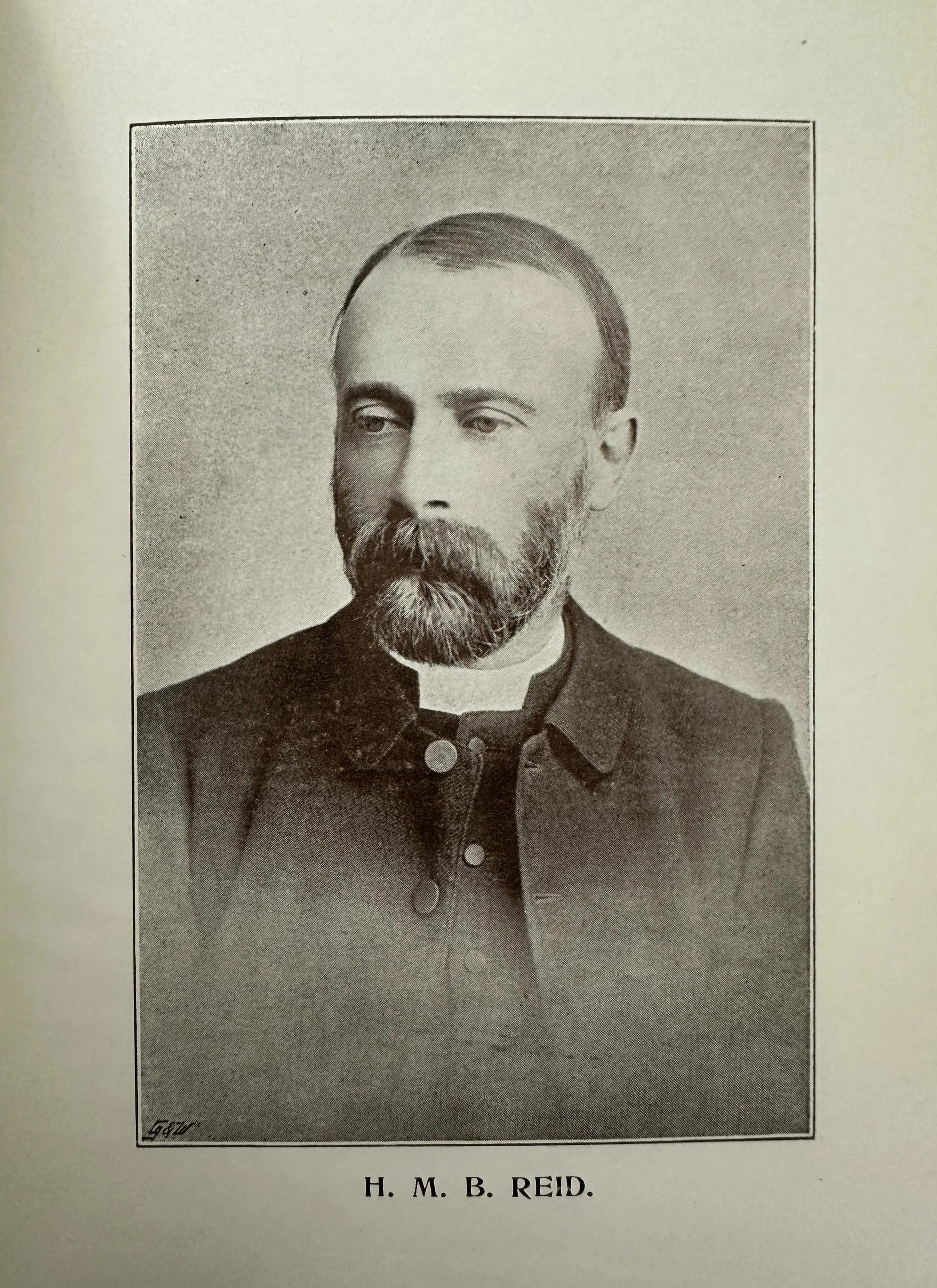
[Illustration: H. M. B. REID.]