Samuel Ferguson on William James.
James Dodson
[Page 11]
Brief Biographical Sketches.
THE REV. WILLIAM JAMES.
THE district between Derry and Coleraine is known as one of the most Presbyterian parts of Ireland. Here Rev. Mr. Hamilton, who was sent from Scotland for the purpose, administered the oath of the Solemn League and Covenant in 1644 to all “save a few Episcopal Ministers and a few profane and ungodly persons,”¹ and subsequently it was voluntarily taken in the same century by many of the people themselves. The spirit of the Covenanters lived in this district until the following century, and the parents of William James were among those who adhered to the solemn vows of their ancestors. In a farm house, near the village of Eglinton, in Faughanvale, Co. Londonderry, he was born in the year 1741, if we are to take the inscription on his tombstone as correct. Whether Mr. James was taken to Scotland for baptism or received that ordinance from one of the Scottish Covenanting Ministers, who periodically visited Ireland, we cannot now tell. Particulars of his early education are wanting beyond the out-
_____
¹ History of Irish Presbyterians, by Rev. W. T. Latimer, B.A. Page 52.
[Page 12]
standing facts narrated in the Minutes of the Scotch Reformed Presbytery. From these we learn that at a meeting held in Crawfordjohn in March, 1763, “Mr. William James, a student from the Kingdom of Ireland,” was taken under the care of Presbytery, having probably at that time completed his undergraduate course at Glasgow University. After appearing several times before the Presbytery during that year, and giving the various trial pieces, and passing the requisite examinations, he was licensed to preach the Gospel in November, and was directed at the same time to remain in Scotland for a few months to preach with one of the older ministers. It was in 1764 that he came to Ireland, carrying with him the highest recommendation from the Church in Scotland. He received appointments from the Irish Presbytery (which had been constituted in August, 1763), and soon after fulfilling these appointments moderation in a call was sought in his favour by the vacant congregation comprising large sections of the counties of Derry, Tyrone, and Donegal. At that time, though there were many societies in these districts, there was no fixed centre for the whole as a meeting place for public worship. This call, which was duly issued, Mr. James accepted, and was ordained in the open air in the presence of a vast congregation, near Cullion, at the back of the hill
[Page 13]
from Bready, on 8th May, 1765. The officiating ministers were, so far as we can gather, Revs. Wm. Martin, and Matthew Lynn, accompanied, in all probability, by some of the Scotch ministers.
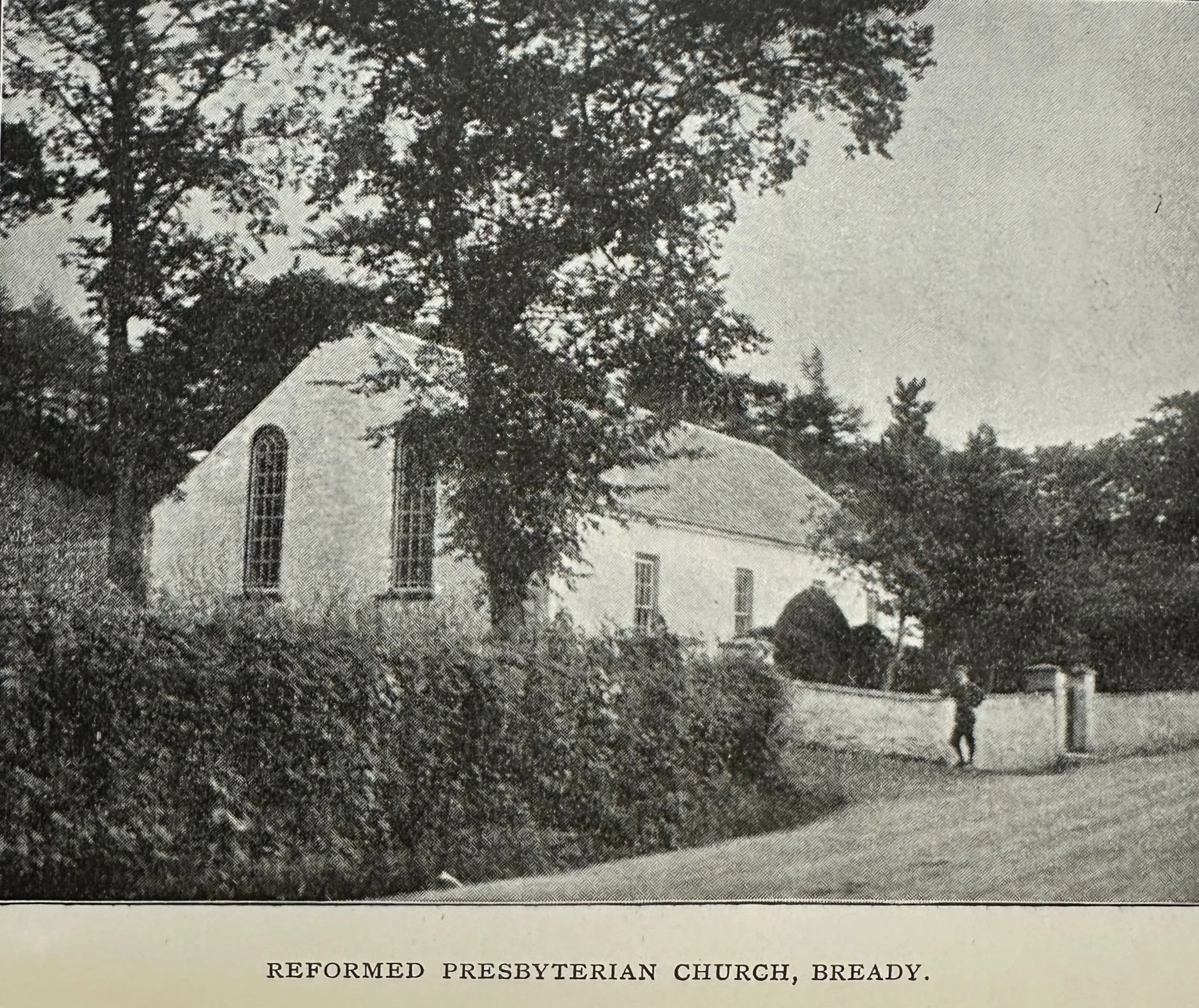
Soon after his ordination, it became necessary to obtain a meeting-house, and much discussion took place as to where it should be located. Some wished to have it built at Mountcastle, near Donemanagh, Co. Tyrone; others living across the Foyle preferred to have it at St. Johnston, where the then Marquis of Hamilton is said to have offered a site, but the majority preferred to build at Bready, where the Church still stands. The site was generously and cheerfully provided, free of rent forever, by the Marquis of Hamilton, ancestor of the present Duke of Abercorn.¹ Though the exact date of the building of the first house of worship has not been preserved, it is evident that it must have been about 1766. We have been told that it resembled a long shed more than a church, and was so badly put together that it fell (as elsewhere recorded), during the ministry of Rev. Samuel Alexander. It is only just to the noble family of Hamilton, to state the fact that not only did they give their interest in the ground free,
_____
¹ The late Rev. Professor Chancellor, D.D., who for a time was Minister of Bready, says that the deputation to the Marquis on the occasion was Rev. Wm. James, H. Denniston, Samuel Gormley, and James Allen.
[Page 14]
[Page 15]
but in addition, offered (we have been told on good authority) to give ten acres for a glebe for the minister, at a nominal rent. At the time, however, for various reasons, the congregation were unable to avail themselves of the offer of the glebe.
Thus, under favourable circumstances in many respects, Mr. James entered on his ministry. He was about twenty-three years of age at the time, of good appearance, well educated, and of good address. One who sat under his ministry has written of him, “he was a good minister.” About the time the Church was built at Bready, he himself went to live at Lisdivin, in a house said to have belonged originally to Sir John Hamilton. It is at present occupied by Mr. Clarke. Very little can now be learned of Mr. James’s ministry. We have gathered that he lectured through the Book of Revelation, and that he was requested to publish his lectures. If he had any serious thought of doing so, his early death prevented him. He did, however, take up his pen, and that to very good purpose, in writing a pamphlet entitled, “Homesius Enervatus,” a letter addressed to Mr. John Holmes, containing
1st. An Essay on Church Communion.
2nd. The terms of Church Communion held by the Reformed Presbytery vindicated.
3rd. Grounds of separation from the Synod of Ireland.
[Page 16]
4th. Animadversions upon a pamphlet entitled, “A Testimony,” and written by Mr. Holmes, Minister at Glendermot.¹
The work (of which we have been unable to obtain any perfect printed copy) contains about 100 pages, and was printed by “Catharine Stevenson, London-Derry, 1772.”
From the introduction we learn that both privately and by means of printed pamphlets, Mr. Holmes had frequently attacked his neighbour, Mr. James, and the principles of his Church, and in this tract “to balance the account,” as he says, Mr. James makes reply. The Minister of Glendermott is twitted by being told that as he was a bachelor, he wished to do something to perpetuate his name, and it is also stated that it is no wonder he bestows his tracts on the Reformed Church, when he calls his own Revd. and dear brethren Arians, Socinians, &c., &c. The argument throughout is conducted with much ability, though written in a somewhat involved style, which makes an analysis of the contents a matter of some difficulty. The pamphlet is punctuated with frequent personal thrusts of a severe kind. We are not aware that Mr. Holmes made any reply to his antagonist.²
_____
¹ For an account of Mr Holmes, see Historical and Literary Memorials of Presbyterianism in Ireland, by Thomas Witherow. Second series, page 108.
² Dr. Witherow says that Mr. Holmes died in the year after “Homesius Enervatus” was published.
[Page 17]
The last department of the publication is, for many reasons, the most interesting. Indeed it tells us part of a most wonderful story, illustrating the old adage “that truth is stranger than fiction.” The facts of the case, gleaned from copies of the Minutes of Presbytery on both sides, are these:—
In the month of March, 1764, a young man named William Moore, then on trial for license in connection with the Synod of Ulster, married clandestinely a Miss Elizabeth Haslett, of Drummashire, or Drumneicy, near Dungiven. Moore had previously sought Miss Haslett’s hand in marriage, but had been refused by her friends, and she had been made to give a solemn promise to cease corresponding with him. He managed, however, to get access to her and arranged to be married to her on a certain evening in March in Bovevagh Presbyterian Meeting-house. Moore was to have a minister present to solemnize the marriage. At the appointed time and place the parties were present, he being accompanied by a student friend named Sherrard, she being alone. When they were met, the minister (?) came on horseback, and having dismounted in the twilight went into the church, ascended the pulpit, and went through the marriage ceremony, whether in a confused or correct way we cannot tell. Having done so, he came quickly down, received six guineas in payment and rode off again, hurriedly, as he had come. The truth had
[Page 18]
soon to be told, and Moore was summoned before his Presbytery. There, he at first refused to divulge the name of the minister (?) who married them. The Presbytery at once took the only course open to them, and suspended both Moore and Sherrard. Being now in a bad fix, Sherrard went to Mr. M‘Causland, J.P., and made oath that Rev. Matthew Lynn, a Covenanting minister from Bannside, married Moore. Another meeting of the Derry Presbytery was held in March, 1765, and the case again came up. Moore and Sherrard now directly named Mr. Lynn as the man who performed the marriage ceremony, and Moore gave account of how he met Mr. Lynn, arranged with him and brought him to the marriage (?) Lynn, who had meantime heard of the allegation against him, was present, and offered to take an oath clearing himself of the whole thing, and demanded to be told the day on which he was reputed to have performed the ceremony. This was surely a reasonable request. This information Moore, his wife, or Sherrard were unable or unwilling to give, beyond saying that it was on a Thursday evening in March. The Presbytery now referred the matter to the Sub-Synod, who, having heard the various statements (Lynn again offering to take an oath of expurgation), advised the removal of the sentence of suspension from both their men. This, of course, was equivalent to saying that Lynn was guilty. The
[Page 19]
proceedings rested here, so far as the Derry Presbytery was concerned.
Mr. Lynn being now injured in what must always be a very tender point with a minister, his character, asked to have the charge against him investigated by the Reformed Presbytery assisted by Commissioners from Scotland. This was done at Drummond, near Ballykelly, in June, 1765,¹ and the minutes of the whole case as heard by them are printed in the last part of Mr. James’s pamphlet. When the inquiry was opened at Drummond, Lynn rose and made his statement, solemnly denying any knowledge of, or part in, the transaction. Witnesses were examined at great length to prove how Lynn was engaged during each Thursday evening in March, 1764, to show that it was impossible he could have been at Bovevagh on any Thursday in the month. So clear and conclusive was the testimony that the court came to a unanimous finding that Mr. Lynn was not guilty, and assured him of their fullest confidence and sympathy.
But the story had wrought its mischief. Mr. Lynn’s usefulness was impaired, and he knew it. We have been told that on more than one occasion, when he went from home to preach, before he
_____
¹ The following were present as constituting the court on the occasion:—Revs. William Martin, Moderator; John M‘Millan, John Fairley (Commissioners from Scotland), Matthew “Lind,” and William James, Clerk. Ruling Elders—John Huston, John Huey, William Cuddey, and William Brown. See “Homesius Enervatus,” page 81.
[Page 20]
began the services, he lifted up his hand and solemnly declared that he was not guilty in the matter. Seeing, doubtless, that some, at all events, of his influence for good was gone in this country, he resolved to accept the urgent call for ministers (made more urgent in his case by a deputation that waited on him) from America, and thither he removed, to the great regret of Bannside congregation, in 1773. He remained an honoured and useful minister in America until 1800, when he died.
But the strange part of the story remains to be told. Long after, we have several corroborative testimonies for saying, a Roman Catholic who was dying in the neighbourhood of Dungiven, confessed that he had been hired by Moore to personate Mr. Lynn at the marriage at Bovevagh, and had received six guineas as remuneration, and could not die with the sin unacknowledged. This man, according to report, closely resembled Mr. Lynn in appearance. We have been unable to trace satisfactorily the subsequent history of Moore, beyond the fact that he emigrated to Nova Scotia as a missionary in connection with the Synod of Ulster. One account (which may not be reliable) paints his life story in dark colours. Sherrard died young, from consumption, and appears to have been, to the end, the dupe of Moore.
Mr. James deserves credit, in that he boldly and manfully took up his pen in defence of one whom he believed to be the subject of a foul calumny.
[Page 21]
After the publication of this pamphlet, Mr. James seems to have attended diligently to the work of his ministry at Bready without distraction. Frequently, indeed, he was away from home, preaching and administering ordinances. We have seen at least one certificate of Church membership signed by him as a Moderator of Session ad interim from the neighbourhood of Ballymoney.
He married a Miss Burgess, an Episcopalian lady of considerable means, by whom he had several children, who returned with their mother to her father’s home, somewhere in County Antrim, a year after Mr. James’s death. It is said they changed their surname from James to Burgess.
Mr. James, from early manhood, had been subject to attacks of erysipelas, and one of these attacks laid hold of his head, and caused his death at the early age of 38 years, in 1779. His remains were interred in the ancient burying-ground of Grange, near Bready, and a neat tombstone, bearing an inscription in Latin, remains to mark the spot.
He was the first stated clerk the Reformed Presbytery in Ireland had, and as the Minutes of the Presbytery, beyond those published by himself in Mr. Lynn’s case, have been lost, it is possible his wife may have taken them with her to her father’s home. The absence of the Minutes leaves a great blank in the history of the Church during those early years.