Samuel Ferguson on Samuel Alexander.
James Dodson
[Page 73]
THE REV. SAMUEL ALEXANDER.
THE Alexanders, of Tyrkeeveny, have a long and honourable history. They were probably among the persecuted families who fled from Scotland during the killing times, and they settled on the brow of the hill overlooking the Glendermott, their home being situated about five miles from the City of Derry. One of the family, it is said, met his death in 1688-9, at the time of the Siege of Derry, under memorable circumstances. He had come down to the foot of the hill to look after the few cattle left to him in those troublous times, and having gone into a little natural plantation to engage in prayer, was discovered when on his knees by some of King James’s soldiers who were out from the camp at the Waterside on a foraging excursion. The soldiers instantly shot this man—John Alexander—who is believed to have been either the grandfather or great-grandfather of Rev. Samuel Alexander, the subject of this sketch. Josias Alexander, who was married to a Miss Millar, of the same townland, was Samuel’s father. There were but two children, Samuel and Jacob, by this marriage. The former, as we shall see, became Minister of Bready, and the latter was, during well-nigh fifty years, a ruling elder and
[Page 74]
guiding spirit in the same congregation. Jacob Alexander was a very godly man, and commanded the highest respect in the whole neighbourhood. He has been described to us as “a man who settled more disputes among neighbours than any magistrate between Derry and Strabane.” The year 1748 was the date of Samuel Alexander’s birth. From his infancy he was of a delicate constitution, and of a very thoughtful and reflective disposition. The father of these two boys died when they were mere children,¹ and this, perhaps, accounts for the fact that his son was grown up before his studies took a definite turn to the ministry. It is more than probable that Rev. William James, of Bready, directed his early education, and caused him to be sent to a classical school that was then conducted by Rev. Mr. Law, at Ballindrait, near Strabane. Here he was prepared for matriculation at Glasgow University, which he entered in 1776. He attended lectures at Glasgow in the sessions 1776-7, ’77-8, ’78-9, ’79-80. Mr. Alexander was twenty-eight years of age when he entered college.
During the last year or two of his attendance in Glasgow there was a “Friendly Debating Society” instituted among the Scotch and Irish Covenanting students. This society was fostered and frequently attended by Rev. John M‘Millan, sen., and young
_____
¹ See “Characteristic sketch of Rev. Samuel Alexander,” in Covenanter, vol. i., page 312.
[Page 75]
[Page 76]
Alexander took a prominent part in its proceedings. The notes of his last address to this society were preserved, and they are interesting as revealing the bent of his mind. In taking leave of his college companions he points them to the unchanging Friend, and urges them to a union that time and space could not sunder.
In March, 1780, the Scotch Presbytery met at Stirling, and authorised Rev. William Stavely to appoint a Presbyterial exercise to Mr. S. Alexander. This was done, and the following year at Sandhills he was licensed to preach the everlasting Gospel. For a few Sabbaths he was to remain in Scotland, as customary at the time, to preach with one of the older ministers, and then to repair to the Church in Ireland. This he did, and in common with the other licentiates, of whom Mr. James M‘Kinney, afterwards distinguished as an author, was one, supplied the vacant congregations, Kellswater, Bready, Bannside, and Ramelton. In the year 1782 Kellswater issued a call in favour of Mr. Alexander, but he not seeing his way clear to accept it, it was left in the hands of the Presbytery. In the following year Bready gave him a call, and this he accepted, and was ordained in the meeting-house there 19th August, 1783. The officiating ministers were Revs. William Stavely (who preached from Acts xx. 28, “Take heed therefore unto yourselves, and to all the flock over which the
[Page 77]
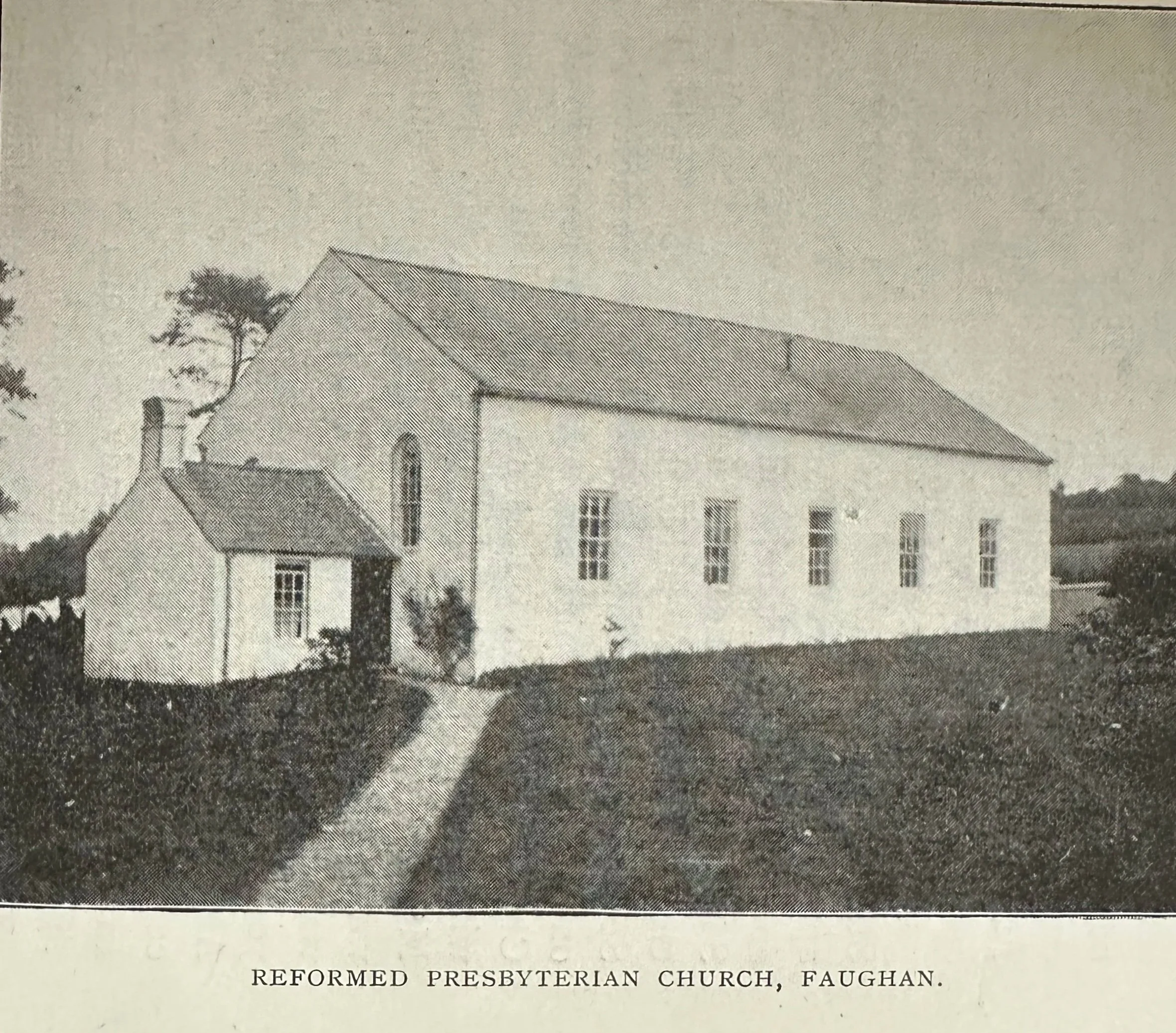
Holy Ghost hath made you overseers, to feed the Church of God which He hath purchased with His own blood”), Robert Young, James M‘Kinney, with John M‘Millan, sen., and Steven from Scotland; a licentiate named M‘Garragh was also present.¹ The charge over which Mr. Alexander was ordained was very extensive. It included Faughan, Derry, Bready, with a considerable contingent from County Donegal. Bready, however, was the centre; there the meeting-house was situated, though it was generally too small to accommodate the congregation, which worshipped more frequently on the terraced green behind the church than inside its walls. Three years after his ordination, on a Sabbath day, when the congregation was engaged at Divine service inside the Church, the roof began to give way. Mr. Alexander directed the people to withdraw, and no sooner had they done so than the roof crashed in all round. Fortunately, through the minister’s coolness, no one was injured. The house of worship that still stands was then built, and a stone was placed, and still remains in a conspicuous place in the wall, bearing the inscription, “This house was built 1786. Rev. Samuel Alexander, minister.” Four years later the present church was built at Faughan Bridge, situated two miles from the centre of Derry city. The meeting-house
_____
¹ See Dr. Reid’s reference to Mr. M‘Garragh in his history, vol. iii., page 396.
[Page 78]
at Convoy was erected for the convenience of the County Donegal part of the congregation in 1802, and the old church in Wapping Lane was built in 1811 for the Derry people.
It is greatly to be lamented that through a fire taking place in the house of Mr. M‘Dougall, Clerk of Session in Bready for many years, the sessional records of the united congregation were destroyed. Previous, however, to that deplorable accident, by which Mr. M‘Dougall was left for a time without a home, extracts were made from the session book. Among these extracts we find the following list of elders in Mr. Alexander’s time given:—
| Congregation | Elder | Residence |
|---|---|---|
| Bready | John Mather | Tamnabrine |
| Bready | Joseph M'Maurice | Tyboe |
| Bready | James Laurimore | Cloghore |
| Derry | Samuel Willock | Creevagh |
| Derry | James Richmond | Derry |
| Bready | Jacob Alexander | Tyrkeeveny |
| Faughan | James Marshall | Cumber Claudy |
| Bready | James Allen | Tamnabrine |
| Faughan | Thomas Allen | Muff Glen |
| Bready | Andrew Stevenson | Ballylaw |
| Derry | John Rodgers | Kildrum |
| Faughan | Simon Robinson | Caw, Waterside (sea captain) |
| Faughan | John Michel | — |
| Bready | Robert Mathers | Coolmaghery |
[Page 79]
| Congregation | Elder | Residence |
|---|---|---|
| Bready | Samuel Arthur | Cooley (school teacher) |
| Bready | John Davies | Tamnabrine |
| Bready | Robert Stevenson | Magheramason |
| Bready | Robert M'Kinlay | Desertone |
| Derry | Moses Speers | Manorcunningham |
| Bready | James Salters | Donaghmore |
| Derry | — Galbraith | — |
| Faughan | Thomas Marchael | — |
| Faughan | John Guy | — |
| Faughan | Andrew Henry | — |
| Faughan | John M'Naught | — |
From this list, for which we are indebted to the kindness of the late distinguished Rev. Professor Chancellor, D.D., Belfast, we can learn something of the extent of Mr. Alexander’s field of labour. There were twenty-four elders in the session of the united congregation—twelve for Bready, seven for Faughan, and five for Derry. During Mr. Alexander’s pastorate regular sessional meetings were held, discipline was strictly, but lovingly, enforced, and every legitimate means used to ensure the growth of vital godliness. From the entire congregation the stipend was £50 annually (representing three or four times that amount to-day), and this, added to the minister’s private means, afforded him a comfortable living.
No man has ever lived more thoroughly in the
[Page 80]
affections of his people than Samuel Alexander. He gave himself up completely to his work as a minister, and he allowed nothing to interfere with his proper employment. The words of old Chaucer in describing one of the most estimable of his Canterbury pilgrims, seem signally appropriate to the subject of this sketch:—
“Wyd was his parische and houses fer asonder,
But he ne lafte not for reyne ne thonder
In siknesse nor in meschief to visite,
The ferreste in his parische, moch and lite,
Uppon his feet, and in his hond a staf
This noble ensample to his scheep he yaf
That firste he wroughte, and afterward he taught
Out of the Gospel he the wordes caughte
But Cristes lore, and His Apostles twelve
He taughte, but first he folwede it himselve,”
The pulpit is, and ever must be, the minister’s centre of influence, and Samuel Alexander fully recognized that truth. In his pastoral visitation and in his periodical teaching and catechising the young of his flock, he could only deal with individuals, or at best with only a few at a time, but in his public discourses, with the magnetism of large congregations before him, the best that was in him came out. In a short “characteristic sketch,” already referred to, by one who knew him personally, and frequently heard him preach, we are told that he excelled in lecturing. In this exercise he delighted, and during successive summer seasons
[Page 81]
he went through twelve chapters of Isaiah and the whole of Hosea. But the crowning effort was when he addressed the congregation on the words of 8th and 9th verses of Hosea xi.—“How shall I give thee up, Ephraim? how shall I deliver thee, Israel? How shall I make thee as Admah? How shall I set thee as Zeboim? My heart is turned within me and my compassions are kindled together,” &c. The memory of the pathos and power of that lecture remained fresh with the writer of the notice after fifty years.
The great theme of his pulpit ministrations was the love of God in Christ. Immediately before his death he completed a series of discourses on the text, “God is love, and he that dwelleth in love, dwelleth in God, and God in him.” When he had concluded his last discourse on that text, he remarked with great feeling that he had now gone as far as he was able, and could only wait for further manifestations of the love of God. He was soon to have those manifestations in a way he knew not. Through the dark portico of death he was to be introduced to a new revelation of the love of God, “for since the beginning of the world men have not heard, nor perceived by the ear, neither hath the eye seen, O God, beside Thee, what He hath prepared for him that waiteth for him” (Isaiah lxiv. 4). On the preparation Sabbath, before the
[Page 82]
communion at Bready, Mr. Alexander preached from Zechariah ix. 9—“Rejoice greatly O daughter of Zion, shout O daughter of Jerusalem, behold thy King cometh unto thee; he is just and having salvation, lowly and riding upon an ass, even upon a colt the foal of an ass.” Before he was through with the discourse his strength was gone and he was evidently in great pain. He made the communion announcements and retired to a neighbouring house, where after a short rest, he ordered his horse to be brought. He mounted and rode home to Tyrkeeveny. He never crossed his threshold again alive. Some years previously he had crossed the River Foyle from Co. Donegal in a small ferry-boat in a terrible storm. The boatman was overpowered by the waves, and Mr. Alexander took an oar, but hurt himself in his effort to get the boat to land. This hurt laid the foundation, humanly speaking, of his death. From his bed of suffering he wrote a solemn and affecting letter, laying the charge of the communion on Mr. Stavely, and saying pathetically that he feared ere the time came he himself would have gone to a higher and holier service in the world of spirits. So the event proved. Stavely came, but only to find Alexander dead. The grief of the congregation was insupportable, and only a man like Stavely could have gone through the ordeal. He looked on Alexander as his own son in the Lord. He had
[Page 83]
officiated at his licensure, he had preached at his ordination, and now, with heavy heart, he took up his work when he was called home. Rev. Wm. Gamble, who assisted Mr. Stavely, could not bear up, but repeatedly broke out into tears in the pulpit and wept as for a brother. When the Monday service came, Mr. Stavely with great power and appropriateness took up the words of Elisha after the translation of Elijah as he smote the waters with the mantle of the departed prophet saying, “Where is the Lord God of Elijah?”
The recollection of the shadows and the light of that communion time remained embalmed in memory with those who were present as long as life itself remained.
Mr. Alexander died on Wednesday, 17th July, 1793, and his remains were interred in the burying-ground of Old Glendermott, three days later. A stone was placed over his grave bearing this inscription:—
“Under this stone lieth the remains of Rev. Samuel Alexander, who departed this life 17th July, 1793, aged 45 years.”
The funeral was one of the largest that ever passed up the old Glen, and even to-day it is possible to hear the older inhabitants of the neighbourhood speak with reverence of one whom their parents described as “the Godly Alexander.”
Perhaps there was mercy in the removal of Mr.
[Page 84]
Alexander just then. He was taken away from the evil to come. He had kept himself free from the Volunteer movement, but now the United Irishmen were coming into power, and it may be questioned if he could have kept himself altogether clear of that rising which drew into its vortex so many able and prominent men in the Church. Was his death in 1793, before the crisis in events came, not a mark of the special goodness of God to him? Nothing unpleasant remains to cloud the memory of one who deserves to live in the grateful recollection of the district in which he laboured, and indeed of the whole Covenanting Church.