Samuel Ferguson on Samuel Akin.
James Dodson
[Page 63]
THE REV. SAMUEL AIKIN.
MR. AIKIN was born in the neighbourhood of Clough, Co. Antrim, in or about the year 1746, his parents being respected members of the Reformed Presbyterian Church. He received his education at Glasgow University and was licensed to preach a very few years after William Stavely, with whom he was always on brotherly and intimate terms.
We have it on the authority of the late Rev. Dr. W. J. Stavely that Mr. Aikin was ordained about 1776 and ministered to the Bannside Congregation, with its dependents, Dervock and Limavady, after the emigration of Mr. Lynn to America.
Mr. Aikin was always rather delicate in constitution, and of very winning manners. He is described as having a very acute and fertile mind. The remark of William Stavely, after hearing Mr. Aikin preach, has been preserved. “He amazes me,” said Stavely, “he preaches like an angel.” Mr. Aikin’s piety was unquestioned, and even those who disagreed with him, or were dissatisfied with him, never ventured to call in question his real godliness.
When the Irish Reformed Presbytery became extinct in 1780, Mr. Aikin does not seem to have been engaged in the active duties of the ministry.
[Page 64]
He is reported to have received the offer of a living (if he would “conform”) in connection with the Episcopal Church. To his credit, let it be told, he at once declined the offer. Someone asked him if he thought there was no salvation outside the Covenanting Church. His reply revealed the man. “I think no such thing,” said Aikin, “but I do think there is no comfort for me outside it.” His political principles, so far as he can be said to have had such, were decidedly Conservative, and this fact led him to have many friends among the landlords. No doubt his good offices were in this way often called into exercise by the harassed members of the Bannside congregation during the troubles connected with the United Irishmen. The members of his scattered charge were always much attached to him, and resorted to him in times of difficulty.
He was installed at Ballylane in 1790—Stavely and Gibson, then of Kellswater, officiating. To be minister at Ballylane meant to have charge of Ballybay and Rathfriland also, so that the work of the three places rested on him. At this time he lived at Gransha, near Rathfriland. One can understand what an amount of physical labour this involved, at a time when there were none of the present facilities for travelling.
It is a sufficient testimony to his ability and perseverance that during his pastorate these congregations increased so much that separation became
[Page 65]
[Page 66]
necessary. Ballybay was very forward in seeking his services as pastor, and at once offered to give him a full support if he would undertake the pastoral oversight of that congregation and Fairview. He on his part expressed his preference for the County Monaghan congregation. It would seem that the settlement was mutually agreed upon and sanctioned in 1798, and arrangements were made for Mr. Aikin entering on his work at Ballybay.
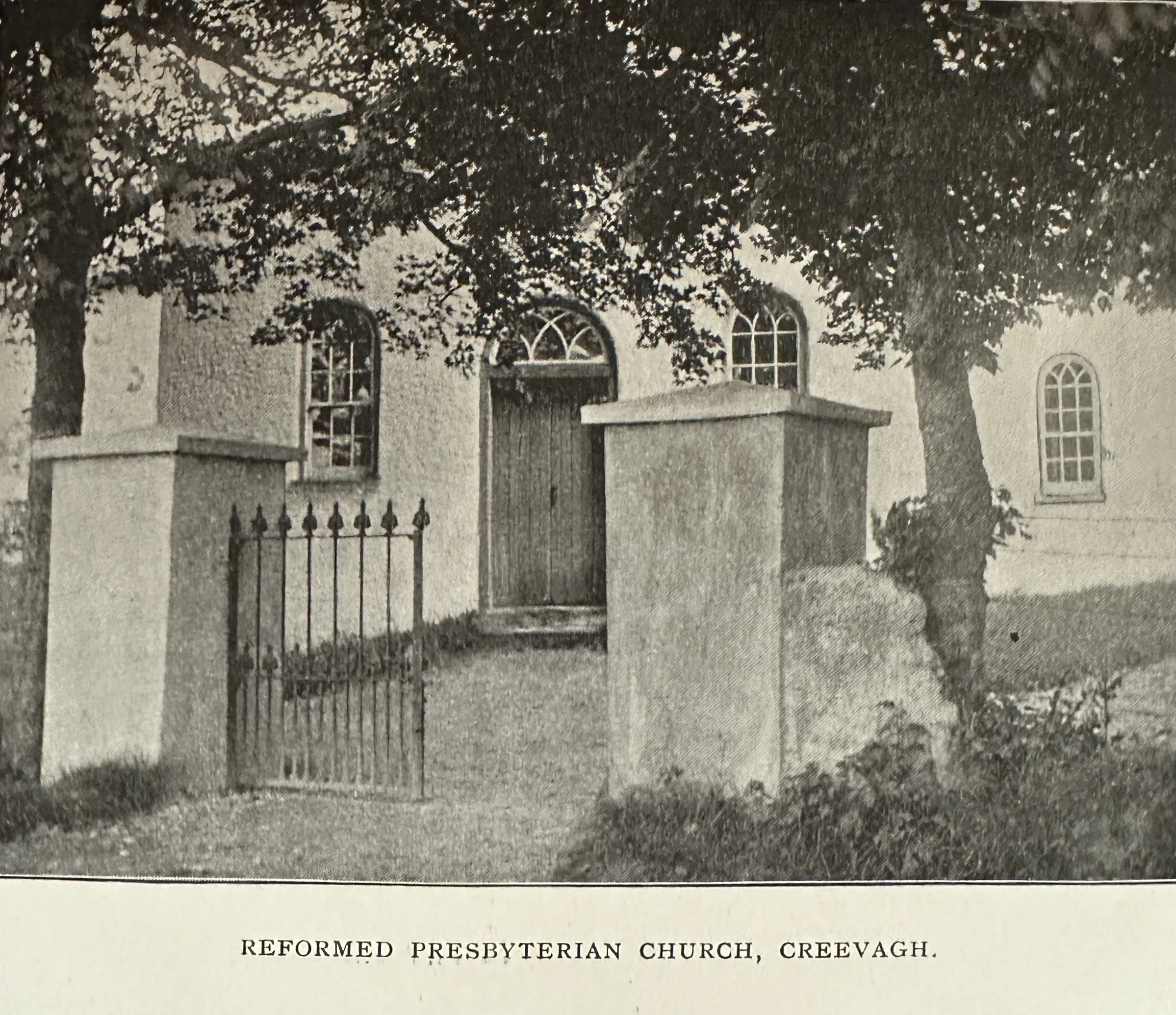
His constitution was greatly enfeebled by asthma, from which he had suffered for many years. Before removing his family to Ballybay, he himself started to ride thither to preach and to find a residence for his family in the neighbourhood of his new charge. He had not gone far when he became very ill and suffered intense pain. Still he pushed on, until he could no longer maintain his seat in the saddle. The pain became insupportable, and he had to stop at the house of an acquaintance by the way. For some time he lingered in suffering at the house of his friend, where he received every kindness and attention, until death came to free him from affliction. He died 25th December, 1798. When it became evident that death was approaching, he was asked where he wished his remains to rest. He replied at Creevagh, whither he was going to preach. And there he was interred in the corner of the graveyard; so that if he was not permitted
[Page 67]
to minister to that people when living, his remains at least rest among them in hope of a glorious resurrection to life eternal. We have been told that a young tree was planted by loving hands at the head of the grave to mark the spot. The memory of the first minister of Creevagh is still green among the descendants of those who called him to be their pastor. Doubtless, though dead, he yet speaks to them.
Mr. Aikin never published anything known to us. He was married to a Miss Adams from his native district—about Clough, and was survived by a family. His son, the late Mr. John Aikin, was for a long time an honoured, useful, and highly intelligent elder in Kellswater congregation, while his grandsons, Mr. Samuel Aikin (now of Ballymena), the late Messrs. Wm. John Aikin and James Dick Aikin, were honoured and generous office-bearers in the Reformed Presbyterian Church in Ireland.