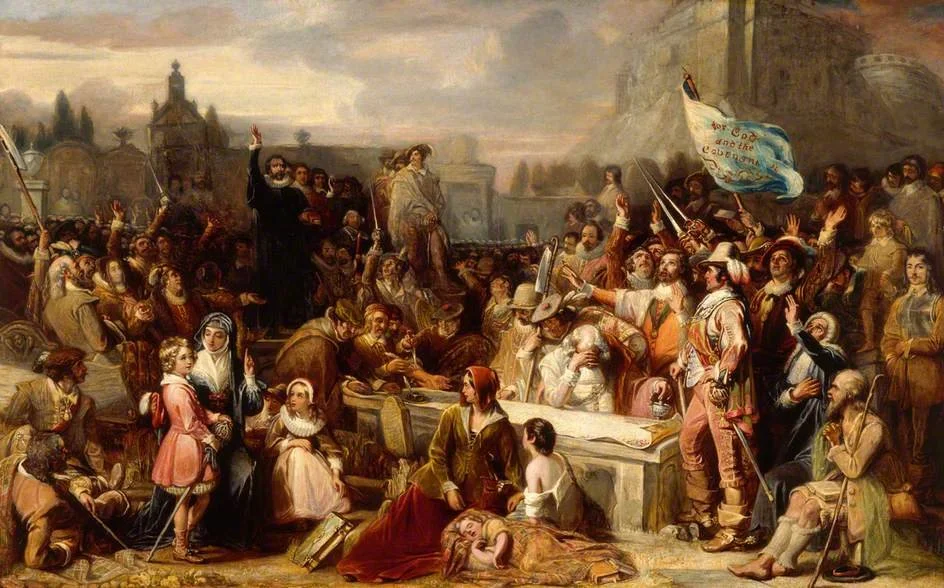
A Converse Betwixt Two Presbyterians of the Established Church, An Elder and a Preacher.
James Dodson
WHEREIN,
The PRESBYTERIAN DISSENTERS from the Establish’d Church, are vindicate from the Charge of Jacobitism; their Principles anent Civil Government, are fairly stated, and succinctly proven consonant to Scripture Light, and the Confession of Faith; and several Important Objections thereanent, answered.
For Confirmation of the Weak, and Information of the Misinformed in that Matter
Rom. 13. 3. For Rulers are not a Terror to Good Works, but to the Evil.—He is the Minister of GOD, a Revenger to execute wrath upon him that doth evil. 6. For this Cause pay you Tribute also: For they are GOD’s Ministers, attending always upon this very thing.
Musculus in Rom. 13. 1. Licet omnis Potestas a Deo sit, non tamen mox omnis Princeps est a Deo. Scriptum est de quibusdam, Ipsi regnaverunt, et non est a me. [“Although all authority is from God, yet not every ruler is therefore from God. For concerning some it is written: ‘They have reigned, but not by me.’”]
Printed in the Year M. DCC. XIV.
[Opening Page]
A
CONVERSE
BETWIXT
An ELDER and a PREACHER.
Elder. GOOD Day to you, Sir.
Preacher. I wish you the like, and am glad I have met with you, if so I may have your good Company by the way.
Eld. You’re welcome to it, such as it is; and I am very well pleased to have yours.
Pr. Pray you, Good Sir, let’s have an Account of your News.
Eld. We are not to expect many News, of any great Consequence to us, till the Parliament sit, and then ’tis probable we’ll not want; tho’ how good they’ll be, I shall not say.
Pr. There are already too shrewd Presumptions, that they’ll be no good News for the True Protestant Interest.
Eld. What Presumptions, I pray you? Perhaps they’re but groundless Surmises; and ’tis best, as our Scots Proverb runs, To bode luck, and have it.
Pr. That’s what I would gladly do: but the Insolence of a Jacobitish Party is an Ocular Proof, that there’s more than groundless Surmises and Jealousies to found our Fears upon.
Eld. I own there’s too much Truth in what you say, for they durst never insult at that rate they now do, since the late Revolution; and they are many of them Persons of a deeper Reach in Politicks, than to appear thus barefaced in their Designs, if they had not Evidence of the Favour of the Government.
Pr. They are indeed Persons of good Sense, and know very well how to manage Intrigues, so as to
[Page 3]
strengthen their own, and weaken the Revolution Party, by throwing Fireballs amongst ’em, to divide them: But there’s one thing wherein I think them much out in their Politicks, of late especially, upon which I would gladly have your thoughts.
Eld. Let’s hear what it is.
Pr. You know, the Divisions of Presbyterians have been very much to their advantage; and none more than these in the West, carried on by some Dissenting Ministers, who as I’m credibly informed by some Reverend Ministers, do actively promote the Jacobite Interest, and create in the minds of good people a Disrespect to the Family of Hanover; And yet notwithstanding, now of late, the Jacobites are as Virulently set against these Men, and their Followers, as against any party of Presbyterians in Britain; pray what may be the Mystery of such a Paradox in Politics?
Eld. There’s truly nothing in all that Conduct of their’s, that needs be accounted strange or Paradoxical, but that which may make it appear to you and others, to be such a Solecism in Policy, is a want of due Information in the true State of the Affair.
Pr. Whence, pray, can that Misinformation proceed? Sure I am the Reverend Ministers of the Established Church, have access to know it well enough, and I have no meaner Vouchers of my Information than them.
Eld. It may be so, we have all been dun’d with the noise of that, that these who dissent from the Established Church are all Jacobites, and the constant din of a party soon fixes a firm Idea of any thing upon one’s mind, when he takes it for granted, that they are so Intelligent, that they ca’nt mistake, and so good that they will not misrepresent, and thereupon rest satisfied, without being at the pains to make an impartial inquiry into the matter; but for my part, tho’ I have heard many Ministers aver it, yet I believe no such thing, and am perfectly assured, that there are none more upright Enemies to a
[Page 4]
Jacobite Interest, than these Presbyterians, who dissent from the Established Church.
Pr. Would you have me so uncharitable to the Reverend Ministers, as to think, that they would willingly impose a cheat upon me in that matter.
Eld. Nay, I do not desire you to esteem so of them; ’tis possible these with whom you Conversed on that head, were too honest to do that: but were they not capable to be misinformed themselves?
Pr. Who could do it?
Eld. Some others worse disposed, who, rather than these they like not should go under a good Character in the World, will invent some odious Name or other to blacken their Reputation. I mind to have seen a late Pamphlet Entitled Britain’s Alarm, the Writer whereof is a Minister of the Establishment, wherein it’s with the utmost confidence asserted, That some of these (I repeat his own Words) who pretend to the greatest strictness of Principle among Presbyterians, and who would be thought to be the only faithful Adherers to the Covenanted work of Reformation in their Lands, have a great Aversion to the Protestant Successor, and a wonderful fondness of the St. German’s Pretender. But he says all this at his own hand, without the least evidence, and no wise Man is obliged to believe his single Assertion, without some proof; it’s like, the Gentleman wanted matter to fill up a Blank with, and rather than say nothing, he would say what was to the Disparagement of his innocent Neighbours, tho’ nothing to the advantage of his Cause.
Pr. Shall I believe you then better, than the Minister?
Eld. I say not that; Believe neither them nor me further, than the truth of the matter of fact evidences who’s in the right; for the Testimony of this, or that Man, is but an artificial Argument, and that of the lowest size.
Pr. What evidence, I intreat you, can you offer for your opinion of these People, that they are Enemies to Jacobitish Designs.
Eld. That I shall willingly show you, two plain
[Page 5]
Postulata being first granted me, The first is, That they are honest Adherers in their Practices, to their own declared Principles. The second, That they are Men of so much Sense, as to perceive and avoid the direct Opposites of these their Opinions.
Pr. I cannot but in reason yield both. The first is so notorious, that their very Enemies, for what I know, do not deny it; for they think, that they adhere but too rigidly to every Opinion they espouse, and that it would be much for the Peace of the Church, if they were of a more Yeilding Temper. And as for the Second, Tho’ I know a great many won’t stand to affirm, that they have not so much as a Mouthful of Sense, yet I’m convinced it is not so: ’Tis not to be expected, considering, that they have not all the Advantages of Education that others may attain, that they should see so far into the Remote Consequences of things, or have so deep a reach in Matters of State prudence, as others: But all that you crave, and somewhat more, may safely be granted them, tho’ they had no more but a common Judgment of Discretion, to distinguish betwixt Good and Evil.
Eld. I proceed then to show you the Reasons of my Opinion. First, It is evident, that they have a very singular regard to the Reformation of Religion from Prelacy and Ceremonies, both in Scotland and England, begun and carried on in the Reign of King Charles the first, as so ought every good Presbyterian. That time of Reformation they esteem so highly of, and that deservedly; that they call it the Time of Reformation, by way of Eminency, and the Church’s Purest time and Best time; and hence they have a peculiar Zeal for the Covenants, which the Presbyterians then entered into, as the best Mean and Expedient for carrying on that Reformation, and think that whosoever does not own these Covenants, which GOD made such eminent means for advancement of His Work, to
[Page 6]
to be of a standing and perpetual Obligation upon the Consciences of all Ranks high and low in Britain, tho’ He owns Parity of Ministers and Subordination of Judicatures, yet deserves not the Name of a true Presbyterian. Whereas upon the other hand it is Nottour, that the whole Jacobitish Party entertain the greatest hatred at that Reformation, that Men can well be capable of; they look upon the whole of it to be nought but Fanaticism instead of Religion, and the most horrid Rebellion against their Prince, and cannot remember the time of these Transactions, but they are ready presently To raise up Leviathan, loading it with bitter Execrations and Curses; and as for the Covenants, what contempt and disdain they cast upon them, no Body that knows any thing of their Conversation or of their Printed Sermons and Pamphlets, can be Ignorant. There cannot be more virulent Scoffs and Jears invented by the wits of the Age, than these that the Jacobitish-Crew do every where baffle the Covenants with, and they are not content only to charge the Death of King Charles the first, whom they know by the Name of the Royal-Martyr, upon these Covenants; but all the disasters, that ever their darling Absolute Monarchs have met with since. Tho’ ’tis too nottour, that the most part of the Revolution Party have little regard to these Covenants, more than they; Wherefore seeing that they are so very opposite in the Foundation Principles of their Parties, ’tis evident, they must be mutually the greatest Enemies one to another of any others in Britain.
Pr. I cannot but own, there is much Reason in your first Proof, but proceed to the rest.
Eld. Another Argument is this, ’Tis known, that of all Presbyterians in Britain, these are the greatest Respecters of the Sufferings and Sufferers under the late Prelacy, and never speak of them without an affectionate Resentment; giving them always the Honourable Titles of Martyrs for the Truth and Interest of
[Page 7]
Christ, accounting their Sufferings a Glorious Testimony to that Reformation and these Covenants, for which, on all occasions, they shew so high a Veneration; and believing firmly, that the Blood of these Martyrs will yet prove a Seed to the Church, and be a pledge of hope, that tho’ the Presbyterian Interest be now very low, yet it will flourish again in Britain, in despite of the Power and Policy of Episcopalians, Jacobites, Papists and Malignants. Whereas, on the contrary, ’tis equally Notorious, that as the Jacobite-Party were the Persecutors, that spoiled, harassed and killed these Witnesses; so to this Day they load them with all the Opprobrious Names of Fanatical-Hypocrites, Damned Rebels, Brainsick-Idiots, and whatever else, Malice in it’s perfection, combined with abundance of Wit can Suggest. And as they run down all these Martyrs, for the Covenanted Reformation, at that prodigious rate of Banter and Calumny, so they every where magnify (that I say not deify) their Royal Martyr, Charles 1st. and the rest of that Malignant Rabble, that were Punished justly by the Parliaments of England and Scotland, during the Reformation. And hence it’s evident, that when not only their Darling Principles, but also their Respective Sufferings in defence of these several Principles are so perfectly Contradictory, they can be no Cordial Friends one to the other.
Pr. Go On I pray you, Good Sir, for I’m perfectly satisfied as to the Truth of what you have hitherto advanced.
Eld. A third Evidence may be this, These Presbyterians were very Zealous, at the time of the Revolution, for the bringing down of Prelacy and Tyranny; and as they had most of any others, felt the cruelty of the Absolute Power of James 7th. As being those who never desired or accepted the benefits of that Antichristian and Illegal Toleration, which he granted to all, Papists and others, thereby overthrowing the Reformed Religion and Liberty of the Nation at once, so they were
[Page 8]
active in their Stations upon the turn of Affairs, to have that Tyrant and his Wicked Complices overthrown, and expelled their Posts both in Church and Common-Wealth: But the Jacobite-Party were exactly on the other side of the Plea, and tho’ they shamefully shrunk into silence and abandoned their Prince, and had neither Tongue to speak, nor Hand to act for him, yet they still retained their former respect to him, and tho’ for their own private ends they submitted to the Government, yet they had all alongst a long look over the Channel to France to their Dear Master. This direct Opposition betwixt these Presbyterians and the Jacobites at the late Revolution, is not only a pregnant, but a Recent instance of their being very far from Friendship one with another.
Pr. Hold there a little, I am not so clear about this last as the former; ’tis generally said, that they are against the Revolution, and particularly that a great many of them are so strict, that they’ll not allow that turn of Affairs the Title of the Happy Revolution, and that they do not think it was a Mercy and a deliverance, and that consequently they’re sorry ever they had so active a hand in carrying it on.
Eld. I assure you there’s much Misinformation there, and what truth ther’s in it, is so disguised and interwoven with Mistake, that it may be wholly rejected as false; For First, These who cleave to Mr. Hepburn, are not at all dissatisfied with the Revolution, tho’ they were sorry at some things in it, that they looked upon as Lesser Mismanagements, as that King William and Queen Mary were of the Communion of the Church of England, exercised some Acts of Erastianism over the Church, did not seclude the Enemies of Reformation from their Counsels, &c. and that the Church bore so good Neighbourhood with the Episcopal Clergy, suffering them to retain their Cures, and taking them in upon too easy Terms to the Communion of the Church, and other
[Page 9]
Maladministrations of that nature; But withal, they still owned and do own, the Government Civil & Ecclesiastic, which proves them well affected to the Revolution Establishment. And as for the other part of these Presbyterians, whom you specially intend as no Friends to the Revolution; they are certainly as much of a Revolution Principle as any body in the Kingdom. They are for Resisting Princes, which would overturn Religion, Liberty and Property: They are for the Free Suffrage of the People in Choosing their Princes: They are for the Being and Power of Parliaments: they are for secluding Princes from the Government that are not Qualified according to Law, tho’ nearest of Blood, and admitting others Qualified according thereto: They are for the Inviolable Conservation of the Peoples Claim of Right; and Consequently they are of Revolution-Principles. They own moreover, that the Revolution was a Temporal Deliverance to the Persons and Liberties of Men, from the gross Attacks of Persecuting Tyranny, and was a Mercy from God, in so far as by that Means He brake the Rod of that great Popish Oppressor, and put a Remora in the way of the bloody Designs of Papists, intending at that time to root out the Protestant Name out of the Land: But to call it a Happy Revolution Complexly considered, or a Real Delivery to the Work and Cause of GOD they are more difficulted; Lest some Samuel or other should say to them, What then meaneth the Bleating of the Sheep, and Lowing of the Oxen in mine Ears? What mean a King and Queen of the Communion of the Church of England? What means the Establishment of Prelacy in England, and the Connivance thereat in Scotland? What mean the Persecutors of the People of GOD, and the avowed Enemies of His Work, to be in Publick Councils and Judicatories, Ecclesiastic, Civil and Military? And what means the Erastianism in the Church? The going back of the Establishment for an hundred years? The passing over
[Page 10]
the Scandals of the Late Time without Repentance? The not renewing Covenant with GOD? And in short, what means it, that Church and State have left the whole Means and Measures that the Presbyterians took before, for advancing the Work of Reformation? And as for what active hand they had in expelling the Episcopal Curates from the Churches, guarding the Convention of Estates, and joining in Arms with the Forces under the Command of the Earl of Angus. They are indeed sorry for the latter, because that was a joining with these wicked Men, who had had an active hand in persecuting the Lord’s People; and who, tho’ they had Power put in their hands to advance the Work of GOD, yet would not employ that Power for GOD and His Interest. And as for the former, they are not sorry for expelling the Episcopalians, for if it were in the power of their hands they would do it yet; but they are sorry that when they had put these out, the Professed Presbyterians that came in their place, did not evidence themselves zealous for the reviving and advancing that Reformation, which the prevailing of the Episcopal Party had put a stop to.
Pr. I am now satisfied in what Sense they may be said to be against the Revolution, and in what Sense they were for it; and I am so far now from thinking, that their being dissatisfied with the Revolution, is an Argument of their being on the Jacobitish Lay, that I think their Exceptions against it, prove the exact contrary.
Eld. I proceed then to a Fourth Evidence. These Presbyterians have in their Publick Declarations, fully and amply declared against the Pretender, whereby they have told all the World, that they are no Friends to a Jacobitish Interest.
Pr. How do they express themselves?
Eld. In their Declaration against the Union with England, given at Sanquhair, Octob. 2. 1707. They say, And upon the like, and other weighty Reasons and Considerations (as Popish Education, Conversation, &c.) we protest against
[Page 11]
against and disown the Pretended Prince of Wales, from having any Just Right to rule or govern these Nations, or to be admitted to the Government thereof. And whereas (as it is reported) we are maliciously aspersed by these who profess themselves of the Presbyterian Persuasion, that we should be accessory to the Advancement of him, whom they call the Pretended Prince of Wales, to the Throne of Britain; therefore to let all concerned be fully assured of the contrary, we protest and testify against all such, so principled, to rule in these Lands; because we look upon all such to be standing in a stated Opposition to GOD, and our Covenanted Work of Reformation. And this is the more Considerable, that it was done at a time, when there were no small fears of an Intended Invasion from France, to advance him.
Pr. But I have been told by our Ministers, that these People were against the Union, and consequently did advance the Jacobitish Design.
Eld. You know very well, that when the Union was on foot, the Gentlemen that were for it, had still that Argument in their Mouths, That there was no other Expedient for securing the Protestant Succession, and Presbyterian Government, but the Union: Tho’ how far they were out in their Politicks, on that head, Fatal Experience begins to convince us, now when ’tis out of time. And having once got this Fancy in their head, presently, every one that was against the Union, tho’ ’twere upon a far other Account, was in these Men’s Compt books writ down for a Jacobite, and an Enemy to Presbyterian Government, and the Protestant Succession; but now the Nation has begun to think otherwise, and when others are absolved from the Charge, ’tis but Reasonable they share of the Common Privilege.
Pr. But ’tis suggested that they are so uneasy at the Union, that to have it blown up, they would be content to advance the Pretender to the Throne.
Eld. That’s a most unjust Surmise, and you know, that ’tis not they only, but many of the People who join with
[Page 12]
the Established Church, that lie under the Imputation of that ridiculous Folly; but I’m persuaded, no Body that’s Master of Common Sense, would be content to hazard all the sad Consequences of setting up a Popish Prince, bred in all the Maxims of French Tyranny, for a mere Uncertainty. And every one that knows the Principles of these Presbyterians, will easily see, that how ill soever they like the Union, they’ll never consent to such sinful means for dissolving it; ’tis not Union with England simply, but the sinfulness of this present Union that makes it unacceptable to them. And as ’tis a steady zeal for the Covenanted Reformation chiefly, that makes them to be against the Union, the same Reason will infallibly always influence them to be against the Popish Pretender.
Pr. Have you any further proof of your Point to offer?
Eldr. Tho’ I think, what has been said, proves the Point sufficiently; yet I shall offer another to conclude all. They do very frequently in their Sermons publicly declare to the People their abhorrence of that Course, and warn them of the Danger and Sinfulness of joining therewith, or having a Hand therein, and as they pray publicly, That the Lord would break the Designs of these malignant haters of his Work and Interest: So they exhort the People to be earnest in Prayer upon that account. All which laid together, proves beyond contradiction, that they are of all Parties in the Kingdom, furthest from having any the least Inclination for the advancement of the Pretender to the Throne of Britain.
Pr. But some affirm that these People and their Preachers, are influenced by French Gold, to be covertly for the Pretender’s Interest.
Eldr. That’s a gross Reproach, which no Body has yet been able to offer the least shadow of Proof for, and was only struck in the Mint of some Body’s impotent Malice, and has been industriously spread by others; but no wise Man will believe so absurd a Fancy, without good Proof of the Matter of fact,
[Page 13]
and that I’m confident can never be done, for what is not, cannot be proved.
Pr. I must own you have offered very good reasons to prove your Point, and therefore I’ll henceforth defend them from that most Groundless Slander: But there remains with me one Difficulty, that I crave your Thoughts upon.
Eldr. Say on, and let us see what it may be.
Pr. Seeing, as you have prov’d, these Presbyterians are no Friends to the Pretender; what in all the World can induce them to be so exceedingly absurd, as to disown the Authority of the Queen, and to be disaffected to the Protestant Successor?
Eldr. Soft words, I pray you, Good Sir, you might have wond’red, why they should be so weak; but to pronounce them absurd, is too hard a Name. We are all too apt to call every Opinion absurd, which we can not clearly see through, and to count any two things contradictory, which we cannot presently reconcile. Just as of old, before America was found out by the Europeans, ’twas generally held absurd, that there should be Inhabitants on the other side of the Glob, walking with their feet opposite to ours; whereas now, both Reason and Experience assure us, that there’s no Absurdity in it.
Pr. I beseech you show me, how this Practice of theirs may escape that Censure.
Eldr. If you would have me do that to purpose, you must have patience to hear a Fair Representation of the Grounds they go upon; and I’m apprehensive, if you’l weigh them without byass of affection, impartially and unprejudicately, you will be obliged to remit somewhat of the Severity of your Censure.
Pr. I promise to hear you patiently, and to judge of what you adduce in their favours on that head, with all the Candor I am capable of, and I desire you to proceed.
Elder. There are some Postulata which they take for granted, and lay as a foundation to their whole Superstructure, which I shall reduce to these Heads. 1. That Magistracy
[Page 14]
is ordained of GOD, for the Glory of GOD, and Good of Humane Society. 2. That consequently, The Less of these Ends, that is in the Constitution and Administration of any Government, so much the less it has of the true Nature of Magistracy, and degenerates so much the more into Usurpation or Tyranny. 3. That GOD has left it to every Politick Body of Men, combin’d in Society, as to determine the particular Form of Government, which pleases them best, so to design the Persons into whose hands they think fit to commit that High and Honourable Trust. 4. That such Politick Body of Men, has Power to circumscribe both the Investiture and Administrations of such a Person so design’d, with what Laws, Restrictions, Qualifications, and Limitations they please, for the Good of that Society. 5. That whosoever accepts the Office, and undertakes the Trust of Government, is bound to have these Qualifications, and to keep these Laws and Stipulations of Government inviolable. 6. That Religion being, of all things, the most valuable to every Man, and Society of Men, every such Body Politick may make the Personal Observation, and public Preservation of that Religion which they profess, one of the Fundamental Stipulations of such a Person’s having Right to govern in such Kingdom or Common-wealth. 7. And consequently, That every such Prince, or Magistrate, is bound to practise and maintain that Religion, so established, as he would have a Right to the Subjects Allegiance, and that upon his Neglect, in such a Case, he loses that Right. 8. That any Body-politick generally professing the True Religion, having by themselves, or their Representatives, established and confirmed the Publick Profession and Practice of that True Religion, by the Sanction of Laws, and made it a Fundamental Qualification of their Sovereigns, That they profess and preserve that True Religion, in all its Parts, as it is established by the Laws of the Realm; are thereupon obliged by the Law of GOD, to take care, that no Sovereigns who are of a different Religion themselves, or maintain any such in their Dominions, be even advanced unto, or continu-
[Page 15]
ed in the Government. 9. That such an Obligation from GOD’s Law, may be made the more clear and undeniable, if such a Body-politick has generally, King and Subjects, entered into Solemn and Sacred Covenants with GOD, mutually in their Places and Stations, to profess, practise, and preserve that True Religion in all its Essential and Integral Parts, as of Doctrine, Worship, Discipline and Government; and to gainstand and abolish all others out of that Kingdom. 10. And that upon this Supposition, Tho’ afterwards it should happen, that any Part, lesser or greater, in such Realm, should fall away from the Purity of that Religion, and forming themselves into a Body, pretending to represent such a Nation, should rescind the Laws establishing the foresaid True Religion, and choose a Supreme Magistrate, of their own Stamp, not qualified according to the former Ancient Righteous Laws; yet notwithstanding that this does not loose the other Part of the Realm, from their Obligation to maintain the Purity of that True Religion, once established. 11. And that consequently, when such Magistrate or Governour, is chosen by that Party, that has made Defection from the Purity of Religion, the rest of the Subjects adhering to the true Religion are not only free not to subject to and own such a Magistrate’s Authority; But they are bound and obliged not to do it, lest thereby they consent to the public Defection of the other part, and to the making void the said Laws establishing the True Religion. 12. And being thus obliged not to submit to, and acknowledge such Authority, they are necessarily also bound to do nothing in their Station, actually and voluntarily, to corroborate the same, or which in the Construction of Law and Reason, may import an Acknowledgment of that Authority. These are the Chief Foundations, if I mistake not, upon which they ground their refusing Subjection to the present Queen, and Dissatisfaction with the Succession, as settled by the Laws of England. Whether or not may they be justly granted them?
Pr. I cannot but own them to be not only reasonable,
[Page 16]
but to have a clear Chain of Dependence one upon another, and all of them to have a direct Tendency to the two great Interests of Mankind, Religion and Liberty. But go on, I beseech you, to show how they apply these several Postulata to the Support of their Opinions.
Eldr. That’s easie: Upon the first seven foresaid Concessions, they build this general Truth; “That every Magistrate invested by the Consent of the People, according to the Laws and Fundamental Constitutions of a Kingdom or Commonwealth, and managing his Government conform to those Laws and Constitutions, has a Legal Right to govern, and the Subjects are bound by the Law of GOD, Nature and Nations, to obey his Lawful Commands.” And hence they justifie the Practice of the Primitive Christians, who subjected to the Authority and Laws of the Roman Senate, and Lawful Emperors; For that they owned not Usurpers, Tertullian tells us, while he saith, Nunquam Albiniani, nec Nigriani, nec Cassiani, inveniri potuerunt Christiani: The Christians were never found to be of the Faction of Albinus, Niger or Cassius. 2. They hold, That as well now after the Propagation of Christianity, as then while it was in planting; “In any Nation where the True Reformed Religion has not obtained the Establishment of the Laws of the Kingdom, and has not been made a Fundamental Qualification of the Sovereign’s Right to govern; the People of that Nation, tho’ Professors of the True Reformed Religion, ought to subject themselves to the Authority of the Civil Magistrates thereof (they having the Qualifications, and governing suitably to the Laws of that Nation’s Constitution) albeit these Magistrates should be Infidels, or of any other Religion different from the True Reformed Religion.” And hence,—
Pr. Hold there a little, if you please: If it be true which you assert, which indeed follows natively from the foresaid
[Page 17]
Postulata, Whence I pray you, is it that they are so much branded and baffled, with denying of that Clause in the 4th Art. of the 23d Chap. of the Westminster Confession of Faith, That Infidelity or Difference in Religion, doth not make void the Magistrates Just and Legal Authority, &c.
Eld. Some no doubt do it Maliciously, who know well enough, that they adhere firmly to all and every Clause of our Confession of Faith. Others through mistake, as conceiving that that Clause can be extended to Scotland; whereas it’s plain, that it can never be meant, that one who is a Heathen, or of the Popish or any other different Religion, from the true Reformed Protestant Religion can be a Magistrate in Scotland, unless we shall abandon our Presbyterian Principles and Covenants.
Pr. Show me I intreat you how that is, for that seems to me a Paradox, how can that Confession of Faith be ours, if it do not agree to our Nation? Surely we are bound to own that Confession as well as other parts of our Reformation.
Eld. The matter is easy, if the words of the Clause it self be remarked. The Words are, Infidelity or difference of Religion, does not make void the Magistrate’s Just and Legal Authority, nor free the People from their due Obedience to him. Where we must specially take notice what it is that Infidelity or difference of Religion are said not to make void, which is the Magistrate’s Just and Legal Authority, and what it is from which they do not free the people, which is due Obedience. Now you have already granted, that no Man who is not qualified according to the Laws of Government, and invested legally with the Government, and Governs not accordingly, can have a Just and Legal Authority, to Rule over any Realm.
Pr. That I have granted, and I look upon it to be a Revolution Principle.
Eld. Well then, you know that the Laws of Scotland make the Professing, Practising and maintaining of the true Reformed Religion, in Doctrine, Worship, Discipline and Government, according to the
[Page 18]
National and Solemn League and Covenant, a Fundamental Qualification of the Sovereigns of Scotland, and a special Stipulation at their entry into the Government, as is evident from their Acts insert in the National Covenant, and from the form and order of the Coronation of King Charles 2d.
Pr. But these Laws and Covenants being abrogate and Rescinded, are no more the Laws of Scotland, and the undertaking to maintain the Peoples Claim of Right, gives now a Just and Legal Authority.
Eldr. I thought you had been more of a Presbyterian than so, to think that these Laws and Covenants can by any Man, or number of Men be Rescinded and made void, so as to loose us from their Obligation; sure I am, no true Presbyterian will cheerfully maintain such a Position.
Pr. Why I pray you may’nt it be maintained? has not any Parliament Power to rescind any Act or Constitution, which has been made by a former Parliament?
Eldr. That they have a Physical Power of Force, is certain, because they do it; but that they have a Moral Power of Right to rescind Acts and Laws made for the Security and Establishment of the True Religion, I absolutely deny; for that would make the Divine Laws, which enjoin us to Contend earnestly for the Faith once delivered to the Saints, and whereunto we have attained, to walk by the same Rule, and to do nothing against the Truth, but for the Truth, to crouch to the Will and Pleasure of Men. And moreover, you granted already in the Postulata, that when a part of a Nation making Defection from the Purity of Religion, do rescind the Laws made in favours thereof, and advance one of their own Kidney to the Government, that the Party adhering to the Purity of Religion, were bound to oppose that Course: And why, I pray you, but because they have overturned the Just Laws and Constitutions; which if they have a Rightful Power to rescind, then their Course is not to be opposed, for he that resists Rightful and Lawful Pow—
[Page 19]
er, shall receive Condemnation.
Pr. But if you deny that Power to Parliaments, do you not destroy their End and Intendment?
Eldr. I deny them no Power, to rescind Laws either sinful, or prejudicial to the Good of the Common-wealth, nor to make Laws tending to the Good of Church, or State; but an Absolute Power to destroy the National Constitutions, and rescind the Fundamental Laws of the Realm, is contrary to the Design of their Representative Capacity and Trust. Do you think (for Instance) that any subsequent Parliament of England has a Power to rescind that Act and Fundamental Constitution, That no Person that is a Papist, or marries a Papist, shall have any Right to succeed to the Crown of England, in all time coming?
Pr. No indeed, I do not think that they can have any such Power; for should I affirm that, I might say, they have Rightful Power to sap the whole Foundations of the security of our Holy Religion, to overthrow the Principles of the Revolution, and reduce us to Popery and Slavery; nay, should I say that, I would be worse than the very Jacobites, who pretend that they’re not for a Popish Prince, but that their Darling has already declared for the Church of England, or that he is about to do it.
Eldr. Will not then the same Principles, that makes you deny the Parliament of England that Power, oblige you in its Native Consequence, if you’re a Presbyterian, to deny a Power to any other Parliament, to abrogate these Laws of Scotland, whereby the Sovereign is obliged to be of the Communion of the Presbyterian Church of Scotland?
Pr. I cannot deny, if I speak ingenuously, but the Consequence is the same in both; for these Laws were just and good, as well as this, and our Covenants bind us against Prelacy, as really as against Popery; but you know that Popery being far more gross and atrocious than Prelacy, and Prelacy being comprehended under Protestantism, we have generally, since the Revolution, thought it
[Page 20]
sufficient, if we get Popery kept out of the Land, and can have our Sovereigns Protestants.
Eld. Every Body owns, that Popery is far more gross and dangerous than Prelacy; but that does not say, but that we are to oppose the one as well as the other; for magis & minus non variant speciem. He that is faithful in little, is also faithful in much; and he that is not faithful in that which is least, will not be faithful in much: And our Obligation both from the Word of GOD, and our Covenant Engagements, is the same against both, in proportion to their several evils.
Pr. You are of the mind then, That none but a Presbyterian can have a just and legal Authority to Rule over Scotland; and that consequently, the Peoples Obedience in Scotland, can be due to no other, but a Magistrate taking and keeping the Covenant; unless they would abandon both these Laws and Covenants, that their Reforming Ancestors made and entered into.
Eld. Whatever may be my private thoughts about that matter, sure I am, these Presbyterians, whose Principles I represent, are perfectly of that mind; nor are they alone in that opinion, for then we might think, that they had been put upon it by necessity for the support of their own opinions; but the whole Presbyterians were of that mind, in the time of the Reign of James 6th, and at the Admission of Charles 2d. to the Government.
Pr. Can that be made appear? Eld. I shall give you their own Words, and let your self Judge, That it was their mind in the Reign of King James 6th, is evident from 8 Act, Parl. 1. King James 6th. The tenor whereof is, That the increase of Virtues, and suppressing of Idolatry craveth, that the Prince and the People be of one perfect Religion, which of GOD’s Mercy is now presently Professed within this Realm, &c. Pr. I own, that this Clause puts it beyond Exception, that it was their opinion, that our Kings ought always to be of the Presbyterian Communion; for ’tis with all Presbyterians beyond Exception, that Presbyte—
[Page 21]
rian Church Government, Worship and Discipline, as well as the Reformed Protestant Doctrine, were at that time Professed in this Realm, and no other form of Religion, whatever Doctor Sage and others of the Episcopal Clergy babble to the Contrary. But go on to shew, that it was their Sentiments before and at the Admission of Charles 2d. to the Government.
Eld. The General Assembly in their Declaration of the date July ult. 1648, laying open the breach of the several Articles of the Covenant, made by the then Engagement in War, have these words, we do also conceive there is a tacit condescending to the Toleration of Superstition and the Book of Common Prayer in his Majesty’s Family. And a little downward, “Neither can we conceive, how the Clause, concerning the Establishment of Prelacy, can consist, with bringing his Majesty with Honour, Freedom, and Safety, to one of his Houses in or about London, without any Security had from him for the Abolition of Prelacy; it being his known Principle, and publicly declared by himself, a little after he went to the Isle of Wight, That he holds himself obliged in Conscience; and by his Coronation Oath, to maintain Arch-bishops, Bishops, &c.”
Pr. I cannot but own, that that speaks very full to the purpose; but go on to the Coronation it self.
Eldr. In the Coronation he was obliged, beside the Coronation Oath of Scotland, to take this Oath: I Charles, King of Great Britain, France and Ireland, do assure and declare by my Solemn Oath, in the Presence of Almighty GOD, the Searcher of hearts, my Allowance and Approbation of the National Covenant, and of the Solemn League and Covenant abovewritten, and faithfully oblige my self, to prosecute the ends thereof in my Station and Calling; And that I for my self and Successors, shall consent and agree to all Acts of Parliament enjoining the National Covenant, and the Solemn League and Covenant, and fully establish Presbyterian Government, the
[Page 22]
Directory for Worship, Confession of Faith, and Catechisms in the Kingdom of Scotland, as they are approved by the General Assemblies of this Kirk, and Parliament of this Kingdom: And that I shall give my Royal Assent to Acts and Ordinances of Parliament passed or to be passed, enjoining the same in my other Dominions: And that I shall observe these in my own Practice and Family, and shall never make opposition to any of these, or endeavour any Change thereof.
Pr. This last is most full and ample to the purpose; for therein he consents for himself and Successors, in the fullest manner, not only to defend and maintain Presbyterian Government, and the whole Covenanted Reformation; but that he should observe the same in his own Practice and Family. Never was K. William, or Queen Anne, more strictly bound to be of the Communion of the Church of England, than the Estates of Scotland bound this Prince, to be of the Presbyterian Communion.
Eldr. Well then, you see that the Presbyterian Dissenters from the Established Church, are not alone in their Opinion; and it must be allowed, that they who approved and ratified the Confession of Faith, understood that Clause as well as any of us now understand it; and yet they thought not that it was for the Interest of Religion, nor their Duty, to admit a King to the Exercise of the Government, that was walking in a different way from that Covenanted Cause, which they were endeavouring to maintain.
Pr. But you see plainly, that the Exigence of our Affairs now, makes us to be content with a Lower Step than our Fathers then needed to be: So that we must content our selves with Protestant Magistrates, tho’ we get not Covenanting Presbyterians to rule over us.
Eldr. But seeing you own the Justice of the Principle, you cannot bring an Argument against the Dissenters from that Clause of the Confession of Faith.
Pr. I must needs own, that ’tis but with little reason, that that Argument is urged against
[Page 23]
them, and that they have equal reason to retort the same upon all that are for the Revolution Establishment; for Popery cannot make void the Magistrate’s Just and Legal Authority, more than Prelacy, in the Sense of that Article of the Confession.
Eldr. That is very plain, but yet we never like to quit that Argument, right or wrong, so long as we think it can do us any Service amongst the Simple People, to support a bad Cause, and gain a Number to our Opinion.
Pr. I’m told, that not only we of the Established Church, but also Mr. Hepburn’s People, make a handle of that Clause of the Confession, against their Brethren.
Eldr. Yes indeed, ’tis their Achillean Topic, both in Publick Harangues to the People, and in their more private Debates: And thus they form their Argument: We in Scotland, are bound by Covenant to the Confession of Faith; this is in the Confession of Faith, “That Infidelity, or Difference in Religion, does not make void the Magistrate’s Authority.” Ergo, We in Scotland ought to give Obedience to, and own the Authority of Infidels, or Persons of a different Religion. And this they propugn with a great deal of Zeal and Vigor; never considering, that ’tis simply impossible, that an Infidel, or an Heretick, or one of a different Religion from the Covenanted Reformed Religion of the Church of Scotland, can by any means come at a Legal and Just Authority to govern in Scotland, without a Total Abolition of our Laws and Covenants, which they profess to stand zealously up for.
Pr. ’Tis like, that they do not admit that Definition of Just and Legal Authority which you have advanced, viz. That it be conform to the Laws and Covenants made by our Reformers; perhaps they think, with many others of us, that Right Hereditary, joined with the General Consent of the Nobility and Commons, gives a Legal and Just Authority.
Eldr. I shall not say, but for
[Page 24]
Argument’s sake, they may seem sometimes to maintain that; but pose them hard, you shall find the more tender of them to go some further, and own at least that the Qualifications of Magistrates specified in the 1 Art. of the Confession of Faith, are necessary towards a Just and Legal Authority, viz. That they be such as are for the Glory of GOD, and manage their Government, for the maintenance of Piety, Justice and Peace.
Pr. Well, they may do so, but then they’ll say, that the Queen’s Government, as ’tis established, is for the Glory of GOD, and for the maintenance of Piety, &c.
Eldr. No; they see that her Government is so mighty a Support to Prelacy and Ceremonies, that they dare not say it is for the Glory of GOD, and that Error and Heresy is rather what it maintains than Piety; so that I’m apprehensive the more considerate of them, will scarce affirm that.
Pr. But may there be nothing gathered from their own Concessions, and professed Principles, to make a clear Decision, in what Sense they would have that Clause of the Confession understood, wherewith they argue so much against their Brethren.
Eldr. Yes, if they could be once brought to stand firm to their own professed Principles, the Debate would quickly be ended.
Pr. I desire you may make that good.
Eldr. You know that they own the Informatory Vindication, as it stood in the first Edition, in Mr. James Renwick’s time, and the Declarations emitted before the Revolution, therein contained.
Pr. Yes, I know they profess a Steady Adherence to these.
Eldr. Well, you’ll see in the Declaration given at Sanquhair, May 28, 1685. Pag. 136. these words; And so it is, that we understand that Part of the 4th Art. Chap. 23. of our Confession of Faith, in a general and abstract Sense, where it is said (in opposition to Sectarians, who assert, that such are not Lawful Kings, who either know not Christ, or believe not in Him) that Infidelity or Difference in Religion, doth not make void the Magi-
[Page 25]
strate’s Just and Legal Authority, nor free the People from their due Obedience to him. We acknowledge it to be true indeed, that Infidels and these of a different Religion, are not (chiefly because such) presently to be declared no Magistrates; for, Magistratus non est Magistratus qua Christianus, sed qua homo. So it is that the Magistratical Power considered generaliter, given for the Good of Human Society, may be in the Person of an Infidel, or one of a different Religion; but specialiter given for the Good of the Church, it is only in the Person of a Professor of the True Religion. Hence, in traveling or trafficking in Foreign Lands, be the Persons in whom is the Power, Infidels, or of a different Religion, we cannot refuse Subjection to their Laws, so far as they are consistent with the written Word of GOD, and our true Christian Liberty. Howbeit our Covenants and Acts of Parliament have put a Bar upon the Admission of any Person, if either Infidel, or of a different Religion, while such, to govern in Scotland; and the Practice of our Church confirms it in refusing the Crown to the late deceased Tyrant, until he subscribed such Demands as were sent unto him.
Pr. There can be nothing fuller or clearer to the purpose than that, and I’m sure they quite forget that whole Paragraph, or else they would never urge their Brethren with that Clause of the Confession, as they do, where it is so fully said, that it is to be understood of Foreign Lands, not of Scotland, and that the Covenants and Acts of Parliament do debar all Infidels, and Persons of a different Religion, from the Government of Scotland. Sure I am, they can by no Artifice elude this Evidence; and so they cannot urge that Clause any further against their Covenanted Brethren, to weaken their hands, in a Principle own’d by themselves.
Eldr. I shall proceed then, where you interrupted me: As they own, that Magistrates, who are Infidels, or of a Different Religion, may, according to Scripture, and the Practice of the Saints, be subjected unto, in Lands which
[Page 26]
have not made the True Religion a Fundamental Stipulation of the Government; so in a Land where it has been made so, and all Ranks have bound their Souls to preserve that True Religion, and every thing tending to its Security, (as in these three Kingdoms of Scotland, England and Ireland) the People cannot, without National Perjury, set up an Infidel, or one of a different Religion, to be their King, nor cheerfully submit to his Authority, without incurring that same Guilt.
Pr. That is the main Hinge of the Controversie betwixt these People, and the rest of the Presbyterians; for tho’ ’tis generally wished by all Presbyterians, that we had such, yet, considering the Difficulty of obtaining them, and the present Posture of the Presbyterian Affairs, we must rest satisfied with the best we can obtain.
Eldr. That Argument taken from the Difficulty of the thing, can never satisfy the Conscience about the Lawfulness of it: for if it be simply against the Law of God, and our Covenants, to have any other Magistrate, but a Covenanted Presbyterian; then ’twill still be our Sin to join with Episcopalians, in setting up, and owning a Prince of that Communion, whatever the Difficulties may be of attaining a Covenanted Presbyterian.
Pr. I grant, that the Law of GOD positively sets down the Qualifications of Rulers, that they should be of our Brethren, i.e. (as the best Commentators gloss it) both by Nation and Religion, that they should be Able Men, Men of Truth, fearing GOD, hating Covetousness, having a Copy of the Law of GOD, and reading therein, to Judge and Rule accordingly, Just, ruling in the fear of the Lord, Encouragers of Vertue, and Punishers of Vice. I grant also, that our Covenants and Laws of Government, do fully determine, that the Kings of Scotland ought to be Presbyterians, practising, preserving and defending the True Religion, in all its Parts: But still it remains a Doubt with me, whether, when they are upon the Throne, who
[Page 27]
may be defective in most or all of these Qualifications, we ought not to subject, for Conscience sake, to their Authority, and take any Civil Justice we can have from them?
Eldr. What is the Reason of your Doubt in that Point? think you that the Rules and Precepts of the Holy Scriptures may be dispensed with at pleasure, and when GOD has in His Word laid down a Platform, by which we are to be guided in the Choice of our Governours, that yet we are free to choose, set up, and subject to whom we please, without regard to these Rules?
Pr. The Reasons of my Doubt are; (1) That I find the Jews, who were certainly under the Obligation to observe GOD’s Precept in that matter, and were a Nation peculiarly in Covenant with GOD, as well as we, and under a more strict and legal Dispensation, not having so much Christian Liberty, as we have now under the Gospel, did notwithstanding own and subject to very wicked Princes, as Achaz, Ammon, Manasseh, Jehojakim, Zedekiah, &c. and were not disapproved for so doing. (2) That the Christians, not only before the time of Constantine the Emperor, but also after, when the Empire was reformed, and Religion had obtained the Sanction of the Civil Law, did own the Magistrates, whate’er they were in Point of Religion, whether Infidels, as Julian the Apostate, or Arians, as Valentinian and others. (3) That not only Mr. Knox did submit to the Authority of the two Popish Queens, but also, all the Presbyterians, our Ancestors, of Blessed Memory, submitted to King James 6th, notwithstanding his overturning the Presbyterian Government, and introducing Popish Ceremonies into the Church; and his Son King Charles 1st. for a good while, till he proved obstinate in refusing the necessary Publick Desires: As also, all the Martyrs before the Year 1680 did own Charles 2d. notwithstanding his having visibly broken the Covenant, and Coronation
[Page 28]
Oath in all its parts, and persecuting these that did adhere thereunto; and I cannot think but that they had much of the Direction of the Spirit of GOD in that matter; And therefore tho’ we are bound by the Law of GOD, and our Covenants, to endeavour to have Religious and well qualified Princes; yet when, in Providence, other Princes are set over us, we are bound for Conscience sake, to submit, not only to the good and gentle, but also to the froward and evil, yet still with this Exception, that it be only in things morally good, or indifferent, not in things sinful.
Eldr. Your Reasons seem at first view to be pretty plausible, and to bid fair for a Proof of your Point, especially with those who would rather have a multitude to follow, tho’ ’twere in a mistake, than go in a safer way with a few; because there may be something of present Ease to cast the Balance on the wrong side: But if I should, in the first place, tell you, that all your Reasons are only taken from Practice, which, tho’ of the holiest Men on Earth, can never gain a Precedency to the Divine Precept, I conceive I should not wholly miss the Mark; for the Platform laid down to the Jews, in reference to their Kings, is clear and full, that they ought to be such Men, as should be not only Patrons of the True Service and Worship of GOD, by defending it, but also Patterns thereof by practising it; and (rectum est regula sui & obliqui) this Precept being the Rule to discern who were Lawful Kings, by their Conformity to it, it behooved also to be a Rule no less certain, to discover who were not such, by their want of Agreeableness thereunto. And it being a sure Rule for the right understanding of Scripture, That when any Difficulty ariseth about any Question or Case of Conscience, we are to look chiefly at the Places of Scripture, for Solution thereof, which speak most clearly and directly to the Point, and interpret the more obscure by the light of the more clear places. It follows, that seeing
[Page 29]
the Precept is so clear and full, and the Practice of the Jews, more obscure and doubtful, we ought in this present case, rather to stand to the determination of the Precept, which is as an Immovable Rock for Firmness and Certainty; than commit ourselves to the practice of the People, which, so far as it has no express Approbation, is but a very unstable and uncertain Bottom; the Precept is as the Pole-Star, which remains always in the same Position; whereas Men’s Practice, is but a wandering Planet, whose Course is sometimes Direct, sometimes Inverse, and so can the less be trusted as a Sure Guide in so difficult a Case. Indeed, if the Scriptures did give a clear Testimony to the Goodness and Lawfulness of the Jews’ Practice, in owning and submitting to these wicked Kings, the Dispute would quickly be at an End; but seeing, the Scripture only records their doing so, without any further approbation, it will not be a clear ground to warrant our following them in the like practice, considering that they continued for a long time, both in great Commissions of Sin, as for Instance, Polygamy, and also Omissions of Duty, as neglecting to keep the Passover for many years, and such like; and yet their practice is not expressly condemned, so it might be in their going along with these wicked Kings, tho’ it was their Sin, tho’ they are not explicitly condemned for it. But moreover in the 2d. place, The People of Israel are expressly condemned by the Prophet Hosea, for setting up Kings, but not by God’s approbation, and making Princes, while he knew, i.e. approved it not; Nor was this the fault of the Nobles only, but also of all the People that went along with that Course, for they are charged with it indefinitely: And that the Jews had set up Kings, and submitted to them, contrary to Right, is clearly implied in that threatening of the Lord by the Prophet Ezekiel, I will overturn, overturn, overturn, till he come whose Right it is. And 3. We have some Exam—
[Page 30]
ples of the People of the Jews, both dethroning Kings, and revolting from them when not deposed; and more probable Reasons to look upon that practice of theirs to be approved of GOD, than the other.
Pr. Let us see these Examples then:
Eld. I shall instance first in the Revolt of the ten Tribes from Rehoboam, upon his refusing their Reasonable Demand, of Ruling them according to GOD’s Fundamental Institution of the Israelitish Government: And if it was lawful for them to revolt, upon his refusing to rule them according to their laws in things Civil, ’tis certain it had been much more so, had their Demand and his Refusal been in things Religious.
Pr. That Example is controverted, and many Commentators pronounce it unlawful which the Israelites did in revolting from the House of David, and the Text, 1 Kings 12. 19. seems to favour them, where its said, so Israel rebelled against the house of David.
Eldr. That they sinned in the manner and management of their Revolt, is easily granted, as particularly in their saucy and disdainful Expression, What portion have we in David, neither have we Inheritance in the Son of Jesse; and in their setting up Jeroboam, without consulting the Lord’s Mind, and in following him in his Idolatry: but otherwise as to the Substance of the Action, in so far as it was a Revolt from Rehoboam, upon his refusing the necessary Stipulations of Government, the thing was just and approved of GOD, as appears from the Text itself, 1 Kings 12. 15. 2 Chr. 10. 15. and 1 Kings 12. 24. 2 Chr. 11. 4. where ’tis expressly said, that the Cause was from the Lord; and this thing is of me, saith the Lord. And whereas ’tis said, that they rebelled, the same is likewise said of Hezekiah, 2 Kings 18. 7. The Lord was with him, and he rebelled against the King of Assyria; which is meant of a lawful and just Revolt from Subjection.
Pr. But when the Text says, that the thing was from the Lord, I doubt
[Page 31]
whether it be meant of his Preceptive and Approbative Will, or only of his Providential Disposal; and so it will not prove that the Revolt of the Israelites was just.
Eldr. ’Tis certain, that GOD’s making a Covenant with one, to give him a Kingdom upon such and such Conditions, is more than a Discovery of His Providential Will only; and ’tis clear, that GOD made a Covenant to give Jeroboam the Kingdom, upon the same Terms and Conditions, upon which He gave it to David, as we see, 1 Kings 11. 35, 37, 38.
Pr. That I cannot deny, proceed if you please to another Instance.
Eldr. Another memorable Example is, in Libnah a City of the Priests, which revolted from Subjection to Jehoram King of Judah, 2 Kings 8. 22. and the reason is given, 2 Chr. 21. 10. Because he had forsaken the Lord God of his Fathers. Now, his forsaking the Lord God of his fathers, was contrary to the Fundamental Constitution of the Israelitish Government.
Pr. But I doubt, that his forsaking the Lord God of his fathers, was not so much the Impulsive Cause, moving them to that Action, as the Meritorious cause, procuring it, as a punishment upon him from the Lord.
Eldr. ’Tis most reasonable to understand it of the first, for they being a City of the Priests, understanding from the Law of God what was their Duty, in reference to the Enticers to Idolatry, and not having power in their hands to execute the Law, may be supposed to have done what was in their power, namely disowned his Government upon that formal Account; And when the Text tells us, that the Edomites likewise revolted; and that the Lord stirred up the Philistines, Ethiopians, and Arabians against him, there is no mention made of that reason, and yet it was the meritorious cause, why the Lord plagued him with these several Enemies, as well as with the People of Libnah; and therefore ’tis to be taken as the Impulsive cause, moving the Men of Libnah
[Page 32]
to that Rejection of his Government.
Pr. What you have said may suffice on that head; go on to another Instance.
Eldr. A third shall be that of the People’s punishing Amaziah, 2 Kings 14. 19. They made a Conspiracy against him in Jerusalem, and he fled to Lachish; but they sent after him to Lachish, and slew him there.
Pr. But how prove you that the People did right therein, for I find nothing expressing their Action to have been approven of God.
Eldr. You know that all your Reasons for submitting to unqualified Rulers, were brought from Practice allenarly, and the alone proof you had for your Opinion, that these practices you alleged, were good and imitable, was this; that you don’t find them condemn’d; and if I should here serve you with the same measure, and tell you, this practice was not condemned, and consequently good and imitable, I should do you no wrong; for I would argue only from your own Principle; but to give you all fair play, I’ll tell you what a very Worthy Divine said once upon the Question.
Pr. Who is that Divine?
Eldr. The Reverend and Faithful Mr. Knox.
Pr. Say on then, for I pay a great deference to his Judgment. I’m sure he was a true Presbyterian.
Eldr. In his Dispute with Lethington, about restraining the Exercise of the Queen’s Mass (see the History of the Reformation of Religion in the Realm of Scotland) after his producing the instance of Jehu, who being a private Subject, rose up against the House of Ahab, and destroyed it for Idolatry; Lethington objecting, that he had produced but one Example; he adds, One sufficeth, but yet, God be praised, we lack not others; for the whole People conspired against Amaziah King of Judah, after that he had turned away from the Lord; and followed him to Lachis, and slew him, and took Uzziah, and anointed him King instead of his Father. The People had not altogether forgotten the League and Covenant, which was made betwixt their King and them, at the Inauguration of Joash his Father; viz.
[Page 33]
That the King and the People, should be the People of the Lord, and then should they be his faithful Subjects; from which Covenant, when first the Father, and after the Son, had declined, they were both punished to death, Joash by his own Servants, and Amaziah by the whole People. Upon this Lethington replies, (just as you do) I doubt whether they did well, or not. Mr. Knox answers, It shall be free for you to doubt, as you please; but where I find Execution according to God’s Law, and God himself not to accuse the Doers, I dare not doubt of the Equity of the Cause. And further, it appeareth to me, that God gave sufficient Approbation and allowance of their fact, for he blessed them with Victory, Peace, and Prosperity for the space of fifty two years after. But Prosperity, said Lethington, does not always prove, that GOD does approve the facts of Men. Yes, said the other, when the facts of Men agree with the Law of GOD, and are rewarded according to his own Promise expressed in the Law; I say, that the Prosperity succeeding the fact, is a most infallible Assurance that GOD hath approved that fact. Now, so it is, that GOD hath pronounced in his Law, that when the People shall exterminate and destroy such as decline from him, he will bless them, and multiply them, as he hath promised to their Fathers: But so it is, that Amaziah turned from GOD, for so the Text doth witness; and plain it is that the People slew their King, and like plain, that GOD blessed them: Therefore yet again conclude I, that GOD himself approved their fact, and so far as it was done according to his Commandment, it was blessed according to his Promise.
Pr. I must own Mr. Knox is very full and clear in that point, and till some Body shall bring me more Cogent Reasons to make me change my Mind, I’m resolved to be of his Opinion: But proceed, if you think it meet, to shew some other Examples.
Eld. If it were necessary, I might Instance further in the Case of Athaliah—and of Uzziah—in the Kingdom of Judah, and in the Kingdom of the Ten Tribes, of Jeroboam the 1st, from whose
[Page 34]
Government, the Priests that were of his Kingdom departed when he fell to Idolatry. 2 Chron. 11. 13, 14, 16, 17. Of Baasha, who was forced to build Raamah, to hinder the Defection of his Subjects, who fell to Asa in abundance out of Ephraim and Manasseh and Simeon. 1 Kings 15. 17. Of Jehoram the Son of Ahab disowned by Elisha the Prophet. 1 Kings 8. 14, 15. For he would not Honour him so much as to look towards him or see him, and consequently he did not own him as his Lawful Supreme Magistrate; for to these Honour is due, by the Express Law of GOD, and in an other place, graced him with no better name, than the Son of a Murderer, which is a Title importing none of that Honour which is due to the Lawful Magistrate. These, and other Examples that might be given, prove that the Practice of disowning the Authority of Persons assuming the Royal Office, is not wanting to overthrow the Argument brought by you from the Practice of the Jews, but after all ’tis a safe Rule Preceptis, non Exemplis standum, we are to be guided by Precepts not by Examples.
Pr. But what say you to the Instance of Saul? He brake the Conditions of Government, yet was owned as King till the Day of his Death.
Eld. We find that he had no sooner committed Rebellion against GOD, but Samuel is sent to him with a Commission to tell him that the Kingdom was rent from him, and to Anoint David King in his stead; and that the People failed, in not formally devesting him, will never prove him still a Lawful King to them, after the LORD had Rejected him; and they Smarted sufficiently for their neglect, as appears by his after Actions and Conduct, for they never had Peace or Safety till David was put in Possession of his Just and Proper Right.
Pr. But David’s Heart smote him, when he was about to Kill him in the Cave and he would not put
[Page 35]
forth his Hand against the Lord’s Anointed.
Eld. That might be from these or the like Reasons, That GOD had Honoured him in making him King, and he was not formally divested; he was likewise David’s Father in Law, and so nearly Related to him, and David was of such a brave Spirit that he would not take such a way as might look like a Clandestine Murther.
Pr. We find not only the People owning Zedekiah that wicked Prince, but even Jeremiah the LORD’s Prophet Supplicating him with the Honourable Title of My Lord O King. And therefore was he not a Lawful Magistrate, notwithstanding his wanting the Qualifications requisite by the Law to be in the Magistrates of the Jews?
Eld. The Peoples owning his Government is no Argument, for they were wicked as himself; Nor can Jeremiah’s Supplicating him for his Life by the ordinary Titles, infer his owning of him for a Just and Lawful Magistrate; for Casuists generally agree, that a Man may use such a sinless Policy for preservation of his Life, tho’ in the Hands of Robbers or unauthorized Grassators. And ’tis certain it must be so allenarly in this case; for the Scripture is clear, Ezek. 21. 27. That the Right of Government belonged not to this Profane wicked Prince of Israel, else the Lord had not Threatned to overturn till he should come whose Right it was.
Pr. If I should grant upon this whole reasoning, that the Practice of the Jews in owning the Authority of such wicked Kings as departed from the Law of GOD, which to them was an Essential condition of Government, cannot be proved to have been right and agreeable to GOD’s Law; but was rather one of their National failings, and declinings from the perfection of the Rule; yet it may be doubted, whether we who are not under so strict a Dispensation, and have more Gospel Liberty than the Jews had, be bound to these
[Page 36]
Laws of Government to which they were bound; especially seeing the New Testament is not so express in setting down the Duties of Magistrates, as these of Subjects.
Eld. I hope you understand the Nature of Gospel Liberty better than to think, that it is a Liberty to sin, or a freedom from any Part of the Moral Law or Judaical Constitutions in so far as they are Consonant to the Moral and Natural Rules of Equity: And therefore whatever Precepts the Lord gave to the Jews, as Morally necessary to the preservation and Propagation of the true Religion among them, are incumbent on us to be observed, unless we shall say (they are the words of Mr. Knox) That we in the brightness of the Evangel are not so straitly bound to regard God’s Glory, nor his Commandments, as were the Fathers who lived under the dark shadows of the Law. And whereas, which you Object, The New Testament is not so explicit in giving Rules to Magistrates by Name, how to Rule, as to Subjects in reference to Obedience, the reason is given by the Learned Grotius in his Notes on the New Testament, and our own Buchanan in his Dialogue concerning the Right of the Scots Government, viz. ‘That the Christians then being a few Dispersed People, and having no abilities for Government, nor Opportunity for Incorporations among themselves, had therefore no Magistrates among them; and consequently the Apostles could not give them any Directions by Name. And yet ’tis certain that neither the Apostle Paul nor Peter leave out the Qualifications of Governours, and Ends of Government, when they tell us, That they are ordained of God, for the punishment of Evil doers, and praise of them that do well; that they are God’s Ministers for Good; that they are to attend always on that very thing, and therefore bear not the Sword in vain, but are Avengers, to execute Wrath on them that do evil; That the end of their Government is, that under it the Flocks of Christ may lead a quiet and
[Page 37]
peaceable Life, in all Godliness and Honesty. And moreover there are many things of no small Concern that are but transiently spoken of under the New Testament, because they had been before sufficiently directed and Regulated in the Old, as the Observation of the Sabbath, Infant-Baptism, &c. and why the Duties of Magistrates may not be of the same kind, I see no reason to refuse.’
Pr. You may remember my second Reason, why I doubted, whether it might not be our Duty, notwithstanding our Fundamental Laws in Scotland, to own the Authority of Persons of a different Religion, when chosen by the Peers of the Land, was this, That the Christians submitted both to Heathens and Arians, after Constantine’s Time, notwithstanding the Empire had generally professed the Christian Faith during his Reign.
El. Tho’ the Christian Faith was openly professed by him, and the Temples of Idols shut up, yet we do not find, to my best Remembrance, any Account in History, that Christianity was formally established by Law to be in all Time coming professed in the Empire; and tho’ it had been so, unless it had been explicitly declared a necessary Condition of holding the Imperial Crown, it would not have answered the Case. And therefore, tho’ they submitted to Julian a Heathen, they did nothing contrary to the established Laws of the Government, and their Submission was still with a View, that that little Cloud would soon evanish, and their Sky clear again, as Ambrose said of him, Nubecula est cito transit. And as for the Arian Emperors, as Constantius, Valens, &c., tho’ I will not say, They deserved it, they went still under the Name of Christians, and Arianism prevailing then much in the World, we cannot infer from the Multitude’s going along with them, That therefore it was Just and Lawful so to do. And yet we find, tho’ the Empire had not the Advantage of so strict
[Page 38]
Laws, as our Realm hath, that the Orthodox Bishops would not consent to the Inauguration of Anastasius, till he had subscribed the Nicene Creed, and Acts of the Council of Ephesus.
Pr. Well I shall not insist too much on that Argument; for I’m sensible, that tho’ I could gain it, it should stand me in no great Stead, considering the many Mistakes of Christians, at that Time, in other Points of Christianity, and the great Confusions of these Times; and that Question not being much canvassed among them, they can scarce be held competent Judges in the Controversy: but I am more pinched with the Practice of our own Reformers and Martyrs.
Eld. As for Mr. Knox and these other Presbyterians, who submitted to the two Popish Queens, there can be no Argument brought from their Practice; for as then the true Religion had not obtained the Sanction of the Laws, and was with much Difficulty striving to get Entrance into the Realm, content to creep into Cottages, or some few Noblemen’s Houses, tho’ it could not get Room in Royal Palaces: And yet we find in the History of the Reformation, that Mr. Knox was never content to let the Queen pollute the Land with her Mass, notwithstanding her consenting to the Allowance of the public Profession of the true Religion to her Protestant Subjects. And tho I own, that the Laws were very full and express, and the Stipulations of Government clear enough in King James 6th’s Time? and likewise that he made too plain and palpable defection to the contrary part, by not only embracing the Liturgy of the Church of England himself, but likewise imposing several Popish Rites upon this Church, contrary to his and the Land’s Covenant with GOD; yet, the sly Methods that he took, to insinuate these things by degrees, and under fair pretences, might cause that the Faithful then should adhere to his Government, as still
[Page 39]
hoping that things might be helped; not seeing at first the full design, as it was laid for the overthrow of Religion. Moreover, his claiming an Ecclesiastical Supremacy, and prosecuting a Design to advance that, did hold the Faithful so busy and occupied, that they had no such occasion to consider their Duty in relation to the Civil Part, and as Truth is the Daughter of Time, it might please the LORD, That that Truth should be more revealed afterwards: And in the Time of King Charles 1st. they still hoped that by humble Means of Addresses, Supplications and Remonstrances, he might be won to the Approbation of the Reformation, and upon his obstinate Refusal, they took up Arms against him and his Compliances, for the Defence of the Reformation, and of themselves, in maintaining thereof; by all which means they resisted him in his endeavours to overthrow Religion and Liberty. And as for these who after the Act Rescissory, still owned the Civil Authority of Charles 2d, ’tis plain they had still some hopes, that if in Divine Providence it should come to pass, that Malignants and Evil Counsellors might be removed from the King, and they obtain Access fairly to represent their Grievances, things might be bettered; upon which Design they appeared in Arms at Pentland, seeking no further thereby, than to obtain Access to make a full Representation of their Case to the King himself, from which they were contrary to all Law excluded: And moreover, at these Times the Question of the King’s being King de jure, was not made the Tessera and Trial of Loyalty, and so they had not so full occasion to enquire into the Question, as afterwards the People of God were forced to do.
All which Considerations make the Case very far different, from what is the Case of Affairs at present. For now the Question has become a Case of Confession, which was not before; and the LORD has helped his People to come to a clearer Determination therein than before: And
[Page 40]
the Case being determined and stated, both in joint Declarations, and Dying Testimonies of the LORD’s People, these Presbyterian Dissenters of whom we are speaking, think they are under a further Obligation firmly to Adhere thereunto, than what their Ancestors were, while the Case was not yet so fully and clearly stated. And as while the LORD thought fit to make other Truths the more precise Testimony of that time, He helped His People faithfully to adhere to, and contend for these; so they think, this being made a peculiar Point of Testimony, cannot but call for the same Adherence to it, from their Hands. And moreover, at these Times the Faithful had still some Hopes left, that Things might be better’d in the public Administrations, while yet there were some considerable Party of Persons of Quality, that were well affected to the Cause of GOD; but now, all such human Probability being cut off, and the Conspiracy for the Advancement of a Malignant Prelatic Interest, being not only strong, but universal almost, it were vain, upon any such Pretext of Hope to get things bettered by the Moyen of Persons of Quality, to wait any further in such Expectation, or to profess a Subjection to the Authority of such Overturners of Religion, with a View of getting the public Grievances represented and redressed. And consequently they think from the Disparity of the Case, that what might be candidly interpreted a patient waiting for Redress of Grievances, and a deliberate way of Management in their honourable Ancestors, who had power in their hands, in some measure, to stop and resist the Exorbitancies of these Rulers, would now be but a foolish backsliding, and relinquishing of a Stated Testimony against Malignants, while they could only conspire with, and strengthen the Government by their Concurrence and Subjection, but not restrain their Governors from any wicked pro-
[Page 41]
jects against the Work of GOD. Pr. I cannot but own, that they advance very good Reason for the difference betwixt the Case of our Reformers, during the Reigns of King James 6. & King Charles 1st. and thereafter, while they owned the Authority then being, and ours now: for I see that our Subjection and Concurrence can neither contribute to preserve any part of the Reformation that remains, nor to stop any Courses that hurt the same; but can only in so far corroborate the Authority, which we must sadly own to be set against the thriving of the Presbyterian Interest.
Pr. But tho’ reason seems not to be much wanting on their side, yet it were to be wish’d, that they had express Scripture to produce, and that would put the thing beyond doubt with all such as own the Bible; whereas when they have only the Laws of the Land and Covenants warranting them, these being but the Acts and Writings of Men, are not so binding on the Conscience.
Eldr. Express Scripture, Man! what mean you by that? are you against Scripture Consequences? perhaps you would be satisfied with nothing, unless the Holy Ghost had said, You in Scotland must not submit to the Authority of any Prince, that does not keep, or enter into the National Covenant, and observe the Laws of the Kingdom. You know the Lord has given general rules concerning Magistrates and Subjection to them, and has left the Circumstances of constituting the particular kinds of Government, designing Persons for it, and making Laws for the ordering thereof to each Common-wealth, who are therein to be guided by the Light of Nature, or Christian Prudence, according to the general Rules of the Word: and we are not to think, that nothing is to be done in either owning or disowning particular Governments, without Express Scripture. I have heard, that one lately become a Field Preacher, is very fond of that way of arguing, and nothing but Express Scripture will satisfy him; but I hope you have not so far dissented yet from the common opinion
[Page 42]
of the Orthodox, as with the Anabaptists, to deny Scripture Consequences.
Pr. No indeed, I will not deny Scripture Consequences, providing they be near and naturally inferred, according to the Rules of good Logic; for both Our LORD and His Apostles made use of them, in accommodating the places of the Old Testament, to prove the Doctrine of the New; nor will I, with that Field Preacher you speak of, reject an Argument natively inferred from the Confession of Faith and Covenants, because I believe these to be consonant to the Holy Scriptures: but only I would be sure, that their Arguments from the Holy Scriptures be native and genuine Consequences.
Eldr. I shall shew you some of them, and see if they be natively inferred or not.
The Scripture lays down these necessary Qualifications, of such as should bear Charge over GOD’s People, that they be Men fearing GOD, Men of Truth or Fidelity, hating Covetousness, that they be just, ruling in the fear of God, Punishers of evil-doers, Encouragers of them that do well, the Ministers of God for good, attending always on that very thing. Hence, by the Rule of Contraries, they infer, whoever have not these Qualifications, are not fit to bear Charge over the Lord’s People: But the present Governors have not these Qualifications, therefore the present Rulers are not fit to bear Charge over the Lord’s People. Again, The Scripture reproves Helpers of the ungodly, and lovers of them that hate the Lord: But the present Governors are ungodly, and haters of the Lord; therefore the Scriptures forbid Subjection to such Governors, because Civil Subjection involves both Help and Love in its formal Notion. Likewise, the Scripture commands us to do nothing against the Truth, but for it. But to submit to Governors that are overturning true Religion, is a doing against the Truth, and such are the present Rulers; therefore to submit to the present Rulers, is to do somewhat against the Truth.
Pr. That general way of Reasoning would overthrow all Subjection to Persecutors, and wicked
[Page 43]
Men, and yet you affirmed before, that they allowed Subjection to Heathen Magistrates.
Eldr. They are not reasoning in general against Subjection to Persecutors of Religion, or to Persons of a false Religion, as Heathens, Mahometans, Papists, Prelatists, &c. But against Subjection to them as over the Reformed Covenanted Kingdoms of Britain and Ireland or any other such Reformed Kingdoms; for they own that it is not Persecuting of the true Religion simply, but Persecuting it as the Peoples Established Privilege, contrary to the Conditions of Government, nor a false Religion simply, but a false Religion contrary to the Established Laws of a Kingdom that makes void a Man’s Right to Govern, and looses the Subject from Obedience.
Pr. Does not that strict Doctrine of theirs draw very near the Popish Doctrine of Deposing Princes that are Hereticks, i.e. not of the Popish Religion?
Eldr. No indeed; for the Papists do not Depose their Kings for their not being of the true Religion, but for their being so.
Pr. But they suppose theirs to be the true Religion, as much as we do ours, and so ’tis for their not being of the true Religion that they Depose them.
Eldr. Their Supposition alters not the nature of the thing, but that their Religion still remains false, and the Protestant is the true Religion, and so ’tis for his being of the true Religion that they hold it Lawful to Depose him. And moreover they put that Power in the Hands of the Pope, who has really no Jurisdiction, whereas the Presbyterians hold it to be only in the hands of the People, or their Representatives, who gave them their Power, and so have Authority to call them to account for Mal-administration. And the Papists are for Deposing and Murdering all such as they suppose Heretics, without respect to the Fundamental Conditions of Government; whereas the Presbyterians allow it only Lawful to Depose when these are palpably broken and visibly overturned; or to deny Allegiance, when these have never
[Page 44]
been undertaken and entered into.
Pr. How comes it to pass then, that the Episcopal Writer should make the Presbyterians to be of a piece with the Papists in that matter.
Eldr. You may as well ask how it is that they cast dirt upon all the Administrations of Presbyterians; and rail upon them for every thing they do, and slanderously impute to them an hundred things they never did or intended; no reason can be given of it but their very Malice and Hatred, which is against the Kind, and renders them incapable to be Candid Judges of any thing the Presbyterians hold or practise. They might as well impute that odium to the Church of England; for they have enacted, That all the Kings and Queens of Great Britain shall for ever be of their Communion; and that no Papist or Person marrying a Papist shall ever come to inherit the Imperial Crown of these Realms; and so they are as much for the Deposing Doctrine, upon the account of Difference from them in Religion, as any Presbyterians can be. But what need we value what these talk upon that Head, you know that and much more was objected to our worthy Reformers, and fathered upon the Covenants, as you may see if you read Lysimachus Nicanor.
Pr. Well, to return from this Digression; tho’ you have said many things (and that perhaps with Reason) to evince that it is a National Sin and perfidious breach of Covenant for us in Scotland to choose and submit to any other as our Lawful Rulers, but such only as are qualified according to the Laws of Scotland; yet you seem all this while to have forgot, that K. William and Q. Mary, and likewise Q. Anne were all taken engaged to the Coronation Oath of Scotland, which proves them qualified according to the Laws.
Eldr. Their taking the Coronation Oath will not prove any such thing, as I shall make evident from these Reasons. 1. That Coronation Oath, is different (at least as it was understood by them, when they took it) from
[Page 45]
what this Kingdom made necessary to be required of the Kings of Scotland, as you may plainly see if you’ll compare it with that Oath, which was required of King Charles 2d. which I have before recited, wherein he sware to observe all the Reformation and Uniformity, in his own Person and Family, and never to make any Opposition thereunto; and wherein he protested his Adherence to the Covenants, National and Solemn League, and his Intention to maintain and prosecute the Ends of them: Now our Reformers thought this necessary to be added to the former Coronation Oath, made in the 8 Act of the first Parliament of King Ja. 6. as explicative of the true Meaning of that Oath; and explicit for the then Work of Reformation. And if it was necessary then, it was so likewise at the Revolution; and consequently, King William &c. not taking it, ’tis evident he was not qualified according to the Scottish Laws; the same thing I say of Queen ANNE.
Pr. But you are not to blame K William and Q. Anne, but our own Representatives, that did not require that of them, and chiefly our Ministers, who never urged the Necessity of it, upon the King and Nobles, but testified abundant Satisfaction with their taking the other Oath, and thereupon sware the Allegiance to them.
Eld. That is an Argument much pressed by the Ministers of the Established Church, that it was not the Fault of K. William or Q. Anne, but of the Scottish Peers, that the Approbation of the Covenants was never required of them, and they could not give more than was sought at their Hands; and the Humble Pleaders urge the same Argument thus, ’Twas not the Fault of the King, or the Peers, so much as of the Ministers of the Established Church, who did not represent to the King and Parliament, the Necessity thereof; and ’tis like King William would have granted it, if it had been required. But all that is pure Jargon, and the Effect of Ignorance; for tho’ I would
[Page 46]
not excuse any sinful Failing in Ministers; yet, it is evident, that tho’ they had represented the Case never so fully to the Parliament, it would not have taken effect; and no doubt the utter improbability of their obtaining, made them the less confident in craving, and so to shift their Duty with a prudential pretence: For tho’ Ministers had sought and obtained of the Parliament, that K. Wm. and Q. Anne, should have that Oath tendered to them, which K. Charles took at his Coronation, ’tis certain that neither K. Wm. nor Q. Anne would have consented to their Demand.
Pr. How can that be made appear?
Eldr. They were pre-engaged by Oath to be of the Communion of the Church of England, and so could not consent to the Work of Uniformity and Covenant of the three Kingdoms: And this is my second Reason, why their taking the Scottish Coronation Oath, could not prove them to be qualified according to the Laws of Scotland; for their being of that Communion, hindered them to swear the Scottish Coronation Oath, with a true Intention to perform; and so their taking of it, behooved to be either in a different Sense from the Primitive Meaning, or then only as a Sham to mount the Throne of Scotland with the more Ease; for ’tis certain, that no Man could take that Oath in its true and genuine Sense, and yet continue in the Communion of the Church of England; and if they took it not in its true and full meaning, their taking it, cannot prove that they were qualified, according to the Laws of Scotland.
Pr. Alas! that’s too Reproachful a thought of K. William especially, that he who was so good a Protestant should take an Oath in such a Sham Fashion, for Advancement to a Throne.
Eld. ’Tis not necessary to say, that he took it disingenuously with a Politick View; ’tis possible, the true meaning of it and the Acts enjoining it was never unfolded to him, and so that he took it really as he understood it. But be that as it will, ’tis too true, that Kings have frequently
[Page 47]
large Consciences, and are put upon many things from Interest, which are unbecoming their Christian Profession: Nor was K. William free of other Failings, that do as much taint his Reputation.
Pr. Instance any such failing, if you can.
Eld. It was very unbecoming his Protestant Profession to swear and sign this Declaration of War in Concert with the Allies, That no Peace be made with Lewis XIV. till he has made Reparation to the Holy See, for whatsoever he has acted against it; and till he annul and make void all those Infamous Proceedings (Of the Parliament of Paris) against the Holy Father Innocent XI. And as some Politick views obliged him to enter into this unhappy Engagement, so it might be in the other Case.
Pr. How shall I be assured, that what you tell me is Matter of Fact?
Eld. You may be perfectly assured of it, if you’ll read the Declaration of War against France by K William and the Allies, at the Hague Feb. 1691. Printed at LONDON by Authority.
Pr. That’s most astonishing, that our King, whom we took for our Deliverer from Popery, should have sworn to defend the Interest of the Pope; And that that War for the Success whereof we kept so many Days of Humiliation, and contributed so much by Men and Money, should have had the Defence of the Pope’s Supremacy for one of it’s Grounds; when we verily thought the sole Design of it had been to secure to our selves, and recover to the French Protestants our Religion and Liberties against the Exorbitant Greatness and persecuting Attacks of a French Tyrant.
Eld. I doubt not but many good People thought that was the alone Design of the War all alongst, without any other Interest, else they had never contributed so much to it’s Support; But how far they have been deceived the Event has shown, for in the late Peace you may find some Articles in favours of the Popish, but none in favours of the Protestant Religion.
But to return to the Coronation Oath, which you allege a sufficient Evidence, that K. William was, and Q. Anne is
[Page 48]
qualified according to our Ancient Laws, ’Tis certain (which is my third Reason) their taking it can never prove that Matter, since ’tis Fact, that they have not endeavoured to make Conscience of keeping it.
Pr. I’ll be glad to see that made appear.
Eldr. It will appear sufficiently, if you consider the Design of making that Oath, and the several heads thereof. (1) The Design of it, as appears from the Act enjoining it, was, that the Prince and People should be of one entire perfect Religion, which was then professed in this Realm. But K. Wm and Q. Anne have not been so, being they were of the Communion of the Church of England. Neither can their agreeing with us in some Points of the Protestant Doctrine, denominate them of the same Religion, while they disagree in Worship, Discipline and Government. And (2) with respect to the Oath itself, whereas they promise therein to worship God according to his Word; we must either say, that the English Liturgy is according to the Word of God, and so embrace it as the Standard of our Worship, or own, that they have not so much as resolved to keep this Clause of it, which respects their own Personal Behaviour. (3) Whereas they promise to maintain the true Religion of Jesus Christ, the Preaching of his holy Word, the due and right Administration of the Sacraments, &c. The several Encroachments they have made upon the Church, prove, that these have not been maintained in that Extent that the Oath requires, for it is to be so maintained, as that no other false Religion be set up with it; but they are, according to that Oath, to abolish and gainstand all false Religion contrary to the same, and to root out of their Lands and Empire, all Hereticks and Corrupters of the Worship of GOD. Whereas on the contrary, all Heretics (save Popish Recusants, and Deniers of the Three Persons of the Godhead) are under the Protection of the Laws. And instead of ruling us by our own Laws and Lovable Constitutions, which is another of the Parts of that Oath, we see
[Page 49]
ourselves divested of our National Freedom and Independency, and obliged to submit our Necks to the Yoke Impositions of our Neighbours.
Pr. I must own, some of these things are said with but too much Truth. Go on then to shew us what other Consectaries they draw from the former Concessions.
Eld. From the two last Postulands they infer That as they can not own the Authority of the present Rulers, so neither can they Contribute Cess and Supplies to Support it; nor compear before their Courts, to own them as Judges.
Pr. These People are too scrupulous with their ridiculous Whimsies. What’s the hazard of paying Cess? sure that has nought to do with Religion; and yet I hear, they make the Refusal of it, one of the Terms of their Communion, as if it were some necessary point of Faith or Godliness.
Eld. At leisure, I pray you, Good Sir, what needs all this Banter? First Examine the Matter before you Condemn it. I suppose you know, that ’tis generally owned, that paying Tribute is a badge of Loyalty particularly Mr. Pool in his Synopsis Criticorum on Rom. 13:6. Says, Causa hæc, cur ob Conscientiam subdi oportet, Sumpta est a signo, quod est pensio Tributorum, quæ est professio tum potestatis illorum, tum vestræ Subjectionis. The Cause of Subjection for Conscience sake is taken from the Sign thereof, which is paying of Tribute, this being a Profession both of their Authority and your Subjection. So that their refusing Cess is a direct Consequence of their not owning the present Authority.
Pr. What say they to the Scripture Precepts expressly enjoining it?
[Eld.] They Believe firmly that they ought to be Obeyed but do not think that they enjoin it to be paid to every one that may demand it, but to such only, as by the Laws of GOD and the Kingdom have a Right to it.
Pr. But Mr. Pool on the Place you just now Cited, says, Tho’ Kings may Demand Tribute unjustly, Subjects can never pay it unlawfully.
Eld. Grotius, whom he there cites, supposes the King to have a Lawful Authority, and that the Imposition only is unjust; and I’m confident these People had rather
[Page 50]
pay an heavy Tax to a Lawful Magistrate, than a Farthing to Recognize an Unlawful Authority.
Pr. Mr. Rutherford in his Lex Rex Quest. 28. Page 260. says, I would not think it fit, easily to resist the King’s unjust Exactors of Custom or Tribute, (1.) Because Christ paid Tribute to Tiberius Cesar an unjust Usurper, tho’ he was free from that by God’s Law, lest he should offend. (2.) Because we have a greater Dominion over our Goods than over our Bodies and Lives, and it is better to yield in a Matter of Goods than to come to Arms, for of senseless Evils we may choose the least.
Eld. Mr. Rutherford there supposes the King to have a Legal Authority, and the Exactors only to be unjust in their Exactions, in which case they would, no doubt, yield considerably, for Peace’s sake, till redress were obtained from the King himself. And as for the Reasons subjoined, The formal Reason of our Lord’s paying Tribute, was, lest he should offend, the Offence then lying in not paying it. Whereas now the Offence to the Generation of the Righteous (they think) lies in paying it to those, as the Ministers of GOD, whom they know to be Enemies to his Work and Cause. 2. They conceive that none of these who have Sworn, with their Lives and Estates to maintain the Covenanted Reformation, have any such Dominion over their Goods, as thereby to contribute support to the visible Enemies of that Reformation; and that so to do, is not a sinless evil, and consequently cannot be chosen before the hardest Terms of Suffering.
Pr. They make a great Noise of strengthening the hands of Enemies, as if their little Moiety of Cess could have any great Influence that way. And when they refuse, they strengthen their hands more, while the Collectors take perhaps three times so much from them, as the value of the Cess.
El. ’Tis true any Cess that is required of them, can do but little, but magis & minus non variant speciem, less and more change not the kind. Paying a Sixpence in obedience to the Command of Authority, is as real an Acknowledgment of its being just and legal, in proportion to their
[Page 51]
Station, as paying a 1000 Pounds would be in another. And tho’ there may be more taken from them by Poinding, than what they’re commanded to pay, that’s only their Suffering, and a Testimony against the unjust Authority, whereas they conceive the paying of it would be their sin.
Pr. I own it was sinful, when the Narrative of the Act declared, that it was to bear down the Gospel; but now there’s no such Narrative, and so, no such danger in paying it.
Eld. They own it was more visibly sinful then: but tho’ there had been no such Express Narrative, the Godly could not, in a consistence with their own Principles, have paid it to K. Ch. whose Authority they had disowned. They might have known for what use it was employed, otherwise than by such a Narrative And if the Declared Use of it states the Case, ’tis evident enough from the Narrative of the present Acts of Parliament: for what use the Cess is paid, for they tell us, it is for the Service of such or such a year; and what good Service has been done by the Cess given to support the War these several years, the Peace, which it has produced, will manifest.
Pr. Is it not as sinful to pay the Taxes imposed since the Union, as effects of that Treaty, as ’tis to pay the Land-Cess?
Eld. Yes, they think, there’s the same Reason of both, and are equally against an Explicit and Voluntary payment of the one as the other.
Pr. How can they avoid it, if they make use of Shoes, Candles, and the like Necessaries?
Eld. There’s a great Difference betwixt an Explicit and Voluntary payment of Taxations to public Collectors, and an implicit and necessary payment thereof, in buying the necessary Commodities whereon an impost is laid; the former is of choice, and a visible Profession of Loyalty, the latter is of necessity, and implies no such thing, being only a Compact with the Merchant to have such Wares at a Reasonable Rate, according to commutative Justice.
Pr. Upon what Grounds do they scruple to Compear before Civil Courts, to receive Distributive Justice?
Eld. As they expect not much Justice there; and
[Page 52]
had rather compose their Civil Differences among themselves, than take them before the unjust, so the chief reason is, that by so doing they would recognize the Authority from whence these Courts derive their Power; so that ’tis only a Corollary from their former Principle.
Pr. To Pass that (for I see our way must part) pray, tell me what disgusts them at the Protestant Succession?
Eld. They are not disgusted at it, as Protestant, in opposition to Popish, but as the Succession is loaded with the unhappy Limitations of English Laws; and this, with the Protestant Successor’s Education in the Lutheran Principles, are the chief Grievances they have at the Hanoverian Succession; had not these things made them unwilling to embark rashly in any Interest, which may not be for the Advancement of Reformation, I should undertake they should have been as Active and Zealous for that Succession, as any of their mean Station in Scotland: and I’m sure, be that as it will, they’ll never lay it in Ballance with that of a Popish Pretender, of whom nothing in Reason can be expected, but destruction to the Common Interest of Religion and Liberty in this Isle.
Pr. I must say, Sir, Now that we are about to part, Your Converse as it has been Diverting to me, so it has made a more Favourable Representation of these People upon the Head of Government, than I have readily met with; may not one conclude hence that you’re perfectly of their Opinion in that Matter?
Eld. It will not presently follow: Justice Requires that I should to my Knowledge give the Favourable View of my Neighbours Opinions or Practices, that they bear, but my doing so won’t presently infer my Believing every part of them to be entirely Right. That Question, whether they be really in the Right in all these Opinions, would require more Time to discuss it; But all that I had in view, you see in this short Conversation, was only candidly and truly to represent what are the Opinions and Practices of these People, that you might be disentangled from the Prejudicate thoughts you had conceiv’d of them, that whether their Opinions about Magistracy can be made to stand Right in every Respect or not, yet they may not appear worse than they really are; and that they are not so much the Effect of a blind Precipitant Zeal, (as a great many People are ready to say) but of some Reflection and Judgment, tho’ mixt with the frailties and darkness that are common to the Human Understanding, and peculiar to their Education, in so Momentuous and Puzzling a Question.
Pr. I’m sorry we must part so soon, but seeing we must, I bid you heartily adieu, and return you thanks for your Obliging Conversation.
Eld. Sir, I’m your humble Servant, Fare ye well.
FINIS.