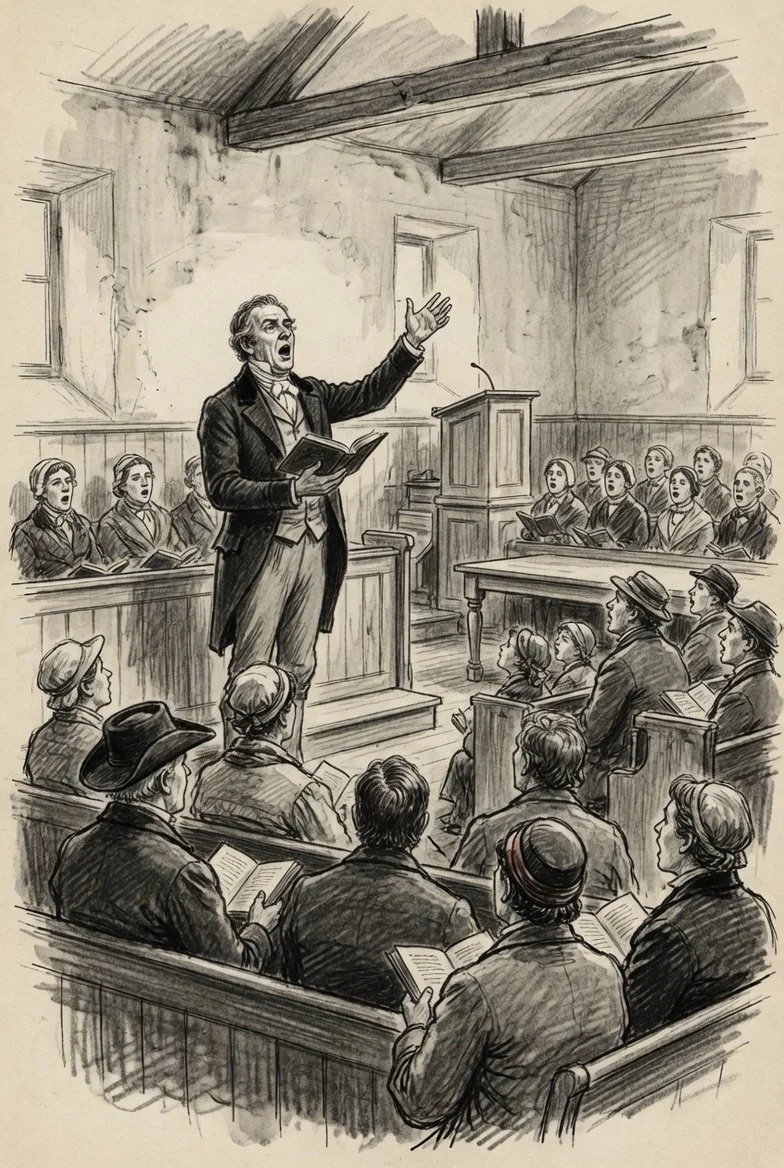
A Letter on Psalmody.
James Dodson
SHEWING,
THAT HUMAN COMPOSURES OUGHT NOT
TO BE USED IN CHRISTIAN-WORSHIP, IN
SINGING THE PRAISES OF GOD.
What thing soever I command you, observe to do it: thou shalt not add thereto, nor diminish from it.—Deut. 12. 32. See also Jer. 6. 16. Isa. 8. 20. and John 14. 15. and Mat. 28. 20.
TO WHICH IS ADDED,
PART OF A LECTURE;
OR, THE
SUBSTANCE OF ONE
FROM THESE WORDS,
And to Jesus the Mediator of the new Covenant. Heb. 12. 24.
ALSO, A BRIEF
DESCRIPTION
OF THE
CHRISTIAN GRACE OF HOPE.
THAT HOPE THAT DOTH ACCOMPANY AND
COMPREHEND SALVATION.
[Philadelphia:]
PRINTED FOR ROBERT JACK. 1790.
[by Francis Bailey]
[Page A2]
A
LETTER
ON
PSALMODY.
Dear FRIENDS,
PHILADELPHIA.
IT is a long Time since I had the Happiness of seeing you all together, and may be, we will never all meet to converse together again; but, be assured, I sincerely wish each of you temporal and eternal Happiness.
I have a few Things to say unto you, which Duty constrains me to request your serious Consideration of, namely, The receiving, observing, and keeping pure and entire, all such religious Worship and Ordinances, as God hath appointed in his Word.
An excellent Summary and Standard of Doctrine, we have in the Westminster Confession of Faith, Larger and Shorter Catechisms. For these we ought to thank God, for bestowing on us such precious Privileges; and with a holy Zeal, endeavour to keep them pure and entire; that is, to add Nothing unto, nor suffer any Thing to be taken from these Truths of God.
What I intend at present is, to observe to you the Corruption which hath entered into the Church, namely, by the admitting and making Use of human Composures, in singing the Praises of God, in the Place of his own Holy Word; i.e. God’s own Book of Psalms, which he hath appointed to be used in Worshipping of him to the End of the World.
And sorry am I to hear, that all of you are so fond of a poor, lame Imitation, that is, Doctor Watts’s, an Author that is far from Orthodox; yea, in many Things, i.e. Points of Doctrine, which I could easily make appear, notoriously erroneous. I will
Page 4
I will now point out some Sentences, that a few days ago I cast my Eyes upon, in the Preface of a Psalm Book of his, printed in Boston, 1768. Where he says, Page 4th of said Preface:—
“It is necessary that I should here inform my Readers at large, what the Title Page expresses in a short Way; and assure them, that they are not to expect in this book an exact translation of the Psalms of David.” And truly the Doctor has here said the Truth: For in his, the Reader will not get a Translation of God’s, or of David’s Psalms, as he calls them: Twelve of God’s Psalms he has thought unworthy even of his Imitation; and those that he hath cast his polishing Pen upon—miserably, I had almost said blasphemously, hath he used them, as being the Word of God. Not content with casting so many of them behind his Back; but even many of those he retains, he useth in a cruel Manner, by cutting and carving, lengthening and shortening at his Pleasure, to make them speak his own Sense; but not the Sense of the Word and Spirit of God, by whom they were written;—and written for our Instruction; and suits the Cases of all the Israel of God; and wherewith they are commanded to worship him.
“If this attempt of mine, saith he, through the divine blessing, become so happy as to remove this great inconvenience, and to introduce warm devotion into this part of divine worship, I shall esteem it an honourable service done to the Church of Christ.”
But here I may say, Sir, Who hath required this at your hands—To tread the Lord’s Courts, to demolish the Glories thereof—the Building of his Hands,—and to erect the Images of your own vain Imaginations in Place thereof?—But what are these great Inconveniencies that the Doctor wants so anxiously to remove out of the Church of Christ? He tells us, Page 3d: “Though the Psalms of David breathe a most exalted spirit of devotion; yet when the best of Christians attempt to sing many of them in our common translation, that spirit of devotion vanishes and is lost—the Psalm dies upon the lips.”
O strange! Strange! Sirs,—What Heaven-daring Language is here! To lay the Blame of the Coldness and Indifferency of our religious Worship upon the Spirit and Matter of God’s Word.
“If I were, says he, to render the reason of it, I would give this for one of the chief, viz. that the Royal Psalmist here expresses his own concerns;—But when we who are Christians
Page 5
sing the same lines, we express nothing but the character, the concerns, and the religion of the Jewish King.”
Surprising indeed! Did this learned Author never read in the Word of Truth—That “No Scripture is of private Interpretation?” The Psalms celebrate the Praises of one infinitely superior to the Psalmist. It is absolutely refused that David in the Character of the Jewish King composed any Psalm: But he did compose them in the more noble and divine Character, a Prophet of God, the sweet Psalmist of Israel. The Spirit of the LORD spake by me, saith David, and his Word was in my Tongue, 2 Sam. 23. 2. and 1 Chro. 16. 7. No Prophecy of the Scripture is of any private Interpretation: For the Prophecy came not in old Time by the Will of Man; but holy Men of God spake as they were moved by the Holy Ghost, 2 Pet. 1. 21. It is also denied, that the Matter of the Psalms respect the Psalmist as a Jewish King, or express his own Character and Concerns as such, &c. They respect one who is infinitely greater, that is Jesus, who is at once David’s Son, and David’s Lord. They respect him directly, for they write of him, or mystically, that is, the Church, the Members of his mystical Body. Search the Scriptures; for they testify of Christ, John 5. 39. Jesus Christ is the same Yesterday, and To-day, and for ever, Heb. 13. 8. The Promise which was made unto the Fathers, God hath fulfilled the same unto us their Children, in that he hath raised up Jesus again; as it is written in the second Psalm, Thou art my Son, this Day have I begotten thee. He saith also in another Psalm, Thou shalt not suffer thine holy One to see Corruption, Acts 13. 33, 35. For David himself said by the Holy Ghost, The LORD said unto my Lord, Sit thou on my right Hand, till I make thine Enemies thy Footstool, &c. Mark 12. 36.—Acts 2. 25.
The Psalms, as well as other Scriptures, are called the Word of Christ, Col. 3. 16. In 1 Chro. 16. 9, the Prophet instructeth the Church in their Duty, saying, Sing unto the LORD, sing Psalms unto him, talk you of all his wondrous Works. And again in Verse 23, Sing unto the LORD all the Earth; shew forth from Day to Day his Salvation, &c.
In Page 5th, he says, “Wheresoever the Psalm introduces him, i.e. David, as a Soldier or a Prophet, as a Shepherd or great Musician, as a King on the throne, or a fugitive in the wilderness, the translators, i.e. all before himself, ever represents him in the same circumstances.”
Note what this vain Boaster says of his own Merit, in Page
Page 6
25. “Though there are many gone before me, who have taught the Hebrew Psalmist to speak English, yet I think I may assume the pleasure of being the first who have brought the royal author into the common affairs of the Christian life, and led the Psalmist of Israel into the Church of Christ, without any thing of a Jew about him.”
He further blames said Translators, Page 7, where speaking of the Celebration of the Lord’s Supper, for not having indulged an evangelical Turn to the Words of David.—“How perpetually, says he, do they repeat some part of the 23d, or 118th Psalm, and confine all the glorious joys and melody of that ordinance to a few obscure lines.” But I answer, Sir, No Translator, I presume, of any of the twenty Versions which you say you have seen, durst have the daring Effrontery, to call such sweet and holy Psalms—“obscure lines.”
In the Beginning of the second Part of the Doctor’s Preface, he says, “There are several songs of this Royal Author that seem improper for any person beside himself; so that I cannot believe, says he, that the whole book of Psalms, even in the original, was appointed by God for the ordinary and constant worship of the Jewish Sanctuary.”* To this I answer, a Pity it was that the learned Doctor’s Belief was so ill founded; for as I said above, “No Scripture is given for private Interpretation.”
_____
* It hath been pretended, the language and manner of these Psalms are not suited to the spiritual nature of our Gospel-Worship. That, however, may as well be urged against the reading of them, as against the singing of them: Nay, against the reading of a great part of the Old Testament in our Christian-Worship. It is certain, many passages in the Book of Psalms,—are expressive of the exercises of faith, repentance, love, or the like graces, which still remain of the same form, as under the Old Testament. The predictions are either accomplished, and so may be sung to the honour of God’s mercy and faithfulness; or, if not accomplished, may be sung in the hopes, that God will accomplish them in his time. The history, of what God did for his Jewish Servants and Church, may be sung with admiration of his love, wisdom, power and grace therein manifested. It is further to be considered, that much of what related to David, or the Jewish Church, was typical of the Character and Concerns of Jesus Christ and the Gospel-Church; and so ought to be sung with a special application thereto. John Brown, of Haddington.
Page 7
pretation.” They were all given by divine Inspiration. And we are commanded to hold fast the Form of sound Words, that is, to keep God’s Word pure and entire; and likewise to sing in the Words of David. Therefore this Charge of the Doctor’s against the Word of the Lord, is certainly false.* But
_____
* Remarkable is that Transcript of God’s revealed Will, the 119th Psalm, both as to Composition and Matter. The Design of this Psalm is, to magnify the divine Law, and make it honourable. It’s Composition is singular, being divided into twenty-two Parts (containing two and twenty Octonaries) according to the Number of the Letters of the Hebrew Alphabet; and each Part consists of eight Verses; all the Verses of the first Part begin with the self-same Letter, i.e. Aleph. And all the Verses of the second, with Beth, and so on throughout the whole Psalm.
Divine Revelation, which is the Matter of the Psalms, is here expressed by ten several Words; and they are expressive of the whole Compass of it, informing us both what we are to believe and practise; what God requires from us, and telling us what we may expect from him. The Things contained in the Scripture, and drawn from it, which the inspired Psalmist expresseth God’s revealed Will, are here called 1st, God’s Law, because they were enacted by him as our Sovereign; and given by God to his Church, for the Rule of all moral and religious Actions. 2. His Way, because they are the Rule of our Obedience, and chiefly respect Jesus who is the Way, the Truth, and the Life of his Church. 3. His Testimonies or Testaments, because they are solemnly declared to the World, and attested beyond Contradiction. 4. His Precepts, because prescribed to us, and not left indifferent. 5. His Statutes, because they are fixed and determined, and of perpetual Obligation. 6. His Judgments, because framed in infinite Wisdom, and because by them we must both judge and be judged. 7. His Word, because it is the Declaration of his Mind, and Christ the essential, eternal Word is all in all in it. 8. His Commandments, because given with Authority, and being lodged with us a Trust, require due Obedience to his Laws. 9. His Righteousness, because it is all holy, just and good, and to us the Rule and Standard of all Righteousness. 10. His Truth and Faithfulness, because the Principles upon
Page 8
But it seems the Doctor was determined to find Fault with a Faithful Translation. “Others maintain, saith he, Page 8, That a strict and scrupulous confinement to the Sense of the Original is necessary to do justice to the Royal Author; but in my Judgment, says the Doctor, the Royal Author is most honoured when he is made most intelligible.” Here he would seem to take in Hand, to set or point out in a clear Light, what the Holy Ghost hath by the Prophet made Unintelligible. For he says, Page 9, “A meer translation of all his (i.e. David’s) verse into English, to be sung in our Worship, seems to darken our religion, by turning back again to Judaism, it damps our delight, and almost forbids the Christian Worshipper to pursue the song.” Oh, Sirs! Pause here a little.—What Language
_____
[Continuation of footnote from previous page:]
which the divine Law is built, are Eternal Truths. And, because all the Promises flow from the sovereign Free Grace of God; and therefore, the Accomplishment of them, from his Eternal Faithfulness. And notable it is, that in all this long Psalm, there is but one Verse (it is ver. 122) in which we may not find one or more of these ten Words or Names.—Only in ver. 132, they are called God’s Name: and in ver. 91, his Ordinances. Therefore, if David, by the Spirit of God directing him, was exact throughout this whole Psalm,—O, then! How were his Affections kindled, how was his Love inflamed towards God’s Holy Word! What Language can parallel this? What Imitation can be compared unto it? Surely None: For these are the Words of God—the Words which the Holy Ghost spake unto the Church of Christ. Therefore, How presumptuous is it, for any Man to say or affirm that the Psalms were not appointed by God for the constant Worship of his Sanctuary! Where then, shall we meet with such a full and divine Description of God’s revealed Will, as is contained in this single Psalm? Here it is called God’s Way, his Law, Testimonies, Precepts, Statutes, Judgments; his Word, Commandments, Righteousness, Truth, Faithfulness, &c. What! Can any human Pen equal such a glorious, heavenly and majestic Description of God’s Word? And this Legacy is given to the Church—A Psalm—to praise God. Yea,—And, if there were none but this one Psalm, it is sufficient to prove that the Psalms were appointed by God for the ordinary and constant Worship, not of David only; but, of the Israel, or Church of God. Away then, with all such false and profane Babblings against the pure and holy Word of the Lord our God.
Page 9
Language is here! I had almost said,—Yea, is it not Treason against the God of Heaven—To speak thus of his Holy Scriptures, which is a Light to our Feet, and a Lamp to our Paths, as unfit for Christian Worship? For the God of Truth assureth us that his “Scripture was given by Inspiration—And is profitable—That the Man of God thereby be made perfect.”
Page 10th, He objects “That Moses, Deborah, and the Prince of Israel; David, Asaph, and Habakkuk, and all the Saints under the Jewish state, sung their own joys and victories, their own hopes and fears, and deliverances; and why must we under the Gospel,* sing nothing else but the joys, hopes, and fears of Asaph and David?” It is easy to answer this Question,—Because, neither Christ nor his Apostles instituted any other Psalm, Hymn, or Spiritual Song to be used in the Christian Church: That they used no other, is manifest, in that they are not left on Record in God’s Book;—And surely there is no Scripture hid from us, that is necessary for God’s Glory, and Man’s Salvation.
In Pages 11 and 12, He maketh a small Acknowledgment in
_____
* “The gospels contain but little of our SAVIOUR’S history, till he entered upon his prophetic office; only that, at twelve years of age, he could explain the Hebrew Scriptures, to the astonishment of all those who heard him. This is a sufficient hint how his youth was employed.—The Psalms contain, all those circumstances of our SAVIOUR’S private employment, on which the evangelists are silent; his meditation on the law, day and night, his firm trust in JEHOVAH, his fervent prayers, and mournful ejaculations. They refer to all the emblematical institutions, typical sacrifices, deliverances and persons, and apply them to the gospel state with as much assurance, and in the present tense, as if certain and already translated. And, They refer to, ‘His joyful birth—circumcision—wisdom, faith, sanctity, when young—baptism—evidence of the HOLY SPIRIT—temptations, and conquests over them—preaching, prayers, praises—resolution to fulfil the law, and perform all righteousness—appointment of apostles—predictions, miracles—healing diseases—opposition from men, being scoffed, reproached, condemned, crucified—agonies under his Father’s wrath—death, sacrifice, atonement—separation of the Humanity from the Essence—embalmment, burial, resurrection—ascension, and investiture as king—destruction to enemies, &c.’” John Hutchinson, Esq.
Page 10
in Favour of God’s own Book of Psalms, when used by skilful Persons. “I confess, says the Doctor, it is not unlawful, nor absurd for a person of knowledge and skill in divine things, to sing any part of the Jewish Psalm Book, and consider it merely as the word of God.—But where the words are obscure Hebraisms, or where the poet personates a Jew, a soldier, or a King, speaking to himself, or to God, the mode of instruction in a Song seems not so natural and easy even to the most skilful Christian, and it is almost impracticable to the greatest part of Mankind. I could never persuade myself (P. 12) that the best way to raise a devout frame in plain Christians, was to bring a King, or a Captain into their Churches, and let him lead and dictate the worship in his own stile of royalty, or the language of a field of battle.”
What Mockery of the Servant and Word of God!—The royal Type of Christ, and Man after God’s own Heart: A Title never given to any earthly Man, but David. How contemptuously does the Doctor speak of this Man of God—(when he calleth him “A Jew, Jewish Poet, Jewish King, Jewish Prince and Psalmist, David the King, Royal Author,—Psalmist, Hebrew Psalmist, ancient Psalmist, King on the Throne, a King or a Captain, David himself, Shepherd, great Musician, Soldier, Prophet, a Fugitive in the Wilderness—sweet Singer of Israel, &c.”) He continues thus, “Does every menial servant in the Assembly know how to use these words devoutly? When I receive the congregation, I will judge uprightly, Psal. 75. 2. A Bow of steel is broken by my Arms.—As soon as they hear of me, they shall obey me, Psal. 18. 34, 44.”
But, where did the Doctor learn, that David acted as Priest in the Church? He was, a King and a Prophet of the Lord. And, was it possible, that the Doctor was so blinded with false Zeal, or stupidly ignorant, as not to see a greater than David here, even in those Psalms, as well as throughout the whole Book of Psalms. David, although a King, is not here to be considered as a King, but as a Member of that Body whereof Jesus is the Head; when we view him in his Afflictions, Trials, Conflicts, Dangers and Exercises of Soul, with his Triumphs, he was an experienced Christian, as he was, such is every Christian in their Exercises, according to their Trials and Measure of Grace; for as one Face answereth to another in a Glass, so doth the Experience of one Saint to another: Hence the Propriety of the Expression,—A Bow of Steel is broken by my Arms, &c.
Page 11
When the Church of God in itself, or any of it’s Members are successful against their enemies, they may say that they have broken Bows of Steel in Pieces, by having condemned every Tongue that hath risen against them, frustrated every Plot, or rendered every Power or Weapon used against them, unsuccessful. Again, when any Society submitteth to Jesus, he obtaineth the Kingdom, he judgeth them uprightly. It is also true of those to whom the Government of the House of God is committed; nor is there a true Believer but hath an Influence in that Government. Again, when any Person or Persons hear the Voice of God with Evidence and Power, immediately they at hearing submit to and obey Jesus.
In Page 13, He goes on in the same Strain,—finds Fault with the Matter and Manner of God’s Word. “Here I may with courage, says our Critic, address myself to the heart and conscience of many pious and observing Christians, and ask them whether they have not found a most divine pleasure in singing, when the words of the Psalm have happily expressed their frame of soul?—But on a sudden the clerk has proposed the next line to your lips with dark sayings and prophecies—with confessions of sins which you never committed—with complaints of sorrows which you never felt—cursing such enemies as you never had, &c.—And how have all your souls been discomposed at once, and the strings of harmony all untuned! You could not proceed in the song with your hearts, and your lips have sunk their joy, and faltered in the tune; you have been baulked and ashamed, and knew not whether it were best to be silent, or to follow on with the clerk and the multitude.”
Amazing! What Doctrine is here! Thus to charge the Word of God so foolishly, as teaching us to commit Sin; and causing us to be ashamed to worship God according to his Word. He affirmeth that we cannot confess our Sins, or acknowledge our obtaining Victories, &c. as David did. Those who know not how sinful they are, may be of his Sentiments, but not otherwise. Whatever Sins David confessed, if we know our Universal Depravity of Nature by Original Sin, (but by the bye, the Doctor is not Orthodox in this Doctrine, see his Ruin and Recovery) there we will not only see the Root, but also feel the Sprouting of all Sins, and will confess them to God. Again, whatever Victories David won, God gave them to him, and they were given for the Church, they belong to it, and such are the Victories, Successes and Prosperity granted to the Church, the Church may and ought to say of them all, they are ours, or they are mine may every one say
Page 12
in Faith. Every Believer too is sometimes conquered, yet he is a Conqueror, and he shall be more than a Conqueror at the last, through his Lord and Saviour, Jesus Christ. How false, how absurd and erroneous, thus to assert, that any of God’s Psalms teacheth us to curse “personal Enemies.”* The Lord keep us from such presumptuous Sin. The Scripture of Truth asserts the contrary: Let the Reader remember, that David was both a Prophet and Type of Christ.—As such, he might warrantably foretell, and denounce the Vengeance of God upon the Enemies of his declarative Glory; and consequently Enemies to the Church of Christ. “Men and Brethren, This Scripture must needs have been fulfilled, which the Holy Ghost by the Mouth of his Servant David spake before concerning Judas—For it is written in the Book of Psalms, Let his Habitation be desolate, &c.” Observe here, Christian Reader, that the Spirit of God, by whom all Scripture was written, thinketh it not improper to quote the Psalms; Yea, to approve of those very Psalms which some blasphemously call David’s cursing Psalms: And why may we not use them?* For, the Law of the Lord is perfect, (the Psalms not excepted) pure, clean and righteous altogether.
_____
* As for these Psalms, which contain DENUNCIATIONS of Divine vengeance upon the enemies of God and his Church, we are to consider, that these expressions were dictated by the infallible Spirit of God;—that the objects of them were foreseen to be irreconcileable enemies of Christ and his Church; that those who sing them only applaud the equity of the doom, which God hath justly pronounced upon such offenders; and that they are to be sung with a full persuasion of the event, as a certain, awful and just display of the Glory and tremendous justice of JEHOVAH. Though we ought, therefore, never to apply them to particular parties or persons who have injured us; yet to decline using them, out of a pretence of charity, is to suppose ourselves wiser than HIM, whose understanding is infinite, and more merciful than the Father of mercies, who is full of compassion, and delighteth in mercy.—Moreover, as these external enemies, devoted to destruction, were in some sense emblematical of our spiritual enemies, within or without us, the passages may be sung with application to ourselves, as directed against these principalities and powers, and spiritual wickednesses, in high places, with whom we have to wrestle, while on earth, Eph. 6. 10,—19. 1 Pet. 5. 8, 9. Rom. 8. 13. Gal. 5. 17, 24. John Brown, of Haddington.
Page 13
Page 14. The Doctor comes to the third Part of his Preface, where his purposed Design in short, he says, is this, “To accommodate the Book of Psalms to Christian Worship.”† And in order to this, says he, “It is necessary to divest David and Asaph, &c. of every other character but that of a Psalmist and a Saint, and to make them always speak the common sense of a Christian.”
Strange! that the Doctor hath made these Exceptions, “A Psalmist and a Saint.” Does he not here, as well as in other Places (as far as his Ability and Pen could reach) divest the Prophet of the Lord of these, as well as his other Characters; and take upon himself to teach the Man after God’s own Heart, and Type of Christ to speak like a Christian? But may we not say, who hath required this at your Hands? I am of Opinion, (and I hope it is not an erroneous one,) that David had a better,
_____
* The book of Psalms is one of the most extensive and useful in holy Scripture, as it is every where suited to the case of the Saints. It is at first much mixed with complaints and supplications, and at last issues in pure and lasting praise. The Hebrews divided this book into FIVE, ending with Psal. xli. lxxii. lxxxix. cvi. and cl. The first four of which are concluded with Amen. Interpreters have attempted to arrange or class the Psalms into a variety of different forms: To me it appears not improper, to distinguish them; some into INSTRUCTIVE, that is, HISTORICAL or DOCTRINAL; some PROPHETIC; some CONSOLATORY; some PETITIONARY; and some EUCHARISTIC. But indeed historical narratives, doctrinal instructions, prophesies, consolations, supplications, praises and thanksgivings are often so pleasantly and profitably connected, in the same Psalm, that it is difficult to assign it to one class, rather than to another. And, what is HISTORICAL, as it relates to David and the Jewish Church, is often TYPICAL, and so PROPHETIC, as it relates to Jesus Christ and the Gospel-Church or heavenly state. Many too of the SUPPLICATIONS respecting deliverances from, or the destruction of enemies, are to be considered as real PREDICTIONS of the events; they being dictated by the inspiration of HIM who can declare the end from the beginning. J. B. of Haddington.
† See Note, Page 6.
Page 14
better, an infinitely better Teacher to instruct him to speak and write the Mind of God, I mean the Holy Ghost, than Doctor Watts hath proven himself to be.
I have not Time at present, to point out every Sentence in this mighty boasting Preface, with which I find Fault.—And shall only point out one or two more:—
In Page 18. He speaks much in the same Strain, as in the last mentioned Page.—After his removing some Obstacles that lay in his Way, i.e. by changing some Sentences, and adding Words, &c. as in Pages 15th and 16th, “Where the Psalmist describes religion by the fear of God, I have (says he) often joined faith and love to it. Where he promises abundance of wealth, honour, and long life, I have changed some of these typical blessings for, grace, glory, and life eternal, &c.”
But if the Doctor must cavil at such Words or Portions of Scripture as these, we need not think it strange, that he findeth Fault with the Book of Psalms: For surely he might with equal Propriety find Fault with all the Word of God.
He thus proceeds Page 18th. “In several other places I hope my reader will find a natural exposition of many a dark and doubtful text, and some new beauties and connections of thought discovered in the Jewish poet, though not in the language of a Jew. In all places I have (says he) kept my grand design in view, and that is, to teach my author to speak like a Christian.” But, blessed be God, that Author, whom he calls a Jew, the Jewish poet, had a better Teacher than Isaac Watts, who arraigns and condemns so much of the precious Truths of God.
Page 25th. The Doctor having spoken to the Praise and Dispraize of sundry Translators prior to himself, saith, “It requires a complete translation, to retrench every luxuriant line, and to maintain a religious sovereignty over the whole work. Thus the Psalmist of Israel might arise in Great Britain in all his Hebrew Glory, and entertain the more knowing and polite Christians of our age. But still I am bold to maintain (says the exulting Doctor) the great Principle on which my present work is founded, and that is, that if the brightest genius on earth, or any angel from heaven, should translate David, and keep close to the sense and stile of the inspired author; we should only obtain thereby a bright or heavenly copy of the devotions of the Jewish King; but it could never make the fittest Psalm Book for a Christian People.”
The Doctor is mistaken, in Teaching that the Devotion of
Page 15
a Jew different from that of a Christian.* For, true Devotion is only by the Power of the Holy Spirit, whose Operations and Effects are the same from first to last, differing only in Degree according to the Measure of Grace granted. The Spirit of the Old does not differ from that of the New Testament, in Point of Benignity and Compassion, &c.—The glorious Attributes and Perfections of God are clearly and fully manifested throughout his holy Word. But why doth the Doctor (this proud Pharisaical Boaster) make Use of these Words, inspired, heavenly? Reader, doth not the Sum and Substance of what I have pointed out to you above,—plainly shew, that here his Tongue gave his Heart the Lie? Hath he not denied both,
_____
* “Whatsoever some may imagine to the contrary, David was a sincere Christian, and believed in Christ, who was to come: All the Difference between the believing Jews, before our Lord’s Coming, and sincere Christians, since that, is, that the former believed in Christ who was to come; whereas the latter believe in Christ who is come. David, as well as Abraham, rejoiced to see the Day of Christ, and he saw it, and was glad. He looked up to that Rock which followed his Forefathers, and that Rock was Christ. The Apostle saith, He died in Faith. Christ and his Church are pointed out and described throughout his Book of Psalms: For, the whole of the Old Testament was designed to point out and describe the Lord Jesus Christ, in his various Offices and Relations to his Church. [“The Old Testament is not contrary to the New; for both in the Old and New Testament, Everlasting Life is offered to Mankind by Christ, who is the only Mediator between God and Man, being both God and Man: Wherefore they are not to be heard, which feign, that the Old Fathers did look only for transitory Promises. Art. 7th of the Church of England.”] This is the Language of Scripture—Throughout the New Testament (which I look upon to be the best Commentary on the Old) the Sacrifices and Services of the Jewish Law are appropriated to Christ; the Book of Psalms, is particularly applied to him and his Church: Nor is there a single Passage quoted out of the Psalms, but what is mentioned and applied as relating to him. Christ himself declared, that he must fulfil all Things which were written in the Law of Moses, and in the Prophets, and in the Psalms concerning him.” Thomas Jones.
Page 16
and that in contemptuous Words? He maintains in this last Sentence boldly, yea presumptuously, That no Angel in Heaven, nor Man on Earth could Translate David (that is, the Book of Psalms) Faithfully, and thereby make a Psalm Book fitting for a Christian People! But, by the Stroke of a skilful Pencil—to retrench every superfluous Line,—and by a few polishing Strokes in this Part of the Word of God, The Psalmist of Israel in all his Hebrew Glory might arise in Britain and entertain the polite Christians of our Age!!!
Strange! O, Strange!—What, and whose Doctrine is this? Is it God’s? May I not in Faith answer, and say, it is not. And blessed be God, for making me to see, and enabling me to say, it is Not.
John Hutchinson, Esq; wisely remarks, that, “Nothing has done more hurt among Christians, than taking the Psalms or Hymns of DAVID the Beloved literally, as if they related only to temporary Transactions or Deliverances wrought for the Jews. This is the miserable Effect of being led implicitly by Apostates and Hypocrites, who are not ashamed to set up their own paltry Performances instead of CHRIST’s perfect Righteousness, and who not only say in their Hearts, but avow publicly, that there are no ALEIM or ELOHIM, that is, Gods, No mere Man could speak in the Stile of the Psalms: No Mortal could answer such pompous Descriptions, or do such infinite Actions; none but the real David was a Man after God’s own Heart, nor durst boast of Purity, impartial Justice, or spotless Innocence. Trace all the Affections and Characters of CHRIST quite through the Psalms, and they will shew it to be neither lawful nor possible for any other to say or undertake such Things as are there.
Reader, I have cursorily glanced over this mighty boasting Preface—And from the few Observations I have made thereon, perhaps, you may expect my Opinion of the Substance or Body of this Author’s Book.—This indeed, to particularize, would be a Work of Extent, too great for the Bounds of a common Letter:—Therefore, I shall only here observe—That the discerning Reader will find the Book and it’s Preface to bear a strong Resemblance. In many of the Doctor’s Psalms, the judicious Reader will find upon Examination but a small Similitude, and in some Places None at all, to those which were written by the Spirit of God.—Only observe these two Places out of a Multitude, for an Example, Psal. iv. 4. 5. and lviii. 3. In the Assembly’s Metre Version of Psalm iv. 4. 5. it reads thus:—
Page 17
Fear, and sin not, talk with your Hearts on Bed, and silent be.
Off’rings present of Righteousness, and in the Lord trust ye.
Here, we have six moral Precepts given us by the Spirit of God; and there is not any of them to be found in Doctor Watts’ Imitation, which runs thus:—
When our obedient Hands have done a thousand Works of Righteousness,
We put our Trust in God alone, and glory in his pard’ning Grace.
What! Is there any Resemblance here? Can any Christian read these two Lines, and say, they represent and contain sound Doctrine? Surely no; for all Works of Righteousness done by our Hands are but filthy Rags;—and are not that Righteousness which we are called upon to offer to God:—But it is the pure unspotted Righteousness of Jesus the Redeemer, that we are here exhorted to offer, which is a Sacrifice of Righteousness well pleasing to God.
In the other Text, to wit, Psal. lviii. 3. it is said,—“The Wicked are estranged from the Womb; they go astray as soon as they be born, speaking Lies.” In this Verse we have a Representation of Sin Original and Actual: For, “Sin is any Want of Conformity unto, or Transgression of the Law of God.” The Wicked (that is, the natural Man) are estranged from the very Womb,—They bring with them into the World a Nature alienated from God, and Enmity against him; which is manifest by their early and constant actual Transgressions:—They go astray,—When? Is it when they arrive at, or become Moral Agents?* No, It is here said to be from the Womb,—as soon as they be born;—Original Sin being as much a Departure from God, as Actual. And their Practice is here called speaking Lies. Well, and what does Doctor Watts in his Imitation say of this Text? What does he say—Nothing—Lo! he passeth it over in Silence! I will
_____
* Doctor Watts says,—“Nor can they be actually criminal in the sight of God, so as to contract actual guilt, till years of knowledge and understanding, and till the mind and will are capable of knowing, chusing, and refusing moral good and evil.” Ruin and Recovery.
Page 18
I will now (Christian Reader) venture to assert, that this Imitation of Doctor Watts’ is unlawful, and ought not to be used in the Worship of God.—For these Reasons: [1] Because, There is no Command, nor Example in the Word of God, to authorize any Person under any Pretence whatever, to add to, alter, or abolish any Part of the Psalms (or Word of God)—which he hath appointed for the stated Rule, to be praised in the Worship of his Church until the End of the World. Again, [2] Because, “That the Practising, or Imposing any New Form of Worship on Christ’s People, which himself never appointed, impeaches his Faithfulness in discharging his Trust to his Church.” And, [3] Because, “Neither the Old, nor the New Testament, will allow any Minister to introduce a single Law or Rite of their own Invention into the Doctrine, Worship, Discipline, or Government of the Church; but requires them to explain, inculcate and apply the general and particular Prescriptions of Jesus Christ; and requires their Hearers to receive Nothing implicitly from them, but carefully to examine all their Doctrines and Appointments by the Oracles of God.” John Brown of Haddington.
For these Reasons, out of many that might be adduced,—I object against Using Doctor Watts’ Psalms in the Worship of God, and all such Imitations,* being like Michael’s Image—A Shadow
_____
* No doubt, one may compose spiritual hymns for his own and others Recreation: But, to admit Forms of human composure into the stated and public worship of God, appears to me very improper. [1] It is extremely dangerous. Heresies and errors, by this means, may, and often have been very insensibly introduced into churches, congregations, or families. [2] There is no need of it. The Holy Ghost hath in the Psalms of David, and other scriptural songs, furnished us with such a rich collection of gospel doctrines and precious promises;—an extensive fund of solid experiences;—an exhaustless mine of Gospel-Grace and Truth;—an endless variety to suit every state or condition, in which, either our own soul, or the Church of Christ, can be, upon earth. These were framed by him, who searcheth the hearts, and knows the deep things of God; and hence must be better adapted to the case of souls or societies, than any private composition whatever. [3] Though the Holy Ghost never saw meet to leave us a Liturgy of prayers; yet, from the poetical composition thereof
Page 19
A Shadow in Place of the Substance. But,—“God hath instituted the Way whereby he is to be worshipped, and limited the same by divine Revelation, that he may not be worshipped by the Devices or Imaginations of Men. Confess. Ch. 21. § 2.
I shall now endeavour to prove to you, that the Singing of Psalms is a moral Duty, and therefore perpetual. And that the Psalms to be used in the Worshipping of God, are those of his own Appointment.* In Order to this, it will be necessary to observe, That the Changing of Prose into Verse (if the Original be faithfully adhered to) is Nothing else, but the Transposition of Words in a Sentence, and does not change the Sense of the Original. This will appear evident, by comparing the Metre Version, usually bound up in our Bibles (which is not improperly called the Assembly’s Version) with the Original. It may not perhaps be amiss to give a short Account of the Formation of said Metre Version:—About the Year 1643, The
_____
[Continuation of footnote from previous page:]
it is plain, he intended these Psalms and Songs for a standing form of Praise in the Church. It is certain, they were used in this manner under the Old Testament. The Holy Ghost hath under the New plainly directed us to the use thereof, Col. 3. 16. Eph. 5. 19. John Brown, of Haddington.
* Here we may answer another that Question, with the worthy Isaac Ambrose, whose Praise or Works are in the Church:—“Whether may not Christians lawfully sing David’s or Moses’ Psalms, and how may it appear?
1. Answered affirmatively, Eph. 5. 19. where, under these three Heads of Psalms, and Hymns, and Spiritual Songs, David’s Psalms are contained.
2. This is proved by Precepts, Patterns, and Reasons. [1.] By Precepts, Eph. 5. 19. Col. 3. 16. and James 5. 13. [2.] By Patterns: 1st. Of Christ himself and his Apostles, Mat. 26. 30. 2d. Of Paul and Silas, Acts 16. 25. 3d. Of the Church, Rev. 15. 3. [3.] By Reasons, as, 1st. Because the People of God have used the very same Words of David’s Psalms in Singing, 2 Chro. 15. 13. compared with Psal. cxxxvi. and Ezra 3. 11. compared with Psal. cxviii. and Rev. 15. 4. compared with Psal. lxxxvi. 9. and Exod. 15. 2. compared with Psal. cxviii. 14. 2d. Because Paul directing to sing Psalms, gives the very same Word or Title as David gives in his Psalms. James 5. 13. compared with Psal. xcv. 2. 3d. Because, David’s Psalms were indited by the Spirit of God. 2 Sam. 23. 2.
Page 20
The English Parliament, having convened about one hundred learned Divines, at Westminster, London, to compile a Confession of Faith, Catechisms, larger and shorter, Directory for public and Family Worship, and Form of Presbyterian Church Government, laid before them an imperfect Draught of this Version of the Book of Psalms, made by Sir Francis Rouse (an English Baronet) recommending it to their serious Examination; who with Laborious Care altered, corrected and approved it, Unanimously, and returned it to Parliament, and both Houses did then approve and authorize said Metre Version to be sung in Families and Churches throughout that Kingdom, 1645. Mr. Samuel Rutherford, and the other Scots Members of said Westminster Assembly, then sent said authorized Version to the General Assembly of the National Church of Scotland, at that Time sitting at Edinburgh, whose Committees had it under Consideration several Years, and having farther corrected and amended it, the General Assembly did approve it, and authorize it to be sung in Families and Churches, as did the Scots Parliament also authorize it throughout that Realm.
Act of the Commission of the General Assembly, approving the New Paraphrase of the Psalms in Metre, and appointing them to be made Use of in Congregations and Families, Edinburgh, November 23, 1649.
THE Commission of the General Assembly having with great Diligence considered the Paraphrase of the Psalms in Metre, sent from the Assembly of Divines in England by our Commission whilst they were there, as now at last by the Brethren deputed by the late Assembly for that Purpose; and having exactly examined the Same, do approve the said Paraphrase as it is now Compiled: And therefore, according to the Power given them by the said Assembly, do appoint it to be printed and published for public Use; hereby Authorizing the same to be the only Paraphrase of the Psalms of David to be sung in the Kirk of Scotland, &c.
A. KER.
Act of the Committee of Estates of Parliament, authorising the Use of the said Paraphrase in Kirks and Families, Edinburgh, January 8, 1650.
THE Committee of Estates having considered the English Paraphrase of the Psalms of David in Metre, presented this
Page 21
Day unto them by the Commissioners of the General Assembly, together with their Act, and the Act of the late Assembly, approving the said Paraphrase, and appointing the Same to be sung through this Kirk. Therefore, the Committee doth also approve the said Paraphrase, and interpose their Authority for the Publishing and Practising thereof; hereby ordaining the Same and no other, to be made Use of throughout this Kingdom, according to the Tenor of the said Acts of the General Assembly and their Commissioners.
T. HENDERSON.
Thus, you see, with what Caution said Metre Version was admitted into the Church—The Authority and Sanction of both Parliaments and Assemblies for the Using thereof,—as being the closest to the Original.
Having given this short Description of this Metre Version of the Book of Psalms, and of the Manner in which they were received, as Part of that Uniformity in Worship, which our worthy Reformers of that Period were so remarkably enabled to accomplish, and to present to the Church of Christ—I shall now proceed to shew, as proposed, that the Singing of Psalms is a Moral Duty, &c.—This appears evident from Scripture and from the Practice of the Church.—All moral Commands are binding,—Therefore perpetual.* The Church are commanded
_____
* Mr. David Dickson, says, “The singing of Psalms—is a Part of the ordinary Worship of God.—And he proves it thus—1st, From the Practice of Christ and his Apostles, Mat. 26. 30. From the Example of Paul and Silas, Acts 16. 25. From Moses and the Israelites, Exod. 15. 2d, Because the Singing of Psalms was commanded under the Old Testament, and that, not as a Type of any Substance to come, nor for any ceremonial Cause: Neither is it abrogated under the New Testament; but confirmed, Psal. xxx. 4. and cxlix. 1. 3d, From the general and universal Commands in the New Testament, Eph. 5. 19. Col. 3. 16. and 1 Cor. 14. 15. 4th, Because the Apostle James says, Is any Man afflicted, let him pray, is any Man merry, let him sing Psalms, Chap. 5. 13. The Meaning is not, that none should sing but such as are merry; for then none should pray but such as are afflicted. 5th, Because by Singing of Psalms we glorify God, we make his Praise glorious: We edify others with whom we sing.
Page 22
ed in the Old Testament to praise God in the Words of David. Not in David’s Time only, but in succeeding Times, as in Solomon’s Time, in Jehoshaphat’s Time, in Ezra’s Time, and about two hundred Years after, in Hezekiah’s Time, they are commanded to sing Praises unto the Lord, in the Words of David and Asaph, See 2 Chro. 5. 12. and 20. 21. Ezra 3. 10. 11. and 2 Chro. 29. 30. We are also commanded in the New, as well as they were in the Old Testament, to Sing Psalms; but we are not commanded to compose new ones:—Neither Christ nor his Apostles instituted any other; but
_____
[Footnote continued]
sing, as well as we edify ourselves. So the End to be proposed in singing, is teaching and admonishing one another, in Psalms, and Hymns, and Spiritual Songs, Col. 3. 16. Lastly, We chear and refresh ourselves, by making Melody in our Hearts to the Lord, Eph. 5. 19. Which ariseth, first, from our conscientious going about it, as a Piece of Worship to God, and in so doing we are accepted in that. Secondly, from it’s being a Part of Scripture, appointed for his Praise, whether it agrees with our Case or not. That being the End wherefore it was designed to be sung is a sufficient Warrant for our joining in the Singing thereof.
1. The singing of Psalms was an ancient ordinance of God in his Church, and a part of divine Worship, and was never repealed under the gospel. Hence the Psalmist calls upon and excites himself and others to this Duty, Psal. xcv. 1. 2. O come, let us sing unto the LORD: let us make a joyful noise to the rock of our Salvation. Let us come before his presence with thanksgiving, and make a joyful noise with Psalms. Here we see, that the Singing of Psalms is coupled with other Duties that are of a perpetual obligation, as prayer, hearing the Word, &c. ver. 6, 7. There are prophecies in Scripture that foretell the state of the church under the gospel, and speak of Psalms being to be used as a part of God’s Worship and service, is evident by comparing Psal. xviii. 49. with Rom. 15. 9.—Jesus Christ was a minister of the circumcision for the truth of God, to confirm the Promises made unto the fathers: And that the Gentiles might glorify God for his mercy; as it is written, For this cause I will confess to thee among the Gentiles, and sing unto thy Name. Psal. xviii. 49. Therefore will I give thanks unto thee, O LORD, among the heathen, and sing Praises unto thy Name. Therefore, If any Psalms are to be sung,
Page 23
but used those already made by God’s Appointment, which the Holy Ghost himself, in infinite Wisdom, hath made to suit all the Conditions, Necessities, Temptations, Afflictions, &c. of all Men in all Ages. Therefore, Those sweet and holy Psalms of the Spirit’s inditing, are to be sung in the Worship of God, by the Church of Christ until the End of the World. There are many Texts in the Book of Psalms, which plainly shew, that they were intended by the Spirit of God for his Worship in New Testament Times, as well as in the Old: Such as these, and the like,—“We will shew forth thy Praise to all Generations. I will sing of the Mercies of the Lord for ever; with my Mouth, will I make known thy Faithfulness to all Generations.”* [Note—The Text and many others seem plainly to point out to us, that such Things or Parts of the Psalms that were Ceremonial, are now abrogated (such as Musical Instruments, &c.) but all the Moral Parts thereof, as well as the Moral Law, are perpetually binding; (so, I say, let it be carefully remembered; that although the Manner of worshipping God under the Old Testament Dispensation was in many Things different from what it is now under the New; yet the Matter of God’s worship is still the same:) And we are exhorted and commanded with our Hearts and Mouths to praise the Lord.] “I will extol thee my God, O King, and I will bless thy Name for ever and ever. This shall be written for the Generations to come: And the People which shall be created, shall praise the LORD, &c. Psal. lxxix. 13. and lxxxix. 1. and cxlv. 1. and cii. 18.”
There are also, sundry Precepts, in the New Testament, which expressly require this Duty of all the Christian Church: The Apostle James entreats or commands to sing Psalms.—Paul and Silas, at Midnight, prayed and sang Praises unto God
_____
[Footnote continued]
surely, they are such as are given by divine Inspiration, as David’s were; those excellent composures being part of the word of God, and full of heavenly matter, tending to instruction and consolation, and being consigned to the Use of the church, surely may very freely be Used by us, especially, when the Matter suits much to our condition.
2. May we not use harps, organs, and other musical instruments, in praising God? A. No; for these, though used in the temple service, were not used in the Jewish synagogues, nor in the New Testament worship, nor are suited to the spiritual nature of it, John 4. 23, 24. John Brown’s Cat.
Page 24
God. Speaking to Yourselves in Psalms, and Hymns, and spiritual Songs, singing and making Melody in your Heart to the Lord. Let the Word of Christ dwell in you richly in all Wisdom: Teaching and Admonishing one another in Psalms, and Hymns, and Spiritual Songs, singing with Grace in your Hearts to the Lord.” James 5. 13. Acts 16. 25. Eph. 5. 19. and Col. 3. 16.
Here you see, that all the Israel of God are commanded to sing Psalms. And God, by his Holy Spirit, speaking by the Mouth of his Servant David, hath furnished the Church with a complete System of Psalms, wherewith to worship him. “Some, being called by David, himself, Psalms, some Hymns, and some spiritual Songs;* so that if the Singing David’s Psalms, be a Moral Duty, and therefore perpetual, then we under the New Testament, are bound to sing them, as well as they under the Old; and if we are expressly commanded to sing Psalms, Hymns, and Spiritual Songs, then either we must sing David’s Psalms, or else may affirm, they are not Spiritual Songs, which being penned by an extraordinary Gift of the Spirit, for the Sake especially of God’s spiritual Israel, not to be read and preached only, (as other Parts of Holy Writ) but to be sung also; they are Therefore most Spiritual, and still to be sung of all the Israel of God; and verily, as their Sin is exceeding great, who will allow David’s Psalms (as other Scripture) to be read in Churches, (which is one End) but not to be preached also, (which is another End) so their Sin is crying before God, who will allow them to be read and preached, but seek to deprive the Lord of the Glory of the third End of them, which is, to sing them in Christian Churches.” Preface—New England Psalm Book.
I shall only mention one Text more for a further Illustration of this Gospel Doctrine, that is, The Singing the Psalms of David. (“These devout and rapturous Compositions, wherein
______
* It is certain, says the Rev. John Brown of Haddington, the Holy Ghost intended these Psalms and Songs for a standing form of Praise in the Church; It is certain, they were used in this manner under the Old Testament. The Holy Ghost hath under the New plainly directed us to the use thereof. Col. 3. 16. Eph. 5. 19. The Psalms, Hymns and spiritual Songs, there recommended, are plainly the same with the MIZMORIM, TEHILLIM, and SHIRIM, mentioned in the Hebrew titles of David’s Psalms, iii. iv. v. &c. cxlv. cxx. cxxxiv.
Page 25
the Graces of Poetry shine with the Beauties of Holiness, and which are justly esteemed the ‘Treasure of the World, and a complete System of Revelation in Miniature.’ Mr Ewen.) And that is, Mat. 26, 30. And when they had sung an Hymn, they went out into the Mount of Olives.” That when Christ and his Disciples celebrated the last Passover, and instituted the Supper, They used none other Psalm, Hymn, nor Spiritual Song, but those already in the Church,—is the Opinion of many learned Divines.* If it be asked, What Hymn did Christ and his Apostles Sing? I answer with, Doctor Lightfoot, The very same that every Company did, viz. the great Hallel, or Hallelujah, as it was called, which began at the cxiiith, and ended at the cxviiith Psalm. No Expositor but grants this, and no Reason to the Contrary; for Christ complied with all the Rites of the Passover, and started not aside from them in this. Here the Lord of David, sings the Psalms of David. What Christ saith by way of Posing, If David in the Spirit call him Lord, how is he his Son? We may say the like by Way of Admiration, If David in the Spirit call him Lord, how did he descend to make Use of his Poetry? What says our Caviller now? Set Forms are too straight for the Spirit. He that had the Spirit above Measure, thinks not so, but useth such. He that gave the Spirit to compose, sings what he composed. That all-blessed Copy of Peace and Order, could have indited himself, could have inspired every Disciple to have been a David, but submits to Order which God had appointed, sings the Psalms of David, and tenders the Peace of the Church, and takes the same Course the whole Church did.”
What Ainsworth saith on the Book of Psalms, is pertinent here, that, “David by manifold Psalms, and Hymns, and Spiritual Songs, set forth the Praises of God, his own Faith in his Word, Exercise and Delight in his Law, with Narrations of God’s former and present Mercies, and Promises of future Graces to be fulfilled in Christ; whom he (being a Prophet) knew that he should be of the Fruit of his Loins, concerning the Flesh, and should sit upon his Throne: Whose Incarnation,
_____
* “The cxiijth Psalm with the five following ones, are called by the Jews the Great Hallelujah, or rather (as Buxtorf saith) the Great Hymn, which they used at their three Chief Feasts, especially at the Passover.”
Page 26
on, Affliction, Death, Resurrection, Ascension, and eternal, glorious Kingdom and Priest-hood, he sang by the Spirit, with such heavenly Melody as may not only delight, but draw in to Admiration every understanding Heart, and comfort the afflicted Soul, with such Consolation as David himself was comforted of the Lord. And these his Psalms have ever since by the Church of Israel, and by Christ and his Apostles, and by the Saints in all Ages, been received and honoured as the Oracles of God, cited for the Confirmation of true Religion, and sung in the public Assemblies, as in God’s Tabernacle and Temple, where they sang Praises unto the Lord, with the Words of David and of Asaph the Seer.”
It is objected by some, That many of David’s Psalms breathe such a cruel and revengeful Spirit against his personal Enemies, as is quite opposite the Spirit of the Gospel. This Objection I have shortly answered above, by observing that David speaking in the Book of Psalms, must be considered as a Prophet and Type of Christ; for, in many Places, David, and his Lord exchange not only Words and Speeches, but also Names. Again, If this Objection hath any Foundation in the Word, (but it hath not) it equally bears against the New Testament, as well as the Old:—This (as will afterwards appear) is evident from sundry Passages in the New Testament. In Mat. 5. 44, Christ instructs his Disciples their Duty towards their personal Enemies, saying,—“Love your Enemies, bless them that curse you, do good to them that hate you, and pray for them which despitefully use you, and persecute you.” This is the Duty of all the Israel of God. And in None, doth this heavenly Temper and Disposition shine more brightly than in David: (“When we consider that fervent Devotion, that Submission to the Divine Will, that Delight in God’s Law, and Zeal for his Worship, that Spirit of Forgiveness in Case of personal Injuries, and the other lovely Graces that breathe through all David’s Writing and History, we must certainly allow him to have been a Saint of the first Magnitude.”) M. Henry. “When his own personal Enemies speak reproachfully of him, &c. How mild his Answers! When his own Brother was so rough upon him without Reason, Why camest thou down hither, &c.? How mild was his Answer—What have I now done? Is there not a Cause? 1 Sam. 17. 28, 29. When his Enemies reproached him, he was not at all disturbed at it, I as a deaf Man heard not, Psal. 38. 13. When Saul persecuted him with such unwearied Malice, he did not take the Advantage which Providence seemed to offer him, more than
Page 27
once, to revenge and right himself; but left it to God to do it for him.—My Hand shall not be upon him, 1 Sam. 24. 13. And, When Shimei cursed him with a bitter Curse, in the Day of his Calamity, he resented not the Offence, nor would hear any Talk of punishing the Offender: So let him curse; let him alone, for the Lord hath bidden him, 2 Sam. 16. 10, 12, &c.” Mat. Henry. Thus you see, the Psalmist was neither cruel nor of a revengeful Spirit,—No, he was of a Dove-like Disposition; and full of Pity, but not of Wrath, as in Psal. 119. 136. Where he mourneth on Account of Sinners, or backsliding Sinners. “Rivers of Waters (saith he) run down mine Eyes, because they keep not thy Law.” Here is Love to God’s Glory, and Pity toward perishing Souls; such Mourners were spared in the Day of God’s Wrath, Ezek. 9.—And although some object, and say, the same Psalmist did hate the Wicked and Profane. Yet he did so, the Scripture saith, with a perfect Hatred, not with a carnal and corrupt Hatred against their Persons, but with a spiritual and sincere Hatred against their Vices and Sins, Psal. 139. 21—20, &c.
“Do not I hate all those, O Lord, that Hatred bear to thee?
With those that up against thee rise, can I but grieved be?
I hate them with perfect Hatred; I count them mine Enemies. Ver. 20. For they speak against thee wickedly, and thine Enemies take thy Name in vain.” Therefore, “The Psalmist presenteth his Affections to be examined of God, and teacheth Men, by his Example, to purify their Hearts in hating Sinners.” D. Dickson. But, the public and avowed Enemies of God’s declarative Glory, and Church of Christ—on such, the Scripture warranteth the Predictions of the just Judgments of God:—“If any Man love not the Lord Jesus Christ, let him be ANATHEMA MARANATHA, 1 Cor. 16. 22. And when he had opened the fifth Seal, I saw under the Altar, the Souls of them that were slain for the Word of God, and the Testimony which they held. And they cried with a loud Voice, Saying, How long, O Lord, holy and true, dost thou not judge and avenge our Blood, on them that dwell on the Earth?” Rev. 6. 9, 10. What says our Caviller to this? This is New Testament Language.—Doth any of the Psalms sound harsher to the carnal Ear?—Yet this is the Word of God, which was written, and given for the Edification and Comfort of his Church.
“As to those Prayers against his Enemies which we find in some
Page 28
some of his Psalms, and which sometimes sound a little harsh to a carnal Ear, surely they did not proceed from any such irregular Passion, as did in the least clash with the evangelical Laws of Meekness: We cannot imagine, that one who was so piously calm in his common Conversation, should be sinfully hot in his Devotion; nor are they to be looked upon as the private Expressions of his own angry Resentments, but as inspired Predictions of God’s Judgments upon the public and obstinate Enemies of Christ and his Kingdom, as appears by comparing Psal. lxix. 22, 23. with Rom. 11. 9, 10, and Psal. cix. 8. with Acts 1. 20. Nor are they any more opposite to the Spirit of the Gospel, than the Cries of the Souls under the Altar, Rev. 6. 10. or the Triumphs of Heaven and Earth, in the Destruction of Babylon, Rev. 19. 1, 2.” M. Henry.
From what I have advanced in Answer to the above Objection, it will appear evident to every judicious and thinking Person, that this, and all Objections against the Book of Psalms are groundless, and have no Foundation in the Word of God.
How judiciously and pathetically do many ancient and modern Divines express their Thoughts in Words of rapturous and holy Joy—In Commendation of,—Faith and Trust in,—Adherence to,—and Consolations received from this sacred Abridgment of Holy Writ.
As this Letter has grown upon my Hand beyond what I intended—I shall hasten to a Close—by a farther giving of my Thoughts on this precious Book—the Psalms—the little Bible, and Church’s Legacy,—in the Words of two or three venerable and ancient Divines:—
Athanasius says, “That (the Psalms) this Book refers to all the Histories of the Old Testament, that it includes all the Prophecies of Jesus Christ, that it expresses all the Opinions we ought to have, that it contains the Prayers that should be made, and that it compriseth all the Precepts of Morality.”
“What is there (saith Basil, speaking of the Psalms) that we are not taught here? Are we not instructed concerning all Moral Virtues, the Magnificence of Fortitude, the Exactness of Justice, the Gravity of Temperance, the Perfection of Prudence? Are we not informed hence concerning the Manner of Repentance, the Measure of Patience, and whatever other good and virtuous things we can name? Here is the Treasure of compleat Theology, here is the common Store-house of all good Documents. The Book of Psalms is a Compendium of all Divinity; a common Shop of Medicine for the Soul; an universal
Page 29
universal Store-house of good Doctrines, profitable to every one in all Conditions.”
And Gerhard expresseth himself thus,—“They are a Jewel made up of the Gold of Doctrine, of the Pearls of Comfort, of the Gems of Prayer. This Book is a Treasure of God’s Works: A sweet Field and Rosary of Promises: A Paradise of sweet Fruits and heavenly Delights: An ample Sea, wherein Tempest-tossed Souls find richest Pearls of Consolation: An heavenly School wherein God himself is chief Instructor: The Abridgment, Flower and Quintessence of Scripture: A Glass of divine Grace representing to us the sweetest smiling Countenance of God in Christ; and a most accurate Anatomy of a Christian Soul, delineating all the Affections, Motions, Temptations, and Plagues with their proper Remedies.”
Mr. John Edwards, speaking of the Psalms, saith, “That there is no Book of Devotion extant in the World that is made up of such Variety of Matter as this is, and therefore is not only the more delightful and entertaining, but is also the more useful and advantageous, the more suitable to the various Conditions and Occasions of Mankind, the more fitted for the several Purposes of the Devout, the more serviceable to the great Ends of Religion and Godliness. For this and many other Reasons, I may conclude, that there is not such another excellent Collection of Devotions under Heaven, as this of the Pious King and Prophet. Here are all things that are proper to beget Religion and Piety in us; here is every thing that is serviceable to nourish and sustain all our Virtues and Graces, and that in the utmost height of them.”
I have now gone briefly over what I proposed,—And given Reasons why Doctor Watts’s, and all such human and unwarrantable Compositions should not be received by the Church in the Worship of God, there being no divine Authority nor Command for so doing. “To the Law and to the Testimony; If they speak not according to this Word, it is because there is no Light in them,” Isa. 8. 20. I have also endeavoured to shew, that the Singing of Psalms is a Moral Duty*—therefore
_____
* The Rev. J. B. of Haddington, truly remarks, that, “No part of the Christian Worship is more plainly warranted by the Oracles of God, than the Ordinance of Singing of Psalms. The ancient Hebrews practised it, at the Red Sea, before
Page 30
fore still binding:—And, that the Psalms to be used in Singing the Praises of God, are those of his own Appointment. These I have proven from the Word of God, and from the constant Practice of the Church:—And adduced Authorities Divine and human, for the Confirmation of this Scripture Doctrine. This is a sufficient Warrant for our Using of the Metre Version usually,
_____
[Footnote continued]
before their system of ceremonial worship was prescribed them by God, Exod. xv. It was preferred to the most pompous sacrifices, even while the ceremonial observances remained in their vigour, lxix. 30, 31—The divine obligation to it, remained in full force, when the ceremonial law, with all its rites, was abolished, Psalms xlvii. 1. 5. 6. 7. lxvii. 4. c. 1. 4. Eph. v. 19.—with ii. 14, 15. Col. iii. 16.—with ii. 16, 17. James v. 13. We have it enforced with the most engaging example of the Angels who kept their first estate, Job, xxxviii. 6, 7. Luke ii. 13, 14. Rev. v. 11, 12. Of Apostles and Saints, Acts xvi. 25. 1 Cor. xiv. 15. Exod. xv. Judg. v. Luke i. 1 Sam. ii. Isa. xxvi. 10. Jer. xxxi. 12. Rev. iv. 8, 9. and v. 9, 10 vii. 10, 12. xiv. 3. xv. 3. xix. 1,—7. Nay, of our Redeemer himself, Mat. xxvi. 30. This Exercise, performed in a manner suited to the dignity of the glorified State, will be the everlasting employ of established angels and ransomed men, Isa. xxvi. 19. 51. 11. Rev. v. 9—13.
Nor is this exercise of inconsiderable usefulness. The whole glories of JEHOVAH, as made known to creatures, and all the wonders of his creating power, his redeeming love, and providential care, belonging to its extensive Theme; it is an excellent means of conveying holy instructions, Col. iii. 16. of inspiring heavenly affections, Psal. lxvii. 7, 8. of recreating holy souls, James v. 13. and in fine, of bearing up and comforting amidst grief and trouble, Acts xvi. 25. Psal. cxix. 54; and hence it is seasonable, not only in this valley of tears, but even in the most distressful condition, Psal. cii. 1. Hab. iii. 17, 18.
It is a duty, which ought to be practised by every person in secret, by himself, James v. 13. Psal. cxix. 62, 164—By every Christian family and society, Psal. cxviii. 15. Acts xvi. 25.—And in every public worshipping assembly and congregation, Isa. xxxv. 1, 2, 6, 10. and lii. 7, 8, 9. and liv. 1. Eph. v. 19. Col. iii. 16. Mat. xxvi. 30. 1 Cor. xiv. 26. Rev. v. 9, 10. and xiv. 3. and xv. 3.
Page 31
ly bound up with our Bibles, as authorized and appointed by the Authorities aforesaid, of which I have given you a short Account:—And which is allowed by learned Men to come as near to the Original, as the Idiom of our Language will bear.
We ought to have A “Thus saith the Lord,” that is, either Precept or Example, for all that we do,—and for all that we believe,—and for all that we receive. “Thus saith the Lord, stand ye in the Ways and see, and ask for the Old Paths, where is the good Way, and walk therein, and ye shall find Rest for your Souls,” Jer. 6. 16. Search the Scriptures, for they testify of Christ, John 5. 39. “All Scripture (the Psalms not excepted) is given by Inspiration of God, and is profitable for Doctrine, for Reproof, for Correction, for Instruction in Righteousness:” Note the Reason,—“That the Man of God may be perfect, throughly furnished unto all good Works,” 2 Tim. 3. 16, 17.* No Room for the Works of Men’s
_____
[Footnote continued]
This duty being of so much importance, we ought to perform it, Under the special influence of the Holy Ghost, 1 Cor. xiv. 15. John iv. 24.—With understanding of the warrantableness, matter, manner, and end of our praise, Psal. xlvii. 6, 7. 1 Cor. xiv. 15. With an holy ardour of affection and vigour of mind, Psal. lxvii. 10. and ciii. 1, 2.—With grace in our hearts, making melody therein, to the Lord, Eph. v. 19. Col. iii. 16.—In the name of Christ as Mediator between God and us, Col. iii. 16, 17. 1 Pet. ii. 5.—And with an earnest aim to glorify God, Col. iii. 16. 1 Pet. iv. 11. 1 Cor. x. 31. The matter ought to be prudently suited to our occasions and conditions, Psal. cxii. 5; Eph. 5. 15: Nor ought the Melody, or, in social worship, the harmony, of voices to be overlooked, Psal. cl.
* All Scripture was written by the holy men of God, as they were moved or inspired by the Holy Ghost, but this of the Psalms was not only written by a holy man, but by a holy man in holy frames, who was not only moved by the spirit to write them, but was in the spirit when he penned them;—(It was not enough to be a Priest to offer Sacrifices, but it must be done by a holy man with holy fire.) And therefore we should sing the Psalms of David in the Spirit of David, and read them as he writ them, with framable tempers to the matter treated. Of all Scripture, our meditation in the
Page 32
Men’s Hands.—No Need of human Composures here! No; “For whatsoever Things were written aforetime, were written for our Learning; that we through Patience and Comfort of the Scriptures might have Hope,” Rom. 15. 4. Therefore, The Word of God is a perfect Rule of Faith:—A perfect Rule for the Doctrine, Worship, Discipline, and Government of the Church.
_____
[Footnote continued]
the perusal of this Book of the Psalms (so full of practical Gospel) ought to be sweet and spiritual (other scripture may be compared to the Body, but the Psalms to the heart, being so full of heavenly affections) every Psalm whereof is a spiritual pang, or fresh gale, breathed by the Holy Ghost on David’s heart, and penned by him, and the rest, in heat of affections. His writing is his feeling, and so should be thy reading: the musick of the Temple should make musick in the living Temples of the Holy Ghost, the sons of Sion.—O, That David’s spirit in these Psalms may be transmigrated into the experienced Reader in proportionable power and energy, wherewith they were conceived and digestedly put over by him to the Church, whereof (as of Christ) he was a most lively type, wading through so many dangers, temptations, ebbings, flowings, yea, and sins too, to create him to be a Looking-glass for the Church and Spouse of Christ;—we can never pass through any condition of sin or sufferings, where first he hath not led the way, and shewn the issues, whose varieties of providences, states and tempers made him of such an evangelical spirit in the time of the Law, as that God stiles him a man after his own heart; so that in him we see, that neither great sins nor great afflictions can separate us from the Love and approbation of God, though the one may cost us dear, and the other may lay us low, yet neither the one nor the other can build up such a partition wall, but that the grappling irons of Faith, Prayer and Repentance are able (through Grace) to demolish it, and make way for us to the throne of Grace, whither if we can but come, we shall be sure to speed, for grace can deny grace to none, that graciously ask it.
If at any time God in his wisdom let us fall, or Satan by his subtilty and strength give us a fall, or we by our weakness catch a fall, all which, may be in one and the same sin, then know, God is more pleased with us when we penitently and faithfully confess our Sin, in the exercise of fresh faith
Page 33
Church of Christ, until the End of the World. Therefore, since it is so,—O, that every one of you, my dear Friends, and all those, who by the Ties of Nature, Grace, or Gratitude, I am bound to love in the Truth, would be zealous to know the Truth, and obey the Truth, and hold fast the Truth, in the Love and Power of it, as it is in Jesus. Persevere in this your Duty,—for, Every Word (and Ordinance) of God is pure. Therefore, see that you add Nothing unto, neither suffer any Thing to be taken from the Word of Truth, under any Pretence whatsoever. “For, verily, I say unto you, Till Heaven and Earth pass, one Jot or one Tittle shall in no wise pass from the Law, till all be fulfilled,” Mat. 5. 18. Then, Sirs, join not with those who rob the Church of Twelve, yea, almost of the whole of the Lord’s Holy Psalms, lest ye be found to turn the Truth of God into a Lie. Remember the Admonition and Threatening of God—Ye shall not add to the Words which I command you. Add not unto his Words, lest he reprove thee, and thou be found a Liar.—Nor diminish Ought from it—If any Man shall take away from the Words of this Book—God shall take away his Part out of the Book of Life, Deut. 4. 2. Prov. 30. 6. and Rev. 22. 19. But cleave with full Purpose of Heart, to the Law, and to the Testimony,
_____
[Footnote continued]
and humiliation,—than displeased when we commit it. Acts of Sinning in the regenerate (contrary to Philosophy) lessen the habits of sin.
But lest Christians wonder (or stagger) at such providences as befall them, God hath shewn us, that we sail but the course of other men that went before us, and have landed safely through many cross winds and high Seas in a happy issue or conclusion, and David is the highest Sea-mark in all the Bible for men of ship-wracked souls, bodies, states, or names, to cast their eye upon who ever lived that endured such, and such variety of affliction, for that he was to be the type, as of the Crown, so of the cross of Christ, yea, and of every Christian, or the Church in general. And therefore what state soever thou beest in, the Psalms are as an Apothecary’s shop, full of boxes, and they are full of all manner of store for men in all tempers and distempers: at all times, and in all tunes to make use of, especially when thou hast to do in a good cause against a wicked enemy.—Abbot’s Preface to the Psalms,
Page 34
Testimony—That the Word of Christ may dwell in you richly in all Wisdom; Teaching and Admonishing one another in all the several Sorts of the Hundred and fifty sweet Psalms, Hymns and Spiritual Songs, which God hath in Mercy, Love, and Pity bestowed upon us. Let us not depart from the good Old Way—the Old Paths,—in which the Saints have trod, to wander through this World after the many human Compositions now in it; But in the Strength of God the Lord, let us Unanimously, and Zealously stand forth in Defence of the TRUTH, against all Opposition thereunto,—And keep pure and entire, all such Religious Worship, and Ordinances, as God hath appointed in his Word.
Your sincere and
Affectionate Friend,
In the Truth,
R. J.
BIBLE DOCTRINE.
FREE GRACE, ere time began, elected some;
FREE GRACE, in time, made CHRIST for them to come;
FREE GRACE, in them, a saving Faith implants;
FREE GRACE, upholds them, through all woes and wants:
Since thus the whole doth GOD’S FREE GRACE proclaim,
Condemning creature worth in every claim;
Then let GOD’S Glory be our constant aim.
Part of a Lecture; or, The Substance of One
Delivered by the Rev. D[avid] T[elfair]
FROM THESE WORDS,
And to Jesus the Mediator of the new Covenant. Heb. 12. 24.
THE Apostle having spoken of Catholic Communion, comes in these words unto the immediate spring and center of that communion, that is, Jesus the Mediator of the new Covenant; he calls him by the name JESUS, which is significant of his saving the Church, which he doth as Mediator of the new Covenant. Two truths are herein expressed:
First, A Covenant, a NEW Covenant.
Secondly, Jesus is the Mediator of this Covenant.
First, The term new evidently sheweth, that there is an old Covenant, in respect of which this is new. There are three Covenants here referred to:
1st, The Covenant of Works made with Adam: This was evidently promulgated at Mount Sinai, according to the foregoing awful manifestations of God in flaming fire, mixed with darkness; with the quaking of the Mount, and sound of the Trumpet, whereby the whole people were affected with dread and terror. This was an affecting discovery of the Misery of Men under the Covenant of Works;—and was like a preface to the Covenant of Grace, shewing at once the necessity and excellency of that Covenant, with an interest in it. In which view the Law is still a Schoolmaster, pointing out the necessity of an interest in Jesus; as John preached repentance, with calling sinners to believe in Jesus, the Lamb of God, that taketh away the sin of the world. This Covenant is clearly revealed by Moses, Gen.
Page 36
2. 17.—In the day thou eatest thereof, thou shalt surely die. There are here party-contractors, God and Man-Adam; Here is a condition required,—Obedience, perfect Obedience to the whole Law, with the whole Heart, and at all Times. It is required that the man be subject to divine authority, not only according to the law of nature, but he was to believe every truth and every command, that the Lord should reveal unto him. Of this nature were the Trees of Knowledge of Good and Evil, with that of Life; as also the appointment of the seventh day to be a day of sacred rest. We have also a penalty, it is Death in case of disobedience, which implied Life, as in Paradise here, so in Heaven afterwards, according to that word, If you will enter into life, keep the commandments. Adam brake the Covenant; and we have become liable to the penalty, Rom. 5. 12. By one man sin entered into the world, and death by sin, for that all have sinned. He died instantly a spiritual death; at once he lost the image and favour of God, became mortal, and liable to the wrath to come. This lost state of men was significantly manifested; when about giving the Law, he appeared in terrible majesty upon Mount Sinai. There was not one word of grace and mercy then.—it was a manifestation of terror, according to the broken Covenant. Hereby
1. they were forced in their consciences to subscribe to the holiness, severity, and equity of the Law.
2. Were terrified with divine severity against sin and sinners.
3. Were convinced that they were neither able to obey the holy Law, nor endure it’s tremendous penalty.
4. They greatly wanted to be delivered from this dangerous state: they could not endure the word spoken; Moses himself exceedingly trembled; they were reconciled to the Mediation of Moses, the typical Internuncius. In some such way Christians are still reconciled to the Mediation of Jesus.
5. Upon the whole, they were persuaded that if some other way were not found out, to deliver them from the Law, they must perish for ever. Nor doth the Law know of any relief. This is the glory of the Gospel, whereby Jesus with eternal life in him, is clearly revealed, and freely offered to us.
Happy are all those who come to Jesus, the end of the Law; who come from Adam to Jesus; from the Law to the Gospel; from themselves to the Saviour. Nothing but wrath, endless wrath is waiting for all others who refuse him. God was gracious in condescending to contract with his creature—man; and good in setting life and death before him. It is called a Covenant, because of the divine authority injoining
Page 37
it, from which the creature could not dissent, without the guilt of disobedience; it is also called a Law. Some are greatly displeased with the Covenant of Works, and even deny, and reason against this Covenant. Those that do so, do bewray much disaffection to the Gospel of God. Whatever these say, this is called the New Covenant, with reference to the Covenant of Works, that is the Old; although the Covenant of Grace is older, being made with Jesus before all worlds. The Covenant of Works is older, because it was first manifested: it is called old, because it waxeth old, decayeth, and vanisheth away, as to all true believers. It is spoke of, Hos. 6. 7. They like Men, or Adam, have transgressed the Covenant. It is pointed out in these or the like expressions, Mat. 19. 17. If thou wilt enter into life, keep the commandments. Jesus hath fulfilled, and become the end of it for righteousness; and the man that doth these things, shall live by them, Rom. 8. 4. God calls his purpose or promise by the name Covenant, Gen. 9. 13. The bow in the cloud shall be for a token of a Covenant between me and the Earth. Jer. 33. 20. If ye can break my Covenant with the day, and my Covenant with the night, that there should not be day and night. In respect of it’s being called a Law, Rom. 8. What the Law could not do, in that it was weak through the flesh, God sent his Son to destroy sin in the flesh; that the righteousness of the Law might be fulfilled in us.
2d, Besides this Covenant, God made a Covenant with Israel, resembling this Covenant of Works: Canaan was promised to Abraham;—now his posterity are about to be put in possession of it;—now it is given unto them upon a Covenant, wherein God requireth of them subjection to his authority, with obedience to all his institutions;—that they should observe his Laws, Statutes, and Judgments, and hearken to his Voice. To all these, they consented, saying, all that the Lord hath said, we will do. Idolatry, superstition, and will-worship of every kind was forbidden them. In case of offences and ordinary infirmities, they were favoured with reconciliation by Sacrifices they were to offer; all which were figurative of reconciliation by the death of Jesus; by this glass, they saw Jesus the promised one, afar off and embraced him. Those who believed, inherited the land according to the promise or Covenant, and were completely saved, as we still are: Others believed not, and therefore did not enter into his rest. The body of the people often broke the Covenant, and he regarded them not, till at last the whole of the unbelieving nation rejected Jesus the great promise, and fell under the penalty. The
Page 38
forfaulter was taken, and the whole nation was deprived and banished Canaan; and (awful to relate) are included under the curse. By this dispensation Israel were not brought under the old Covenant of Works: They were under the Covenant of Grace. This was made to Adam, and to Abraham and his posterity. The Apostle, Gal. 3. 13, expressly proveth, That the renovation of the Covenant of Grace to Abraham was in no way abrogated by the giving of the Law; it could not make the promise made to Abraham of none effect. It was a Covenant of Duties, such as those who are under the Covenant of Grace are still favoured with; we may break our Covenant of Duties, and be chastised; but God’s Covenant of Grace stands fast in Jesus, and cannot be broken, Psal. 89. Israel in the breach of that Covenant, was a figure of all ignorant, profane, idolatrous and hypocritical professors, who refused the mercy contained in the Covenant of Grace,—which many do, by despising the Grace of the Covenant, through ignorance, negligence, error and profanity. We will further add, That the Covenant of Works made with Adam, is further evidenced by the seals added to it. The Tree of the Knowledge of Good and Evil pointed out a confirmation of the sentence of Death against the Covenant breaker. The Tree of Life was for the confirmation of Life to the Covenant keeper. No man now hath any reason to reflect upon Adam, because, wherever the Gospel is, Jesus (the Tree of Life) is there. We are commanded to eat his flesh, and drink his blood, and live for ever; While despisers of Jesus must wonder at their own folly in refusing him, and perish for ever.
3dly, Here we have the New Covenant or Testament confirmed by our Lord’s blood. This Covenant was made with Jesus before all worlds, in favour of those who were chosen in him, before the foundation of the world,—and were predestinated to the adoption of children by Jesus Christ to himself, according to the good pleasure of his will, Eph. 1. 4, 5. In this Covenant, we have 1st, a new Covenant head, that is, Jesus given, Eph. 1. 22. to be head over all things to the Church which is his body; and given for a Covenant of the people, Isa. 49. 8. 2d, A new Covenant condition, which is our Lord’s fulfilling all righteousness, which unspotted righteousness endureth for ever. It is a complete fulfilment of the Covenant of Works, Gal. 4. 4. He was made of a woman, made under the Law, to redeem them who were under the Law, that we might receive the adoption of sons. 3d, Is
Page 39
3d, It consists of absolutely free promises: Jesus himself is the Covenant, the great promise, and all the promises are in him. He is the true God and eternal life. This includes complete deliverance from all sin and misery, with a happiness that cannot enter into the heart of man to conceive.
4th, In this Covenant there is a most comfortable connection, stated in the way how Covenant blessings are granted,—1st, Reconciliation goes before the holy spirit, the holy spirit before life, life before actions of Faith, love, and the like; as hungering before a meal, and weariness before rest. If this order is called Conditions, they are only connections of stated order, whereby blessings are connected; as the breaking of the day is the condition of the sun’s rising, or youth the condition of old age: The one precedeth the other, not as the cause doth the effect, but as the antecedent goeth before the consequent. 5th, The Law stands in a new relation to this Covenant; in the Covenant of Works, obedience was the condition of privilege; but here privilege goeth before duty; if we are not quickened we cannot act. The Law commands us to flee to Jesus, and Gospel grace enables to perform Law duties—set free from the Law Covenant, we come under the Law as a rule of duty. 6th, According to the Covenant of Works, acceptation was upon obedience; but according to the New Covenant we are accepted in the beloved;—acceptation begins with the Person and extends to the service: Abel’s person was accepted before his service. According to the Covenant of Works men were to be accepted and rewarded in themselves; but here we are accepted in the beloved.—Although there is no perfect service, yet done in Faith, we are accepted like Abraham;—these men were justified by Works; but here we are justified and saved by Grace, Eph. 2. 8. By Grace are ye saved; there men are condemned; but here is Salvation. The reward there was of debt; but here it is of Grace. The Lord blesseth their endeavours like Hannah in praying, and Gedion and Sampson in fighting. The Covenant of Works sheweth to men their duty, and what the Law requireth of them, which is absolute Holiness of Nature, and Righteousness of Life, according to the untainted purity of the Law;—with damnation merited by every breach of the Law, according to the rigid severity of the threatning, Rom. 6. 23. The wages of Sin is Death;—and as many as are of the Works of the Law are under the curse, Gal. 3. 10. But the Covenant of Grace is a manifestation of the love, mercy, good will, and kindness of God, in
Page 40
saving Sinners to the Praise of his Grace. It sheweth what God hath done in gathering all his Family in one, in Jesus Christ, Eph. 1. 10. What he doth in saving Sinners, and what all Sinners are ordered to be called to him, so what we may expect from him.—Here is reconciliation for enemies, Rom. 5. 10. For if when we were yet enemies, we were reconciled to God by the death of his Son,—Life for the dead, 1 Cor. 15. Jesus is the Quickening Spirit;—Righteousness to Cloath the naked, 1 Cor. 1. 30. He is made of God unto us righteousness;—pardon for the guilty;—purity for the unclean;—mercy for the miserable;—and Eternal Life for the heirs of Hell. We are not to come to him as Saints, or possessed of any one good quality to make up a title to him; but as Sinners to the Saviour of the lost, and as guilty to be pardoned.
Secondly, In the words we have the character of the glorious person to whom we are to come, it is to Jesus in the character of Mediator of the New Covenant.
The Covenant hath a Mediator; hereby the Covenant is effectually secured. A Mediator necessarily supposeth a variance between different parties:—The end of a Mediator is to make up that difference. Some are mediators by intreaties, this is not sufficient in our case, pleading will not do, without our debt be discharged. Jesus is such a Mediator, that he is also the surety of the better testament, Heb. 7. 27. A Mediator by suretyship for his people, is therefore a Mediator by ransom, redeeming, 1 Tim. 2. 5. There is one God and one Mediator between God and man, the man Christ Jesus; who gave himself a ransom for us. In the New Covenant, he is the Mediator, the Priest, the Sacrifice, the Alter, all in one person: Ignorance of, and opposition to this, is the great evidence of the degeneracy of the Christian religion. Here we observe,
1st, that unto the office of a Mediator it is required, that there be different parties concerned in the Covenant,—and that by their own will, as it must be in every compact; so saith the Apostle, a Mediator is not one, but God is one; Gal. 3. 20. That is, if none were concerned but God, as it is an absolute promise, or precept, there would be no need of a Mediator, such as Jesus is;—in the notion of a Mediator our consent is required:—
2, In a Mediator it is required, that the parties be in such a state, that it is impossible, that the parties treat immediately; therefore there was no Mediator in the Covenant of Works:—it is far otherwise here. When God gave the law to Israel, which was to be a Covenant, they found
Page 41
found the necessity of a Mediator between God and them, Deut. 5. 23. The heads of the tribes called upon Moses to hear the words of the law by his means. This is the voice of all men really convinced of sin and misery, and hereby they are reconciled to the mediation of Jesus.
3d, It is necessary that the Mediator be accepted of and trusted in by both parties, and such as admit not of his terms, can have no interest in his mediation. God reposed the whole trust in him, Isa. 42. 1. Behold my servant whom I uphold. Jesus accepted of it saying, Psal. xl. 7.—Lo I come to do thy will, O my God. Again every believer reposeth his trust in him, and consents to his Covenant in all the forms of it; without this we have no part or share in him.
4th, It is required of him, if the parties be of different natures to partake of both; such is Jesus, he is both God and man, and so suitable as man to deal with men, and infinitely suitable as God-man to deal with both parties. He at once hath the feeling of our infirmities to succour and relieve the distresses of his people, with the power and influences of divinity to do it effectually; Here the wisdom, love, and goodness of God shineth with the brightest evidence.
5th, A Mediator must be a volunteer,—such is Jesus. Be it so, that he was appointed of the Father, and came to do his Will; He was to do that in the discharge of his office which could not (according to any rules of righteousness) be imposed upon him without his own voluntary consent. In this God resteth in him, and so doth every believer by Faith and Love.
6th, In his voluntary undertaking to be our Mediator, two things were required,
1st, That he should take away whatever kept the Covenanters at a distance. The design of the Covenant was for reconciliation and peace; hereon depended satisfaction, and making atonement by sacrifice: Therefore none could undertake to be the Mediator of this Covenant, but he that was able to satisfy the justice of God, glorify his Government, and fulfill his Law. This could be done by none, but by him of whom it might be said, That God purchased his Church with his own Blood.
2d, That he should purchase and procure the communication of all good things, Grace and Glory,—(this is the foundation of Merit) and the grant of all good things, to us for his sake. He sendeth the Comforter, procureth our access to God with confidence, and acceptance; communicates every needful blessing, maintains our peace, keeps his people by his Almighty Power, and will save compleatly.
7th, It is required of this
Page 42
this Mediator, as such, that he give assurance, and undertake to the parties concerned a fulfilment of the terms of the Covenant.
1st, On the part of God towards men, that they shall have peace and acceptance, in the sure accomplishment of all the promises of the Covenant. This he doth declaratively by the Gospel only; he was not surety for God, who hath confirmed to us the promises, by the solemnity of an Oath, by himself, when he could swear by no greater, Heb. 6.
2d, On his people’s part, that they will accept the Covenant; which he enables them to do by his Power. The provision of this Mediator is an effect of infinite Wisdom and Grace, the most glorious of all the Works of God. This is the center of his Eternal Counsels;—In the Womb of this one Mercy, all others are contained.
To conclude—1st, we may observe, That the Covenant of Works was broken and disannulled, because it wanted a Mediator:—the Covenant was broken and the Human Race ruined.
2d, The Covenant at Sinai had no such Mediator, as could expiate Sin. Hence,
3dly, Both of them became means of Death and Damnation. 2 Cor. 3. 7. If the ministration of Death written and engraven upon Stones was glorious: If the ministration of condemnation is Glory, much more doth the ministration of Righteousness exceed in Glory.
4th, And that, God saw it necessary to put all things in the hand of a Mediator, that the Covenant might not be frustrated. They are sunk in madness and folly, who delight in the Works of Nature and Vanity; and who have no relish for, but neglect this most glorious, most excellent, and most necessary of all the Works of God. In Jesus the Mediator we may rest with confidence, pleasure and safety. If we will not be damned for ever, we must fly to, and lay hold upon, Jesus the Mediator, and the hope set before us, Heb. 6. 18. The Glory of God shines here in the face of Jesus alone. It is the ministration of the Spirit for quickening, influencing, enlightening, reviving, nourishing, fitting us, to spiritual-mindedness; and through Grace here leading to Glory. While all contrary doctrines, will end their votaries in perdition and endless despair. While here we have present help in need and trouble, in Jesus the Mediator of the New Covenant.
May God bless his Word of Truth,
for Christ’s Sake.
AMEN.
Unnumbered Title Page / Page 43
A BRIEF
DESCRIPTION
OF THE
CHRISTIAN GRACE OF HOPE,
THAT HOPE THAT DOTH ACCOMPANY AND COMPREHEND SALVATION.
My dear Christian Friends,
THERE are eight precious Graces, that doth accompany Salvation,—and which are means of gaining a well-grounded Assurance, viz. Knowledge, Faith, Repentance, Obedience, Love, Prayer, Perseverance and Hope. The sense and feeling of all these, yea, of but one of those things that accompany Salvation, &c. may make thee conclude, that thy estate is good and safe, and that eternal happiness will be thy Portion at last.
I will (only at this time) give you a brief description of the last mentioned of those Graces, to wit, Hope: selected and abridged from Mr. Thomas Brooks, on Assurance.
First, I shall shew you (very briefly) That Hope doth accompany Salvation: and Secondly, what that hope is that doth accompany Salvation.
1st, That Hope doth accompany Salvation, see Rom. 8. 24. For we are saved by hope. And Gal. 5. 5. For we, through the Spirit, wait for the hope of righteousness by faith. Read also, Eph. 1. 18. 1 Thess. 5. 8. Tit. 3. 7. and 1. 2. By all these scriptures it doth fully appear, that, Hope doth accompany Salvation, and border upon eternal life.
2d, What
Page 44
2d, What Hope that is, doth accompany and comprehend Salvation. It is a Grace of God, whereby we expect good to come, patiently waiting till it come.
1st, I call it a Grace of God, because he is the Donor of it, and therefore he is called the God of hope, Rom. 15. 13. Now the God of hope fill you with all joy and peace in believing. Here, God is called the God of hope, because he is Objective, the only Object of our hope; and he is effective, the only Author and Worker of hope in the soul. Hope is no natural affection in men—they are not born with hope in their hearts, as they are born with tongues in their mouths: Hope is nobly descended, it is from above, it is a Heavenly babe, that is formed in the soul of Man by the Power of the Holy Ghost. And as Hope is no natural affection, so, it is no moral Virtue, which men may attain by their frequent actions; but Hope is a theological virtue or grace that none can give but God.
2dly, I say it is a Grace of God, whereby we expect good to come, I say good, not evil; for evil is rather feared, than hoped for by any. The Object of this hope hath four conditions. 1. It must be good. 2. future. 3. possible. 4. and hard or difficult to obtain.
3dly, I say, Hope is a Grace of God, whereby we expect Good to come patiently waiting till it come. Rom. 8. 25. But if we hope for that we see not, then do we with patience wait for it.
Again, That Hope that accompanies Salvation, is always conversant about holy and heavenly Objects, as about God and Christ. 1 Tim. 1. 1. Paul an Apostle of Jesus Christ, by the commandment of God our Saviour, and our Lord Jesus Christ, which is our Hope. In these words, Christ is set forth as the Object of our hope,—by him we hope to obtain the remission of our sins and the eternal salvation of our souls. Sometimes Hope is exercised about the Righteousness of Christ. Gal. 5. 5. For we through the Spirit, wait for the hope of righteousness by faith. Sometimes hope is exercised about God the Father. 1 Pet. 1. 21. Who by him do believe in God, that raised him from the dead, and gave him glory; that your faith and hope might be in God. Sometimes hope is exercised about Word and Promise. Psal. cxix. 49. 81. 114. and cxxx. 5. &c. Remember the Word unto thy servant, upon which thou hast caused me to hope, &c. &c. Hope in the Promises, will keep the head from aking, and the heart from breaking, and both from sinking and drowning. Hope exercised upon the Promises, brings Heaven down to the heart: and the Promises are the ladder by which Hope gets up to Heaven. So, Hope
Page 45
Hope in the Promises will not only keep life and soul together, but it will keep the soul and glory together. For,—Hope in the Promises will support distressed souls,—settle perplexed, comfort dejected,—reduce wandering, confirm staggering and save undone souls. Psal. xlii. 5. and cxix. 49, 50. and Hos. 6. 1, 4—compared. What the breasts are to the child, and oil to the lamp, that are also the Promises to Hope;—as it lives, thrives, feeds upon and embraces them. Heb. 11. 13.
Again, Hope is exercised about the glory and felicity, the happiness and blessedness that is at God’s right hand. Tit. 2. 13. Looking for that blessed hope and the glorious appearing of the great God, and our Saviour Jesus Christ. Col. 1. 5. For the hope which is laid up for you in Heaven. Hope, in this place, is taken for the things hoped for, viz. for all that glory and felicity, that blessedness and happiness, that is laid up for us in Heaven. So, Heb. 6. 18. Who have fled for refuge to lay hold upon the hope set before us. Hope here, is put for the Object of hope, viz. Heaven and happiness, So hope is put for the glorious things hoped for, Eph. 1. 18. And thus you see those precious and glorious Objects, about which that hope that accompanies Salvation is exercised.
Again, That Hope that accompanies Salvation, &c. is grounded upon the firmest foundations, to wit, the Promises of God;—and is built upon the free Grace of God, 1 Pet. 1. 13.—Upon the infinite and glorious power of God, Rom. 4. 21. And it is built upon the truth and faithfulness of God, 2 Tim. 2. 13. These precious and glorious foundations do bear up the hopes of the saints, as the three pillars bore up the hangings of the tabernacle. I say, the hopes of the saints are built upon the strongest foundations:—It is founded upon the love of Christ,—upon the blood—righteousness, satisfaction, and intercession of Christ, &c. It was a good saying of Bernard, I consider (saith he) three things in which all my hope consisteth, to wit, 1. God’s love in my adoption. 2. The truth of his Promise, and 3. His power of performance. Therefore, let my foolish cogitations cease murmuring;—For I can answer with sure confidence, I know in whom I have believed; and I am certain,
1. That in love he adopted me.
2. That he is true in his promise, And
3. That he is able to perform it. This is the threefold cord, which is not easily broken. But, the hopes of the hypocrites and wicked men, are always built upon weak slender and sandy foundations,—as their own profession,—lamps, duties, qualities, &c. Those that build upon these
Page 46
these lifeless Images of grace, will certainly fall, and great will be their fall.
Divine Hope may be known from false hope, by its excellent Properties: It carries a man to Heaven, for Life to quicken him,—and for Wisdom to direct him,—and for Power to uphold him,—and for Righteousness to justify him, and for Holiness to sanctify him, and for Mercy to forgive him,—and for Assurance to rejoice him, and Happiness to crown him. Divine hope takes in the pleasures of Heaven before hand;—it lives in the joyful expectation of them, and in a sweet anticipation of what it possesseth by faith. It will outlive all fears,—cares, trials, troubles, afflictions and temptations. Saints have much in hope, though little in hand;—they have much in reversion, though little in possession; they have much in the promise, though little in the purse. So, hope in the Promises, makes a Christian to stand and triumph over all afflictions, oppositions and temptations, &c. and gives life and strength to all their religious duties and services, 1 Cor. 9. 10. He that ploweth, should plow in hope; and he that thresheth in hope, shall be partaker of his hope. Makes the soul quiet and still in the midst of all storms and tempests;—and lodges it safe and quiet in the bosom of God, Job, 11. 18. And thou shalt be secure, because there is hope; yea, thou shalt dig about thee, and thou shalt take thy rest in safety. It brings the soul to bed safely and sweetly, in the darkest night,—in the longest storm, and in the greatest tempest, Heb. 6. 19. Which hope we have as an anchor of the soul, both sure and stedfast, and which entereth into that within the vail. Hope enters within the vail, and takes fast anchor-hold of God himself; and therefore blow high, blow low, rain, or shine, the soul of the saint is safe: Our best and greatest estate lies in invisibles;—not in what we have in possession, but in what we have in expectation;—This, makes the soul to wait, yea, wait long for a Mercy, as it did Abraham, Rom. 4. 18, 19, 20, 21. Though the vision stay, yet Hope will wait for it, Hab. 2. 1. Yet a little while says Hope, and he that shall come, will come, and will not tarry. This it will work the soul to a quiet and patient waiting upon God for Mercy, Rom. 8. 25. and Psal. cxxx. 5, 6.—Christ, says Hope, knows his own time, and his own time is best, and he will not stay a moment beyond the time he hath promised or prefixed; therefore says Hope, Be not weary, O soul, but still wait patiently upon The Lord. 1 Thes. 1. 3. Remembering without ceasing, your work of faith, and labour of love, and patience of hope. Hope is
Page 47
is the mother and nurse which breeds and feeds Patience:—If it were not for hope, the heart and patience would both die. Look, as faith gives life and strength to hope, so doth hope give life and strength to patience: Therefore patience is called Patience of hope. Divine hope is of a soul-purifying nature, it puts a Christian upon purifying himself, as Christ is pure, 1 John, 3. 3. And every man that hath this hope in him, purifieth himself, even as Christ is pure. Now hope purifies the heart and life thus, by keeping the purest Objects, as God, Christ, the word and the soul together; and by making the soul serious and conscientious in the use of all soul-purifying Ordinances; and by making a fire in the soul, to burn up all those corruptions and principles of darkness, that are contrary to that purity and glory that hope hath in her eye;—and by working the soul to lean upon, live in, and to draw purifying virtue from Christ,—who is the Spring and Fountain of all purity and sanctity: And thus, Hope purifies those that expect to be like to Christ in glory. It is permanent and lasting, Prov. 10. 28. It will never leave the soul, till it hath lodged it in the bosom of Christ, Prov. 14. 32. The righteous hath hope in his death. But, Ah Sirs! A hopeless condition, is a very sad condition! it is the worst condition in the World; it makes a man’s life a very hell,—Prov. 13. 12. Hope defereth maketh the heart sick. A soul without hope is like a ship without anchors, &c. and Lord, where will that soul stay, that stays not on thee by faith! But O remember this Christian reader, That that Hope that accompanies salvation (and which is in some degree in every Christian) is a long lived,—lively and living hope, 1 Pet. 1. 3. Blessed be the God and Father of our Lord Jesus Christ, which, according to his abundant mercy, hath begotten us again unto a lively hope:—A hope that will not die,—a hope that will not leave a man in life nor death, Psal. lxxi. 14. But I will hope continually, and will yet praise thee more and more. Therefore, let no trials,—no troubles,—afflictions, nor oppositions keep down thy hope;—But say (as David) I am peremptorily resolved in the face of all dangers, difficulties, and deaths, to keep up my hopes;—and, through grace, come what will,—I will rather let go my life, than my hope,—I will hope continually.—Seeing, a hopeless condition, is a very sad condition:—Therefore, I would caution you against doubting;—but believe, and still hope,—and be strong in the Faith of Christ, giving Glory to God. Caution, 1st, Remember that all saints have not these things that accompany salvation, in the
Page 48
the same degree: But, if thou hast but the least measure or degree of that Knowledge,—that Faith—Love—Repentance, &c. that accompanies Salvation, Yea, from thy sense and feeling of but one of those precious things, thou mayest be assuredly confident of thy Salvation. The least degree O Christian, of those things that accompany salvation, will yield thee an heaven hereafter; and why then should it not yield thee a heaven hear? It will undoubtedly yield thee a Crown at last, and why should it not yield thee comfort and assurance now? Surely it may, if thou art not an enemy to thine own soul, and to thy own peace and comfort.
Again, Though thou dost not find every one of those things in thee that do accompany Salvation,—Yet if thou dost find some of those things, I, though but a few of those things, yea, though but one of those things that accompanies—comprehends—and that borders upon Salvation, thou mayest assuredly conclude, that thy Estate is safe and good,—and that eternal happiness will be thy portion at last.
And, That this may be the happy condition of both the Reader and Transcriber.
May God of his own Free-Mercy and Will, grant,
for Christ’s Sake.
AMEN.
ROBERT JACK.
FINIS.