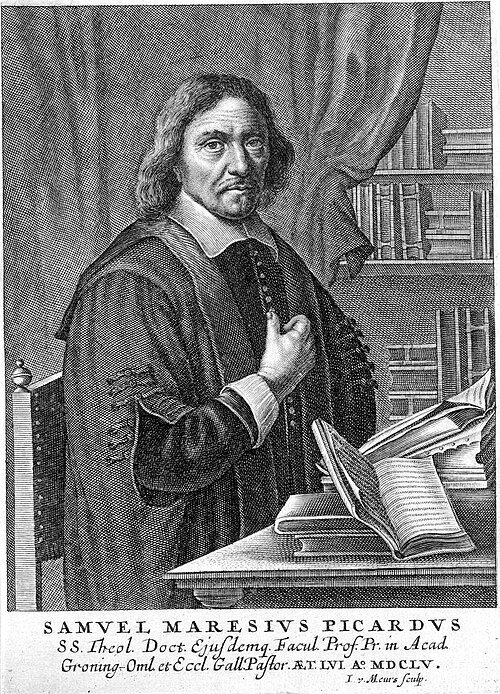
Chiliasm Unnerved,
James Dodson
addressed to
Mr. P. Serarius;
By
Samuel Maresius.
Groningen,
Printed by Johannes Cöllen, bookseller and printer.
In the year 1664.
Samuel Maresius's Chiliasm Unnerved (1664) stands as a representative specimen of classic Reformed historicist eschatology at a moment of acute pressure, when Chiliast expectations were proliferating across the Protestant world and demanding serious theological response. Writing within the four-element framework shared by the mainstream Reformation—historicist hermeneutics, postmillennial expectation, the conversion of the Jews, and the destruction of the dual Antichrist in Rome and Constantinople—Maresius defends the spiritual and heavenly character of Christ's kingdom against every form of carnal millennialism with considerable exegetical force and structural clarity. His demolition of astrology as a theological source, his chain-argument against the Chiliast sequence from universal Jewish conversion through Palestinian restoration to Levitical worship, and his insistence on precisely two sensible advents of Christ are all arguments that retain their weight and deserve careful engagement. The reader should however note that Maresius operates with the continental sequencing in which the millennium is a concluded past epoch, a position that was already being reassessed by British Reformed theologians moving toward a future millennium conditioned on prior prophetic fulfillments, and his occasionally dismissive treatment of the Jewish conversion question requires more nuance than he brings to it. His hermeneutical principle—that OT prophetic language about Israel must after the incarnation be read evangelically concerning mystical Israel and heavenly Canaan—is sound as far as it goes but requires the further distinction, which Maresius does not fully develop, between the Parousia as spiritual millennial arrival and the Second Coming as final bodily advent, a distinction that would have given his spiritual-kingdom argument a more positive and complete eschatological account. Read with these qualifications in view, Maresius remains an indispensable witness to the integrity of the classic Reformed framework and a powerful corrective to every form of the carnal millennialism that continues to distort Protestant eschatology in our own moment.—ED.
[Dedication Page 1]
To the Reverend and Most Learned Man,
Mr. Peter Serarius,
Samuel Maresius sends greeting.
If hoary age lends any authority to error, then the palm must be awarded to your Chiliasm, although in its defense you do not follow the hypotheses of earlier men in every respect. For immediately after the times of the Apostles it began to gain ground among those who, carried away by Jewish prejudices, preferred to invent some earthly kingdom of Christ rather than simply and absolutely confess it to be spiritual, mystical, and heavenly.
Yet the more plausible that opinion is to the flesh—which, weighed down by its own burden, cannot very easily strive upward toward intelligible things—the more suspect it must always be to the godly and faithful, who know from the Scriptures how to distinguish the way from the homeland, the race-course from the goal, and the place and time of battle and conflict from the time and place of triumph. For it is absurd to wish to expect on earth those things which are at last to be obtained in heaven.
Nor do these imaginations harm only the salvation of individuals, while they await on earth and in Palestine the delights of the Kingdom of Heaven, which ought at last to be sought and hoped for in the heavens, according to that most celebrated formula of the ancient liturgies, Lift up your hearts. Rather, they also greatly burden the common cause of the Church before the supreme Powers, as though the Church’s halcyon days were to come forth by means of their destruction.
[Dedication Page 2]
Common minds, to whom it is almost implanted by nature to loathe present things and hope for better things from the future, are easily inclined toward innovations in the Commonwealth, where, from dogmas of religion, they are commanded to expect better things day by day. Nor are we ignorant what the progeny of the Quakers in neighboring Britain, under the vain hope of the Fifth Monarchy, have hitherto meditated and attempted.
Most men of nearly that flock—men otherwise not bad—and you also among them, Most Learned Sir, judged that such revolutions of affairs in this world were portended last year from some conjunction, I know not what, of all the planets in Sagittarius. When little books on that matter had appeared in Dutch and Latin, yours among others—which, according to your courtesy, you had sent to me—I was asked by one of our students, an excellent young man, Mr. Paulus Onia of Lesna, to compose for him, after the academic manner, a disputation on that subject. I was unwilling to refuse him.
Accordingly, here on the 30th of March of last year, that disputation on the matter was held, which I have now caused to be reprinted in the present little work. I had hoped that it would not proceed beyond the bounds of the Academy. But it pleased you, who, because you abound in leisure, indulge these speculations rather willingly, to attack it in a public writing.
Having seen that, I had resolved to keep silence: first, because advancing age and weightier occupations call me away from controversies of this kind; secondly, because I did not wish to enter publicly into conflict with you, a good and pious man, and otherwise my friend; thirdly, because your own little book seemed to me to carry its own refutation along with it.
Yet at length, when certain men urged me, judging that something ought to be replied, I began, in my usual manner, to return something. And in three disputations held successively, with those most select young men as respondents—Mr. Jacobus ab Hummel, of Eybergen in Gelderland; Mr. Johannes
[Dedication Page 3]
Maurius, of Drenthe; and Mr. Michael Engels, of Ketwig in the Mark—I refuted the first part of that writing of yours which had been opposed to me.
My intention was to examine the rest in the same manner. But so great a nausea seized me at those absurd opinions—concerning the kingdom of Christ in the flesh, soon to be established at Jerusalem; concerning the Martyrs and Saints who are then to rise again and live delicately with us on earth; concerning the significance of the stars and their spiritual dominion—that I abandoned that undertaking. This was especially so after I happened upon a new little book of almost the same genius as yours, entitled The Morning Awakener of the Jews, filled in general with the same dreams, although differing from yours in many heads. Yet, if I had continued in the refutation of yours, I would have had to bring that book also to the same anvil.
But I have not undertaken the task of bringing back to the rule of the Divine Word whatever others rave about. Too heavy a province would lie upon me if, as though I were prefect of that hospital which is assigned to the incurable, I were bound to bind up the wounds of them all.
You had indeed expected the final destruction of Roman Babylon from that quarrel which had hitherto prevailed between the Most Powerful Monarch of the French and Pope Alexander. But what, already at the time of the former disputation on the conjunction of the planets a year ago, I believed to have taken place—namely, that the Pope had returned into favor with the King, because rumor so reported—is now, while I write these things, reported to have been fully accomplished, so that in that respect the hope of the Chiliasts has vanished.
Although I do not deny that even that peace is no less glorious to the Most Powerful King of my France than disgraceful to the Pontiff, who had to eat what he had badly mixed for himself. Certainly it contributes to the further wearing down and depression of the Roman See, though not to its final overthrow, which you seemed altogether confident would proceed at this time by the arms of the French. At least on this occasion all good men ought mutually to congratulate one another that much has fallen away from pontifical arrogance.
Whether the verses lately circulated throughout this Belgium in the public newsletters of March 11, as though transmitted from France, tend to that purpose, let the judgment be yours:
The cock* has crowed; the Apostle weeps: behold him weeping;
It shows that Peter, when erring, repented.
Behold a new cock and a new Peter—but from how unlike a cause!
The former warned Peter to weep; but this one laughs.
But as to my having wished this rather slight gift to be inscribed to you, Most Learned Sir, as an ἀντίδωρον, a return-gift for each of your two little books, you will reckon it the more equitable in proportion as you were the more liberal in wishing both to oppose and to inscribe to me your lengthy apologetic response.
Yet this saw I shall not draw back and forth in future, neither with you nor with anyone else. I shall spend the remaining residue of life upon better occupations than refuting opinions of this sort, which are more than sufficiently refuted by themselves, by their own hypotheses, and by the disagreement of their own defenders.
Nor indeed would I wish to snatch from you those little rattles of yours, with which you are so greatly delighted. It is enough for me to have cut through the grosser sinews by which this machine seemed to be moved, so that it can neither stand any longer nor proceed any farther.
Nevertheless, so far as I am concerned, it shall be permitted you to abound in your own sense. And mindful of the apostolic sentence in Philippians 3:15–16, I shall remit nothing of that Christian love and affection with which I have hitherto embraced you.
Farewell.
Groningen, March 12, according to the local style, 1664.
_____
* The poem plays on Gallus, meaning both “cock/rooster” and “Frenchman/Gaul.” It contrasts the biblical cock whose crowing moved Peter to tears with the French “cock” who makes the pope/Peter weep while himself laughing.
[PAG. 1]
THEOLOGICAL DISPUTATION
Concerning the
CONJUNCTION
of all the Planets in Sagittarius, which is said to have occurred, as they report, on the 1st or 11th of December in the year 1662, and concerning those things which are said to be portended thereby.
1.
Nothing is more common among men than to be easily persuaded concerning those things which they vehemently desire, and to fashion prophecies out of their own wishes. To this may rightly and deservedly be referred that common proverb, Lovers frame dreams for themselves, and also that other, The Sabines dream what they wish. And just as those who are seized with panic terror tremble at the rustling of the least leaf, as though Hannibal were at the gates, and as though everything they fear were already hanging over them; so those who have once conceived vain hopes gather from every side material for cherishing and sustaining them, and drag, by a twisted neck, whatever extraordinary things happen either in the commonwealth or in nature.
2.
This may be seen in the Jews of the present day, who eagerly catch at any empty little rumors from which they suppose the advent of their imaginary Messiah to be imminent. Of this very thing Menasseh ben Israel, the Amsterdam Jew—otherwise, according to the genius of his nation, a learned man while he lived—gave a specimen in that little book which he entitled The Hope of Israel. Nor are there lacking among the circumcised those who, at the first crash of the sky, believe that the coming of Elijah is at hand, and prepare themselves to receive him.
3.
But this also obtains in that sort of men whom the common people are accustomed to call Humorists. Since these men are, for the most part, not bad men, from disgust at that great corruption which rages far and wide in this world, they await a calm and halcyon season that will succeed these storms, and bring in a great and favorable revolution of affairs in the age. Hence so many bold assertions—not so much conjectures as affirmations—concerning the imminent destruction of Antichrist and Rome, and concerning the day of judgment. Of these, the former is assigned in a little book published in London eight years ago to the year 1666; the latter to the year 1711.
And recently we seemed, from the face of public affairs, to be expecting this not improbably, when the most powerful Monarch of the French moved arms against Alexander, and seemed, as it were, girded to execute the decrees of God against that mother of fornications. But that hope has been beheaded by their reconciliation, while meanwhile so many signs of the last return of Christ the Saviour to judgment, such as are noted in the Scriptures, are showing themselves. Nevertheless, since it is not ours to know the times or seasons which the Father hath put in His own authority, Acts 1:7, we prefer here to suspend judgment, and silently await the work of God, which without doubt will come to pass in its own time according to Scripture, 2 Thess. 1:8; Rev. 18:5–8, rather than rashly define anything concerning such matters.
[Page 2]
4.
Hence also so many dreams go forth into the open air, so many new revelations are hammered out and dragged into the light; perhaps it would have been better for these to have been suppressed, since the event has already in part proved their falsehood and vanity. Hence especially these four chief things are expected at this time by some men:
First, the universal conversion of the Jews to the faith of Christ, and the restoration of the Jewish commonwealth in Palestine.
Second, the abolition of the man of sin.
Third, the institution of the glorious kingdom of Christ on earth, to last for a thousand years.
Fourth, the first resurrection of the Martyrs, who, with the godly and faithful, are to live delicately in this kingdom of the Fifth Monarchy, until through Gog and Magog still other wars rush in.
And again great Achilles is sent to Troy.
5.
But in these atrabilious imaginations there is scarcely anything sound. The Apostle indeed, Rom. 11:25 and following, predicts some conversion of the Jews before the last advent of Christ and the resurrection of the dead. Yet certain learned men, with Melanchthon—whom Marlorat also seems to follow, having transcribed his words on this passage—understand this prophecy of Paul concerning the conversion of the Jews in this way: that it will come to pass that, from time to time until the end of the world, some of the Jews will be converted. These perhaps will make up that number of one hundred and forty-four thousand sealed out of all the tribes of the children of Israel, of whom mention is made in Rev. 7:4.
Hence there are not lacking those who deny that this universal conversion of all the Jews is to be expected near the end of the world. Among these is that anonymous author of the book published in England, whom we mentioned a little before. To these are added also Luther and Cramer, cited by Johann Gerhard, On the Destruction of the Jews, §111; and Gerhard himself seems to waver, because of those reasons which he there rehearses to himself. At least, just as the manner and order of that more solemn conversion of the Jews lies on the knees of God, so we rightly deny that they will return into the land of Canaan and possess it again, as the same Gerhard establishes the negative by various arguments in the same place, §109.
6.
And certainly those who dream of this restoration of the Jewish commonwealth in Palestine, and who, because they suppose it to be imminent, show themselves beyond measure liberal toward certain Jews who are in distress, ought at the same time to expect the restoration of the Levitical worship and of the Temple of Jerusalem to that condition which both the Jews await through their pseudo-Messiah, and the Papists trifle about as to be brought forth through their Antichrist. One may rightly call him a figure formed according to the idea of the Armillus of the circumcised; concerning which see both Buxtorfs, both in the Talmudic Lexicon under that word, and in the Jewish Synagogue, last edition, chapter 50. For the Jewish polity was so bound up with the Levitical worship that its laws cannot obtain when that worship has been overthrown.
7.
Those things which are thrust upon us to satiety by the patrons of that absurd opinion from Moses and the Prophets are either in the order of promises, not predictions; and since promises are conditional, they therefore lacked their event because those who had received them did not stand to the condition. Or, if they are numbered among predictions—which we allow—they must be considered fulfilled in the literal and lesser sense in the liberation of the Jews from the Babylonian captivity, but mystically and spiritually in the redemption of the true Israel by Christ, as both are signified in Zech. 9:11.
Against this error, see Galatinus, On the Secrets of Catholic Truth, book 9, chapter 9, and Raymundus Martini, whom Galatinus almost always interpolated, Pugio Fidei, part 2, chapter 14, §4. Both demonstrate from the Scriptures and from Jewish monuments that the Jews ought no more to await a third possession of their land than a third temple.
8.
As to the second point, the Apostle indeed teaches that the man of sin is to be worn down little by little by the Spirit of the mouth of Christ, but not utterly abolished otherwise than by His illustrious advent, when He shall come to judge
[Page 4]
the quick and the dead, 2 Thess. 1:8, when He shall appear the second time without sin unto those who look for Him unto salvation, Heb. 9:28. Let no one here dream of some illustrious third advent of Christ, intermediate between the former, when the Word was made flesh, John 1:14, and that last advent at the consummation of the age, when He is to judge the quick and the dead. For the Christian faith, taught from the Scriptures, has hitherto learned to expect no other.
It is known among all how much the empire of Antichrist has suffered through the Reformation, and how much his strength has been worn down by the preaching of the Divine Word. That very rupture which recently intervened between the Pontiff and the King of France has reduced him into the order of the humbler brethren, since he was obliged in every respect to satisfy the King, and did not dare to hurl against the most powerful King the brutish thunderbolts of his predecessors. But what the last destruction of Antichrist will be, when, and how it will proceed, is not easy to define. At least in its own time that will happen which they say was once uttered by Emperor Frederick:
Rome, long tottering, driven by various errors,
Shall fall, and shall cease to be the head of the world.
9.
The millenary kingdom of Christ on earth—which is the Fifth Monarchy and the third head of this expectation—is a brain-born fiction. It was first forged by Cerinthus, the heresiarch; and the supposititious author of the poems commonly called Sibylline, likely brought forth by the Paraclete of Montanus, adopted it in such a way that he led many of the ancients into participation in a plausible error. And it is a matter of just wonder that Erasmus Schmidt, professor at Wittenberg, undertook an apology for these poems, added at the end of his Greek-Latin New Testament illustrated with his learned notes. Whoever wishes to see very many sayings of the ancients on this matter should consult Sixtus Senensis, Bibliotheca Sancta, book 5, annotation 233, and book 6, annotation 347.
10.
Certainly Christ Himself, in that solemn confession of His before Pilate, professed in express words that His kingdom is not of this world, John 18:36. Nor does He take away earthly kingdoms from others, who has merited heavenly kingdoms for us. Nor will He return from heaven—which receives Him until the times of the restitution of all things, Acts 3:21—except when He shall descend at the consummation of the age to judge the world and render to each according to his works.
And as readily as I pardon the milder opinion of those Chiliasts who promise to the Church on earth only some moderate quiet and relaxation after Antichrist has been cast down from his throne—although in these lands wars and conflicts are never lacking to the godly—
[Page 5]
so absurd to me seems the opinion of those grosser Millenarians who suppose that Christ will visibly reign on earth and will offer to His own those delights which flow more easily from Virgil’s Fourth Eclogue than from the divinely inspired Scriptures. See Jerome, preface to book 18 on Isaiah, to Eustochium.
11.
And that the passage Rev. 20:4 does not tend to that end is clear even from this: that those thousand years have long since passed, from whatever point you fetch their beginning—whether from the incarnation and passion of Christ; or from the time of the Evangelical preaching through the Apostles and the overthrow of the Jewish polity, from which to Gregory VII learned Dutch interpreters note that about a thousand years flowed by; or finally from the empire of Constantine the Great, under whom ethnic idolatry began so to totter that Satan was then truly bound so that he should no longer seduce the nations.
On this matter see both the Dutch interpreters on Revelation 20, and Ussher, On the Succession and State of the Christian Churches, chapter 1, and Johann Crocius, Anti-Weigelius, part 1, chapter 13. That passage in Revelation indeed has its difficulties. But Chiliasm sufficiently collapses so long as it is not apodictically proved that the beginning of those thousand years must be drawn from the total overthrow of Antichrist. Against that stands the Apostle of the Gentiles, who places the total ruin of Antichrist at the last advent of Christ, 2 Thess. 1:8.
12.
The first resurrection, the fourth hope of these men, mentioned in the same place, Rev. 20:6, is mystical, not physical, of the same order as that which is celebrated elsewhere in the Scriptures, as particularly in Eph. 5:14. Yet it must also be observed that the restoration of the Church is sometimes described under the image of resurrection, as in Ezek. 37:1 and following, and Rev. 11:11.
At least, just as absurdly as you would conceive Christ reigning on earth after the manner of men, when He denied before Pilate that His kingdom is of this world, as we have just seen, so absurdly will you imagine either some partial resurrection of the godly, when all are to rise together, just and unjust, Dan. 12:2; John 5:28–29; Acts 24:15; 1 Cor. 15:22–23; or a familiar and daily commerce of mortals and wayfarers who shall remain on earth with the blessed and those who have attained their end, so that they may eat, drink, play, and live delicately with them for a thousand years.
13.
For what Christ granted His Apostles, that they should eat and drink with Him after His resurrection, Acts 10:41, was not a prelude of that mixed state, which carries with it a thousand absurdities, but
[Page 6]
served only to prove the truth of His resurrection, lest any scruple concerning it should remain in their minds. Nor, if the ancient Doctors of the Church were entangled in those errors through the Pseudo-Sibylline books, are they on that account less erroneous.
Certainly, as Jerome notes in the place already cited, Dionysius of Alexandria learnedly and eruditely refuted what had slipped from Irenaeus on these matters. And it deserves the less credit because Apollinaris, who on account of other errors is not well spoken of among the ancients, undertook the cause of Irenaeus against Dionysius. But you may see this error also solidly refuted against Weigel by Crocius, Anti-Weigelius, part 2, chapter 13, question 4.
14.
It is not now our purpose to attack with exactness these monstrosities of opinion, since to relate them is to refute them. But we judge that we will do something worthwhile if we show what a figwood prop some men have very recently sought for them from the placita of calendar-writers, who, from the conjunction and synod of all the planets in that sign of the Zodiac which is distinguished by the name Sagittarius, which occurred on the 1st or 11th of last December, dare both to predict and to expect all these things.
15.
From this our city of Groningen there first appeared, about three months ago, a Dutch sheet with this title, Wat Nieuws en Wonderlijcks, printed for G. V. D., and, unless I am mistaken, from the press of Augustinus Eyssens, from the observation of Theodore Hoen, whose name is celebrated among calendar-writers. He affirmed that a similar conjunction had not occurred since the time of Noah’s flood, when it had taken place in Aquarius.
And when something similar had appeared from Germany in German under the title of a Prodromus, Peter Serarius, who lives at Amsterdam, a vehement assertor of Chiliasm, composed from both a Brief Dissertation—as it is entitled, although it is sufficiently prolix in Latin—Concerning that fateful and admirable conjunction of all the planets in one and the same sign of Sagittarius, the last fiery sign of the triplicity, on the 1st and 2nd day of December in the year 1662. In that dissertation, as much from the Sacred Scriptures as from the nature of the conjunction itself and other circumstances of preceding and accompanying things, he says it is clearly proved that that illustrious advent of Jesus Christ is imminent, in which He will, first, recollect the scattered nation of the Jews; second, abolish the man of sin, who hitherto has obtained the chief rule both in the Church and in the world; and third, at last erect His glorious kingdom on earth.
16.
That man is certainly good, pious, and learned; a constant friend of our Duræus the Irenicist, and once, unless I am mistaken, his colleague
[Page 7]
at Cologne. But he is self-opinionated, and is believed to be somewhat inclined toward Schwenckfeldianism; although in letters recently sent to me, with which he was sending this dissertation of his, he professed that among the doctrines of the Christian parties he judged none more agreeable to the Scriptures than the Reformed.
Indeed, not long ago he rendered excellent service in refuting in Dutch that Socinian and impious little book entitled On the Apostasy of Christians; and, in my judgment, much better service—let this be said without offense to him, for it has always been permitted to good men to differ even concerning the same matters while friendship remains unharmed—than he rendered in defending in French against Mr. Amyraut the millenary kingdom of Christ, which Amyraut had attacked at length against Mr. Launoy, now among the saints, once the alpha of his friends.
17.
I do not wish to linger over the title of the dissertation of that Reverend Man, nor to weigh all the things which he has heaped together from the circumstances of preceding and accompanying things. Let it suffice to have observed at the threshold that he does not even agree with our Groningen G. V. D. For the latter had said, from Theodore Hoen, that the Noachic conjunction of the planets had taken place in Aquarius; but the Reverend Man himself, with the same Theodore Hoen and others also being praised—who claim that they have certainly gathered this from tables of conjunctions—says that it occurred in Pisces, a watery sign, page 13.
And he falsely supposes that another illustrious advent of Jesus Christ is to be expected, besides that in which He shall appear returning from heaven at the consummation of the age for the judgment of the quick and the dead. For hitherto the Christian faith, instructed from the Scriptures, has learned to expect no other. And since this is the first falsehood of all these conjectures, whatever is built upon so sandy and false a foundation must necessarily collapse.
18.
But let us see whether from the nature of that conjunction any such thing can be drawn forth even by little figs. Certainly I do not deny that such is the condition and corruption of human affairs, in which there is nothing sound, that it easily indicates that we are not far from the consummation of the age. The sixth millennium of the world is turning toward its end, which eternal Sabbatism seems about to follow. And very many things predicted by Christ and the Apostles as about to happen before His return to us have long since obtained their event, so that scarcely anything else remains for the godly than to pant after their last deliverance, and repeat that cry of Rev. 22:17, 20: “Even so, Lord Jesus, come.”
But that the conjunction of all the planets in Sagittarius has anything to do with this—much less with those things which the Chiliasts dream, and those who with the Quakers and the English whirlwind-spirits await the Fifth Monarchy on earth—I deny and utterly deny.
[Page 8]
19.
For first, concerning neither the motion, nor the position, nor the number of the planets do present-day astronomers agree among themselves. For there are not lacking men very much versed in this kind of study—though others call them human planets—who number this earth which we inhabit among the planets, and suppose that it presents and displays itself to the inhabitants of the moon, if it has any, or if some presume that it has any, in such a way as the moon is to us.* They also simply subtract the sun from the order and number of the planets, asserting that it is perpetually fixed in the center of the universe, incapable of that double annual and diurnal motion upon which depends the constant alternation and variation of night and day and of the seasons of the year, as well as either that miraculous standing still which occurred in the time of Joshua, Josh. 10:12–13, or that portentous going backward which happened in the time of Hezekiah, 2 Kings 20:10–11.
20.
Nor will that conjunction favor this expectation any more if, dismissing the paradoxes of Copernicus and the Copernicans, or the vortices of Descartes, you prefer to philosophize from the principles of Ptolemy. For Salmasius, in his learned Diatribe on Climacteric Years, pages 308 and 309, will teach you that neither Ptolemy himself nor any of the ancient mathematicians either made mention of these great conjunctions, or at least judged that by them a judgment ought to be made concerning general changes of the world.
And you will dream that Platonic palingeneses are portended from these revolutions and constellations just as readily as that recollection of the Jews or first resurrection of the martyrs concerning which you wish to flatter yourself. The phenomena of nature, in relation to spiritual things, are like those pictures which, from whatever direction you look at them, will always seem to themselves to be looking at you.
21.
Besides, our soothsayers are not sufficiently consistent with themselves. For some refer this to the millenary kingdom of Christ, others to the consummation of the age. For Alsted—a distinguished man, and one who seems to have erred in this error most learnedly of all—casts the beginnings and preparation of the millenary kingdom into the year 1694. When that kingdom is finished, Satan will again be loosed, Gog and Magog will fight against the Church, and the age will be disturbed with various commotions, Christ receiving Himself again into heaven with those who were partakers of the first resurrection. See his Thesaurus Chronologiae, chapter 54, which contains the chronology of the great conjunction. And to this Mr. Serarius aims.
But Theodore Hoen predicts from it the end of all things, because, when a similar conjunction had taken place in Aquarius at the time of the Flood, this present conjunction in Sagittarius, a sign which they call fiery, portends that the time is now at hand, as Ovid speaks in Metamorphoses I:
_____
* [This describes Copernicans who count the earth among the planets and remove the sun from the planetary order. Maresius is not here accepting their astronomy but using disagreement among astronomers to weaken astrological certainty. ED.]
[Page 9]
When sea, and earth, and the seized palace of heaven
Shall burn, and the laborious mass of the world shall suffer.
22.
But neither are they sufficiently agreed among themselves concerning the thing itself. For Alsted indeed contends that the great conjunction of Jupiter and Saturn occurred in a watery trine at the time of the Flood. But he had not seen, as our men do today, that then all the planets were conjoined in the same sign, either Aquarius or Pisces.
Moreover, it seems sufficiently absurd that astrologers, according to their own pleasure, distribute the four trines in the Zodiac by elementary qualities, so that one is watery, another fiery, a third airy, and the fourth fiery. For who taught them this? Since those properties cannot belong to the stars either formally or eminently. Not formally, certainly, if the whole school of the Peripatetics is to be heard, which denies that the matter of the heavens and stars is elementary, and maintains that they consist of some fifth essence, I know not what, to which neither moisture, nor dryness, nor heat, nor cold belongs.
But if the primordial incorporeal light was divinely condensed into stars on the fourth day of the six days’ work, then indeed they might in some way be called fiery, but not earthly or watery, unless by those who would wish in one body to compound cold things with hot, moist things with dry.
23.
Nor do they possess those qualities eminently. For by no certain reason, nor by indubitable experience, can it be established what the influences of those constellations are of which the whole Zodiac consists, or what specific operations they have upon these lower things, so that we should attribute to one the power of becoming watery and moving waters, and to another the efficacy of kindling fire and intensifying heat.
And, to speak only of Sagittarius, whom the Jewish astronomers call the Arrow, as they call Aquarius the Bucket: since he is the last of the autumnal signs, he ought rather to be reckoned among cold signs than hot, and among earthly or watery signs rather than fiery ones. As an arrow is attributed to it because under it we feel the first prickings of cold and winter.
24.
And indeed how little fiery Sagittarius was recently, when all the planets are said to have come together into his inn, as though about to deliberate together concerning the Jewish-Christian commonwealth—unless perhaps insofar as under him, to conquer the cold, a blazing hearth had to be built everywhere—is sufficiently proved by that bitter and long-lasting frost out of which we are scarcely escaping.
[Page 10]
And just as Crassus, in Plutarch’s life of him, falsely answered a certain philosopherling who was trifling before him that it was dangerous to move camp under Scorpio, saying that he feared Sagittarius much more, because he was being assaulted everywhere by the arrows of the Parthians; so I may rightly say that less was to be feared from Sagittarius at the time of that conjunction than from Aquarius, pouring out upon us his snows and frozen waters.
25.
But these explorers of the heavens, as they are called in Isa. 47:13, are so absurd that not only do they assign elementary qualities to those most pure and simple bodies of the stars, and divide their empire over the elements according to their pleasure, but beyond this they dare to attribute moral qualities to their planets, so that they make some good, others evil, and others of a middle condition, according as they have applied themselves either to good ones or to evil ones. But Moses would have spoken falsely when he said that God created all things very good, Gen. 1:31, if He had willed some of the stars to be evil and harmful by their condition.
26.
And not content with dividing the elements among the stars by most subtle devices, so that each of them might know what lay beneath its empire, men have gone farther, and have assigned to each sign of the Zodiac the rule of individual members in the human body: the head to Aries, the neck to Taurus, the arms to Gemini, the breast to Cancer, the heart to Leo, the intestines to Virgo, the reins to Libra, the private parts to Scorpio, the thighs to Sagittarius, the knees to Capricorn, the legs to Aquarius, and the feet to Pisces.
If you ask the reason for this distribution, you will hear nothing else than that they so will, so command, and let their will stand for reason. Nor did they stop even here; for, as though they had been appointed by the Lord as overseers for the dividing of households among the stars, they again assigned individual regions and provinces of the world to individual signs, as though for the purpose of relieving the care of the Deity Himself in the government of the universe.
27.
In all these things you may see the clear origin of both Gentile and Pontifical idolatry, the latter having interpolated the former. For you should not think that it came from any other source that the heathen once assigned to their distinct deities their own elements, arts, and provinces to govern, even with contrary interests and efforts, through which Mulciber stood for Troy, Apollo against Troy, and also their own diseases either to inflict or heal. All these things have revived in the Papacy.
Indeed, upon foundations of this kind rests a great part of that most hideous magic, which has assigned to each sign of the Zodiac and each planet its own spirits, to be called forth by certain charms, detained by certain characters, and bound to certain metals
[Page 11]
and figures. Agrippa treats these things extensively and harmfully in his Occult Philosophy, book 3.
It is astonishing that men otherwise pious and learned should wish, from such foolish and harmful principles, from a discipline so vain, which is everywhere condemned in the Sacred Scriptures, Isa. 40:24–25; 47:13–14; Jer. 10:2, to define those things which pertain to the economy of the kingdom of Christ and are known to Him alone.
28.
And since Moses so expressly testifies, Deut. 29:29, that secret things belong to Jehovah our God, I wonder that Mr. Serarius so fearlessly asserts, page 18, that the Creator placed in the heavens the signs of all things that are to happen from the first beginnings of the world, so that those who have eyes to see might also see there, as in a mirror, the things which in their own time are to happen on earth.
For in that case the Church would not have needed prophets supernaturally illuminated to foretell future things, but only optical tubes and skilled astrologers, who by their help might penetrate into all the secrets of God expressed in the stars, and might, with the aid of the steganography of Trithemius, explain and resolve that heavenly Scripture which is formed by the position and aspects of the stars, according to the follies of Gaffarel in part 4 of his Unheard-of Curiosities, which concerns the reading of the stars.
29.
But among those things which Sacred Scripture declares to become known to us through the heavens and stars, Ps. 19:1–2; Rom. 1:20, the secrets of future events, which God willed to reserve to Himself alone, are not numbered.
But I proceed further. And since these good men wish so many and so great things to be portended and presignified by that conjunction of the planets, I would gladly ask them why they would rather gather these things from the concurrence and conjunction of all the planets in the same sign than from their opposition or other aspects. Certainly, if the moon at the time of her conjunction with the sun ceases to shine, but in opposition is full; if eclipses of the sun, which occur at the time of its conjunction with the moon, are only apparent, while those of the moon itself are real at the time of opposition, I do not see why the conjunction of the planets should be more feared than their opposition.
Then, if this earth must be reckoned among the planets, as the Copernicans maintain, I do not understand why the other planets, whether disjoined or conjoined, can have more power over it than it has over the others.
30.
But in vain will you strive, with the learned man, page 23, from places of Scripture which mention signs in the sun and moon, Matt. 24:29; Luke 21:25, and elsewhere throughout. For if those signs had to be taken literally, they would be altogether portentous and contrary to the laws of nature. But in that
[Page 12]
conjunction of the planets nothing anomalous appeared, much less monstrous; nothing that departs from the natural law which God placed upon them from the beginning, from which one might rightly gather, as Dionysius the Areopagite is once said to have done from the miraculous eclipse of the sun which occurred at the death of the Lord, either that the Author of nature was suffering, or that nature itself was soon to fall.
31.
But Thomas Campanella, the Dominican monk, supplied something to be laughed at by the learned when, in Physiology, chapter 3, he numbers the anomalies of the equinoxes—which perhaps are in men’s computation, not in the things themselves—among the signs of the last judgment. Likewise it is a matter of wonder that Hugo Grotius, On the Truth of the Christian Religion, book 1, should strike against the same stone, and number among the diagnostic signs of the last conflagration the sun approaching nearer to the earth than before.
For those declinations and eccentricities of the sun, if there are any—let judgment concerning them rest with those more skilled in such matters—preserve a perpetual law. Indeed, the more the sun seems to us to be nearer, as in the time of winter, the less it transmits its ardor and heat to us. Therefore those things which proceed from the constant law of nature ought not to be numbered among portents and prodigies.
32.
Wherefore, if all the planets were recently seen under the same sign of Sagittarius, this was done from their regular and ordained motion, which God imparted to them from the beginning of creation. Thus it ought rather to have been a portent to us if they had not come together there at that article of time.
Indeed, even if man had not sinned, those conjunctions and oppositions of the planets would have occurred under the direction of Divine Providence. The stars and heavenly bodies were indeed divinely established as diagnostic and diacritical signs of the times and seasons of the year, Gen. 1:14, as the learned men of whom we are speaking continually urge. But they were not established as prognostic signs of the hidden counsels of God, concerning which we are to be instructed from the book of Scripture, not from the book of nature. These things must be learned from the Bible, not from the stars; and what in this kind is destitute of the authority of the Scriptures is despised with the same ease with which it is proved.
33.
Let the stars, for our part, influence elementary bodies so that they variously affect them; nevertheless, no right belongs to them over the minds and wills of men, which are of a more eminent nature and condition than they are; and the wise man will rule the stars. Then I would gladly ask these men whether those things which they dream are going to happen because of this conjunction of the planets, or whether this conjunction and syzygy has occurred because those things are going to happen. For even if one thing being suitably placed were
[Page 13]
soon to happen, neither of those alternatives would follow from it.
In many cases, two things can be posited at the same time, neither of which will be the sign, cause, effect, or necessary adjunct of the other. Peter does not philosophize because the staff stands in the corner; nor does the staff stand in the corner because Peter philosophizes, although it can happen that in the same chamber both the staff stands in the corner and Peter philosophizes.
34.
Therefore learned men waste their labor and oil when they attempt to adapt certain more notable events in Church and commonwealth to those great conjunctions of the planets, although not of all the planets, as was laboriously done by Alsted, and after him by Mr. Serarius in his dissertation, pages 10 and 11. For those events did not occur on the day and moment when those conjunctions took place. Indeed, although those planets never remain together for long, because some advance more quickly and others more slowly, they nevertheless wish the effects or significations of those conjunctions to continue for many years, just as they imagine that the effects of that great conjunction of Jupiter and Saturn, which took place in the year 1603, still endure.
35.
And so, since they return by fixed turns, and the preceding conjunction is perhaps held to continue until another takes place, by the same right you will necessarily refer absolutely all events—small, medium, very great, and middling—to some one of them, just as whatever happens in time must be referred to the conversion of the first movable as the measure of all our time.
And you would most absurdly maintain that from that momentary meeting of the planets in some sign of the Zodiac so many and so great things depend certainly and infallibly with moved operation, when each comes there by his own roads only for this reason, like Cato once entering the amphitheater, that they may leave; so that they do not even remain there for a moment, but proceed in their motion.
36.
Nor can the planets be thought to have obtained from that synod any new powers which they would thereafter unfold for the recollection of the Jews, the ruin of Antichrist, the millenary kingdom, and the resurrection of the martyrs. Rather, from the analogy of the conjunction of the moon with the sun, their powers could be said to have been weakened rather than strengthened by that conjunction. For the moon, by her conjunction with the sun, falls away from that light which she fully enjoys in her opposition to it.
37.
I readily confess that many unexpected revolutions have happened in our times, on account of which the year 1660, as Mr. Serarius observes on page 16, could rightly be called Annus Mirabilis, or the year of prodigies and marvels. But no reason can be brought forward for any connection of those affairs
[Page 14]
either with the conjunction of the planets that was only to occur two years later, or with those heads which are expected from it.
The Providence of God turns human affairs according to His own pleasure in such a way that He often brings forth His light out of darkness, often mocks the empty hopes and foolish counsels of men, often raises unexpected storms from the place where the greatest calm was expected. But to wish to assign all these things to the aspects of the planets—what else would that be than, having left the Creator, to leap over to creatures?
38.
If any monsters among men or beasts were brought forth around the years 1659, 1660, and 1661, which Mr. Serarius touches upon in the same place, these ought not to be ascribed either to the recent conjunction of the planets, which had not yet occurred, or to the preceding one, whose powers ought already to have failed. Monstrous births usually have their own causes on earth, so that they need not be fetched down from heaven out of the stars. Such portents have from ancient time been produced from time to time, even among the Gentiles, as may be seen in Julius Obsequens, On Portents.
I confess that from such things an indication can be taken of God’s wrath against men and of His impending judgments, and that in this way God provokes mortals to repentance. But from such things to wish to divine the auspices of the Fifth Monarchy, and the first resurrection, and the return of the Jews into Palestine—which, if they were to be expected, ought to be called joyful rather than mournful things—would be to proceed farther than is lawful.
Nor do I see why what the learned man reports concerning an infant born in Norway at the beginning of the year 1661, who in his mother’s womb was heard twelve times to cry out, “Woe to Denmark, woe to the whole world,” pertained more to the preceding conjunction of the planets than to the recent one what was lately reported in the newsletters, that an infant had been born in England not only with all his teeth, but also speaking perfectly and intelligibly on the very day of his birth.
39.
Indeed, often in such things, God permitting it, Satan and the ventriloquial spirit intermingle themselves, in order to deceive men and lead them away from serious confidence in God and from the study and oracles of the Scriptures. To what end should these portents be esteemed more highly than the Apocryphal books of Tobit and Fourth Esdras, of which latter not even the Roman Church admits the book? Yet Mr. Serarius defends its authority, page 25—so that like lips may have their lettuces.
Nor, if either Scaliger—not Josephus, as the learned man thinks, but Julius Caesar Scaliger—or Bibliander thought more humanely concerning that book, is it therefore to be placed in the citadel,
[Page 15]
since it is stuffed with cabalistic trifles, and was forged by some semi-Jewish Christian, so that, under the name of a most holy man and of great celebrity among the Jews, the mysteries of the Christian religion—yet mixed with various errors—might be indirectly instilled into the Jews themselves.
40.
For that nothing was more frequent in the first and second century of Christianity than this sort of pseudepigrapha and pious frauds is better known among the learned than that it ought to be demonstrated at length. And that this Fourth Esdras was written after the books of the New Testament, no one moderately versed in that book and in these books will rightly be able to deny.
But the pretended prophecy of Tobit, which Mr. Serarius was pleased to transcribe in heavier characters at the end of his dissertation, neither exists in that form in the Greek and Latin copies, which mention only the second Temple to be built at Jerusalem after the Babylonian captivity had been loosed, according to the Prophets, so that in reality they contain, under the appearance of a prophecy concerning a future thing, a historical narration of a thing already done; nor do the things which the version of Paulus Fagius has, according to the Chaldaizing Hebrew copy of Constantinople, look anywhere else than to the ravings of the circumcised, who with their Messiah, and through him, vainly expect the repair of Jerusalem, and of the Temple, and of the Levitical worship in it.
41.
Nor does the learned man rightly conclude, page 17, that this conjunction of the planets portends those things which he says, because the day which preceded it, namely December 10, fell on the second Lord’s Day of Advent, whose Gospel, as they commonly say, is taken from Luke 21:25: “And there shall be signs in the sun, and in the moon, and in the stars,” etc. As though that our blessed God, to whom all His ways are known from eternity, besides this meeting of the planets and agitation of these heavenly powers—whether the stars ought to be distinguished by this name, let others see—had expressly commanded this prophecy and exhortation of the Lord Jesus also to be read aloud and inculcated to all on that very day immediately preceding this meeting, in case perhaps still in this last moment of time some would be willing to repent and deserve to be saved.
42.
I do not wish to scrutinize these words more closely, nor to inquire either how men, by repenting, may deserve to be saved, since all our merit, according to Bernard, is the mercy of God; or how the repentance or impenitence of men may be doubtful and hang in uncertainty for God Himself, since, according to the doctrine of these men, all things that are to happen even
[Page 16]
to the end of the world depend so much upon the fatal position of the stars that they cannot but happen; or how that annual distribution of Gospel readings can be referred to the commands and mandates of God—whether it be an invention of Paul the Deacon or of Alcuin in the time of Charlemagne—which nevertheless many think does more harm than good to the Church.
But I do not see what connection ought to be imagined between that conjunction of the planets and this Evangelical reading, so that they should be judged to have concurred together not without some special omen.
43.
For first, even if that observation were valid in the Gregorian, or new style, it nevertheless ceases in the old, or Julian style. And so that omen which, on this hypothesis, ought to have terrified Amsterdam, could not have obtained here at Groningen. For the vigil of that conjunction, which there was the second Lord’s Day of Advent, here among us was the first Lord’s Day of Advent.
Then it is false that that Evangelical reading from Luke 21:25 belongs to the second Lord’s Day of Advent, whose Gospel is taken from Matt. 11:2 and following; rather, it belongs to the first Lord’s Day, which, according to the Julian style, indeed fell on November 30 / December 10, and according to the Gregorian on December 3 / November 23. This is enough to disturb the calculations of our computists.
44.
Furthermore, those signs which Christ commemorates there seem to many rather to look toward the overthrow of Jerusalem by the Romans, and the destruction and dispersion of the Jewish nation, than toward its recollection and restoration. Indeed, even if they pertained to the consummation of the age, they would nevertheless portend none of those things which the Chiliasts invent and dream.
Then also those signs mentioned by Christ ought not to be understood literally but mystically, as is sufficiently gathered from Rev. 8:12; 9:2; nor do the Millenarians themselves deny it. For by the sun is understood the condition of the Church, and by the moon the political state. The sun of the Church is darkened and suffers its eclipses through heresies and the smoke of errors coming forth from the pit of the abyss; the moon of the polity is turned into blood when its face is deformed by bloody wars. Therefore the prophecy of Christ ought not to be dragged to those things which happen, or are imagined to happen, to the stars.
45.
Besides, granting, but not conceding, that the signs of which Christ makes mention are to happen sensibly in the very lights of heaven, the conjunction of the planets of which we are treating cannot be dragged to this. For as that conjunction was visible
[Page 17]
to no one, whereas in prodigies and portents this is required, so no sign ought to be considered to have been made in the sun, moon, and stars, when they suffer no subjective change or alteration, and all things in them proceed according to the motion first impressed upon them by God and the constant laws of nature.
Nor is there reason why, from the countenance and posture of these magnates of heaven and rulers of the world—for so Mr. Serarius calls them more than once, pages 13 and following—you should gather that their conjunction is portentous; since, on the contrary, it ought to have been a portent if at that article of time they had obtained another position and countenance. Thus from it you can gather by no certain argument that it is necessarily the forerunner of some great and eminent universal change.
46.
But, says the learned man, then the moon was seen, newly emerged from the rays of the sun, vehemently inflamed by bodily conjunction with Mars, wholly fiery and burning; and this the more because Mars himself also had been made more inflamed by conjunction with the sun, and the sun in turn more hostile and troubled by conjunction with Saturn.
To this finally is added that Mercury, who is good with the good and evil with the evil, is here necessarily the worst with the worst. For he, being bodily joined to Saturn, what else does he bring in this universal combustion by his influences than all kinds of fallacies, deceits, and betrayals, filling all things with sinister suspicions, secret conspiracies, and internal hatreds, and thus filling up the measure of all injustice and violence on earth? Meanwhile Venus and Jupiter, whose proper house this is, although they too were present, were nevertheless so remote and so hindered and obstructed by the combustion and malignity of the intervening planets, that by their more benign rays they could not penetrate to us so long as strangers were raging there in another’s house.
47.
I do not wish to dissect to the quick this grandiloquent speech formed from the hypotheses of the vainest discipline; nor to inquire by what right more is to be feared from combust planets than from others; or why the sun is corrupted and made hostile by conjunction with malignant Saturn rather than Saturn is corrected and improved by the nearness of the sun; or whence Mercury has so versatile a disposition, that with the evil he is evil, and with the good, good.
Let it suffice that nothing of evils and vices is said here to be portended which has not already raged abundantly among men for many ages, and all that sewer of crimes must be ascribed to the corruption and voluntary wickedness of men, not to innocent stars. If all these evils are at last to be expected from that syzygy, by what right or argument will you gather that therefore those four heads
[Page 18]
of good things which you extort from it are now imminent? Add that, since the planets remained in that conjunction for a very short time, the malice of some of them could not for long alter or impede the benign influences of the rest.
48.
They also urge that the planets came together in Sagittarius, a fiery sign, in the same place where, most recently, on September 29 or October 9 of the year 1603, the great conjunction was made, under which we still labor, since its full and final operation has not yet been completed; as though the heavens, which are said to declare the glory of God, wished by their voice nothing else than to repeat that signification of the preceding great conjunction, and to confirm to us by a repeated proclamation that this combustion is no other thing than that the present world of the impious is certainly about to be melted down.
But it is strange that the powers of that great conjunction of the year 1603 had not yet failed when this other, greater, greatest one was either impending or had occurred. Then if this recent one ominously signifies nothing other than that one did, I do not see why those three or four grand things should be held to be portended by this one as now, now imminent. And since the future conflagration of the world at the consummation of the age and the universal resurrection of good and evil men is sufficiently clearly to be expected from the Sacred Scriptures, 2 Pet. 3:1, nothing more certain can be demonstrated from the position of the stars.
49.
Yet learned men would not dare to say that this conjunction is that Sign of the Son of Man of which Matt. 24:30 speaks, nor indeed do they say, or can they say, that it is the indication of that last parousia of which the Sacred Writings make mention. For according to them, after the first resurrection of the martyrs and the unfolding of their millenary kingdom, various impieties will follow in the world, Satan bursting from his bonds, and Gog and Magog renewing their assaults upon the Church of God.
Yet it is difficult to divine whence those seeds of new crimes are to spring forth among men after the world of the impious has been entirely burned up, and Christ for a thousand years has had the whole world in these lands most obedient to Himself. Certainly such things cannot be conceived except by men secretly imbued with Origenism, which it may suffice here to indicate in passing: so long a train of absurdities does the delirium of Chiliasm drag along with itself.
50.
In this conjunction, moreover, this seems most ominous to Mr. Serarius, page 15: that the planets did not stand together in that sign for more than one day. But on the contrary, that would have been ominous and
[Page 19]
miraculous if they had stood still even for a moment, as happened with the sun and moon in the time of Joshua, and had not each proceeded on his own way.
Nor does the comparison of the learned man move me. “For,” he says, “just as if you should see the chief men of a city, or the generals of an army, having met most solemnly, suddenly again and, as it were, tremblingly depart from one another, everyone can gather from this that some great matter lies beneath; so precisely here, while those leaders of the heavenly ones, scarcely once having met within so many ages, hasten away again from one another so quickly, do they not deservedly strike terror?”
I pass over the fact that the learned man presently adds that that greatest meeting of his planets could not have been seen by us. For he writes of it as still impending in this way: “Outside our sight, in a place subterranean to us Europeans, and at a nighttime when we were oppressed by sleep, they were gathering into that common palace of the heavenly Sagittarius.” But it is Gentile and heathenish to attribute to the stars that they govern the fates of men and preside over them, from which error progress was made long ago to their worship. Rather, they serve men, who rightly use their position and light for their own affairs.
51.
Besides, rulers in a city and military prefects in camps do not always come together for serious and momentous matters, but sometimes for a draught of wine, a pipe of tobacco, and mere relaxation of mind. And when they do come together for serious matters, they deliberate seriously among themselves, confer counsels, and each brings forth what he thinks concerning common affairs. But he would be insane who attributed such consultations and deliberations to the stars, which are destitute of sense and reason.
Thus it is of the same bran that the learned man observes, both on page 15 concerning the order in which they separated, and concerning other smaller conjunctions to follow on October 21 of this year 1663 and November 22 of the year 1664, and on page 13 concerning the posture of these rulers of his in that meeting of theirs, in which all were seen to be endowed with a very sad and troubled countenance. Yet, on the contrary, if there were in them any sense of future things, they ought to have gone forth with a very glad and cheerful countenance, since, as these men judge, they portended nothing but pleasant and salutary things for the Church.
52.
I would not deny that among portents may be reckoned both that new star which appeared in Ophiuchus in the year 1603, mentioned by the learned man on page 14, and the comets of the years 1618 and 1652, which he reports on page 15, and also that one of the year 1659 which was seen near the heavenly eagle—not, as the others, drawing after itself a flaming tail, but from its front brandishing a fiery javelin like a sting and aiming at the body of the eagle.
But those comets have nothing to do with
[Page 20]
the fixed and ordinary motion of the planets, which, in this great automaton, so wisely and skillfully made, must necessarily now meet one another, now recede from one another. Indeed, although Claudian said,
Never has a comet been seen in heaven without harm,
yet it is well known that certain learned men have protested against him. Then concerning the determined meaning of those portents, it is scarcely established from anywhere else than from the event.
53.
But as to the recent conjunction of the planets, from which these men expect such remarkable things, so that they call back the minds of the faithful from heaven to earth, and change the spiritual, heavenly, and eternal kingdom of Christ into an earthly and temporal monarchy, I wonder that they attribute so much to it, not observing that the same thing can be dragged by the Mohammedans to their own cause, because their most celebrated weapons are bows and arrows; or by the Pontificians and Jesuits to their own cause, who would from it omen the return into favor of their Alexander with great Louis, from whose opposition more good might be hoped for our Churches than from the concurrence and conjunction of all the most benign planets.
54.
And if we now remember that empty clamor which some years ago stirred up in almost all minds the false rumor spread by astrologers concerning a great and extraordinary eclipse that was going to occur in the sun, and bring upon the whole world darkness more than Cimmerian—which nevertheless scarcely took anything from the ordinary light—we will not easily be disturbed by the futile chatterings of unhealthy men, rashly bursting into the counsels of God and assigning to the stars those things which belong to His wise and imperceptible Providence.
Certainly nothing is safer for a wise man than to philosophize very soberly concerning future things; and, concerning those things which look to the Church of God, to adhere to Peter’s proverb, nothing rashly, and always to oppose to those dreams and scarecrows of astrologers that saying of Jer. 10:1–3:
“Hear ye the word which Jehovah speaketh unto you, O house of Israel. Thus saith Jehovah: Learn not to walk in the way of these nations, and be not dismayed at the signs of heaven; for the nations are dismayed at them. For the statutes of the peoples are vanity.”
There, according to Jerome’s testimony, he speaks properly against those who venerate heavenly things, and who suppose that the human race is ruled by those things which were placed as signs of years, seasons, months, and days, and that earthly things are governed from heavenly causes.
[Page 21]
FIRST PART OF THE VINDICATIONS
QUESTION
Concerning the Universal Conversion of the Jews, and the Restoration of the Jewish People in Palestine
1.
Although those things which are disputed in the Academies, so long as they remain within academic bounds and personally offend no one, are not usually attacked by anyone outside them, nevertheless, by I know not what fate of mine, it happened that several of my disputations last year found adversaries and censors whom it least befitted.
Among these Mr. Peter Serarius professed his name. Having seen my disputation held ten months ago concerning the conjunction of all the planets in Sagittarius, said to have occurred on the first of December, Julian style, in the year 1662, he opposed to it an apologetic response, addressed to me by name, intending to demonstrate that he had rightly gathered from it that shortly the Jews were to be recalled into Palestine, the man of sin abolished, and the millenary kingdom of Christ erected upon earth.
2.
For some time I doubted whether I ought to draw this saw back and forth with him; and, being occupied with weightier matters, I judged that I would do better if I left the whole matter to the judgment of the fair and pious reader. For he inserted almost my whole disputation into his response.
But when I understood that several Mennonites were applauding him, and that his former writing had been translated into the Dutch tongue,
[Page 22]
so that the fables he had made might please that little populace, I judged that some spare hours ought to be granted for examining his response and vindicating my disputation. This I shall do in the spirit of meekness, passing over the barbs with which his writing bristles from time to time, and forgiving them with a Christian mind.
3.
That he takes it ill at the threshold that, neglecting his theological reasons, I did only this—to show that his arguments sought from the stars were not apodictic, nor resting upon infallible hypotheses which no one could contradict—rests on no just foundation. For the very title of my disputation sufficiently indicates that nothing else was then proposed to me, and that I did not wish expressly to attack Chiliasm and its appendages, or to weigh what he composed in French against Mr. Amyraut—whom I hear, and grieve, to have departed this life not long ago—in favor of the millenary kingdom of Christ.
Nor indeed ought I to have entangled myself in a quarrel which lay between him and the most celebrated Amyraut, or in an academic exercise to undertake the refutation of a larger book, written in that language which few of our academics understand, and against that book of Amyraut which I have never seen.
4.
The things which the learned man noted against §§1, 2, 3, and 4 of my disputation are slight. Whether I rightly called the Jews—sworn enemies of the Cross of Christ and glorying in the flesh—recutiti, “circumcised ones,”* by a word, he says, borrowed from heathen mockers of the holy nation, let Christians judge.
Nor is that nation now holy to me, among whom the fountain and author of all our holiness was blasphemously traduced as an impostor. Nor does it make more for the reproach of the Jews if they are called recutiti than if they are called circumcised, since among Latin authors and glossographers these two are synonyms. So observe the commentators on Persius, on that saying of his in Satire 5: You silently move your lips, and grow pale at circumcised Sabbaths. There they interpret circumcised Sabbaths as the Sabbaths of the circumcised, that is, of the circumcised people.
And it was just as lawful for me to mark with indignity by this name Jews foolishly glorying in the circumcision of the flesh, as it was lawful for Paul, Phil. 3:2, to call circumcision itself an ἐκφαυλισμός, a mutilation, or κατατομή, concision.
5.
But as to my comparing the swollen hopes of today’s Chiliasts with the empty expectations of the Jews, yet under this distinction, if it so pleases the learned man—that the Jews expect as still future what has long since passed, while these men for the most part expect what never shall be—this was done by me with so much the better right, because, in Jerome’s judgment, the dreams of the Chiliasts proceeded from the ravings of the Jews.
For Jerome, in his Catalogue of Ecclesiastical Writers, when treating of Papias, that man among the ancients whom Eusebius, Ecclesiastical History, book 3, last chapter, says was a storehouse and steward of many fables, and of very slender judgment, speaks thus:
“This man is said to have published a Jewish deuterosis** of a thousand years. Irenaeus and Apollinaris followed him, and the others who say that after the resurrection the Lord will reign in the flesh with the saints,” etc.
6.
So the same Jerome, on Ezekiel 36, denies that Christians expect, according to Jewish fables, which they call δευτερώσεις, a jeweled and golden Jerusalem from heaven. A little before, he had said that this is expected by the Jews in the kingdom of a thousand years, when they assert that the city Jerusalem is to be built, and the Temple which is described at the end of that volume, and the happiness of all things.
And in the preface to book 18 of his commentary on Isaiah:
“If we receive the Apocalypse of John according to the letter, we must Judaize. If we discuss it spiritually, as it was written, we shall seem to contradict the opinions of many of the ancients: among the Latins, Tertullian, Victorinus, Lactantius; among the Greeks, to pass over the others, I shall mention only Irenaeus, bishop of Lyons. Against him that most eloquent man Dionysius, bishop of the church of Alexandria, wrote an elegant book, laughing at the fable of the thousand years, and at a golden and jeweled Jerusalem on earth, the restoration of the Temple, the blood of sacrifices, the leisure of the Sabbath, the injury of circumcision, marriages, births, the education of children, the delights of feasts, and the servitude of all nations; again wars, armies and triumphs, the slaughter of the conquered, and the death of the hundred-year-old sinner,” etc.
7.
Indeed, I may rightly and deservedly make my own the words of the same Jerome there, concerning those who even today embrace that heresy of the Chilionelites, as it is called by Philastrius On Heresies, and flatter themselves in such expectation:
“I do not envy them, if they love the earth so much that in the kingdom of Christ they desire earthly things. And after abundance of foods, and after the gluttony of the throat and belly, they seek those things which are beneath the belly.”
8.
Furthermore, I believe that the ruin and total destruction of Antichrist is to be expected. But when and how it will proceed I would not have rashly defined. Nor do I think that hope will be absolutely beheaded through the reconciliation, if it proceeds, of the King of France with the Pope. But at least in that case the hope of those men will be beheaded who hitherto have especially wished and, humanly speaking, believed that this discord would conduce to that end.
And so far was I from wishing to boast, as though through the preconceived reconciliation between the Monarch of the French
_____
* [I rendered it as “circumcised ones,” but the Latin is sharper and more mocking: literally, “cut-again ones.” Maresius defends the term by appealing to Persius and by paralleling Paul’s κατατομή in Phil. 3:2.]
** [I left these as deuterosis/deuteroses. In patristic usage this refers to Jewish “second traditions,” repeated teachings, or later rabbinical traditions. It is related to Mishnah-like traditional accretions.]
[Page 24]
and Alexander, the Roman Pontiff, that hope concerning that hope of the judgment of the great harlot now drawing near had already vanished, that on the contrary I wish this glory to the most powerful King of France: that he may most happily serve in executing the appointed judgments of God upon Babylon. And I wish this madness to Alexander: that he may remain of a stupefied mind, and proceed, by his foolish pride, to stir up against himself the most just arms of the French, so that thus in him may be fulfilled what a certain heathen said with sufficient Christianity, if the name of Jehovah be put in place of Jupiter: Whom Jupiter wishes to destroy, he drives mad.
Thus his own Pasquinade lately threw in his teeth that although he is neither God nor man, but a middle thing between both, as his Canonists speak, he acted very stupidly and like a brute because, with his keys, concerning whose power he is accustomed to boast, non ha saputo serrar il Turco n’el Seraglio, ed i Galli n’el Gallinayo—he did not know how to lock up the Turk in the Seraglio and the Gauls in the henhouse, so that they should not come forth against him.
9.
Therefore I neither despair of the overthrow of Babylon, nor do I wish to overthrow the prophets of Israel, or the Christian and pious hope of Israel, as Mr. Serarius injuriously attributes to me. Rather, I laugh at Jewish hopes and at the empty hopes of the Chiliasts.
And as to those things which are predicted in the Scriptures concerning the overthrow of the seat of Antichrist and the desolation of Babylon by those very kings whom she had once made drunk with the wine of her fornication, I most firmly believe that these things will happen in their own time. But since, according to the learned man himself, it is rash to define the year or day, I prefer in silence and pious ἐποχή to await the work of God rather than immediately to lower the fasces before him who thinks himself either divinely instructed or convinced from the Sacred Writings concerning the imminent danger—why Mr. Serarius separates these two things, let him see for himself—so that he cannot keep silence.
For we are admonished by John not to believe every spirit, 1 John 4:1. And what prevents me from rising up to those enthusiasms is the warning of the prophet: “Do not say, A conspiracy, concerning all things wherein this people says, A conspiracy; neither fear ye their fear, nor say that it is to be dreaded,” Isa. 8:12.
10.
But since the learned man has reduced to four heads those things concerning which, in his apologetic response, he wished to dispute against me, let us begin from the first, which concerns the universal conversion of the Jews to the faith of Christ, and the restoration of the Jewish people in Palestine.
Here it must be observed at the beginning, from §5 of my disputation, that I did not indeed deny some conversion of the Jews before the last advent of Christ and the resurrection of the dead. Rather, I wished only to define nothing concerning its manner and
[Page 25]
order, and only denied that the Jews would return into the land of Canaan and possess it again.
Therefore I can here leave in its own place this whole controversy concerning the universal conversion of the Jews, and occupy myself only with the other member of the question. Meanwhile, however, lest we should seem to have handled this matter with too light an arm, come now, let us discuss each part of it.
11.
As to the conversion of the Jews, which still seems to be expected, I do not deny that by persuasion of it many Christians have more vigorously applied themselves to the Hebrew language and to the study of Talmudic and Jewish matters. Yet we have other motives of greater importance for cultivating it, since by that means we more happily and easily penetrate from time to time into the mind of the Divine Oracles.
Nor yet would you say with greater right that the excellent gift of tongues was restored to Christians in the last century so that knowledge of Hebrew might serve the conversion of the Jews, than that it was restored for advancing the truth among Arabs and Turks through knowledge of Arabic, although concerning the conversion of Arabs and Turks to be hoped for, nothing, so far as I know, exists in the Scriptures—unless perhaps certain new prophecies also wish that to be expected shortly.
12.
But just as spiders make their poison from the same flowers from which bees gather their honey, so there are not lacking those who, from that qualified expectation of the conversion of the Jews—by which good and pious men burn with an honest and holy desire of promoting their salvation, and of recalling them to the camp of the Lord from which they have deserted for so many ages—on the contrary seize an occasion for devising and disseminating among Christians absurd and monstrous opinions which are by no means to be borne or admitted.
For Isaac Peyrère, author of the book On the Pre-Adamites, which formerly we refuted, and indeed among the very first of all, in his Deprecation to the Roman Pontiff concerning this book published by him while he outwardly professed the Reformed religion, asserts that the purpose of writing that book arose in him from the desire of promoting the conversion of the Jews predicted by the Apostle. And on page 62 he ominously declares that the present Alexander VII himself has been divinely reserved as the pastor for these ages, who would gather both flocks, Jewish and Gentile, and make one out of the two. This is to attribute to Antichrist those things which belong to Christ in Paul, Eph. 2:14.
[Page 26]
13.
Although neither could the Pre-Adamite hypothesis have served that work, since the Jews are to be converted by the Sacred Scriptures acknowledged and established, not attacked or overthrown; nor can that conversion morally proceed through the Pontiff and his ministers, since nothing delays it more than Pontifical idolatry, and that very harsh manner of dealing with Jews among the Pontificians, if ever they embrace the Pontifical sacred rites, having fallen from the limekiln into the coal-pit.
For they are compelled to suffer the loss of all their possessions, as though acquired by unjust usuries by themselves or their parents, unless perhaps they are physicians, whom alone the Pontiff exempts from that penalty. On this matter, and how much it hinders the conversion of the Jews in the Papacy, Sandys the knight should be consulted, or his Relation of Religion, chapter 41.
14.
As, then, Peyrère absurdly cloaked his eccentric conceptions under the conversion of the Jews, and, flattering the Pontiff like a hungry dog begging a morsel, with little success as a soothsayer, augured that Alexander was to be divinely set over that work; so also today’s Chiliasts abuse the same hypothesis not a little, when they lay it down as the foundation of many errors pertaining to their Chiliasm, with which it is joined by no bond of necessity.
For what has that conversion of the Jews to the faith of Christ to do with their return into Palestine, the rebuilding of Jerusalem, and the restoration of the Temple and Levitical worship? What has it to do with Christ’s sensible and personal advent to earth before the day of judgment, that He may reign on earth for a thousand years, with such abundance of all earthly goods as not even swine from the herd of Epicurus would desire a greater? What has it to do with the premature resurrection of the Martyrs and of very many Saints to those earthly delights, many ages before the universal resurrection of all and the day of judgment?
15.
Therefore, concerning the conversion of the Jews, some things are certain, some probable, and some altogether false.
There are several certain and indubitable things. First, it seems most certain that God has, and will have until the consummation of the age, among the Jewish and Israelitic nation, by a certain special privilege of that nation and singular mystery, some of His elect, whom you may rightly call with the Apostle, Rom. 11:5, “a remnant according to the election of grace,” to be converted and brought to Christ in His own time.
The experience of all ages has also clearly confirmed this. For the Gospel of Christ has never been so sterile with respect to men of that nation dwelling among Christians, that from time to time some have not been found, and are not found, who by the evangelical hook have been drawn out from the sea of their errors and brought over to the knowledge of Christ. Among these were not a few who afterward also deserved very well of the Christian cause; for example, Samuel Marochianus, Paul of Burgos, Nicholas of Lyra, Peter Alphonsus, Jerome de Santa Fé, Johannes Isaac Levita, Immanuel Tremellius, and the like.
16.
Second, this also is certain: that those alone from the Jews constitute the true Israel of God—however few in number hitherto—who belong to the election of grace. Thus the rest, growing hardened, although according to the births of the flesh they seem to be Israelites and glory in the flesh, nevertheless lie when they claim to belong to the Israel of God.
The Apostle teaches this more clearly in Rom. 9:6–7 than that it can be called into doubt by anyone.
Third, no one will deny that many Israelites everywhere gave their name to Christ at the time when the Gospel was disseminated far and wide among the Gentiles by the Apostles. This is clear both from the distribution of labors between Peter and Paul, to whom respectively fell the circumcision and the uncircumcision, Gal. 2:7–8, and from the very inscription of the epistles of Peter, James, and Paul to the Hebrews. Not to mention that many churches were once gathered to Christ in Jerusalem, Caesarea, and all Palestine, and that many Jews dispersed among the Gentiles, such as particularly the Bereans celebrated in Acts 17:11, joined faith to the Gospel.
17.
Fourth, this also is certain: Christians are bound, especially those among whom Jews live, and whom God has otherwise specially furnished with gifts and lights necessary for this, to employ every necessary effort for convincing or converting the Jews. This must be done from the Scriptures of the Old Testament, as from a principle common to them and to us. Therefore it also matters that their authority and αὐθεντία be preserved whole and intact in all respects.
Against this act most theologians of the Roman communion, for whom it is customary to equal or prefer the shining streams of their Vulgate Version to the Hebrew fountains. Yet this does not obtain so universally in the Papacy—whatever Lindanus, Gordon, Regourd, and Morinus may pretend—that God has not from time to time raised up men who heartily resisted them. Such, against Lindanus, was Johannes Isaac, professor of Cologne, in relation to the Jews; and such, against Morinus, Simeon de Muis, professor of Paris, showed himself among Christians, a most valiant defender of the Hebrew truth.
[Page 28]
18.
For this purpose much labor has hitherto been performed by Raymundus Martinus in that excellent work, considering the times, which he entitled Pugio Fidei; by his interpolator and perpetual copier, Petrus Galatinus, in his book On the Secrets of Catholic Truth; by Adrianus Finus of Ferrara—or Finus Adrianus, as he is called by some—in The Scourge of the Jews; and by many others, who from the very darkness of the Papacy endeavored to lend to the Jews some evangelical light, although not sufficiently clarified from the smoke of Papistic traditions.
Nor have some Protestants been wanting to themselves in the same zeal. Among them the illustrious Plessis deserves rightly to be praised, both in his golden work On the Truth of the Christian Religion, which Hugo Grotius wished to imitate both in title and in purpose in his little work of the same name, and especially in his learned Exhortation to the Jews. It would be worthwhile for that work to be translated into the languages of those European peoples among whom the Jews dwell. Thus I wish that the Reverend Hoornbeeck and Hulsius, in this our Belgium, would dexterously and happily persist in the undertakings begun in this part.
19.
But although our age abounds in learned men well versed in the Oriental languages, especially Hebrew, yet there are few who seriously and solidly expend that light—which, mediately or immediately, remotely or proximately, they must acknowledge as received from the Jews—upon the conviction or conversion of the Jews.
From this indeed there sometimes come forth among us Sacred Criticisms, indeed even very sinewy ritual and Talmudic observations; not so much useful illustrations and explanations of this or that place of Scripture as sometimes verbose and intricate entanglements, indeed even depravations; and many diatribes which abundantly commend both the arrogance and the erudition of their authors. But either nothing, or very little indeed, flows from those Rabbins which contributes even slightly to the promotion of the Christian cause among the Jews, either ἀνασκευαστικῶς, by vindicating places of Scripture from their tricks and παρερμηνείαις, misinterpretations, or κατασκευαστικῶς, by confirming and proving the heads of the Christian religion.
20.
Indeed, even if some useful things for this matter sometimes proceed from the commentaries of learned men, nevertheless, since they are written in the Latin language, which most Jews both detest and do not know as the idiom of the Edomites, for that very reason they can contribute little to their
[Page 29]
conviction or conversion.
Therefore, supposing that Christians are bound to these duties of sincere charity toward them—and by so much the stronger right as it is more certain that from them according to the flesh came Jesus Christ our Saviour, Rom. 9:5, and, according to His own saying, salvation is of the Jews, John 4:22, and that we owe to that nation whatever light and salvation we have obtained, Isa. 2:3; whence Augustine calls them our capsarii, our book-carriers, who carry the codices for us as we study, on Psalm 40; just as servants are accustomed to carry books after their masters, so that the former fail by carrying while the latter profit by reading, on Psalm 56—they must necessarily be received among Christians, contrary to what many pronounce too harshly and unfairly, that they are in no way either to be tolerated or admitted.
21.
For extinguished coals cannot be kindled except by contact with burning embers. Nor will you be able to take with you, that he may be more closely instructed in the ways of the Lord, one whom you hate and chase away worse than a dog and a snake; nor make him a fellow-citizen in the kingdom of Christ, whom you either refuse to receive altogether into the same city with yourself, or think should be received only with some mark of shame and infamy, from which there remains in his mind an aversion toward you.
And otherwise, by good and honest laws, the evils which are commonly feared from their arts and manners to the destruction of the commonwealth could be guarded against: namely, if they were obliged to observe in merchandise and the business of lending what is incumbent upon the rest of the citizens. And indeed they should have as much right concerning civic trades and mechanical arts as the others, but in such a way that they redeem it by a somewhat heavier tax or acknowledgment, lest they seem to be held in plainly equal standing with native Christians and those of the household of faith.
22.
Then one must converse with them prudently indeed, but familiarly, especially by those who can mingle speech with them in the common or popular language, and who are furnished with such erudition in Hebrew matters as they may dexterously use to instill into them a taste of the truth.
The living voice affects more; and no one is usually so obstinate in error that he does not willingly hear the one whom he has perceived to be his friend and thirsting for his salvation, and wishing to teach in such a way that he is also ready to be taught better things, if indeed they should be brought forward.
To those more familiar conversations, in which it should not be held as a fault against the Jew to have freely brought forth what he thinks, let there be added little books written in the common language, and brief catechisms composed from testimonies of the Old Scripture, by which the foundations of Christianity may be popularly instilled into them without all bitterness.
[Page 30]
If they oppose anything to these, in defense of their inveterate superstition, let all of it be borne with a patient mind and refuted with the spirit of meekness.
23.
Indeed, where Jews have been mixed among Christians, ministers of the Church will do a worthwhile work if, from time to time, they descend without acrimony to Jewish controversies, both in order to convince the Jews themselves, if perhaps any of them should enter our temples—in which there is nothing, as in the Pontifical temples, which would rightly offend them—and in order to hand to Christians themselves the torch of the Divine Word, by which in private conversations they may give light before any Jew.
In the Papal dominions it indeed obtains that Jews are bound each year to attend sermons held for them by some monk. But besides the fact that such a sermon is often unlearned and teeming with mere invectives, and is instituted only for the sake of appearances by the authority of the Pope, lest he should seem altogether to have neglected the conversion of the Jews, it remains fruitless for this very reason: that the Jews are compelled to attend it. For faith is persuaded; it is not commanded, nor compelled.
24.
These things indeed are certain to us concerning the conversion of the Jews.
But it seems probable that some more notable and numerous return of them to Christ remains to be expected before the day of judgment, because the words of Paul, Rom. 11:11, 14, 15, 25, are, not altogether undeservedly, drawn in that direction by most men.
This I certainly judge probable, because great men also think the same. And it has always been a matter of religious caution to me to depart from the more received opinion in the Church of Christ, especially one to which the Apostle seems to favor, as he does this one both in the places cited here and in 2 Cor. 3:16.
Nor is this opinion approved among us only by the votes of many; it is also supported by the authority of the more ancient writers. For Augustine, book 2, Questions on the Gospels, chapter 33, applies to this the parable which is found in Luke 15, where, after the prodigal has been received, the anger of the firstborn is appeased and he is recalled into the house. “For there will one day be,” he says, “an open calling of the Jews in the salvation of the Gospel.” That manifestation of calling he calls, as it were, the Father’s going out to entreat the elder son.
25.
And yet not all, whether ancient or more recent, are of that opinion. What Melanchthon and, from him, Marlorat thought concerning this matter I reported in §5 of my disputation: namely, that the Apostle means nothing else than that there remain in that people some elect persons who from time to time are going to believe in Christ while the Gospel is preached among the Gentiles.
Of the others whom I mentioned there I repeat nothing. I had cited, from Johann Gerhard,
[Page 31]
Luther and Cramer for the negative. But, leaving Cramer aside, Mr. Serarius brings forward a German testimony of Luther from his Postils, which seems to favor the affirmative. Yet he ought to have consulted the place cited by Gerhard from volume 8 of the Jena German edition, folio 119.
Nor ought I to have withdrawn trust from a Lutheran doctor concerning the opinion of Luther in such a matter. Nor would it be surprising if Luther himself, in an obscure matter, was not always consistent with himself.
For as to the claim that the Lutherans themselves expunged and corrupted what their Luther had written, because the Wittenberg and Jena editions vary—although Mr. Serarius asserts this—I would not easily bring my mind to believe it, both because no one hitherto has called their good faith into doubt, and because no advantage would have returned to them from it.
26.
At least Chrysostom seems to have anticipated Melanchthon in his opinion. In homily 19 on Romans 11, he understands the Apostle’s meaning to be this: not that the whole universal nation of the Jews has been cast off, but that even now many have believed, and many again will believe.
Nor has a decade yet elapsed since there appeared the Analytical Review of the Epistle to the Romans by that very celebrated theologian, while he lived, and a name illustrious among the good, Mr. Theodore Zwinger, pastor of Basel, who quite openly inclines toward the negative opinion, question 9 on the second part of chapter 11 of that epistle.
And since that particular conversion of the Jews, to be continued until the consummation of the age, seems to the defenders of this opinion sufficient for explaining Paul’s mind, they do not think that anything further must be established, but that one must altogether acquiesce in the saying of Caesarius, Dialogue 4, Bibliotheca Patrum, vol. 2:
I shall not yet be persuaded that the Jews have been recalled; for neither does the Lord teach these things, nor does the Apostle Paul, etc.
27.
Those also who do not wish to proceed beyond Melanchthon’s opinion have their own sufficiently weighty arguments, which seem to have been weighed by Origen among the ancients. For when he had said, book 8 on the Epistle to the Romans, on chapter 11, that the blindness of the Israelites would at some time cease, he adds these words:
“But who that all Israel is which shall be saved, or what that fullness even of the Gentiles will be, God alone knows, and His Only-begotten; and perhaps those friends of His to whom He says, ‘I will no longer call you servants, but friends, because I have made known to you all things which I have heard from My Father.’”
Indeed, whoever weighs what we noted above concerning the conversion of certain Jews always continued, and further to be continued until the end of the world, will perhaps find in those things what is sufficient for himself to explain Paul’s judgment on this matter.
[Page 32]
28.
Nevertheless, in our judgment, those think more humanely and more nearly according to the Apostle’s mind who, besides that daily conversion of a few Jews which has always continued from the times of the Apostles—even so that, while I write these things, I receive letters from Amsterdam from a certain Reverend and Most Learned minister of that city, who writes that he has three Jewish catechumens to be instructed in the Christian religion—still expect those times in which Jews are to be added to Christians in a much greater number, namely, after the tyranny and idolatry of Antichrist has more declined, and the scandal thereby objected against them has been taken away and removed from the path.
29.
But just as the expectation of those times ought not to hinder us from applying every assistance and effort to promote the conversion of the Jews living among us, so we must take the greatest care lest, with the brush of that expectation, we paint tragelaphs,* and conceive things which rightly and deservedly must be banished to the atrabilious phantasms of an injured imagination.
For Bullinger, learnedly discussing this matter on chapter 11 of the Epistle to the Romans, approves this restoration by the testimony of Isaiah taken from chapter 59, which is clear. But because Paul himself immediately subjoins to that testimony another from Jeremiah 31, he does this so that no one should dream anything else concerning this deliverance than the thing itself demands.
“For many dream of certain carnal things: riches, victories, a kingdom, a carnal metropolis Jerusalem, the prescribed land of Canaan, provinces, absolute peace in these lands, and I know not what folly. But the truth contains none of these things. For it cries out: the Deliverer will be present, but One who delivers from iniquities, who forgives sins, confers righteousness, saves through faith, and so, even in this life, with pleasures despised, leads to joys through the cross and mortification of oneself.
“God will change the mind of the Jews, so that they cease to hope for worldly things, and now receive Him with open arms whom hitherto, while expecting another, they have rejected. He will not send a new deliverer, but the One once sent, Jesus Christ our Lord, He will render lovely, sweet, and delightful to them, so that thereafter they will not wish or desire another Messiah; indeed, they will grieve over that former obstinacy and ingratitude of theirs and of their fathers.
“This is the sound doctrine concerning the restoration of Israel, concerning which some chatter certain more-than-futile things without sufficient circumspection. For let us remember that the kingdom of Messiah is a spiritual kingdom.”
30.
I judged that this whole passage of Bullinger should be transcribed, so that it may be evident that already a whole century before my times, the greatest men, and those who deserved best of the Church of God, hissed off and numbered among dreams and atrabilious
_____
* [I translated this literally as tragelaphs, goat-stags, a classical image for impossible hybrids or grotesque fictions. In smoother English: “monstrous impossibilities.”]
[Page 33]
deliria whatever Mr. Serarius has been pleased, beyond the limits already set above by me, to smear upon his pages concerning this matter, and to obtrude upon the Christian reader as indubitable oracles.
Meanwhile I repeat this again: I do not wish to stand in the way of the hope of those who still expect, near the end of the world, some more numerous conversion of the Jews than that which has hitherto proceeded from the time of Christ’s assumption into heaven; nor do I object to the two testimonies of Paul from Romans 11 and 2 Corinthians 3 being referred to this. But first, I contend that that greater multitude of Jews will then be converted in no other way, by no other means, and with no other success than the rest of the elect of that same nation who up to this point have been gathered to the Church of Christ; and that by the ordinary proclamation of the Gospel they will be called not less to the cross for Christ than to glory with Christ.
Thus I shall not depart by even a nail’s breadth in this part from Pareus, Piscator, Diodati, my most illustrious colleague Jacob Alting, whom Mr. Serarius objects against me, or any other sound-minded theologian, whether he be Trojan or Rutulian.*
31.
Second, I do not understand why the seal which is described in Revelation 7:4 ought not to be understood, as I judged, of Jews—or rather Israelites—to be converted from unbelief to faith until the consummation of the age, with a definite number put for an indefinite one.
For the noble Launoy himself, our friend while he lived, and against whom especially the most illustrious Amyraut had opposed himself concerning Chiliasm, although afterward they returned into favor, in his commentary on the Apocalypse, which appeared in French under the name Ione le Buy, Lord de la Perie, expressly compares that Apocalyptic prophecy with the Pauline places, Romans 11 and 2 Corinthians 3, and vigorously asserts that in both places the same Israelites and their conversion are treated.
Ribera the Jesuit agrees with him in his commentary on this place of the Apocalypse. Yet if that number of twelve thousand from each tribe seems too small to Mr. Serarius to suffice for his expectation concerning the Jews one day to be converted, why at least does he not allow it to be applied to the conversion of the Jews made hitherto, and still future, until that Platonic year or most happy palingenesis in which, eagerly and in troops, whatever there is of the circumcised nation throughout the whole world will give its name to Christ and return into Palestine?
32.
And I wonder that Mr. Serarius so boldly attacks me with these words:
“What? Does it seem likely to you that Revelation 7 treats of Jews to be converted from unbelief to the faith of Christ? Does not the Angel expressly name them the servants of God, whom he wished to be sealed on the forehead? Verse 3. But here the Apostle in Romans 11 treats of unbelievers to be delivered from unbelief.”
For since this vision was exhibited to John concerning that which was still in becoming, those one hundred forty-four thousand Israelites could not have been sealed by the uncreated Angel without, by that very fact, being delivered from unbelief and brought over to Christ.
33.
Nor is what the learned man adds of a better stamp. He says:
“Then, since in Revelation 7, among all the tribes of the children of Israel, no mention is made either of Dan or Ephraim, but here it is affirmed concerning all Israel and the whole house of Jacob, from which neither Dan nor Ephraim can in any way be excluded, that they are to be saved, it must necessarily be concluded that this Pauline mystery, which he did not wish us to be ignorant of, is one thing, and that Apocalyptic mystery, which is scarcely granted to be known, is another.”
But nothing prevents Paul from having expressed his mystery concerning all Israel synecdochically; and by another mystery, which is scarcely granted to be known, John in the Apocalypse omitted the tribe of Dan.
When the Pontificians wish this to have been done because Antichrist is to come from the tribe of Dan, the thing refutes itself by its own absurdity. It is far more probable to say either that Dan was omitted because immediately after the death of Joshua the Danites defected from the worship of God, Judges 18:29, 31; or that, in the round and duodenary number, Levi might obtain his place, although he had no lot in the land of Canaan—as though by this means the Holy Ghost wished to guard against anyone wrongly interpreting this prophecy of John concerning Palestine again to be divided among the Israelites.
34.
As to Ephraim being omitted, Mr. Serarius’s memory here deserted him. For since Joseph had two tribes, Manasseh and Ephraim, there is no doubt that where in the enumeration of the tribes Manasseh and Joseph are named distinctly, under the name of Joseph the tribe of Ephraim must be understood.
For since Ephraim had obtained the right of primogeniture, Gen. 48:13, 19, it often happened thereafter in the Scriptures that his tribe is expressed by the name of Joseph. See Psalm 77:67.
But if I wished to insult the learned man, I certainly could easily return to him his own words concerning these and similar παροράματα, oversights, of his: “These things bear before themselves more the marks of a desperate cause than that they bring any patronage to your cause.”
But whatever is established concerning some future, more abundant calling and conversion of the Jews near the end of the world,
_____
* [This is a Virgilian allusion: “whether he be Trojan or Rutulian.” Maresius means he will agree with any sound theologian, regardless of party or side.]
[Page 35]
it is false either that it will be simply universal, or that through it, or with it, the Jews will return into Palestine, recover their ancient polity, and—what is still more dreadful and unworthy of Christian thoughts—restore the Levitical worship and the Temple of Jerusalem. These monstrosities of opinion will next be weighed.
35.
Therefore, assuming the expectation of some more celebrated conversion of the Jews to happen one day, there are three things concerning which today’s Chiliasts err, as they say, by the whole breadth of heaven.
First, that it is going to be universal.
Second, that it is to be conjoined with the return into Palestine of that Jewish nation converted to Christ.
Third, that then both the Temple of Jerusalem and in it the Levitical worship must be restored.
Concerning these things we must now speak in order.
As to the first, Mr. Serarius rests on no other foundation in order to prove the universal conversion of the Jews than that, he says, the Apostle declares in Romans 11:26 that all Israel will be saved.
36.
I do not deny that certain Pontificians think the same. But if the learned man follows their camp, then at the same time he must establish that this conversion of all Jews will proceed through Enoch and Elijah returned to us, as Bellarmine asserts after others in book 3, On the Roman Pontiff, chapter 6. Bellarmine also wishes, by this as a third quasi-demonstration, to prove that Antichrist has not yet appeared, because Enoch and Elijah, who are to oppose Antichrist when he comes and finally convert the Jews, have not yet come.
But the thing itself declares how little the Pontificians agree with themselves here. They imagine that Antichrist will be a Jew by nation, from the tribe of Dan, that he will restore the Temple of Jerusalem and the Levitical worship, and that he will have his chief followers from the Jews whom he has led back into Palestine; indeed, that he will cruelly murder those two heavenly heralds of the Gospel, Enoch and Elijah, applying, by what right or wrong, the place which appears in Rev. 11:7–8.
How, then, would absolutely all the Jews be converted to Christ, if the greatest part of them is then going to serve Antichrist?
37.
Cornelius à Lapide the Jesuit saw this in that place of Paul. For after he had cited Thomas, Cajetan, and Sotus from his own side, who held that absolutely all Jews are to be converted and saved at the end of the world, he opposes that opinion in these words:
“Third, and best, all Israel—that is, almost all; very many from the individual tribes of Israel, except the one tribe of Dan, will be converted and saved at the end of the world. Except the tribe of Dan,
[Page 36]
because from this tribe none are sealed among the 144,000 sealed from the twelve tribes of Israel, Rev. 7. Hence many think the Danites will adhere to Antichrist. Certainly St. Hippolytus, in his book On the Consummation of the Age, and many others teach that Antichrist will have the Jews as his chief followers and defenders. And Christ, John 5:43, and Paul, 2 Thess. 2:10, sufficiently signify this”—from the Jesuitical hypothesis and imagination—“as I shall say there. Therefore absolutely all the Jews will not be converted to Christ at the end of the world.”
I do not delay over the principles from which the Jesuit draws this conclusion. For the present, the conclusion itself suffices for me in demonstrating that not even those who indulge their imaginations more in this matter dare to conceive this conversion of the Jews as universal.
38.
Then I would gladly ask our Chiliasts to deign to solve for us the following problems.
Will that conversion of absolutely all the Jews then existing in the whole world proceed simultaneously, or successively? Will it proceed through ordinary ministers of the Church, such as she now has, or through extraordinary ones immediately sent by God for that purpose? Are Enoch and Elijah to be admitted to that work, as the Pontificians dream, or rather John the Evangelist, whom the fanatics a few years ago in England were expecting, and were trifling that he had now come into Hungary? Is that whole multitude of Jews first to be converted before it is led back into Palestine, or first to be led back there before it is converted? Will that conversion precede the return of Christ to these lands, the first resurrection, and the inauguration of His millenary kingdom, or will it follow each of these?
Certainly, those who think that they have the sense of all prophecies ready at hand, and who have fashioned new keys by which all the mysteries of the Apocalypse can be unlocked, if they wish to have credit with us concerning the universal conversion of the Jews which they promise, must at the same time satisfy both us and themselves by the solution of these difficulties.
39.
Not undeservedly do I ask whether it is to proceed simultaneously or successively. For if it must proceed successively, it will be a matter of longer bench and of many centuries, and perhaps many other conjunctions of the planets will meanwhile occur in heaven before the effect of this recent one is brought to completion.
But if simultaneously, it will be the work of a miracle equal to the resurrection of the dead itself, by which Jews scattered throughout the whole world, apart from the proclamation of the Gospel—even though faith is from hearing the Divine Word, Rom. 10:17—suddenly seized by enthusiasm,
[Page 37]
will be converted to Christ as though in one moment.
Then if God is going to employ the ministry of certain men for that matter, ordinary ministers seem likely to accomplish little for this among a nation which, Paul testifies, seeks signs, 1 Cor. 1:22; since the gift of miracles has long since ceased among Christians, so that whoever still requires prodigies in order to believe is himself a great prodigy, Augustine being witness, City of God, book 22, chapter 8.
But we are commanded in no place of Scripture to expect extraordinary ministers furnished with signs and prodigies for converting the Jews. Indeed, in the last times only Antichrist and his ministers are said and predicted to be made illustrious by signs and prodigies, Matt. 24:24; 2 Thess. 2:9; Rev. 13:13. And he will be to me an atrabilious dreamer who will rave that Enoch, or Elijah, or John the Evangelist, or that wandering Jew so greatly celebrated at the beginning of this century and also in the preceding one, is to be employed for that work.
40.
Besides, if all Jews are to be converted, each in his own province, before their imaginary return into Palestine, since by their conversion they are by that very fact going to be gathered to Christ and His Church, what further profit will the long and difficult pilgrimage into Palestine bring them, since wherever they are they can worship God in spirit and truth, according to the privileges of the New Covenant, Mal. 1:11; John 4:21, 23, 24; 1 Tim. 2:8?
But if they must first come into Palestine before they are converted, then either they will obtain the reward of their faith before they believe, or their return into their fatherland will not be the promised reward of their conversion and faith. The former refutes itself by its own absurdity; the latter is contrary to the principles of the Chiliasts.
41.
The water will equally stick for them if they must define whether the universal conversion of the Jews which they dream is to precede the beginnings of the millenary kingdom, or to proceed only after it has been begun.
If they say the former, they will not easily find by what leader, or under what auspices, so great a multitude of Jews can return from all parts of the world into Palestine. For before this kingdom is begun, they will everywhere be in hostile territory. And if the journey of the Israelites long ago from Egypt into the land of Canaan was forty years, forty centuries would now have to be spent for Jews returning by armed hand into Palestine from all the corners of the earth.
If they dream the latter, besides dreaming that men are called to Christ in a plainly different way than either any of the Gentiles, whose fullness will already have entered, or their own predecessors among the Jews, who all proceeded through straits to splendors and through the cross to glory—for these are imagined to be called to glory without the cross, to honors without reproaches, to triumphs without conflict—it will be difficult for our new prophets to explain among whom Christ will meanwhile reign at Jerusalem.
Certainly not among the godly from the Gentiles, since their fullness will already have entered, and no godly and elect person of that order will then remain on earth. Nor among the recently converted Jews, since Christ is thus conceived to reign there before they have arrived there; that is to say, He would then rule in an empty court.
42.
But many weighty arguments stand in the way of hoping for or believing that there will one day be a universal future conversion of the Jews.
First, Paul’s axiom in Rom. 9:6–9 would then be false: that not all who are from Israel are Israel, nor are all to be reckoned sons of Abraham who are from his descendants and seed. For, if the conversion of all and each of the Jews were posited, then however many would be from Israel would also be Israel, since no one from Israel’s descendants would be found who was not inscribed in the book of life and did not belong to the election of grace.
Besides, Scripture everywhere teaches that very few from the Jews according to the flesh are going to believe and be saved. The places of Scripture tending to this are obvious: Isa. 1:9; Rom. 9:27–29; 10:16; 11:3, 5, 7. Then Raymundus Martinus, Pugio Fidei, part 2, chapter 11, §2, and from him Galatinus, On the Secrets of Catholic Truth, book 9, chapter 2, citing a Talmudic testimony from tractate Sanhedrin, chapter Helek, prove that very few Jews were to be saved by Messiah, and that the matter under Him would turn out as at the time of the liberation from Egypt, when, namely, from the six hundred thousand men who had crossed the Red Sea, only two, Joshua and Caleb, entered the land of Canaan.
43.
Furthermore, since Christ Himself says that He will scarcely find faith on earth when He returns to these lower things, Luke 18:8, and compares the last times with the times of Noah and Lot, Luke 17:28–29, in which very few were withdrawn from public calamities, how, I ask, could the serious universal conversion to Christ of so many Jews scattered throughout the whole world consist with these things? For if they were to enter the way of life, that narrow gate of which the Lord makes mention, Matt. 7:13, would not suffice; rather, the broadest and widest doors
[Page 39]
would have to stand open.
Then, with respect to that nation, the axiom of the Lord repeated twice in the Gospel would cease: “Many are called, few are chosen,” Matt. 20:16; 22:14. For, if this universal conversion of the Jews in the last days is posited, there will be as many called as chosen, nor will the fewness of those to be saved, as before, heighten the value of grace and salvation.
44.
Nor is there reason why Mr. Serarius should urge the words of Paul, that all Israel and the whole house of Jacob shall be saved. For first, the Apostle makes no mention of the whole house of Jacob being saved. Therefore it pleased the learned man here to see twin suns, and to attribute to Paul what he did not say.
Second, there are not lacking ancient and more recent interpreters—among whom is our great Calvin, that most successful interpreter of Scripture, to me worth many others—who take “all Israel” to be saved mystically, of the body of all the elect and those who will believe in Christ, both from the Jews and from the Gentiles, establishing that then the whole mystical Israel will be saved when the fullness of the Gentiles has entered and the number of the elect has been completed.
It will not be troublesome to append Calvin’s words:
“Many understand this of the Jewish people, as though Paul were saying that religion is still to be restored among them as before. But I extend the name Israel to the whole people of God, in this sense: when the Gentiles shall have entered, the Jews also will at the same time return from their defection to the obedience of faith; and thus the salvation of the whole Israel of God will be completed, which must be gathered from both; yet in such a way that the Jews obtain the first place, as the firstborn in the family of God.
“This interpretation has seemed to me more suitable because Paul wished here to designate the consummation of the kingdom of Christ, which by no means terminates in the Jews, but embraces the whole world. And in the same way, Gal. 6:16, he calls the Church composed equally of Jews and Gentiles the Israel of God, thus opposing the people gathered from dispersion to the carnal sons of Abraham who had departed from his faith.”
45.
Now according to this interpretation, the salvation and glory of the whole mystical Israel would indeed crown the fullness of the Gentiles. But the Apostle would not be saying that after this fullness has entered, Israel properly so called is to be brought over into the way of salvation. Rather, the Apostle would only hand down this mysterious thing: that blindness or hardening has happened to the Jewish nation somewhat in part, and will continue only in part until the fullness of the Gentiles has entered—that is, until the consummation of the age.
For God always has His own from the Jews, and will further have them, even one day in great number, whom He gathers and will gather to Christ while this fullness of the Gentiles enters,
[Page 40]
which the last Advent of Christ will immediately follow. And certainly there would be a great mystery even in this: that although among the Gentiles themselves God often moves His candlestick from its place, and by His just judgment takes away the light of the Gospel from entire peoples, after He has gathered from among them those whom He had elect there, nevertheless there are always among the Jews those whom He plucks as His own; so that, though the vintage among them has ceased for so many years, He yet continues the gleaning until the consummation of the age.
46.
That opinion seems especially favored by the fact that, from the style of Scripture, there appears to be no interval between the completed fullness of the Gentiles and the day of judgment. For Christ, according to many interpreters, Luke 21:24–25, immediately connects the completion of the times of the Gentiles with His last advent. So the same Christ, sending out His Apostles to call all nations, promises that He will be present with them until the consummation of the age, Matt. 28:20.
From this one may not altogether preposterously gather that the calling of the Gentiles to Christ will endure until that point. But lest we seem more obstinate in a doubtful matter, I freely grant, first, that the Apostle is treating of Israel properly so called when he says that all Israel will be saved; second, that when the calling of the Gentiles is inclining toward its end, and the number of the elect among them is failing or already just about to be completed, the Jews will be converted to Christ far more fervently and in greater abundance than has happened up to that point.
Meanwhile, however, I deny that from this it is rightly gathered that the conversion of the Jews before the day of judgment will be absolutely universal.
47.
For first, those who are known to have grown hardened cannot belong to that “all Israel” which is to be saved, and concerning them the Apostle professes that hardening has happened in part to Israel. As no sound man will deny that this worse part has been by far the greater from the time of Christ, so I do not know with what face anyone would dare to maintain that nothing of that unhappy lot will plainly be overturned among the Jews at that article of time when they are called to Christ in a much greater number than before.
Besides, as the fullness of the Gentiles must be restricted to the elect alone from the Gentiles, as the thing speaks for itself, so all Israel to be saved cannot be extended beyond the remnant according to the election of grace, of which the Apostle makes mention in Rom. 11:5.
To this purpose belongs the observation of Johann Gerhard, On the Extreme Things of the Jews, §111, which I report in his own words, because Mr. Serarius wished that I had noted his arguments:
“Nor can the conversion of absolutely all Jews be hoped for absolutely. For as the fullness
[Page 41]
of the Gentiles does not denote each and every nation and the individual persons of them, but a great number from the people of the Gentiles, so also by all Israel is not signified the whole Jewish people and all its individual persons, but a certain notable multitude of the Jewish nation.”
48.
Furthermore, “all Israel” here sounds no different than the very fullness of the Israelites of which mention is made in Rom. 11:12. Therefore, when the Apostle says that all Israel is to be saved, he means nothing other than that the fullness of Israel, begun from the times of the first Christian Pentecost and to be continued in the calling of the elect from that nation until the consummation of the age, will then be completed and perfected when, after the fullness of the Gentiles has been brought in, Jews will come to Christ and embrace Him in a far greater number than before.
Finally, under the name of all Israel to be saved, only and all the elect from Israel must be understood. That these have hitherto been saved in great number after Christ crucified is well known; and we altogether believe that they will further be saved, with very many from the Jews dwelling among Christians coming to Christ when the tyranny and idolatry of Antichrist has ceased, if not entirely, then at least in great measure.
49.
And concerning that first head, more than enough. Now let us come to the second, which follows the former as a scar follows a swelling.
For it is a small thing that the Chiliasts await a universal conversion of all and each of the Jews, throughout the whole world, one day to proceed in a moment. But this is far more dreadful: that they wish all Jews to be recalled and led back into Palestine, so that there they may recover and restore their ancient polity.
I see three sorts of men in this opinion.
The first are the Jews of the present day, who expect such a Messiah under whose auspices they will return into their fatherland, restore the Levitical worship, and recover their fields. Whoever wishes to see their ravings, let him read the Jewish Synagogue of the great Buxtorfs, father and son, last chapter.
The second are the Pontificians, whose Antichrist—because they refuse to acknowledge him at Rome—is to perform those very things which the circumcised expect from their Christ or Messiah.
The third are the Chiliasts, who think that through Jesus Christ our Redeemer that will happen which the Jews await from their pseudo-Messiah, and which the Pontificians trifle will proceed through Antichrist himself. Here I marvel that the Jews could so far rub off their ravings upon Christians, that these latter were willing to adopt them with the scheme only slightly inverted,
[Page 42]
forgetful of what was once neatly said by Tertullian against Marcion: “Let the heretic now cease borrowing poison from the Jew, as they say the asp from the viper.”
50.
If you ask a Pontifician about the opinions of the Jews, he will laugh at them and reject them. If you ask a Chiliast about the ravings of the Pontificians, he will hang them upon his hooked nose and judge them unworthy of response. Why, then, shall we pronounce more favorably concerning the dreams of the Chiliasts, born from Jewish deuteroses, as I demonstrated in its place from Jerome?
And certainly it must be lamented that there are among our men those who, after grain has been discovered, still wish to feed on these acorns. It is now roughly the twentieth year since a man distinguished by piety and learning, the most noble and ample Mr. Eybenius, of blessed memory, while he lived first senator and then most weighty consul of the commonwealth of Groningen, and several times most prudent curator of the Academy, gave me a little disputation of one sheet, held at Franeker under the presidency of the most celebrated Mr. Maccovius, with Henricus Spankeranus responding. Its title was this:
Theological Exercise, containing the Restoration of the Jews, both internal and spiritual from death to life, and external and temporal from this dispersion and servitude of the Romans into their own land, namely Canaan.
Yet I would believe that that most celebrated theologian defended this rather for the sake of exercise, by way of paradox, as he often had the custom of doing—especially since he was not the author of those theses—than that he truly thought so.
51.
But how greatly this our Academy has always abhorred those teratologies [monstrous doctrines or monstrous sayings], I would name no more certain witness than the most celebrated Doctor Henry Alting of pious memory, once my very close colleague in the Theological Faculty, father of our most illustrious Mr. Jacob Alting, hitherto our colleague in the Academy, whom it pleased Mr. Serarius to object against me as though he favored his trifles, from which nevertheless he is doubtless more remote than heaven from mud.
That most celebrated and, while he lived, most solid theologian, in his Problems of Theology, locus 10, problem 27, treats this question: “Whether the Jewish polity is ever to be restored in these lands?” And he concludes it negatively, certainly by apodictic arguments:
that that polity ought to have endured only until Christ exhibited in the flesh, from Gen. 49:10; Dan. 9:26–27; Matt. 24:15 and following, to which prophecies the event has also hitherto answered;
[Page 43]
that the causes of that instituted polity now fail and cease, namely the distinction of the Jewish people from other nations, Gal. 3:28; Col. 3:11, and the seat of doctrine and of the Church, which has been propagated into all nations, John 4:22–23; Matt. 28:19;
that the restoration and restitution of that polity has been made—mystically, of course—and today is made in the New Testament through the Gentiles, and in its own time will also be made through the Jews called and associated with the Gentiles, Acts 15:16–17 from Amos 9:11; Rom. 11:25;
that the kingdom of Christ in this world is universal, not particular, and spiritual also, not corporeal, Ps. 2:5–6; Isa. 49:5–6; Matt. 28:19; Luke 17:20; Rom. 14:17; John 18:37–38;
and that if the restoration of that polity were to be expected, God would not have allowed it to lie in ruins for almost sixteen centuries, nor the reckoning of the tribes to be disturbed and confounded; finally, He would not have hindered the attempts of those who endeavored that restoration, as has happened several times.
52.
To these the most celebrated man adds a final argument, indeed of great weight, but which today’s Chiliasts, as we shall see afterward, make of no account: that if the Jewish polity is restored, the ceremonial worship of the Jews will also be restored.
But this latter thing—which in his time was rejected by all as most absurd—is now adopted by Mr. Serarius and his associates, as we shall see afterward. For these are his words, page 13, against §6 of my disputation, which certainly strike into me a certain horror:
“Nor do you infer badly that we who expect the said restoration must also at the same time expect the restoration of the Levitical worship and of the Temple of Jerusalem.”
Likewise:
“I do not deny that the Jewish polity is so bound up with the Levitical worship that its laws cannot obtain when this has been overthrown. And if only you rightly conceive the polity which we expect in the Kingdom of Christ”—these things I cannot conceive, because I cannot conceive monsters that overthrow our Christianity—“it would not seem so absurd to you that some Levitical worship and Temple is to be restored.”
To have reported these things would be to have refuted them, unless the order of disputation required that these also be refuted more distinctly in their own place.
53.
But before I come to that, I ask that we weigh a little more closely that return of the Jews into the land of Canaan, which Mr. Serarius vehemently and with indignation defends on page 12 against §5 of my disputation.
Indeed he wishes that I had noted the arguments by which Johann Gerhard attacks this foolish imagination concerning the Jews to be gathered and returned into Palestine. But it is a rhetorical figure by whose benefit he wished to escape, lest he be forced to refute them. For why did he not repeat them
[Page 44]
from the author himself, in the place On the Extreme Things of the Jews, §109, where in his own manner that learned man assembled several reasons tending to this end, which no Chiliasts can solidly refute?
To this he refers:
First, the prophetic oracles, which testify that the Jews are to be so cast away from the face of God that they are never to be led back into their ancestral seats, nor can they rebuild Jerusalem, as had been done in the liberation from the Babylonian captivity: Isa. 34:19–20; 35:2; 30:14; Jer. 6:20; 7:14–15; 9:11; 19:11–12; Hos. 9:15, 17; Amos 5:2. And lest anyone think that these passages looked only to the Assyrian or Babylonian captivity, behold other passages for you which cannot be referred to that: Dan. 9:26–27; Zech. 12:6, 11.
Second, the Jews’ own confession, which he demonstrates from Galatinus, book 9, On the Secrets of Catholic Truth, chapter 5.
Third, places of the New Testament: Matt. 23:37–38; 26:64; 1 Thess. 2:16.
Fourth, the origin and absurdity of this Jewish dream. For its origin and fountain is the opinion concerning the earthly and carnal kingdom of Messiah, to which Scripture most strongly opposes itself.
54.
But lest we seem only to fight with alien arms, come now, let us bring forth those arguments by which we may directly demonstrate the absurdity of that opinion.
First, therefore, it is certain that there are now many more Jews throughout the whole world—especially if we believe their fables about the immense number of their people dwelling secretly and splendidly beyond the river Sabbation*—than Palestine would suffice to contain and feed. Thus, if they returned there, they would immediately have to send new colonies elsewhere, or fight among themselves because of the narrowness of their settlements, unless here you invent a miracle similar to that which the Jews narrate was perpetual in the Temple of Jerusalem: that however great a multitude of men existed in it, nevertheless no one felt that narrowness or had to complain about it.
Besides, if the Jews are one day to be led back there, this will happen either after their conversion to Christ, or before it. Whatever the Chiliast says, he will feel the water stick to him.
If this journey precedes their conversion, with what faith, for what end, and under whose auspices will they undertake it? If they have already been converted to Christ before they gird themselves for that journey, what need will there be to return there, since as far as the world extends they can be subject to Christ, be ruled and defended by Him, and cleave to Him, because “the earth is the Lord’s and the fullness thereof,” Ps. 24:1?
55.
Furthermore, either all the kings and princes of the earth, in whose dominions the Jews live or through which they would have to pass, will already have been destroyed to annihilation, according to the hope of the Chiliasts, when the Jews are recalled
_____
* [This is the legendary river Sambation/Sabbation associated with Jewish traditions about the lost tribes.]
[Page 45]
into Palestine, or they will still retain their forces and their power, the millenary Kingdom of Christ, whose seat will be Jerusalem, not yet having begun.
If you conceive the latter, the Jews will have to open a way for themselves through iron, battles, and much blood, through the multitude of enemies which will oppose them on every side. If you prefer to imagine the former, would it not be better for them to occupy the empty seats of the unbelievers already slain everywhere than to undertake a long and inconvenient journey into Palestine, where, on account of the narrowness of the province, they will be able to dwell less conveniently?
Then either they will return there separately and by parts, or together and united. If the former happens, those who come first will choose the more convenient seats for themselves, and leave, as the common saying goes, “pots for the absent.” If the latter, then they will have to come together somewhere from all parts of the earth; and for this to happen, there will be need of a greater miracle than that by which all beasts were brought to Noah’s ark.
56.
Moreover, in this last dispersion of the Jews, which has now continued for so many centuries—so that more years have now flowed by since they lost the land of Canaan than are numbered from their obtaining possession of it under Joshua until the overthrow of the second Temple—such a confusion of the Israelite tribes has taken place that none of them knows from what stock and family he is sprung.
Nor has this confusion of genealogies occurred in that nation without a special providence of the Deity: first, so that by this means the Jews may be convinced that the Messiah has now come, for the expectation of whom that singular and accurate distinction of tribes and care of genealogies was divinely appointed; then, so that they may understand that return into the land of Canaan is now closed against them, which therefore cannot any longer be possessed by them according to the distribution once divinely made, with each tribe obtaining its own portion, since no distinction of tribes remains among them.
57.
Furthermore, by dreaming of that return of the Israelites into the land of Canaan, the Chiliasts not only do the same things as the present-day Jews themselves, but also plainly enervate the arguments both of Christians against the Jews, and of the Orthodox against the Pontificians.
For Christians, wishing to call back the Jews from the empty expectation of their imaginary Messiah who will deliver them from the present dispersion and lead them back into Palestine, show from the Scriptures—explained according to the Jews’ own traditions—that their recollection from the Gentiles promised in Deuteronomy 30 and similar places, which it also pleased Mr. Serarius to scrape together as a support for his opinion, occurred in the time of Cyrus, when they returned from Babylon. The place most express for this is Neh. 1:8–9, where Nehemiah, supplicating God for the return of the Israelites from the Babylonian captivity, rests upon that very Mosaic promise, Deut. 30:2.
To this also pertain Jer. 29:10 and Ezek. 39:25, 27. But just as in that return of theirs in the time of Cyrus they obtained the second possession of Palestine, so their traditions deny that a third is to be expected, as Raymundus Martinus proves from the Scriptures and Jewish traditions, Pugio Fidei, part 2, chapter 14, and Galatinus, his interpolator, On the Secrets of Catholic Truth, book 9, chapter 5.
[Page 46]
58.
Certainly, in the book Seder Olam, which is cited by Raymundus and Galatinus, it is thus written:
“It is written, Deut. 30:5, ‘And the Lord thy God shall bring thee into the land which thy fathers possessed, and thou shalt possess it.’ Can it be that there will be for them a third possession in the future? It teaches what must be said to this, namely, what He says: ‘which thy fathers possessed, and thou shalt possess it.’ They were to have a first and second possession, but there will not be a third possession.”
Indeed, Raymundus contends that the third possession of their former land, which they vainly await, was to be given, according to the testimony of the prophet Ezekiel, chapter 7, to the Saracens for their reproach. He also proves from the Talmudic book Sanhedrin, chapter Helek, that the ten tribes are never to return to the land of Israel.
It is unnecessary to deduce these things more fully; it is enough to have pointed the finger to the sources. At least the Chiliasts undermine these arguments of Christians against the Jews, when, contrary to the Scriptures and Jewish traditions, they dare to promise them a third possession of the land of Canaan.
59.
But they also undermine, by their imaginations, the arguments of the Orthodox against the Pontificians. The Pontificians wish their Antichrist—just as imaginary as the Jewish Messiah—to rebuild the Temple of Jerusalem and sit in it; and they drag by a twisted neck to this the passage of the Apostle, 2 Thess. 2:4.
But all Protestants show by many and various arguments that the Temple of Jerusalem must never be restored, on account of the prophecies of Dan. 9:26 and Christ, Matt. 24:2, and because the Levitical worship is to cease forever. That the Temple must not be restored, Raymundus Martinus proves both from Jer. 7:4 and from Jewish tradition, Pugio Fidei, part 2, chapter 9, no. 16, and Galatinus, On the Secrets of Catholic Truth, book 5, chapter 10.
By this reasoning the Orthodox demonstrate that the Temple of God
[Page 47]
destined by Paul as the seat of Antichrist is not the material Jerusalem Temple, never to be rebuilt, but the mystical Temple of the Church, which the son of perdition was going to infest, corrupt by his idolatry, and oppress by his tyranny.
But according to the Chiliasts, the Orthodox waste both oil and labor in these observations, since the Jews are to return into Palestine and build a third Temple, in which, according to the Pontifical hypothesis, Antichrist could place his seat.
60.
Besides, for this reason also the return of the Jews into Palestine seems vainly expected: Christ foretold to the Jews that their house, of which they so greatly boasted, would be left to them desolate, and that the city itself would be changed into a mournful solitude, Matt. 23:38; Luke 13:35, and that Jerusalem would be trodden down by the Gentiles—that is, aliens, Romans, Saracens, Franks, Turks, would occupy it by right of victory—Luke 21:24, until the times of the Gentiles were completed. This may be understood either of the times destined for calling them to Christ, or rather of those assigned for punishing them at last, when Christ appears for judgment.
Origen, cited by Grotius on this latter passage, undoubtedly relied upon these things when he contended that the Jews were never to be restored to their fatherland; and this also is Chrysostom’s opinion there. But here it must be observed that the particle until or up to which point denotes that this is to happen before those fulfilled times of the Gentiles, namely, that this city is to be trampled by the Gentiles; but not that after those times it is to be restored and repaired.
61.
Moreover, the dwelling place of the Israelite people ought to have been in Palestine only so long as the interposing wall stood by which they were distinguished from the Gentiles. But after these Gentiles have been called to communion of the Covenant and of Grace in Christ the Saviour, in whom there is no distinction of Jew or Greek, circumcision or uncircumcision, there is no ground from which it may be believed that the Jews, even converted to Christ, will dwell separately from other peoples—unless we also imagine that the Christian name will remain only among them, and that nothing of Evangelical knowledge and truth will survive among other peoples. But I would not easily believe that any Chiliast would dream such a thing on his Parnassus.
To these things I add that the Apostle, treating of the more numerous conversion of the Jews near the end of the world, immediately joins to it the resurrection
[Page 48]
of the dead—that is, in reality, according to many ancient and recent interpreters, the consummation of the age, Rom. 11:15. Yet if that resurrection is taken mystically, not physically, as some prefer, and denotes, as Launoy himself asserts in his commentary on that place, that the Gentiles will then be illuminated with new light, and that those from among them who were sunk in the darkness of paganism are to be called to Christ, and those who had previously fallen away from His legitimate worship are to be recalled to the truth, then the Jews will have still less need to occupy special seats, since they could obtain sufficiently suitable ones among those very nations among whom they now live as exiles.
62.
But just as so many things stand against the opinion concerning the return of the Jews into Palestine, so also this overturns it: Mr. Serarius more than once pronounces, pages 12 and 14, that this third possession of Palestine will be eternal for the Jews.
For if this is true, then the possession to be hoped for by the godly is not heaven but earth, nor is that consummation of the age to be feared by the impious, in which the heavens and earth will pass away, as described in 2 Pet. 3:7. Therefore the ancient Christians in Tertullian prayed wrongly for a delay of the end, since that end will always be delayed and never come, and the world will remain eternal a parte post, as we speak in the Schools, and things will proceed henceforth in the same course as hitherto. Nor will the dogma of certain Rabbis be to be rejected, as especially that of Maimonides in Moreh Nevukhim, part 2, chapter 28, expressly defending the perpetuity of the world.
The learned man indeed brings forward Gen. 15:18–19 to prove that eternity. But there the nations are enumerated whose possession God was going to grant to Abraham’s descendants; it is not there said that they were going to possess that whole land by eternal inheritance.
63.
Indeed, in Gen. 17:8 this very thing appears concerning the whole land of Canaan to be given to Abraham and his seed as an eternal possession. But that the word ʿolam does not always denote absolute eternity, but some finite, though indefinite, duration, is too well known to need lengthy explanation. Nor is any other eternity of that possession to be understood than that of the covenant then sanctioned in circumcision, which was not to endure beyond the times of Christ exhibited.
That eternal possession could also be understood not so much with respect to the sign as to the thing signified, as is clear even from this: that this eternal possession is also promised to Abraham, although he never possessed anything in that land of his pilgrimage. For that merely restrictive
[Page 49]
and moral perpetuity, the whole time which flowed from the first Passover to the last is sufficient.
And one could have believed that Mr. Serarius—what I would prefer—understood this possession and eternal inheritance of the land of Canaan in no other way, unless he contended that possession did not answer to that promise which befell them only for a small time. For if the possession of one thousand five hundred years, which flowed from Joshua of the Jews to our Jesus, is only “a small time” to the learned man in comparison with that eternity which he dreams, then this eternity will have to be absolute, compared with which a thousand years are like one day, 2 Pet. 3:8.
64.
Finally, two consequences of that dogma, which the learned man himself freely acknowledges, overturn that imagination concerning the Jews returning into Palestine and, if it please God, dwelling there forever while leaving heaven to God: namely, the restoration of the Jewish polity and, together with it also, the restoration of the Levitical worship.
I do not delay over the fact that what I had called the restoration of the Jewish commonwealth in §6 of my disputation, he wishes to be called the restoration of the kingdom of Israel. For certainly no one, so far as I know, has denied that the name of commonwealth also pertains to kingdoms, and that kings and monarchs preside over the commonwealth. Indeed, the commonwealth of Israel is expressly mentioned by Paul, Eph. 2:12.
But this is slight. Far more serious is this: that the Chiliasts wish the political government of the Jews according to the forensic laws delivered by Moses to be restored, although Jacob predicted that it would endure only until Messiah, Gen. 49:10. For whether with the Vulgate interpreter, Leo Juda, Castalio, our Dutchmen, the Genevans, Diodati, the Italian, Spanish, and English translators, you here render it scepter, or tribe, as the most illustrious Mr. Alting, my honored colleague, contends in his learned Shiloh that it must be rendered, nevertheless this prediction will always imply that through the advent of Christ in the flesh that political government by which that people was distinguished from all others would cease.
65.
Indeed, such was the condition and character of that government, as it had been established by Moses, that in many ways it was bound up with the religion and worship of those times, and had many mixed laws, which could partly be called forensic and partly ceremonial.
And from this, in passing, it comes about that Christians neither use nor are bound by that Israelite forensic law. For that government was, in its own way, theocratic and religious, because the commonwealth was then in some measure in the Church.
[Page 50]
But now all our political government, under whatever form it comes, is a human ordinance, 1 Pet. 2:13; and the Church is in the commonwealth, not the commonwealth in the Church, as Optatus of Milevis elegantly observed. Thus, with respect to the commonwealth, the Church is not so much a citizen as a resident alien, as Grotius well warns, On the Right of the Supreme Power in Sacred Things, chapter 4, §9.
But if we were bound to the forensic laws of the Israelites, by the same reasoning we would have to observe the Levitical ceremonies with which they were interwoven. No Christian, however, will persuade himself of that.
66.
And just as that political government of the Old Testament cannot be in use in our times, so neither could it agree with that state of the Jews reduced into Palestine which the Chiliasts invent.
For if then the land of Canaan will of its own accord and from itself bring forth all things necessary for living most delicately, having been withdrawn from the double curse—both the special curse which lay upon it because of Deicide, as someone rightly calls the crucifixion of Christ, the Lord of Glory and God blessed over all, and the common curse which lies upon the whole earth from sin, so that it bears almost nothing good unless it is cultivated and watered by much sweat of mortals—if likewise the Jews will then be brought to such holiness through Mr. Serarius’s triple Koph* that there will be no place among them for injuries either to be suffered or inflicted, of what use, I ask, will agrarian laws, statutes about servants, cities of refuge, public judgments, and many similar things be to them, which there is no point in mentioning one by one?
67.
As to ceremonial and Levitical worship, these men—otherwise not bad, but indulging too much in their dreams and prejudices—could have persuaded themselves of nothing more anti-Christian, nothing more contrary to the apostolic doctrine, nothing more repugnant to the liberty obtained for us through the blood of Christ, than that it will one day be restored in Judea under Christ’s auspices.
Indeed, I scarcely believe my own eyes when I see Mr. Serarius, page 13, confessing in express words that he and his associates, who expect the restoration of the Jews, at the same time also expect the restoration of the Levitical worship and of the Temple of Jerusalem, and that the Jewish polity is so bound up with the Levitical worship that its laws cannot obtain when this has been overthrown.
Will that Temple, then, which stood only in expectation of the first advent of Christ, Hag. 2:9; Mal. 3:1, be restored again—the Temple concerning which Christ Himself foretold that not one stone would be left upon another which would not be thrown down, Matt. 24:2? Are those victims again to be slaughtered which prefigured Christ to be exhibited, and which, now that He has been exhibited,
_____
* [Maresius is mocking a Kabbalistic inference drawn from the Hebrew letter ק / Koph and the triple Kadosh of Isaiah 6:3, “Holy, holy, holy.”]
[Page 51]
can be of no use? Is that veil which at the death of Christ was torn from bottom to top, Matt. 27:51, to be mended, even when the veil is to be removed from the hearts of the Jewish nation, 2 Cor. 3:16?
68.
The Apostles, in their most celebrated Synod, Acts 15:10, judged that that intolerable yoke of legal ceremonies was not to be placed upon the necks of Christ’s disciples. Paul, Gal. 5:1, does not wish us again to be subjected to that yoke of servitude. In the same place, verse 2, he declares that Christ will profit nothing those who wish to be circumcised again. Everywhere he is wholly engaged in drawing Christians away from legal observations of this kind: Gal. 3:23–24; 4:9; Col. 2:8, 14, 16, 20; Heb. 7:18; 10:1, etc.
The ancient Catholics inserted into the catalogue of heretics the Nazarenes, Jews by nation, who contended that the observation of legal ceremonies was necessary for Christians. From ancient time, the Doctors of the Christian Church have especially labored in this, in their disputations against the Jews: to prove that the legal ceremonies had to be abrogated in their own time; indeed, by that very fact, that God does not wish them ever to be restored.
They proved this because the Temple destined for that worship was irreparably overthrown; because in that Temple shortly before its overthrow, and in execution of the desolation denounced against it by Christ, Matt. 23:38, those voices were heard of which Josephus makes mention, Jewish War, book 7, chapter 12 in the Latin edition, chapter 31 in the Greek: μεταβαίνωμεν ἐντεῦθεν, “Let us depart hence”; because those shadows and figures had to vanish when the body was exhibited; because no sacrifices of the New Covenant are acceptable to God except those spiritual sacrifices to be offered to God through Christ, of which the Apostle makes mention, 1 Pet. 2:5; because together with the distinction of nations, the distinction of places for the worship of God was taken away by Christ, John 4:21, 23; 1 Tim. 2:8; Mal. 1:11; because the Melchizedekian priesthood of Christ so succeeded to the Aaronic priesthood that there can no longer be place for the latter.
69.
That assertion, therefore—I shall no longer call it merely an atrabilious imagination, but an impious, harmful, and utterly anti-Christian assertion—by which the whole Gospel of Christ is overthrown in one blow, concerning the Levitical worship to be restored one day, and the legal ceremonies, dead and buried with Christ and from that time deadly, to be called again into use; that assertion, I say, I pronounce and denounce with so much the greater liberty as anathema, because the Apostle also said, and judged that anathema
[Page 52]
must be said, to such evangelists from hell, Gal. 1:8.
Against that restoration, I say, of the Levitical worship and of the Temple of Jerusalem, which men—not now foolish but mad—in this light of Evangelical truth dare to dream, two things chiefly stand, which we have already touched upon: first, the state of perfection and most exact holiness which our dreamers claim for the Jews reduced into Palestine; second, that confusion of the tribes which the illustrious Mr. Alting teaches in his Shiloh that the Jews themselves acknowledge.
70.
As to the first, since these delirious fabulists imagine—these words of just indignation are extorted from me not by hatred of persons, God knows, but by zeal for Christian truth and the sincere profession of the Gospel of my Redeemer, the Lord Jesus Christ—that the Jews in Palestine will arrive at so high a peak of perfection that they perfectly fulfill whatever is commanded in the moral law, and overcome that impossibility of the law which Paul urges in Rom. 8:3—for Mr. Serarius openly teaches this on page 13—they show by that very fact that all sacrifices, at least expiatory ones, all legal sprinklings and purifications, will be useless to them.
For as in morals, where there is no law, there is no sin, Rom. 5:13, so in ceremonies, where there is no sin, there can be no law, Gal. 3:19.
The noble Balzac, a most eloquent man, was laughed at even by his own people because, in his Prince, he had proceeded so far in flattery that he described him as ἀναμάρτητον, sinless, and as one who used the Sacraments of the Church, as these men love to speak, more for refreshment than for purification.
But our Chiliasts must return to that madness: while promising to their Jews converted to Christ a Pelagian ἀναμαρτησία, sinlessness, which nevertheless never befell any Christians, Scripture crying out against it, 1 John 1:8; James 3:2, they nevertheless subject them to those rites which at the very least ought to be destined for washing away sins of daily incursion; and they wish medicines and plasters to be applied where not even the smallest wounds are to be feared.
71.
As to the second, by this very fact the Levitical worship cannot be restored, because for its exercise there would have to be discerned not only the Levitical tribe from the others, but also within it the Aaronic family, and in that family legitimate successors through the straight channels of lawful genealogy, both of the pontificate, or supreme priesthood, and also of that ordinary priesthood which was once distributed into twenty-four orders.
For if King Uzziah was struck with leprosy because he seized the censer, who would dare, in that new Temple, not conscious of his own legitimate calling,
[Page 53]
to discharge the priestly office?
Let our Millenarians, then, run ahead into Palestine as scouts of the Jews who are to return there, and let them see to it that the cities once destined for the habitation of the Levites and priests are restored and assign them for lodging; and let them call down fire from heaven, by which the legal burnt-offerings may be lawfully offered; and, furnished with a metallic rod, let them seek that pit in which Jeremiah is said in 2 Macc. 2:4–5 to have buried the ark of the covenant at the overthrow of the first Temple, so that they may bring it into the new Temple which they are constructing. And let them divine what is the genuine signification of so many words pertaining to that ancient worship in Moses, which for this very reason also God by His singular providence willed to perish, that even by this means He might demonstrate that the restoration of the Levitical worship is never to be expected.
72.
Thus, therefore, the chained errors of the Chiliasts collapse. From the universal conversion of all Jews they gather their return into Palestine; and they confess that this return cannot be conceived unless the Jewish polity is at the same time restored according to the Mosaic laws; but that there can be no place for that polity without the restoration of the Levitical worship and of the Temple of Jerusalem destined for that worship.
But we, by analysis, contend that the Levitical worship neither can nor ought ever to be restored; indeed, that he is an apostate from Christ and the faith of Christ who dreams that its restoration is to be divinely made. Hence even the Pontificians, far sounder in this than the Chiliasts, attribute it to Antichrist that he will restore it and erect that Jewish altar against our Evangelical altar, from which those who still serve the tabernacle have no right to eat, Heb. 13:10.
But by that very fact, because the Levitical worship is not to be restored, it follows that the Jewish polity bound up with that worship cannot be restored. And because it is impossible for this polity to be restored, you vainly establish that all Jews will return into Palestine, since they ought not to return there except to recover their ancient polity.
And so, thus far, these things have been disputed κατασκευαστικῶς, constructively, against those monstrosities of opinion.
73.
But after our opinion has been established by invincible reasons, we must now come to the arguments of Mr. Serarius, by which he strives to prove that for the Jews one day to be converted, Palestine is to be restored, and in it their ancient polity, and even the Levitical worship itself in the Temple to be repaired at Jerusalem.
First, therefore, he argues thus, page 9:
“If from that Pauline saying, Rom. 11:25, some conversion of the Jews hitherto hardened
[Page 54]
and unbelieving must be established, it must necessarily be said that all Israel will one day be saved, and that the impiety which has hitherto lain upon Jacob will one day be taken away by the Saviour who shall come out of Sion.”
I answer, first, that in its place I have fully demonstrated that by the name of all Israel in Paul, mystical and spiritual Israel is to be understood, not individual Jews according to the flesh. Therefore the universal conversion of the Jews cannot be carved out from this.
74.
Second, besides those things which were more fully disputed concerning this matter, I observe that the prophecy of Isaiah cited by Paul in these words, “The Deliverer shall come out of Sion, and shall take away ungodliness from Jacob,” is deservedly used by him to prove that all true Israel is to be saved, since the Saviour came into the world for this end: that He might deliver His people from their sins, Matt. 1:21.
Hence He is predicted to take away the ungodlinesses of Jacob, when He shall come to Sion, or to Sion, or on account of it, as the original text has Lésion, and the LXX interpreters, ἕνεκα σιὼν [for Zion’s sake]. Therefore Beza suspects that by a scribal error ἕνεκα crept into Paul’s text.
And yet Christ also came as Deliverer out of Sion: both because He suffered outside the gate, proceeding from Sion to Golgotha, Heb. 13:12; and because the joyful message and Gospel of that liberation obtained for us by His blood went forth out of Sion, Isa. 2:3; Ps. 110:2; Luke 24:47.
And just as by His death He obtained for His whole Israel the remission of their sins, so He will apply this benefit to each one from His true Israel, called to Himself in order, by the grace of His Spirit, until the consummation of the age.
75.
We note this in passing, lest the Chiliasts drag the words of this prophecy, which are concerning the first advent of Christ, contrary to the mind of the Prophet and Apostle, to that personal and sensible advent of the Saviour by which they imagine Him to be about to come into Judea, so that there, after the manner of earthly kings, He may reign for a thousand years among the Jews converted to Himself.
For Christ, in His second and final advent, by which He shall come to judge the quick and the dead, will appear without sin to those who look for Him unto salvation, Heb. 9:28.
But if you say that here it treats of the advent of Christ, or of the Deliverer, to convert the Israelites before the day of judgment, then—as I do not deny that Christ will go forth by His Word and Spirit from His mystical Sion, that is, the Christian Church, when He shall wish to gather again the remnants of Israel pertaining to His election and redemption—so I deny that He will come personally and sensibly out of earthly Sion
[Page 55]
for this work, since He is not to return in that sense before the day of judgment, Acts 3:21. Nor can He proceed from earthly Sion to convert the Jews, because from the hypothesis of the Chiliasts, strangely raving, the Jews must be converted and already returned into Palestine before Sion is restored.
76.
Second, Mr. Serarius argues thus, page 12:
“If all Israel is one day to be saved through faith, and that before the last advent of Christ, then it must necessarily be said that the whole people is one day to be gathered again into one body, and that not in heaven but on earth. And if on earth, why not in the land of promise, in Canaan, in that land which God Almighty promised to the Fathers, that He would one day give it to them and their descendants for a possession and eternal inheritance, and which hitherto they have possessed only for a small time?”
I answer: granting some more numerous conversion of the Jews near the end of the world—for we have hitherto proved that it will not be universal—it is not necessary on that account that the Jews be gathered again into one political body. For it is sufficient if, wherever they have been converted by the ministry of Christians from the Gentiles, they gather themselves to them in the profession of the same faith and Christian religion, as has always happened before, whenever any Jew has been brought over to the faith of Christ.
Therefore Mr. Serarius here viciously begs the principle. For he takes as the means of proving his thesis that very thing which is in question, namely, that the Jews cannot be converted unless they are gathered again into one political body.
77.
As to the promise made to the Fathers, concerning which we have spoken more at length before, Mr. Serarius is unjust to God if he maintains that it has not yet hitherto been satisfied. For it ought not to have been extended beyond the advent of Christ in the flesh.
Third, he heaps up in the same place condensed citations from Moses and the Prophets, without reciting the words of Scripture upon which he chiefly relies. And because in §7 of my disputation I had answered in general that all these things—which it is not worthwhile to spend good hours weighing one by one—must either be referred to promises which, since they were conditional, were therefore not fulfilled because the condition was not performed; or to predictions which, in the literal sense, obtained their event in the return from Babylon, and in the mystical sense, in redemption through Christ, the good man makes an uproar and refers us to those things which he disputed against Mr. Amyraut, where he showed, he says, that that distinction between promises and predictions is the empty evasion of a man turning away from the light of truth.
[Page 56]
78.
I answer: I do not have so much leisure from weightier occupations that it would please me to examine what the learned man smeared upon his pages in his assertion of the Millenary Kingdom against Mr. Amyraut. For he has heaped together so many things there, through ἀμετρίαν τῆς ἀνθολκῆς, a want of measure in dragging things together, while he wishes to serve his hypothesis, that to examine them in order and distinctly would require a labor almost not unlike that which the poets’ Hercules employed in cleansing the stable of Augeas.
Indeed, whoever denies that a distinction can be made in Scripture between promises and predictions will seem to me unworthy to be disputed against from the Scriptures. And just as ineptly would you seek a special promise in any prediction whatever of some future thing, so ridiculously would you maintain that nothing was promised which God did not absolutely decree and predict to effect.
Indeed, as certain and immovable as it is that the land of Canaan was not promised to the Israelites to possess and retain except under the condition of obedience and faith, so it is also certain that they have now rightfully fallen from that possession—passing over other things—because they did not stand to the conditions divinely imposed upon them.
79.
But, says Mr. Serarius, whatever God promised to this nation, He foresaw and decreed would come to pass; and whatever He foresaw and decreed, He predicted and promised.
I answer: in these few words many absurdities are contained, and things which need the file.
First, He foresaw is viciously placed twice before He decreed. For God foresaw nothing as future unless first, in the sign of reason, He had decreed either to effect it or permit it.
Second, speaking universally, it is false that God predicted and promised everything which He decreed would come to pass. For many things are going to happen from God’s immovable decree which have neither been predicted nor are to be numbered among promises.
Third, as I do not deny that God promised nothing to the Israelite nation which He had not decreed to promise, so I deny that He promised nothing which He had not decreed to effect. The Israelites were those whom Moses led out of Egypt, and to whom God had promised that He would give the land of Canaan to possess. But because they were rebellious against God calling them, with respect to themselves they fell from that promise and fell in the wilderness, Heb. 3:17–18; Num. 14:37; Ps. 95.
80.
Fourth, he objects on page 14 the place Gen. 15:18–19, from which he thinks he demonstrates that there will be a time when the descendants of Abraham will possess by eternal inheritance this very land, into which after four hundred years of servitude their fathers were once introduced, the whole of it as it is described there. But since to this very day it has not yet been fulfilled—for the people of Israel has never hitherto possessed the Kenites, Kenizzites,
[Page 57]
and Kadmonites—it must necessarily still be fulfilled, namely, after they shall one day have returned from this great and last Babylonian captivity, in which they still remain.
I answer: it is sufficiently inaccurate, whether from the style of Scripture or of the Prophets, to call the present dispersion of the Jews the Babylonian captivity, since they owe it to neither Babylon, neither literal nor mystical.
Then, to this knot which he ties from these three peoples, many things could be opposed from the commentaries. For why should it not suffice to say with Jerome that the Israelites did not obtain this full possession because they did not stand to the conditions of the covenant from which it had been promised? For if the whole male multitude which had gone forth from Egypt was not admitted into the promised land because of their unbelief; if for the Israelites introduced through Joshua the possession which they had now obtained was made more difficult and was often disturbed because of their sins; if for the same reason the ten tribes were first carried away forever from it, and the Jews themselves were driven from their possession by the Babylonians for seventy years, then afterward were utterly cast down from it by the Romans for sixteen hundred years, what will prevent it from being said that the descendants of Abraham did not obtain the whole conditional thing because they did not stand to the whole condition?
81.
Or why should I not hold with Abulensis that Abraham’s descendants from Hagar or Keturah, comprehended in that promise, possessed the things which the sons of Jacob did not obtain? Or why should I not say with Augustine that these nations were possessed not indeed under Joshua, but nevertheless under David and Solomon?
But passing these things by, I say that those three nations—the Kenites, Kenizzites, and Kadmonites—nowhere else mentioned, were in fact possessed by the Israelites, whether at least in David’s time, or even in Joshua’s. For the boundaries here marked out by God, from the river of Egypt to the Euphrates, within which without doubt those three peoples were also included in the time of Abraham, were obtained by the Israelites under David and Solomon, as is clear from 2 Sam. 8:1ff.; 1 Chron. 18:1ff.; and 1 Kings 4:24.
Nor is there great difficulty in establishing that the condition of the promised land was one thing with respect to the peoples who inhabited it in the time of Abraham, and another in the time of Moses or Joshua, so that those who were then distributed into ten or eleven peoples were afterward reduced to the number seven, not as to boundaries, but as to denomination.
[Page 58]
82.
For how great a change could have taken place in the proper names of peoples, how easily those three could have been suppressed by other neighboring peoples and brought over with them into a common name within the space of four hundred years, there is no one moderately prudent who does not easily understand.
And that the matter is here as I say, several things prove.
First, that God, renewing to Moses that promise made to Abraham, Ex. 3:17, contains Himself within the number seven, such as is also expressed in Deut. 7:1.
Second, that the same boundaries are proposed in Josh. 1:3–4 as in Gen. 15:18–19, although neither in Joshua nor in Moses is further mention made of those three peoples.
Third, that in the promise made to Abraham mention is also made of the Rephaim, whom nevertheless neither Moses nor Joshua ever enumerates among the peoples to be subdued; and, on the contrary, that mention is often made in Moses and Joshua of the Hivites, who are not commemorated in the promise made to Abraham.
Fourth, that Scripture does not always so adhere to the number seven of nations to be occupied that sometimes only five are named, as Ex. 13:5, sometimes six, as Ex. 23:23.
83.
These reasons certainly altogether persuade me that those three peoples were comprehended under the others who were possessed either through Joshua or at least through David. Therefore, even if the promise made to Abraham had been absolute—which nevertheless Mr. Serarius will never carve out from those words, “To thy seed I will give this land,” since the rebellious Israelites in the wilderness after those 430 years also belonged to the seed of Abraham, yet because of their unbelief never possessed anything of that land—that would do nothing for the learned man, who gratuitously assumes that those three nations, the Kenites, Kenizzites, and Kadmonites, were not comprehended under those seven which Joshua subdued, or under the others which David conquered and left subdued to Solomon.
Here it would be the business of his industry to show us on geographical tables where those three peoples have or once had their situation, whose possessions have remained untouched by the Israelite people to this very day. Perhaps he will find them in Nova Zembla, or in Plato’s Atlantis.
84.
But his Kabbalistic observation concerning the triple Koph, corresponding to the triple Kadosh, or the Seraphic Trisagion of Isa. 6:3, so that from it he may gather that the people will then be truly holy when this promise made to Abraham is fulfilled in them, is too frigid to move anyone who has
[Page 59]
a sound mind in a sound body. These are the sports of human ingenuity, not to be used in a serious matter. By equal right I shall say that this people will never be truly holy, because it will never thereafter arrive at that triple Koph. Sacred Theology needs other supports than trifles of this kind; whoever feeds on them seems to me to labor under a depraved appetite and to prefer husks to the bread of the Divine Word.
85.
The fifth objection of the learned man, page 15, is drawn from the prophecy of Ezekiel 20:33–34, where he says that there exists an entirely absolute promise and prediction: that one day, after that solemn former introduction made in the time of Moses and Joshua, that whole people Israel is again to be led back—not from Egypt, but from all the lands and peoples among whom afterward they were dispersed, and among whom they still remain dispersed—into the land of Israel.
I answer, first, that this text seems to most interpreters to be threatening rather than promissory. Second, that it stands against that very universal conversion of the Jews which Mr. Serarius defends, since God is then going to deal with Israel as He dealt with their fathers in the wilderness, and will exclude the transgressors and the impious from among them out of the land of Israel; in which words also the condition is quite openly expressed.
Third, that there is promised there, as to the letter, the return from the Babylonian captivity through Cyrus; and, in the mystical sense, spiritual redemption from sin and death through Christ.
86.
The little observations which the learned man urges on this prophecy are lighter than straw.
“He compares,” he says, “the wilderness of the Gentiles with the wilderness of Egypt.” Very well—because their return from Chaldea into Judea was similar to their departure through the wilderness which they entered when leaving Egypt.
“God,” he says, “punished the transgressors and impious in the wilderness of Egypt. And here He will do the same.” As He in fact also punished the impious and transgressors of the people when He snatched them from Babylonian captivity, and excluded the reprobate from communion of the salvation and grace which is in Christ.
“The whole nation,” he says, “was at last introduced through Jordan into the land of promise.” But the whole nation which had been carried into Babylon also returned into Judea, just as the whole mystical Israel will be brought through the wilderness of this world into the heavenly Canaan.
87.
Sixth, he objects, page 16, the place Jer. 23:3–7, where the Lord God is introduced as a Shepherd who again gathers all His scattered sheep.
I answer that Jeremiah speaks both literally of the Jews at length to be recalled from Babylon, and mystically of the elect to be gathered into the Church,
[Page 60]
just as we read of Christ that He had to die in order that He might gather into one all the dispersed children of God, John 11:52.
Nor is the meaning of Isa. 27:13; Ezek. 39:28; and Mic. 2:12 different. For such prophecies of the prophets must be understood according to the letter concerning those things which had to happen to Israel according to the flesh until Christ exhibited in the flesh, in such a way that, as to the times following Christ’s incarnation, they must be explained only evangelically concerning mystical Israel and spiritual or heavenly Canaan. This is according to the prophetic style, by which spiritual and evangelical things are generally described by metaphors taken from the corporeal things of carnal Israel.
88.
But in this the Chiliasts err by the whole breadth of heaven: concerning a thing which they wish to be future in the last times of the New Testament, they bring forth nothing from the New Testament, but only from the prophecies of the Old. And the things which here had to be understood in a spiritual sense, they interpret carnally; and things which are to have their final completion in heaven, when God gathers His elect from the four winds, Matt. 24:31, they imagine are to be perfected on earth.
So I need not be to Mr. Serarius a great Apollo or an admirable mystagogue if I establish and demonstrate:
First, that Palestine and its possession until Christ were a type and sacrament both of the Christian Church to be joined together out of both peoples, and of the heavenly inheritance to be obtained through Christ.
Second, that in the Babylonian captivity was adumbrated our spiritual captivity under sin, and also the sad condition of the Christian Church under Antichrist.
Third, that in the liberation of the people through Cyrus and their return into Judea in the time of Nehemiah, Ezra, and Zerubbabel, there was signified both redemption through Christ and the liberation of the Church from the yoke of Roman Babylon.
Fourth, that the most splendid promises made to Israel through the Prophets pertain to Israel according to the Spirit, and are to have their completion in heavenly glory.
While I follow this Ariadnean and Evangelical thread, Mr. Serarius, I do not pour darkness upon the light of Sacred Scripture, but, as far as in me lies, I scatter the clouds which hover before your mind, and strive to remove that Jewish veil which I see and grieve has been placed around your eyes in the reading of the Old Testament.
89.
But because in §7 of my disputation I had proposed a specimen of this truth from Zech. 9:11, from there the learned man takes, as it were, his seventh argument, and disputes at length, pages 17 and 18, that Zechariah treats
[Page 61]
not of the Babylonian captivity, but of this very long-lasting dispersion and desolation.
I answer that this is assumed by him, not demonstrated. For the Prophet treats of redemption through the blood of Christ to be poured out in that first advent of His which is described in verse 9; and he proposes its pledge and type in that liberation from the Babylonian captivity which had recently befallen the Jews.
And to Mr. Serarius asking who from this extracts two such distinct liberations, of which one is literal and diminished, the other mystical and spiritual, I answer: this is done by any interpreter who is not raving and who is not plainly a stranger in the Scriptures.
90.
Nor is this opinion overturned by his little subtleties. For this double liberation proceeded, as he himself speaks, not because of the righteousness of the Jews, but through and because of Christ, namely, from the force of the covenant which the Lord God made with their fathers.
And although the Jews were liberated from the Babylonian captivity even before the blood of the Divine Testament was poured out, nevertheless already before that the type of that blood, the seal of the covenant initiated with their fathers, had been poured out; and the spiritual benefits which were bestowed upon them rested on the efficacy of the blood of Christ one day to be poured out for them.
The Babylonian captivity also could be called a pit in which there was no water, comparatively with those times in which they could draw waters with joy from the wells of salvation, Isa. 12:3. But what belonged to that condition only comparatively and in a qualified sense—although Jeremiah describes it as very sad in his Lamentations—had to be said absolutely of captivity under sin, figured by that captivity, and from which Christ redeemed us by His blood.
And the things which the learned man further heaps up in order to attach his own dreams to Zechariah collapse of themselves, like little boys dreaming the things they think and sing.
Indeed, granting that this prophecy treats of the last conversion of the Jews, nevertheless that stronghold to which the Jews must return after Christ crucified cannot be Sion or earthly Jerusalem, because it will not be a fortified place when they are converted to Christ, but deserted and desolate. Therefore the things which are said prophetically concerning the Church and the benefit of Christ to be shared in her ought not to be dragged elsewhere.
91.
But although we interpreted literally with the Chiliasts the places of Scripture which treat of the return of the Jews to the Church and to Christ, nevertheless nothing would follow from that for the restoration of the Levitical worship, which Mr. Serarius fearlessly affirms is to be expected.
Therefore let us hear the eighth argument, from
[Page 62]
page 13, which properly pertains to this:
“If only,” he says, “you rightly conceive the polity which we expect in the Kingdom of Christ, it would not seem so absurd to you that some Levitical worship and Temple is to be restored.”
I answer that in these mysteries of yours I am Davus, not Oedipus,* and I do not know what kind of polity you expect in your Millenary Kingdom, perhaps not unlike that which the monk Campanella described in his City of the Sun, or Thomas More in his Utopia.
This one thing I know: nothing in your opinions seems to me more absurd and intolerable than the restoration of the Levitical worship and of the Jerusalem Temple, which you prefer to expect and defend against the Evangelical doctrine rather than to remit even a hair’s breadth of your other paradoxes. These, by that very fact, can in no way stand, since at last they are poured back into this restoration of the Levitical worship and are suspended from so rotten a peg.
92.
You can put some color upon your other errors, and we easily bear with those for whom Pandora left in the jar certain sweetest and at the same time emptiest hopes. But that we should admit this last one, upon which nevertheless the rest depend, you will never obtain so long as Evangelical doctrine obtains among us.
Nor do we acknowledge any other polity of the Kingdom of Christ on earth besides that by which He wills His Church to be governed: by the preaching of the Divine Word, the administration of the Sacraments, and the exercise of the Discipline instituted by Him.
Then also we do not care what you expect, but what you prove. For this lies upon you, not to divine, but to demonstrate.
For what you say from Deut. 30:1–3, etc., that God promises and predicts that at last, sometime after their dispersion to all the ends of the earth, they will again return into their fatherland, where the Lord is to circumcise their heart and the heart of their seed: first, it has the condition of repentance and conversion to God annexed in verse 2; second, it obtained its event partly in the return from the Babylonian captivity, as is clear from Neh. 1:8; Ps. 106:45–46; 126:1; 147:2, and other places; partly and mystically in the calling and conversion to Christ, Acts 2:39ff.; 13:43; 14:1; 17:11; 18:8; 1 Pet. 1:1; James 1:1; Rev. 7:4–5ff.; third, it treats of the circumcision of the heart, not of the flesh, that is, of that sanctification and circumcision made without hands, which is obtained in Christ and through Christ, Col. 2:11.
_____
* [Davus is the stock comic servant, not a solver of riddles; Oedipus is the riddle-solver. Maresius means: “I am no initiate into these riddling mysteries.”]
[Page 63]
93.
Nor is there greater force in the words of Deut. 30:8, which you especially urge: “But thou shalt return and hear the voice of the Lord thy God, and shalt do all His commandments which I command thee this day.”
“I ask,” you say, “what were those commandments which Moses then commanded, if not that Levitical worship? Therefore they will observe this when through faith in Christ their hearts will truly be circumcised; and that yoke which hitherto has always been impossible to all flesh, through the Spirit of Christ will at last become sweet and easy to them. And then it will openly appear that Christ truly came not to dissolve the law, but to fulfill it, Matt. 5:17, both in Himself as head and in all Israel as His mystical body.”
But in this tangled discourse there are more theological errors than words.
You ask what those commandments are which the faithful converted to Christ will observe? Ask that of the Apostle Paul, who in Rom. 10:6–8 expressly says that this word, which Moses here signified was to be observed, is the word of faith which is set forth in the Gospel.
94.
Besides, those commandments of which mention is made here, if they are referred to the law, are not ceremonial, but moral; Moses in the preceding things had denounced blessing upon their observance and curse upon their transgression.
And how, I ask, would ceremonies have been observed under Messiah, under whom it is so clearly established from the Scriptures that they were to cease, as the illustrious Plessis so learnedly demonstrates in his Exhortation to the Jews, last chapter, page 210 and following?
Then here that observance of the divine commandments is indicated which flows from the circumcision, not of the flesh, but of the heart, and follows it. But if the commandments of Levitical worship are to be observed by those whose hearts are circumcised by Christ, why are we Christians also not bound to those ceremonies?
We, I say, who, Paul being witness, Phil. 3:3, are the true circumcision, worshiping God in the Spirit, glorying in the Lord Jesus, and not trusting in the flesh. We who have been circumcised in Christ with the circumcision which is made without hands, the body of sin having been put off by the circumcision of Christ, Col. 2:11. We from whose necks the Holy Ghost removes this intolerable yoke of ceremonies, Acts 15:10; Gal. 5:1.
95.
What also is more absurd than to drag those things which occur in Scripture concerning the easy, sweet, and pleasant yoke of Christ to the yoke of legal ceremonies? Matt. 11:29–30; 1 John 5:3.
Christ indeed did not come to dissolve the law, but to fulfill it. But how? By calling us back to those meager, weak, and beggarly elements of the world, to which we have died, to that handwriting of rites which He took out of the way, having affixed it to His
[Page 64]
cross? Gal. 4:9; 4:3, 9; Col. 2:8, 14, 16. Far be it from us to dream any such thing.
Rather, Christ, as our head, fulfilled the law for us, so that by the force and merit of His most perfect obedience and most full satisfaction, justified before God, we may obtain eternal life. And being made obedient to the Father unto the death of the cross, Phil. 2:8, and made subject to the law in order that He might free us from its curse, Gal. 4:4–5, He fulfilled and accomplished everything which the ceremonial worship prefigured. Hence also the veil of the Temple was torn in His death, as something henceforth going to be useless, Matt. 27:51; and in dying He cried, “It is finished,” John 19:30; grace being substituted for the moral law, and truth for the ceremonial law which had been given through Moses, John 1:17.
Thus not undeservedly the Rabbis cited by Plessis teach that all the commandments of the law are to be recalled to one under Messiah, from Hab. 2:4: “The just shall live by his faith.”
96.
Christ also fulfills the law in His own people by the benefit of true Sanctification, which He gradually works in them by His Spirit, substituting for ceremonial purity true and inward purity; for circumcision of the flesh, circumcision of the heart; for the laborious cessation of the Sabbath, an Evangelical and mystical Sabbatism, so that they cease to do evil and begin to do well. He inflames them to the love of God and neighbor, and causes them to delight in the law of God according to the inward man, as the Apostle professes concerning himself, Rom. 7:22.
But all this Sanctification and performance of the commandments of God, concerning which also Jer. 31:33 and 32:39 speak, first, is common to all the elect brought over to Christ, both Gentiles and Jews, so that He demands nothing more special from these than from those, as all are constituted under the same covenant of grace.
Second, it will proceed in Jews still to be converted in no other way than it has hitherto proceeded in those who from that nation have hitherto been brought over to Christ and are from time to time brought over. He would become insane who should say that they were bound to the ceremonial things.
Third, it is indeed begun in this life through some perfection of parts according to the measure of each one, but it will not obtain the fullness and perfection of degrees except in heaven.
97.
Only then will the Church of Christ be without spot and without wrinkle, not only imputatively through the benefit of Justification, but also subjectively through the completion of Sanctification, Eph. 5:27, when, clothed with the sun, she will have the moon beneath her feet, Rev. 12:1, and will be clothed
[Page 65]
with that pure and splendid fine linen of which mention is made in Rev. 19:8.
But here I do not wish to press that sore of Pelagian ἀναμαρτησία, sinlessness, which the Chiliasts seem both to boast of and promise to Jews reduced into Palestine, as though then they will no longer be liable to any sin or any transgression of the law, nor stumble any more at all; and thus either they will delete from the Lord’s Prayer the clause by which we daily ask the forgiveness of sins, or will use it rather humbly than truthfully, as the Pelagians dreamed, who for that reason were condemned in the Council called Milevitan, canon 8.
98.
Moreover, Mr. Serarius’s assertions in this part fight among themselves and mutually oppose one another, like cold things with hot and wet things with dry.
For we do not see how, with that fullness of holiness which they promise to their Jews in Palestine, and by which, being now fully withdrawn from sin, they ought also to be withdrawn from diseases, pains, and death, which are the wages of sin, Rom. 6:23, there could consist the exercise of Levitical worship and that continual remembrance of sins which occurred in it, of which the Apostle makes mention, Heb. 10:2–3, expressly teaching that the use of legal sacrifices ought to cease where there remains no consciousness of sin.
The Pelagians, about to defend their ἀναμαρτησία, fought from the praise of Zacharias and Elizabeth which is read in Luke 1:6. But Augustine, book 1, On the Merits and Remission of Sins, chapter 13, proves from this that Zacharias was not free from all sin, because as a priest he also had to offer for his own sins.
Therefore, since the Levitical worship, as long as it flourished, reminded each man of his sins, it could not obtain among men wholly freed from every stain of sin. Thus one of the two things which Mr. Serarius asserts must be false: either that there will no longer be any place among men for Levitical worship, or that those men, as long as they give themselves to it, will not be immune from all sin.
99.
But I confess that I do not understand what Mr. Serarius means when he professes on the same page 13 that he indeed expects, together with the restoration of the Jews, also the restoration of the Levitical worship and the Temple of Jerusalem; yet not according to the form which the Jews await through their pseudo-Messiah, and the Pontificians trifle will proceed through their Antichrist, but according to that form which Moses saw on the mountain, and according to whose archetype the Levitical worship and the Temple itself were once instituted.
These things are to me mysteries inaccessible, and of which it has not yet been permitted me to be an initiate. Not undeservedly, therefore, may I
[Page 66]
here use the words of Jerome to Ctesiphon concerning Pelagius:
“You know what you teach your disciples inwardly; mentioning one thing with the mouth and hiding another in the conscience. To us outsiders and unlearned men you speak in parables, but to your own you confess mysteries; and you boast that you do this according to Scripture, because it is said, ‘Jesus spoke to the crowds in parables,’ and to the disciples in the house He says, ‘To you it has been given to know the mysteries of the kingdom of heaven, but to others it has not been given.’”
100.
For the sensible and external Levitical worship itself had been divinely instituted according to that form which Moses saw on the mountain, Ex. 25:40. Therefore, if it must be restored according to the same form and the same archetype, in a material and sensible temple and through the same Aaronic ministers of sacred things, it will certainly be wholly the same as that which flourished in the time of the Old Testament.
But no other worship is awaited by the Jews through their pseudo-Messiah, and trifled by the Pontificians as to proceed through their Antichrist. Then also, since that worship can be considered either ectypally or archetypally, if it is to be restored, this must happen in the former way, since the archetype still flourishes in the New Covenant and the worship of the New Testament, as the Apostle also expressly teaches, Heb. 8:5; 10:1.
101.
Finally, the learned man urges, pages 18 and 19, various places which, as he thinks, make for the return of the Israelites into Palestine. From these he wishes it to be understood that we ought to await a third possession of their land, and a third Temple such as is described by Ezekiel, chapters 40, 41, etc., and by Tobit in his prophecy to his son. Yet with respect to the ten tribes, which are by far the greatest part of the Israelite nation, this repossession of their land which we expect will not be the third, but only the second, since they, from their transportation into Assyria, have never yet returned to their fatherland to this very day.
I answer: first, more than enough has hitherto been answered to those places which are heaped together for the return of the Jews into Palestine.
Second, I am moved no more by the authority of the apocryphal Tobit, filled with Talmudic fables, than by Fourth Esdras. Yet Tobit could be understood of the second Temple, as Ps. 122:3–5 of the first, which David was meditating, since that Psalm in the title is ascribed to David.
Third, Ezekiel’s Temple is mystical, spiritual, and heavenly, not stone and earthly, as all Christian interpreters hitherto have judged. See among others Hafenreffer, the theologian of Tübingen, in the book which he entitled The Temple of Ezekiel.
102.
As to the ten tribes, just as in Isa. 27:12 a general dispersion from the Euphrates to the river of Egypt is denounced against the whole nation,
[Page 67]
so only some gleaning of the whole nation is predicted. Nor is there doubt that many from the other tribes returned into Palestine after the Babylonian captivity. For the edict of Cyrus looked to his whole empire, and therefore extended to that nation as far and wide as the Assyrians and Chaldeans had ruled before him.
And we see in Luke 2:36 that Anna the prophetess, daughter of Phanuel, from the tribe of Asher, is mentioned at Jerusalem. And in Acts 2:9–10 we read that Israelites from every nation under heaven were in Judea, and therefore from those regions into which Shalmaneser had carried away the ten tribes.
It is also enough for us that, from the twelve tribes, as they are mentioned by Paul, Acts 26:7, very many long ago embraced the faith of Christ by the preaching of the Apostles and gave their name to the Church. This is sufficient for the truth of the prophecies, which Mr. Serarius prefers, without foundation, to understand literally rather than mystically, although in such matters only the mystical sense can be urged after the distinction between Jew and Greek has been removed. Especially he ought to remember that his Achates, Paulus Felgenhauer, in his Good News, of which more soon, warns more than once that in such matters the flesh and letter are not to be attended to, but the spirit.
103.
But this is the disposition of all Chiliasts: that they most vehemently will whatever they will, and by right or wrong drag places of Sacred Scripture by the hair, and from them compose artificial centos of their doctrines, sufficiently skillfully woven together, to which nothing is lacking except solidity and truth.
When the printer had reached this point, and while I am writing these things, I happened upon a little book of almost the same bran as this writing of Mr. Serarius, which the author entitled The Morning Awakener of the Jews, or The Jew Returned. In it there is so great a heap of absurdities that I certainly repent of the labor hitherto expended in refuting trifling fictions of this sort.
That author, in place of his own name, proposes its French anagram—although he wrote in Latin—expressed in these words, Habite en Sion, in which he seems to place a great mystery. Yet from that anagram I would make Jehan Beijson, if I knew anywhere a man of that name.
104.
He has so placed his counters that he wishes the beginning of the conversion of the Jews to be made in this very year, immediately afterward to return into Palestine for those delights of the golden age, which he describes fully and accurately.
He agrees in many things with Mr. Serarius, especially
[Page 68]
concerning the return of the Jews into the land of Canaan, who, with the rest of the world, are to be governed by Christ visibly reigning at Jerusalem. He relates what the face of human affairs will then be, what arts will be exercised among men, both liberal and mechanical, what disciplines will be cultivated or will cease.
Yet in many things he differs from Mr. Serarius. For he imagines that the polity of the Jews reduced into Palestine will be plainly other than it once was, namely, to be governed without laws, without magistrates, and without judgments. And he is so far from restoring the Levitical worship then, that he even contends that the use of our Sacraments, Baptism and the Supper, will then cease.
105.
But whether this my Betison—let it be permitted to call him so, if I err in assigning it, until he himself reveals his genuine name—is the same man whom Menasseh ben Israel, in his letter given to Paulus Felgenhauer nine years ago, says wrote in French a treatise Du rappel des Juifs, I would not affirm.
But I see that he is not far from that Felgenhauer in his little work entitled Good News to Israel, in which more than once he attributes to himself prophetic light and divine revelations. So it is not strange to me that a fanatic man, as anyone may easily gather from that little book of Felgenhauer, rubbed off these imaginations of his upon Mr. Serarius. For in the dedicatory epistle of that little book of his to Menasseh ben Israel, he professes that he had cultivated intimate friendship with Serarius and had gone with him to that Jew, in order that they might treat with him concerning certain signs announcing the advent of Messiah. And unless that Rabbi who was consulted had still expected Elijah, he could have settled the whole matter with them.
That little book of Felgenhauer, with annexes, from which I note these things, was published at Amsterdam, from the press of George Trigg, at the beginning of the year 1655. After we had happened upon these discussions, the very Reverend and most solid theologian, the most illustrious Mr. Dr. Obadiah Widmar, my very close colleague in the Theological Faculty, according to his kindness, deemed it worthy to share it with me.
106.
Therefore, since I find that these men by no means agree among themselves, I here break off the plan which I had begun, of examining the whole apologetic response which Mr. Serarius wished to oppose to my disputation. For it is both unseasonable to wrestle with specters, or to contend with Quakers, and sordid to crush caterpillars.
If you refute someone from that flock, Felgenhauer will cry out that he did not sufficiently perceive the foundations of true Chiliasm, and would demand that the sword be turned against himself. If you finish off Felgenhauer’s
[Page 69]
most trifling trifles, Betison will rise up and contend that neither Serarius nor Felgenhauer, his Achates, rightly understood the mysteries of his sect, and that he alone is wise, while the others flit about like shades.
Thus this labor will remain like the web of Penelope, in which there was always something left to weave and unweave. When Mr. Serarius has come to agreement with Betison or Felgenhauer, and has reconciled his imaginations with their ravings, I shall think again about weaving this web against them. Meanwhile, because they have nothing certain on which they stand, and no two Chiliasts are found who agree with each other, I shall stop for a while, until Mr. Serarius has been able to bring his theses and hypotheses into harmony with the hypotheses and theses of his fellow initiates.
SECOND PART OF THE VINDICATIONS
QUESTION
Concerning the Abolition of Antichrist
1.
I add only a word concerning the second head of Mr. Serarius’s apology, which concerns the abolition of Antichrist, against §8 of my disputation.
The question is what is the sense of the Apostle’s words in 2 Thess. 2:8. Concerning them I already spoke at length some time ago, both in the Dissertation on Antichrist against the Illustrious Grotius, page 12, and in Antichrist Revealed, part 2, chapter 4, §8 and following.
Mr. Serarius, following the Vulgate Version, wrongly renders τὸ ἀναλώσει as “will slay,” when it rather signifies “will consume,” “will consume gradually,” and so in reality “will wear down little by little,” as I had warned.* And since the Apostle says two things concerning Antichrist, namely, that he is to be consumed by the Spirit of Christ’s mouth, and abolished by His illustrious advent, τῇ ἐπιφανείᾳ τῆς παρουσίας αὐτοῦ, Mr. Serarius does not wish the former to signify that sufficiently great depression of Antichristian
_____
* [Maresius treats this as meaning “will consume,” not merely “will slay.” His theological point is that Antichrist is gradually consumed by the Spirit of Christ’s mouth through the preaching of the Word, but finally abolished by the brightness of Christ’s coming.]
[Page 70]
tyranny which was made by the preaching of the Divine Word and by the benefit of that Reformation under which we live, and the latter to signify his total abolition in the day of Christ. Rather, he wishes, page 20, the former phrase to look to the abolition of that tyranny which Antichrist exercised on earth, and the latter to the kingdom of Christ to be erected in its place, both in the Temple and in the world.
But this is not to accommodate one’s own conceptions to Scripture, but Scripture to one’s own conceptions. Indeed, Antichrist cannot be wholly abolished unless Christ reigns most fully. But to signify that thing there was no need here of a double phrase, since there obtains here what the French lawyers say, Le mort saisit le vif—“the dead seizes the living”—and the removal of one is the possession of another.* Then the abolition of Antichrist by the illustrious advent of Christ is not the erection of an imaginary kingdom of Christ in the Temple of Jerusalem or in the world, of which there is neither handbreadth nor footprint in the Apostle.
2.
It is enough for me that Mr. Serarius attributes that abolition of Antichrist to that illustrious, visible, and sensible advent of Christ which we await. I am not ignorant that some interpreters drag this illustrious advent of Christ, by which Antichrist is to be abolished, elsewhere. But twenty years ago we proved against the illustrious Grotius that, from the style of Scripture, no other sensible and visible advent of Christ is to be understood than that which the godly are bound to await, concerning which Titus 2:13 and Heb. 9:28 treat.
And certainly, unless Antichrist were still to survive and to have his followers, although his power has now greatly declined, and his temporal power has been much gnawed away and cut down, when Christ appears, Christ Himself would not have said in the Gospel, Luke 18:8, that when He comes He will scarcely find faith on earth, and that the number of believers will then be sufficiently rare, as also our Dutch interpreters have well noted there.
But since, according to my simplicity, after the first ἐπιφάνεια of Christ, by which the Word was made flesh, John 1:14, and God was manifested in the flesh, 1 Tim. 3:16, I think no other is to be expected except that by which He will come to judge the quick and the dead, whereas Mr. Serarius holds that between the advent by which the Word was made flesh and that last one by which, at the consummation of the age, He will judge the quick and the dead, a third must be interposed, let us see which of us speaks more agreeably to Scripture.
3.
Scripture certainly acknowledges only a twofold sensible and visible advent of Christ: the first of infirmity, that He might be judged; the other of majesty, that He may judge. Nor is He believed in the Creed to be returning from heaven, whither He ascended,
_____
* [Maresius uses it to say that when one possessor is removed, another succeeds immediately; therefore, if Antichrist is removed, Christ reigns by that very fact.]
[Page 71]
except when He shall come to judge the quick and the dead. And to this tends the excellent place, Acts 3:21.
Nor does the Apostle allow us to doubt concerning it, Heb. 9:28, when he teaches that Christ, having once been offered—in the first advent, namely, to exhaust the sins of many—will appear a second time, ἐκ δευτέρου, to all who look for Him unto salvation. But concerning a third intermediate advent to be expected besides, nothing appears in the Scriptures.
The place John 14:18, 20 is absurdly brought here by Mr. Serarius, since it treats either of Christ’s return from the sepulcher through resurrection, not of His return from heaven after His ascension; or at most it looks to the advent of Christ, not personal, of which alone we are treating, but only virtual, through the operation and presence of the Holy Ghost, which does not come into controversy.
4.
Concerning the place Isa. 59:20, which Paul cites in Rom. 11:25, we have spoken before. For either it denotes the first advent of Christ, that by His death He might exhaust the sins of many, and so turn away ungodliness from Jacob; or it denotes only His virtual advent, by which, through His Word and Spirit, He will illumine the Jews to be converted and bring them over to faith in Himself.
The place Zech. 9:9 and following favors Mr. Serarius just as little, since it must be understood of His first advent, and of its efficacy and success. Indeed he says, page 21, that many things can be brought here, both from the Sacred Writings and from Rabbinic writings, by which it is plainly evident that there will be one advent of Christ to convert the Jews and restore the kingdom to Israel, and another by which He will come to impose an end upon the world and deliver the kingdom to the Father.
Likewise, he says, one time will be when, the history of the Antichristian horn having been completed, or the times of the Gentiles having been finished, the Son of Man will appear in the clouds of heaven, about to receive the kingdom; and another when, after the last resurrection of all flesh, the kingdom not incumbent upon Him, but, Paul being witness, 1 Cor. 15:24, to be laid down and delivered to the Father, will come. But in all these things there is not even one grain of salt.
5.
For if you believe Rabbinic writings, you will believe only one advent of Messiah, against the doctrine of the New Testament. Nor will there be any more need of a personal advent of Christ for converting the Jews still remaining to be converted until the consummation of the age, than such an advent was necessary for converting so many myriads of Jews and Israelites who gave their name to Him after His assumption into glory.
The Son of Man coming in the clouds of heaven to the Ancient of Days to receive the kingdom, Dan. 7:13–14, is Christ, after the completed
[Page 72]
work of our redemption, ascending into heaven and sitting at the right hand of the Father. Hence that very sitting of His at the right hand of God is expressed by “reigning,” 1 Cor. 15:25.
And whoever dreams that Christ has not yet received the kingdom, but that it still remains for Him to enter upon it, seems to me to contradict Christ to His face and to blaspheme His glory. See Matt. 28:19; Mark 14:62; John 17:5. Nor in an obvious matter is there need of more.
These things are just as discordant as if you absurdly imagined, with the followers of Socinus, that Christ’s kingdom will not be eternal, contrary to the most express Scripture, 2 Sam. 7:13; Isa. 9:6; Dan. 7:14, 27; Luke 1:33; Rev. 7:17. For by delivering the kingdom to God and the Father, 1 Cor. 15:24, He will not lay it aside, but rather will present and set it forth complete and consummated in all its numbers, after the last enemy has been subdued by the glorious raising of His own people to life.
6.
But it is rather harsh that Mr. Serarius, page 21, is pleased to set me in an equal degree of blindness with Menasseh ben Israel, because Menasseh indeed believed that a certain resurrection of the dead ought to concur with the advent of Messiah, but not that last resurrection of all flesh which is to be at the end of the world—in which he does the same as the Chiliasts—and yet he does not admit that Messiah has already come.
As for me, because I profess that Christ, as the firstborn from the dead and the firstfruits of the resurrection, has long since risen, and yet do not see that a peculiar resurrection of the just, already begun in Christ, is to be completed by a similar resurrection of the whole mass of the just, but miserably confuse it indiscriminately with the resurrection of all flesh, as though there were no peculiar resurrection of the just and another resurrection, at a distinct time, of mortals indiscriminately.
Let this odious comparison pass with the other errors of Mr. Serarius. But I pity him, because while he and his Felgenhauer attempt a syncretism with the professed enemies of the Gospel, they preferred to adopt or incrust their very grave errors rather than to stand with the common doctrine of Christians, as it is expressed in the Apostles’ Creed. For there mention is made of one resurrection, then to proceed of the just and the unjust, Acts 24:15, when Christ shall come to judge the quick and the dead, John 5:28–29.
7.
But, Mr. Serarius, if the whole mass of the just is to rise before the rest, then that second resurrection which you seem to admit at the consummation of the age will be only of the unjust—which I do not know whether you can sustain. Then those who during the Millenary Kingdom will have been godly
[Page 73]
and just either will not die at all, or when dead will not rise again, or, if they do rise, they will not belong to the mass of the just, whose former parts ought to have been in the resurrection.
Of such great labor, evidently, was it to found the Chiliastic race, that nothing so absurd has escaped the Apella-like Jew,* nothing so opposed to the Evangelical doctrine, which these men are not willing to adopt as a support for that amiable insanity.
As to Antichrist, since you hold that he is to be abolished by the illustrious and personal return of Christ from heaven, and only one such advent of Christ is to be expected at the consummation of the age, it is clear from this that Antichrist is to be utterly abolished only at the consummation of the age, although it can happen before that, that his primary seat falls, and that the magnates of the world who first endowed the beast so liberally devour her flesh.
8.
But so that the ἀκαταστασία, disorder, of the Chiliasts may more plainly appear, I shall not do amiss if I institute a brief comparison between Mr. Serarius and the author of the Awakener, whom I mentioned above, and whom, since his anagram seems to lead us there, for the sake of distinction we have called Betison.
In many equally absurd matters they seem to agree; but they disagree concerning these very things in several respects, so that nowhere could there have been greater disagreement concerning the same errors.
They both agree concerning the Jews to be led back into Palestine, where they may live genially. But Mr. Serarius destines for them their ancient polity; Betiso, a plainly new one. Mr. Serarius promises them the restoration of Levitical worship; Betiso is so far from that, that he even predicts the abrogation of Evangelical worship. According to Mr. Serarius, Christ will come from heaven to convert the Jews; but according to Betison, they will be converted to Christ before He comes.
9.
They agree in expecting an earthly kingdom of Christ, which He Himself will administer openly and in the flesh at Jerusalem. But this kingdom, according to Mr. Serarius, will be only of a thousand years; according to Betison, of six thousand years.
They also agree in assigning a twofold ascension of Christ into heaven: the first following His resurrection, the second following the administration of the Jerusalem kingdom. A twofold sensible return of Christ from heaven is also celebrated by both: the first for taking up the earthly kingdom, the second after its times have been finished and completed. They also defend a twofold common resurrection of the dead, one of which will be joined with the beginnings of Christ’s earthly kingdom, but the other sometime after that kingdom has been finished and completed.
And so, just as some who labor under a certain defect
_____
* [“Judæo apellæ” alludes to Horace’s Credat Judaeus Apella—“let Apella the Jew believe it.” Maresius uses it polemically for credulous Jewish fables.]
[Page 74]
of the eyes see all things double, so for these Doctor-Chiliasts all things are doubled, besides and against the mind of the Scriptures. Nevertheless, in these doublings they are entangled among themselves in marvelous contradictions.
10.
For according to Mr. Serarius, at the first return of Christ only the mass of the just will rise, and there will be no judgment before the consummation of the age. But the promiscuous resurrection of the good and evil—although he does not speak consistently with himself concerning that promiscuous resurrection either—will take place at the consummation of the age, when Christ will return again to judge the quick and the dead.
But according to Betison, all things will go plainly to the contrary. For at the first return of Christ, according to his deuterosis, there will be the last catastrophe of all things, and there will be the end of this unclean world and wicked age. Good and evil will rise, and the final judgment concerning both will be held. But in the other return, only the godly who have died most holy under His peaceful and glorious kingdom will rise, or the survivors will be changed, and this without any judgment. Indeed, then according to his placita the demons and the impious will be withdrawn from the punishments of Tartarus, which they will have sustained for six thousand years.
Thus these two writers seem to me to understand each other no more than the builders of Babel did.
11.
And would that they would at last consider how dangerous it is ἐμβατεύειν ἃ μὴ ἑωράκασι—to intrude into those things which they have not seen; how great a scandal they raise among Christians when, resting upon obscure and very doubtful things, they tear down and overturn the most certain things; how grave a crime it is to call back to earthly things the hopes and expectations of the godly, whose πολίτευμα, commonwealth, ought to be in heaven, and to wish to change the seat of perpetual warfare, such as earth is for the godly, into a place of triumph and rest.
Would that they would consider how much it opposes the Gospel to fabricate from the spiritual and heavenly kingdom of Christ an earthly and worldly one, and to render the doctrine of truth hateful to the princes and kings of the earth, as though He who gives heavenly kingdoms were shortly about to take earthly kingdoms away from them.
These dogmas also instill into the common people, who are always aspiring after new things, a spirit of sedition; and they inflict a wound upon the Church so much the more harmful as, by this subtler art, the Devil, alluring the minds of the faithful to the expectation of security, peace, and delights of every kind on earth, renders them less prepared for the cross and tribulation to which nevertheless they are called by the Word of God.
But here I stop, and pray for sounder counsels for these men, and a sound mind in a sound body.
THE END