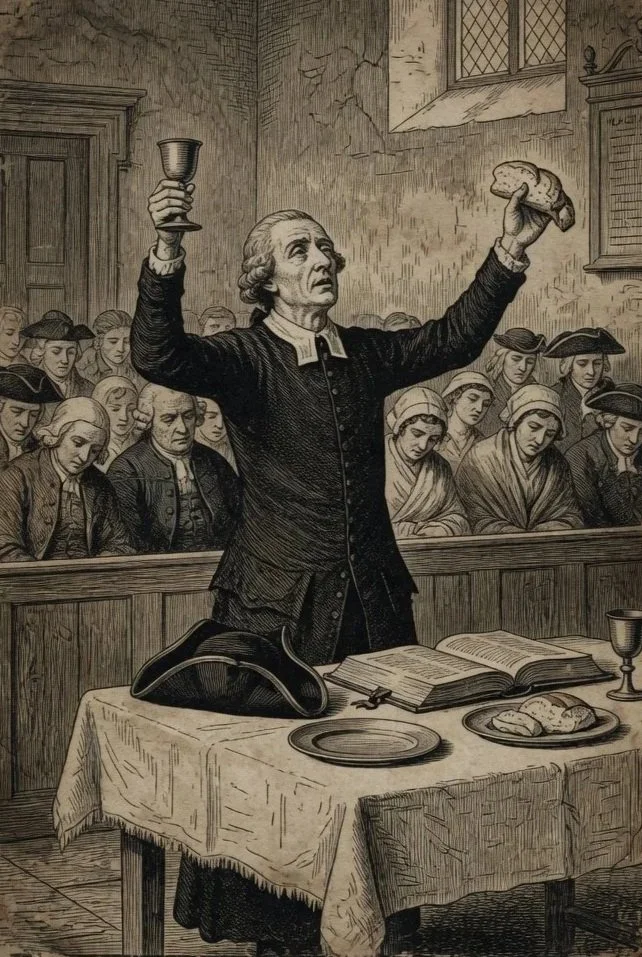
An Apology and Vindication, or, the Practice, and Binding Obligation
James Dodson
OF
Following CHRIST’S INSTITUTION and EXAMPLE in the
Administration of the SUPPER,
ASSERTED AND DEFENDED.
To which is added, An
APPENDIX,
CONTAINING,
Copies of some Original Papers, with some short Account
of what transpired at last Meeting of Synod in the case of
the Rev. Mr. David Smyton, and a copy of his Declaration of
Secession from them, and his reasons for so doing.
Published by a COMMITTEE appointed by order and in name of the Petitioners and
Remonstrators in the associate Congregations in Kilmaurs, Beith, Paisley, and
Kilwinning.
NUMB. ix. 2. Let the children of Israel keep the passover, &c.—according to all the rites of it, and according to all the ceremonies thereof shall ye keep it.
LUKE xxii. 19. And he took bread, and gave thanks, and brake it, and gave it to them, saying, This is my body which is given for you. This do in remembrance of me.
1 COR. xi. 2.—Remember me in all things, and keep the ordinances as I delivered them unto you.
GLASGOW:
Printed by JOHN BRYCE, for the AUTHORS.
And Sold by G. CALDWELL, Paisley; G. LAIRD, Greenock;
and J. WILSON, Kilmarnock; &c.
M.DCC,LXXXIII.
[ii]
TO THE
PUBLIC.
WHERE an apology to the public for this Publication as necessary as fashionable, we judge the right of self defence might justify the measure, while to maintain and vindicate the right of injured truth is the motive.—No question but this publication would have been more seasonable and advantageous for the cause, had it appeared unto the world sooner, but better late than never.—The ground of the controversy with us being new, and more arising and prevailing amongst a party, who had once set fair out for lifting a testimony for a covenanted work of reformation,—this not only gave us no small disquiet and compunction of mind, that ever occasion should have been by such given to contend on that head;—but also made us dread the consequences of bringing a subject of this nature first upon the carpet, to be exposed unto the view of the world, especially in such a time as this, when every kind of controversy amongst Christ’s professed witnesses, at best, becomes a matter of mere speculation to an unthinking world, and is not a little improved to the disadvantage of truth; yea, is ridiculed and vilipended by an apostate, profane, and irreligious generation.
And though we had sufficient provocation for it, both from the church judicatories with whom we are, or were, connected, and likewise from a champion for the novelty, who peeped out from behind the curtain in order to vindicate his own practice, yet we were still loth to exhibit the matter to public view, (as, if needful, could be made evident) until the Rev. Mr. Ramsay, whom we had still looked upon as a friend to our cause, or rather to the interest and cause of Christ, took the field, by publishing a sermon and some Letters, wherein, according to our judgment and the testimony of the best authorities, he not only cut down the binding obligation of Christ’s example in the administration of the supper and cast a slur upon the memory and writings of many eminent divines once famous in the church of Christ in their day and generation;—but also represented our character and contendings on that head in such a light, as laid us under an inevitable necessity of appearing to the world in defence of the cause we had contended for, and our own conduct and reputation also; nothing being more scriptural and natural then this, Audi et alteram
[iii]
partem, i.e. Let the opposite party be heard, as says the ancient Roman proverb; and, Doth our law judge any man before it hear him, and knoweth what he doth, said the Jewish doctor—and, Paul, thou art permitted to answer for thyself, said King Agrippa. Had the two authors above noticed, sufficiently regarded the mischief and disadvantage that pursues a spirit of discord and contention, when once it enters into the mystical body of Christ, the beginning of strife being as one who letteth out water; or had their inclination for preserving harmony and mutual forbearance been so powerful as to have engaged them in a practice suitable to their high pretensions thereunto,—they had saved us and the public this piece of trouble. But, being otherwise determined, we cannot slip this opportunity in appearing for such important truths, when thus warrantably called thereunto. But, perhaps, not only this publication will, by our antagonists, be treated with disdain, scorn and contempt, but also we ourselves will be accounted by them factious persons, raisers of needless feuds, divisions and disorders, and who are never pleased with any thing, unless we be allowed to be judges, as it often falls out with any person or persons, or party, who, in this declining age, begin to contend for a strict adherence to every article of a professed testimony for the doctrine, worship, discipline and government of the covenanted church of Scotland, in opposition to the corruption and compliance of the times.—But this needs be no disparagement to the cause of Christ, nor to contenders for it. The apostatizers and compliers are the instrumental causes of all this, and not witness-bearers against it; for, look to the church of Christ in all ages, and you will find, that the Lord still stirred up and enabled some to contend against the current and prevailing steps of defection. It was so in our first and second reformations; and how much more necessary in a time of apostacy and deformation? And these were still accounted a blessing, which are now reckoned a pest to society; for, there cannot be a more infallible sign of a church or nation’s being on the eve of destruction, than when all go on in their corrupt courses, and justify themselves therein with the adulterous woman, who wipeth her mouth, and saith, I have done no evil; and there is none found to oppose or contend against this.—Take away these, and then the candlestick shall soon be removed out of its place, as a Scottish witness, some time ago, well observes, “Remove the pillars, (says he) and then the house will soon clap together about our ears.” So it was with the once famous Asiatic and most of the Grecian churches; for, without an acknowledgement of sin, there can be no repentance, and, without repentance, no returning or amendment of life; and, without
[iv]
an amendment, no remaining or continuing, Remember, therefore, from whence thou art fallen, and repent, and do thy first works, or else I will come unto thee quickly, and remove thy candlestick out of his place.
All we observe anent the subject itself, is, that what we have published as to matters of fact, was spoke in public auditory. And as there are no designed mistakes in it, if any thing of this kind shall appear in representing or mentioning the matters in judgment, we are willing, upon scriptural and rational evidence, to be informed and convicted.—Only, as these sheets were wrote by men of a private character and capacity, whatever inaccuracies may be found therein, we hope our learned opponents will shew themselves so much of gentlemen and Christians, as to take no advantage of us on that head; and, for typographical mistakes in words or figures, we only crave the allowance due to a thing of this nature, wherein so much authority, divine and human, is produced, cited, or referred unto.
And, finally, let us add, that, when we entitle these pages, Apology and Vindication, it is not to be understood properly as an apology for, or a vindication of ourselves or our own conduct in this affair: No; we mean only thereby a vindication of the practice of following Christ’s example according to his command and institution, as an apology of reasons why we cannot concur with, or acquiesce in the contrary scheme or novel practice.—And if our weak endeavours herein shall, thro’ a divine providence and blessing, (which claims the care of directing every mean to its own proper end) prove any thing useful for the information of the misled or ignorant,—the confirmation of the wavering,—the reclaiming of neutral indifferents,—convicting of the prejudiced,—and confronting of obstinate opposers and gainsayers,—then the end, in a subserviency to the glory of God, is gained: for, that many may be found contending for the whole of a covenanted work of reformation; and so that all Christ’s instituted ordinances may be dispensed in purity and in plenty, and with the demonstration of peace, receiving, observing, and keeping pure and entire all such religious worship and ordinances, as God hath appointed in his word, is the earnest desire of
The PUBLISHERS.
[1]
AN
APOLOGY AND VINDICATION, &c.
INTRODUCTION.
WE, a poor, illiterate, ignorant and despicable handful of the Associate congregations of Kilmaurs, Paisley, Kilwinning and Beith, being in adorable providence shut up to the disagreeable necessity of publishing and exhibiting to the world at large, the following relation of the naked truth of real matters of fact and deed, as far as we are able to understand by our narrowest inquiry and most penetrating researches, by way of apology and vindication, against the aspersions that have been so liberally cast upon our conduct and manner of appearance at the bar of church courts, or manner of seeking redress of grievances, which we apprehended ourselves warranted to require as Protestant Presbyterians, and as a part (though most unworthy) of that church and land, whose highest honour was once to be called Hephzibah and Beulah, a land married to the Lord, we need not here insert our grievances, as the same so often occur in the following relation, but would desire to speak things, as we know and view them, in the fear of God, and as soon to stand before our Judge, without passion or prejudice to any man’s person, feud or favour of any; and that not so much for our own vindication, as for the vindication of what we take to be truth; and to transmit it, so far as we understand it, in its connection and divine entire form, to posterity.
It is well known what treatment we have received from church courts, and publications emitted from the press; in which we are liberally branded as the worst of criminals; charged with idolatry and perjury; a people driven and tossed by every moderate gale; a people full of prepossessions and prejudices: —the blasphemies of the Romish mass are ascribed to our views: —a people that admit of things, than which nothing can be more ridiculous; —our views are held to be antiscriptural, and
[2]
to support them we must be indebted to a new revelation; as holding rites only worthy of the man of sin; holding things in express terms forbidden; things given up by the covenanted church of Scotland; neither appointed by the acts of this church, nor in general practice; things pointedly excluded in our standards; holding things that are old customs; a people depreciating and highly departing from our standards; requiring what is in the last degree absurd mockery; a very important change in our public profession and testimony; holding things which the standards stand opposed to; things that are dropt as unimportant and unnecessary; horrible manglers of the divine rule; as holding things effectually destroying the unity of the sacrament; innovators in a most solemn ordinance, who recede from our Lord’s prescribed pattern, and in the most public and presumptuous manner trample his dying command under our feet; holding things contrary to the received faith and order of the church of Scotland to this day, and, in a peculiar and distinguishing way, of Seceders; imposing the dead forms of a service book upon the church: —we are held out to be professors only fit for consignation in Bedlam, till we recover as much of our reason as may qualify us for being members of human society; persons deserving to be treated with incivility; holding things unscriptural in themselves, and pregnant with the worst and most alarming consequences; persons doing every thing in our power to put our leaders in chains, and exhibit them in triumph; busy in practising upon the weak, the credulous, and the prejudiced; connecting things as far asunder and as little related to one another as Lapland and Japan; grasping at every novelty; fishing for faults among our connections; casting off the cloke of religion; [confirming?] baubles; desiring to be talked of; gaping for every opportunity of acquiring importance; wiser than our teachers; such chaff as it will be no loss, but gain to a church to be cleared of.
THIS is a short specimen of the liberal abuse cast upon our appearances after related, and all for the requiring the keeping pure and entire all such religious worship and ordinances as God hath appointed in his word, both as to matter and manner. If it had appeared to us our own personal cause, we should have wished to bear every such contemptuous usage without uttering a syllable again by way of retaliation. But as we are as much confirmed in our own views, that it is the cause of God and truth we are engaged in, as our friends can possibly be that it is not, we resolved on our vindication and apology in the following order; wherein the matter in controversy between our friends and us will be seen in broad day-light to the eyes of the impartial in the world:
[3]
1st, An account of the rise and progress of this controversy, consisting of some of the representations, remonstrances, petitions and speeches read before the judicatories, with some remarks thereupon, and inferences deducible therefrom.
2dly, To shew the doctrine and practice of the church of Scotland as to this point, and adduce some testimonies of divines who have taught the point pleaded for, both at home and abroad.
3dly, Consider some of the doctrines advanced against the pleaded for practice, with an examination of some of their authorities.
Lastly, Consider the late decision of the Associate Synod, comparing the same with the word of God, the Judicial Act and Testimony, and other publications emitted by the Secession, among our hands: of all which at some length and in their order.
PART I.
WE begin with what was first proposed, A short account of the rise and progress of this controversy, as far as we know.
The great prophet of the church, the teacher come from God, who is infallible and unerring, hath long since certified, Matth. xviii. [7], Wo unto the world because of offences; for it must needs be that offences come; but wo to that man by whom the offence cometh. Luke xvii. 1. Then said he unto the disciples, It is impossible but offences will come; but wo unto him through whom they come. Mark ix. 42. And whosoever shall offend one of these little ones that believe in me, it is better for him that a millstone were hanged about his neck, and he were cast into the sea. 1 Cor. xi. 19. For there must be also heresies among you, that they which are approved may be made manifest among you. We by no means plead innocent: our hands are deep in the provocation. Our friends have a great deal to say for themselves, notwithstanding all the evidences of his indignation that is smoaking against us and the generation. They say of themselves, Judah yet ruleth with God, and is faithful with the saints. We have nothing to boast of but weakness and wickedness, and it is of the Lord’s mercies we are not consumed.
How this omission found its way into the church, none we know of as yet hath pretended to determine. All we shall affirm is, that we never knew of it till of late; that we heard of it being in the practice of a reverend father in the present Associate Synod; and when we heard the same, and beheld the practice taking place near our own doors by members of the associate Presbytery of Glasgow, which practice very much affected us.
It is with regret that we are at present laid under the disagree-
[4]
able necessity of publishing our judgment in the following relation to the impartial world; for, if we take a view of the church of the living God in all ages, we may see that, when in her progressive state pointing towards reformation, friends generally harmonize together, and enemies speak and act mildly towards her righteous cause: but, in declining times, they turn more lukewarm and indifferent. Where can we find one instance more striking than in the present period? What confusions, debates and divisions about divine things by them of whom better things were expected.
A witnessing body in these bounds were in a state of peace and harmony in their joint attendance on gospel ordinances, both solemn and ordinary, till, of late, some ministers, as above noticed, took a different practice in the administration of the Lord’s supper, in not following our Lord’s command and example in taking the elements when about to set them apart by prayer. The practice of taking before prayer was what we had, as soon as capable, been taught as the scriptural order of administration contained in the divine institution. The above omission was stumbling to many. It was, still more so on account of a publication by Mr. Gibb, concerning the administration of the sacrament of the Lord’s supper. This book appeared to many to maintain several doctrines concerning the administration of the Lord’s supper, contrary to the divine institution, (as shall be afterwards noticed) which caused many of the Lord’s people to stumble, and marred their comfortable communion. On this account, some went to their ministers; some of whom, instead of getting satisfaction, were rather further grieved.
We also saw other things creeping in amongst us; such as, the not doctrinally debarring before dispensing this holy ordinance, at least in the way and manner used in this reformed church, in going thro’ the precepts of the moral law, these being the law by which is the knowledge of sin, the perfect and eternal rule of righteousness, (which practice is well warranted and enjoined, Jeremiah xv. 19.—And if thou take forth the precious from the vile, thou shalt be as my mouth, Ezekiel xxii. 26. and xliv. 23);—these things were called indifferent; yea, they who practised the old way, seemed to excuse their brethren engaged in the new scheme. Yea, it came to that length, that in public discourses on fast days, they apologized for the practice of these ministers. This being the case, some thought that there should be an uniformity in dispensing so solemn an ordinance: but we suspended our judgment for a time on account of our confidence in, and regard toward our teachers. We also thought that our reverend pastors, at their meetings, would have advised their Brethren to have left off these
[5]
practices that were offending the Lord’s people. We were led out to think this, because it is a certain fact, that a reverend minister was desired, and did undertake, and also performed, in laying the matter before his brethren, a considerable time before any petition was moved. But, instead of this mean having the desired effect, those ministers defended themselves, and continued the practice.
We thought this course contrary to Christ’s institution, and our confessions of faith, books of discipline, and the laudable acts and constitutions of this reformed church, as also the immemorial practice of the same, as we shall afterwards see. The Lord’s people amongst us came to be more and more stumbled. They thought, that the solemn ordinance was not dispensed according to the divine institution of our Lord Jesus Christ, who alone is King and head of his own church, to give forth laws and ordinances at his pleasure. So that, in regard to his ordinances, and for the preservation of truth, two Sessions agreed to petition the reverend the Associate Presbytery for redress of grievances, in their own name, and in name of their congregations.
These petitions were laid before the presbytery of Glasgow, which met at Kilmarnock the —— day of ——. We shall not insert these petitions for the sake of brevity. When presented to the presbytery, instead of the grievances being redressed, they were increased. A revd. minister asserted, that the taking before prayer was a profanation of the Lord’s day: he likewise said, that he did not count himself bound to any earlier period of reformation than the last. Also, when an elder express his fear signifying the bad consequences that would attend the new scheme, it was answered by another minister, that he hoped he would be a lying prophet,
We observe, in the first place, that if following our Lord’s command and example be a profanation of his day, we are at a loss to know how the Sabbath is to be sanctified but in a due observation of all such religious worship and ordinances as God hath appointed in his word. 2dly, We observe, that the elder’s fear has not been groundless, as is already evident, nor yet the minister’s hopes exceeded.
The presbytery not entering into the merits of the cause, allowed the petitions to ly in the clerk’s hands till next meeting. At next meeting little was done in the affair; but referred to next meeting. At next meeting again, it was moved by a member, to withdraw the petitions, and bring in the cause by way of overture. Those concerned yielded to the motion upon this proviso, that their taking back their petitions was not to be construed as a giving up of the cause. The presbytery agreeing
[6]
to this, the petitions were taken back. At next meeting an overture was given in and received by the presbytery, craving uniformity in the administration of the sacrament of the supper; but little was said to the merits of the cause. A revd. minister said, that our Lord Jesus took the bread and cup, but this he did as king and head of his church, but was not in this imitable; yet he declared, that he would neither in the pulpit nor out of it find fault with any of his brethren who took the elements before prayer, but would recommend forbearance. He said, if forbearance be not our duty, why was it recommended to us in scripture?
The above speech was no way satisfying to us, because we think that Christ’s kingly prerogative shines in the whole of his actions of administration. If his taking the elements be an act of his kingly power, as herein he is not imitable, how is he imitable in the other actions? Again, if the imitation of him in this action be an usurping of his prerogative, how can any be forborne with in that usurpation?
There was a petition given in from Paisley, craving light and uniformity in the administration of the sacrament. It was kept till next meeting of presbytery.
Which being at Paisley, there were given in petitions from Kilmaurs, Kilwinning and Greenock to the same effect. Petitions being read, and commissioners heard, there was a motion made, to the presbytery just now to enter into the merits of the cause. Another motion was made, not to enter into the merits of the cause; but for ministers to meet together in private for prayer and conference about the affair. Roll being called, and votes marked, it carried by a great majority to enter just now into the merits of the cause. Whereupon two ministers gave in a dissent under form of instrument. The presbytery entered into the merits of the cause. The first member that spoke, insisted, that the whole affair should be presently considered, and satisfaction given to petitioners; and that it was his judgment, that the command in the institution, Do this, bound the administrator in dispensing, equally with the participator: the other ministers in their speeches seemed to approve of the practice pleaded for, as they had practised the same; but laid their speeches in such a way as to vindicate the complained of practice, and seemed rather to disapprove of the course taken by petitioners; except another minister, who rose and delivered a written speech, containing the sentiments of many orthodox divines, fully asserting and confirming all that the petitioners pleaded for, proving the divine right of the same. This speech gave great offence to many of the ministers. Most part of the elders gave their judgment on the petitioners side. The mode-
[7]
rator spoke, and read a paper containing many things we thought grievous; animadverting on Paisley petition, pretending to refute it, brought heavy charges against petitioners, and the cause they pleaded
for. The presbytery came to no determination, on account of absent members, and so referred it to an after-meeting.
The presbytery met at Kilmarnock. One of the ministers who had dissented, stood up, and read his reasons of dissent: he complained of the presbytery’s manner of procedure; charged the petitioners with
sectarian principles; called the point pleaded for mere circumstance, saying, that he would not be in the place of them that gave the offence for a thousand worlds. It was answered by the moderator, that he
seemed like a superintendant or bishop to rule over us. The presbytery proceeded to consider how to issue the affair without further entering into the merits of the cause. A revd. minister made a motion, that the whole affair should be judicially determined by the presbytery according to the word of God; or otherwise the whole of the cause be referred simpliciter to the Synod, and for commissioners to carry up their cause, and be heard upon the same. The motion was backed by two elders. Another motion was made, Refer to the synod for advice, and delay. The first motion was insisted on at considerable length by those who made and backed it; but was not regarded so as to take the judgment of the court upon the same. The other motion was insisted on, which seemed agreeable to the majority; but, when it was given in to the moderator, he told them, that it would not bear the state of a vote, having but one side. Upon this, those for the first motion pleaded that it might be made the other side of the vote, so that the vote might be stated, Refer simpliciter to the synod, or consult and delay; but this was also rejected, and the motion split, viz. to consult or delay. Roll being called, and votes marked, some not voting at all, it carried by a majority, Consult.
Here we observe, that it appears to us, that the affair was so politically laid as to bring that supreme court to give an advice against us, before we were heard, before ever the synod entered upon a consideration of the merits of the cause. There was no way left us to appear before the synod at that time, but by a protestation. But because of the aversion we discerned in our ministers, and the regard we had to them and confidence in them, we protested not; which we have regretted since that time. We shall only add on this, that whether or not the treatment given to the first motion as above, be agreeable to the rights of those who made the same, or if it favours of despotism
[8]
and arbitrary proceedings, we submit to the candid judgment of others.
Thus the presbytery, taking the whole burden on themselves, carried up the cause, in their own way and manner, to the Synod for advice: the tenor whereof follows, “The Synod unanimously agree in giving this advice and direction to the brethren of Glasgow presbytery, that they exercise forbearance with one another in this matter; that they inform the people, that the Synod reckon it very unjustifiable for them to endeavour to impose their judgment upon others in this matter; and that they deal with them to guard against reflections upon those who observe a practice different from what they think best; and that if they find it difficult to deal with the people, they call in the assistance of members from other presbyteries, as they find necessary.”
The petitioners being informed of the advice of Synod, both by ministers and elders who were at the Synod, we met and considered the advice, and were not satisfied, for the following reasons:
First, Because we thought the forbearance recommended in that advice, was a toleration of different practices in a solemn branch of the worship of God, clearly revealed in the word, which is but one.
Secondly, It had a tendency to set up a schism in the church of God, and to lead persons of different judgments to go each of them where they affected the different practices; and so to say to one another, I am of Paul, and I of Apollos, 1 Cor. iii. 4. a practice clearly condemned in the word of God.
Thirdly, It appeared to us, that said advice was rash in declaring our conduct unjustifiable, or, which is the same thing, condemning our conduct. As there is no middle state between the terms, we say it was rash to condemn us before we were heard, John vii. [51]. Doth our law judge any man before it hear him.
Fourthly, We think it very hard, to have our appearing for what we think most agreeable to the divine rule called reflections; and still more hard, to bid us guard against appearing for what we think best. In that case, we may never appear for any thing; as none conscientious will appear for a thing that they do not think best. But this seems to put an end to testimony bearing.
We do not say, that the two last particulars were so clearly reported to us at the first as above, but the first was: and when we got a sight of the Synod’s advice, it every way agreed with our information, although in some points it exceeded. The above being the case, commissioners were chosen to attend the first meeting of presbytery, which was at Glasgow, with in-
[9]
structions to enquire, Whether or not the presbytery rested in the Synod’s advice, and gave it as their judicial sentence, or see what answer they gave to our petitions; and if the presbytery rested in the advice of Synod, and so dismissed our cause: if so, they were instructed to protest against said sentence of presbytery, founded on that advice, and appeal to the next meeting of Synod.
The moderator declared that the advice of Synod was the sentence of presbytery. Whereupon, the revd. Mr. Smyton, protested in his own name, and in name of all that would adhere to his protest. The elder and commissioner from Kilmaurs adhered. The other commissioners were taking instruments; but the presbytery refused, by telling them that they had no cause before this court; which surprized the commissioners, as hereby they were denied their just rights and privileges as men and Christians. Sure we had a cause there; but what the presbytery did with our cause we have not yet learnt; for there was no proper answer given to our petitions, although we attended many times for that purpose.
We further observe, that the presbytery declared, that commissioners, as commissioners, had a right to carry the advice of Synod home to their constituents; but would not allow them to be commissioners to prosecute the cause any further before them; but whether this may be viewed as arbitrary procedure, or if it was the due exercise of that ministerial power and authority vested in the courts of Christ for the edification of his body, is submitted to the impartial to judge.
But here Mr. Ramsay has the assurance and confidence to publish to the world in P. 4. of his letters, “That the advice had not been under consideration by them (viz the petitioners) one single moment, nor so much as communicated either by Presbytery or Synod, or any other way than by general, vague and uncertain report.” Astonishing, indeed! that his own brethren, ministers and elders, can carry nothing from courts, but vague and uncertain reports. If so be, with much propriety may it be said, that his performance is only vague and uncertain, since not published by Presbytery or Synod. And to say, that he had not a moment to deliberate on it, would be absurd.
But to return to his first page, he tells us, “That the congregation he is connected with has, in the Lord’s distinguishing goodness, been preserved in harmony and peace.” Here we are at a loss to know what is meant by the harmony and peace he speaks of. Can we suppose him to be ignorant that a number in his own congregation are very much grieved at the new mode of administration? Or can we suppose he thinks,
[10]
they are all well satisfied that have not appeared at courts for redress of grievance?
In the same page, he professes his “most sensible feelings for his brethren and the people under their care, and that various occasions of knowing their circumstances had been afforded him.” Observe, how unbecoming it is for a minister to be so very uneasy about his brethren, and those under their care, and to have so little feeling and concern for his own.
He likewise finds us, Page 3. culpable in many things, viz. “Our frame of spirit: and the manner of conducting our cause: and so little prayer, and so much talk: and have not set ourselves open to conviction, but catched hastily at an opinion, fixed it in our mind, and then cast about for some plausible things to support it; and have not been in the proper use of means for information.”—However much reason we have to condemn ourselves for the want of a right frame of spirit, yet we are not conscious that ever he witnessed any frame of spirit we were in, abstracting from human frailty, that could give him the least ground for this charge. That law of charity we are under, obliges us to conclude otherwise than he does, where our grounds are not better instructed than he instructs his. In the above there is a number of heavy charges brought against us without being supported. We must let these amongst the rest of his uncharitable heart judgings pass, and refer to the old proverb, An evil mind makes evil meanings. But we would rather suffer than retaliate. We shall only add, that it is God’s prerogative to judge the heart, and conclude with the observation of solid divines, (before him) That whenever a matter contended for did not satisfy, those unsatisfied always quarrelled at the manner.
Downward, in the same page, he tells us, “That several brethren have assured him that few, in some places scarcely a single person, of the great numbers embarked in this cause, have applied to them for instruction and advice.” Here we are charged in general, without condescending upon any particular instance: but dare any of his brethren in Kilmaurs, Paisley, Beith, Kilwinning, or Newmills, assure you as above? We are sure they cannot. Whence is this? Says he, Mal. ii. 7. The priests lips should keep knowledge, and they should seek the law at his mouth; for he is the messenger of the Lord of hosts. But please look a little forward, and observe what is said of the priests, verses 8, 9. But ye have departed out of the way: ye have caused many to stumble at the law; ye have corrupted the covenant of Levi, saith the Lord of hosts. Therefore have I also made you contemptible and base before all the people, according as ye have not kept my ways, but have been partial in my law. Here we ob-
[11]
serve, that we think by this quotation from the seventh verse being so often brought as being against us, we may infer, that they want to lead us into a stupid, blind and implicit obedience and faith in our ministry. But this is not the way to the law and to the testimony: If they speak not according to them, it is because there is no light in them.
Likewise, P. 4. he observes, how we have treated the courts of Christ and their determinations with contempt and wantonness. A very heavy charge indeed! our contending for what we believe to be truth, called contempt and wantonness, by a minister of the gospel! But it is without evidence, or shewing his proof. If we do not deceive ourselves, we deliberated on the advice of Synod, and went to the great Shepherd to seek light from the holy oracle; and though we found it contrary to advice given, or any other which allows a multiformity in any one act of God’s worship, we humbly applied to the courts, that they and we might be guided in the ways of truth.
In P. 5. he “must sympathize with his entangled friends, candidly confessing, that his mind was once much warped with the common prejudices.” We may observe, that his sympathy towards us seems not to be great, or else he had not brought so many grievous, groundless charges against us. If contending for what we believe to be truth be called prejudices by our professed friends, what can we expect from our open enemies?
He likewise tells us, that “the circumstance of taking before prayer had been ever familiar to his eyes, and familiar to his own practice, ever since he was put in trust with the mysteries of God, having never deviated in a single instance from (what he calls) the common mode.” But how astonishing is it to hear him own, that “his judgment was not properly informed, and that his attention had never been duly turned to that object?” May we not justly draw the conclusion from the above, That, if kneeling before the altar, or falling down before the cross, or saying orals, or counting beads, had been familiar to his eyes, (or whatever might have been the fashion, have we not reason given us to think that) his practice would have been the same? To find an ignorant unlearned man having his judgment uninformed, and his attention never turned to the objects of the holy ministry, would be no surprize; but to find a man bred to the ministry, put in trust with the mysteries of God, and yet ignorant of his own practice in the actions of the most solemn ordinances; we would not think it strange to find him turn the chace upon all divine ordinances, provided it were to serve his own inclinations. Downward in the same page, he says, “his mind is now better made up.” Many indeed are
[12]
wise in their own eyes. And why? because they judge amiss concerning themselves. We are expressly commanded not to trust our own judgment in our cause.
But to return to the presbytery of Glasgow, several members advised commissioners, that, if not satisfied with the judgment of presbytery, there was nothing competent for us but to remonstrate and appeal to the Synod. Whereupon petitioners from Kilmaurs, Paisley, Greenock and Kilwinning appointed commissioners to meet together, and seek council from the Lord in this matter.—After some time spent in prayer, a remonstrance was drawn up, and agreed on, subscribed and presented to next meeting of Presbytery; which was rejected for want of formality. They were nothing but scriptural formalities that we pled for, either in our petitions or remonstrances. They would not be bound to observe scriptural forms themselves; but would oblige us to observe every the smallest form of their courts. We still think it our duty to contend for truth and uniformity in the worship of God. We afterwards brought forward our remonstrances to the next presbytery at Beith, with all the formalities necessary. Because it is needless to insert them all, they being the same in substance, we only insert one; the tenor whereof follows:
THAT whereas many of us under-subscribers, with many others, did, about the beginning of this present year, regularly, by way of representation and petition, bring forward a cause unto the reverend the associate presbytery of Glasgow, respecting a different manner of procedure amongst members of a witnessing body, as to the administration of the sacrament of the Lord’s Supper, some of them taking the elements before prayer and thanksgiving, and others not; which matter has been very humbling to us; and this we thought ought to have been by them judged upon in the merits of the cause, that the mind of the Lord might have been known: but, after attending several meetings of said presbytery, at last, the presbytery came to the following resolution, to apply to the revd. Synod at their last meeting, for advice; which was a mutual forbearance with one another in this matter: whereupon our cause was dismissed without judgment given thereupon. Wherefore we look upon ourselves as laid under the disagreeable necessity of remonstrating against the above advice, as all the deliverance, it seems at present we are to have, as to our difficulties; and that for the following reasons.
Reason 1st, What was delivered to us by the revd. presbytery, as the advice of Synod, seems not to be calculated to answer
[13]
the ends of union, which is necessary for comfortable communion, in a matter of faith and case of conscience. Seeing men’s judgments seem to be so opposite to one another respecting the actions of taking the elements before prayer, as being a part or not a part of the order in the manner of administration laid down in the divine pattern in the institution, we humbly judge that the administrator is bound to pay a strict attention to the manner of administration to the divine pattern either of example or precept of the Lord, as the unchangeable order in the institution unto the end of time in his church. Moreover, as this difference of judgment and practice is become productive of fatal consequences amongst us in the western bounds, we think the cause required a judicial weighing in the balance of God’s sanctuary.
Reason 2d, As this diversity of opinions and practices seems to affect the divine institution as to the proper extent of the obligation arising therefrom upon the administrator, as to the precise manner after which he is to copy; so this deliverance seems not to be explicit with respect unto what is the actual manner of administration bound unto by the institution, and what is not; so that we humbly conceive, that, notwithstanding this deliverance, there is no vindication or declaration of the kingly authority of the Lord Jesus Christ, the glorious institutor, with respect unto the precise manner and limits of the law of administration, as the invariable rule of practice unto his after administrators in the church unto the end of time.
Reason 3d, In the present case, when multitudes are labouring under a prevailing difference of judgment, as to the extent of the institution, we humbly conceive, that nothing less could nor will answer the ends of edification and unity, than the declaration of the voice of Christ in his word, ministerially brought forth by his servants: and it is his voice alone that the sheep are bound to hear; for, it is not the bare say, or simple advice of ministers or judicatories, that can bind conscience in matters of divine institution: for we think ministers and church-courts ought to give some evidence, that what they say is the mind and will of the Lord Jesus himself, the only Lawgiver to his church and people, that so there may be no implicit faith given by church members, but that their faith may have a Thus saith the Lord for the ground of its holding in all matters of revealed religion.
Reason 4th, Because this advice doth not rectify the real jarr and contrariety, that this diversity of opinions places betwixt the first and second reformation-principles with respect to this point: for to us it seems as evident, that the express manner in the order of institution of taking, blessing, breaking and giving,
[14]
was the order of administration held forth in the Scots Confession as nearest Christ’s own action, chap. 22. which says, “That they be administrated in such elements, and in such sort, as God hath appointed.” Again, they say a little downward, “What Christ Jesus did and commanded to be done, is evident by the evangelists and by Paul.” And as the acts of assembly, and first book of discipline, chap. 2. declares, “That the sacrament should be ministred after the manner of the kirk of Geneva, all ceremonies and rites invented by men should be abolished, and the simple word followed in all points; in the due administration of the sacrament, all things should be done according to the word of God, nothing being added, or yet diminished,” If we mistake not, the same is sworn in the national covenant. Their approbation of this manner of administration, we say, we think is as evidently clear to us, as for us to suppose, that the Westminster Assembly renounced the action of taking, as being no part of the divine pattern to be followed by administrators, when the Directory itself declares, that the ministerial action of taking, blessing, breaking and giving, are all in consequence of the holy institution, command and example of our Lord Jesus Christ. Now all that is disputed, is, the order of the actions; and if, according to the Directory, it be that the administrator is bound invariably by the holy institution, command and example to the several actions, we think the order of these actions, is abundantly clear in the order of the institution, 1 Cor. xi. 23. &c. which institution doth not admit of any change or alteration; for, thus saith the Lord, See that ye observe all things whatsoever I commanded you, Matth. xxviii. 20.
Now, we look upon ourselves, through this diversity, as brought into a labyrinth; as our Judicial Act and Testimony, and solemn vows homologating the Scots Confession, national covenant, books of discipline, Westminster confession and directory, without the least exception as to this point; and as the venerable assembly at Glasgow, 1638, revised and approved the acts of Assembly 1562, 1564, as to the original manner held forth in the kirk of Geneva: and therefore to make our Westminster Assembly hold forth a doctrine contrary to the above received and sworn to principles, we think, was never the intention of the Assembly of the church of Scotland, in approving of the above mentioned Confession and Directory, as we think is evident from Mr. Rutherfoord and others their declared principles on this point, and the general practice of his church ever since;—which causeth us to think there was no change of judgment with the church of Scotland in respect to this matter from any thing laid down in the Westminster Con-
[15]
fession and Directory, otherwise we would think, that the general practice of the church would be contrary to that which by solemn oath they had given their approbation of in the national covenant, as is evident from acts thereto subjoined.
Wherefore, and in consequence of the above reasons of remonstrance, we humbly and earnestly intreat the reverend Synod to consider this matter, without undue delay, which appears so weighty and humbling to us, that, if there was any mistake with our reforming fathers in the first period of reformation as to the above point, or with us petitioners, this court may represent it to us from the word of God: and, for this end, we humbly enquire,
1st, If our glorious head Christ, did not perform all the several actions, in his manner of administration of the supper, ministerially, and for an example to after administration, as well as that of appointing and instituting them in a kingly capacity?
2dly, Doth not the divine precept, as well as the example, bind the administrator to the several actions delivered by Paul to the Gentile church, as the invariable rule of practice to the church in all after ages, in order that we may have this ordinance whole and entire, as to the manner thereof? and if it doth not, from what in the divine institution or precept binding thereto, can it be gathered, that there is an action recorded not binding, when it appears for the present to us, that neither institution nor precept makes any division or exception?
3dly, We humbly would crave, that it may be enjoined, that all under the Synod’s inspection, may practice in this particular according to the letter of God’s word, and the general practice of this reformed church; as the contrary is of direful consequence to us in this western bounds; ay and until the reverend Synod, under divine conduct, give their judicial judgment respecting the extent of the institution; and thus shew us the mind of the Lord, that so our faith may not stand in the wisdom of men, but in the word of the Lord; that we may all be in one mind in the faith, and live in love and in the fear of the Lord; and that the God of truth and peace may delight to dwell among us.
And that he who leadeth Joseph like a flock, and walketh among the golden candlesticks, and is the Wonderful Counsellor, may so direct the reverend Synod in this, and other matters that may come under consideration, so as ministers and people may attain to, and persevere in the faith as it is in Jesus, is essayed as the prayer of Petitioners.
[16]
AT this presbytery there were two petitions presented, one from Beith, and another from Newmills, signed both by the elders and people in the different congregations, craving transmission to the Synod in common form; but were rejected for want of formality, the presbytery using their influence to persuade the petitioners to withdraw their papers; saying, that what they pleaded for, was nothing but matters of indifference. They then entered into the merits of the cause. Many things being offered, one member asserted, that the elders bringing forward the elements, might justly be said to be a taking before prayer: If their so doing be any part of the administration belonging to the administrator, let the candid reader judge. Another member asserted, that all the actions belonging to the minister, both before and after prayer, were but common actions; and none refused his assertions to be just, but one. To this we may observe, that, if the whole actions of administration be common actions, we know not how it can be peculiarly assigned to ministers more than others. It has indeed been told us, that ministers ought to dispense this ordinance, 1 Cor. iv. 1. as being stewards of the mysteries of God. But if they be only common actions, where is the mystery of God? If the minister’s actions be solemn actions founded on the divine institution, why is the due administration of the sacrament made a branch of the ordinary worship of God, as in our Confession, chap. 21. sect. 5?
Many other arguments and speeches, together with hard reflections upon petitioners (for brevity’s sake) we omit. What was there then said to the conviction of many of a numerous auditory of different denominations, and has since been made the subject of conversation among many to our grief and concern, seemed only to discredit a gospel-ministry, and to weaken their authority in the church. The presbytery coming to a vote, Transmit or not, it carried by a majority, Transmit, not without difficulty and opposition. The elder from Paisley, viz. Thomas Beveridge, declared, that he would never have it said, that he had defiled his hands with transmitting such a dirty cause; predicting, that petitioners would think shame of themselves; telling, that he knew some men belonging to their congregation, some time ago, that took some strange notions concerning the civil magistrate, and left them, one went to the Glassites, another to the Independents; and said that they were all turned quite wild. Thus far as to this presbytery.
The next being at Paisley, the two last petitions being again presented, the one from Beith was transmitted, the other from Newmills was rejected.
[17]
The Practice and Binding Obligation of following Christ’s Institution and Example, in the administration of the Supper, ASSERTED and DEFENDED.
AMONGST the awful evidences of the Lord’s anger and displeasure against us, and the many spiritual judgments that have fallen upon us, in this degenerate and perfidious generation, these of error, delusion and division (the fruits and baneful consequences of our revolt and apostacy from God, and a covenanted work of reformation) seem to be none of the least,—according to these words of divine inspiration—They have chosen their own ways, &c. I also will chuse their delusions. My people would not hearken to my voice, and Israel would have none of me. So I gave them up unto their own hearts lusts, and they walked in their own counsels. Isa. lxvi. 3, 4. Psal. lxxxi. 11, 12. It is indeed ominous and alarming to see politicians, misled statesmen, and corrupt church men so infatuated and left of God, as to plan out such measures with their own hands, which, if invariably pursued, would at last roll the great united body over a precipice, into inevitable ruin and destruction; But it is still more truly awful and deplorable, to see professed witnesses against the present course and current of defection, adopt or espouse such novelties in the doctrines of religion; yea, in the most august ordinances and institutions of Christ, which, if obstinately persisted in, must undoubtedly land them in a torrent of contention, animosities, shameful divisions and disorders; to the great dishonour of God, prejudice of truth, offence and stumbling of the godly, and to the further provoking of the Most High to leave his house, and forsake his heritage; and to give the dearly beloved of his soul into the hands of her enemies.
But without insisting on any thing further by way of preliminary or introduction, in surveying of this pamphlet, we do not at all pretend literature, or abilities, to say what might, or ought to be said on the subject, or the nature of the thing would require. Neither will we attempt to enter on a final discussion of these points, which do not so properly lie within our sphere, or province, to determine; but shall leave them to the judgment of the more judicious and learned—What
[18]
we principally at present, intend is, by reviewing of Christ’s institution and example in the administration of the Supper, the practice of the church in her primitive and purest times, the doctrines contained in the performances now under consideration, and the Advice of the Synod, endeavour to make it evidently appear, that the new scheme of practice, now licensed and contended for, is contrary to, and inconsistent with scripture, the practice of the best reformed churches, namely, the church of Scotland, in her first and purest reformation, our standards, the judgment and writings of many learned and eminent divines, in different ages of the church,—and of sad consequences.
We do not design a formal answer, nor to trace the author along in a disquisition of every thing exceptionable; or to take those particulars noticed as they are arranged by him, in a haranguing order, but only as they fall in to be observed in the different articles above specified; it being more our concern to strike at the ground work of the novelty, than to batter the building; for, the contrary proposition being established by truth, the basis of the new structure must needs give way, and then the whole fabric will, of course, fall to the ground.—The plan we are to prosecute the subject upon, for order and distinction’s sake, shall be the following:
PART II
SECTION I.
Of the divine warrant for taking the bread before prayer, from Christ’s institution of the Supper.
THERE are only two authors (so far as we know) who have made any formidable appearance in the world, in defence of the new practice; and, it appears plain to us, that both of these found the ground of their plea upon human authority (as, indeed, they could have no other for it) the practice of some particular man, or writing, or something worse if worse, did we say? Yes, Worse,—For, human authority, if it does not steer wide from a divine warrant, is not to be rejected, and far less despised.—Such testimony has often been
[19]
very helpful, in illustrating of divine truths; and is here what we have both abused and used in its own part: but, for men of good sense and learning, thus to argue from negative proof must, at best, be inconclusive. And, to reason from a thing’s being probable, or possible, that it was actually done, must appear most nonsensically trifling and absurd.—Seeing the divine rule is the only unerring one, and what can be warrantably fixed upon, we must give it the pre-eminence: and, in doing of this, there needs nothing more in the entry, than to recite the words of institution, as they stand in the divine record,—And as they were eating, Jesus took bread, and blessed, and brake it, and gave it to the disciples; and said, Take, Eat, This is my body, &c.—And he took bread, and gave thanks, and brake it, and gave it to them, saying, This is my body, which is given for you: This do in remembrance of me, &c.—For I have received of the Lord, that which also I delivered unto you, that the Lord Jesus, the same night in which he was betrayed, took bread, and when he had given thanks, he brake it, and said, Take, Eat, This is my body broken for you: This do in remembrance of me. Matt. xxvi. 26. Luke xxii. 19. 1 Cor. xi. 23 &c.
Now, as this is a truth so well established, that the greatest advocates for the novelty have never had the effrontery to impugn or deny, it would be an insult upon reason and good sense to insist upon arguments, to prove or investigate a self-evident and self-existent truth—As for the judgment of sound divines, commentators, and others, upon these words, they will come in our way, of course, to be noticed afterwards, when we have occasion to observe the new gloss palmed upon them, both as they are ministerial or sacramental actions, and the symbolical or mystical meaning.—We therefore proceed to
SECTION II.
Of the practice of the Primitive and Reformed churches abroad.
NOW, that the taking of the bread, according to Christ’s institution and example, was practised by the apostles, we have not the least ground to doubt: and that it was continued still by their successors in the primitive churches, is evident from ancient church history. To evince this, let us first hear the testimony of Justin Martyr, who lived in the beginning of the second century, about 120 years after Christ, as it stands recorded in Mr. Petrie’s history, from the works of Raban Magentius, Justin in Apol. 2. fully sheweth the manner
[20]
of Christian service in his time, viz. “The ancient Christians had their meetings on Sunday, they began with prayers for the church, the writings of the prophets and apostles are read, as time will permit.—He who hath the charge, hath a sermon to the people, and exhorts them all to the imitation of the best things: then all do rise up and pour forth prayers.—Again, when the prayer is ended, bread and wine mixed with water, is brought forth; which being taken, he who hath the charge goeth before the people, with an earnest voice, in praising God and thanksgiving, and the people do answer with a loud voice, Amen.”
Another testimony we have related by the same author, from the writings of one Amularius, who lived about the eight century; and, when speaking of the primitive times, says, Lib, Cap. 24. “Christ took bread, and also the cup,” whereof Cyprian saith to Coecilius, “We find, we observe not what Christ commanded, unless we do also the same thing which he did, We depart from the divine institution, wherein consisteth the command of the Lord and his apostles.” (a) “So saith he, and so do the reformed churches; but the Roman church do not so.”—
What puts this point beyond all exception, Amularius observes the first action of taking the bread, and seems to prove it, from Cyprian’s asserting, that Christ’s command bound to do what he did; and Mr. Petrie adds “So saith he, and so do the reformed churches practise.”—Now, Cyprian lived in the beginning of the third century, Amularius in the eighth, and Mr. Petrie in the seventeenth century.—And besides all, Mr. Petrie, being then minister of the Scots congregation at Rotterdam, had thereby access to know, above many, what the practice of the church was, upon this point, both in the Netherlands, and his native, the reformed church of Scotland.
To the above, let us add a few of the words of the author of the Enquiry into the constitution, discipline, unity and worship of the primitive church, for the first 300 years after Christ; who, when treating on the sacrament, in confirmation of the above testimonies, says, “The prayer used, as described by Justin Martyr, bread and wine were offered to the minister, who, receiving them, gives praise and glory through the Son and Holy Ghost.”—And downwards says, “The minister, having received the bread and wine, he offereth up prayer and praises unto God.”—And that, by this one prayer, both the elements were consecrated at once: for he says,
_____
(a) Petrie’s church history, cent. 8 and 9.
[21]
viz. Justin, “that the minister took both the elements together, and blessed them, and then they were distributed,—He did not consecrate them distinctly, but both together.—After prayer was ended, they read the words of institution, that so the elements might be consecrated by the word as well as prayer, whence Cyprian calls the sacramental elements the food that is sanctified by the word of God and prayer.” (a)
We know, that to these authorities taken from antiquity, it is objected, that the ancient churches had different practices, and used many things in worship, that cannot well be contended for.—To this we would say, that we plead for no more, and nothing less than what the word of God allows,—and, as it is well said by one in answer to the grand plea of prelates (who, to strengthen their cause, produce Ignatius and so many of the fathers on their side) alledging, that Presbyterians have none of the fathers in their favours except Jerome; and that the judgment of one father cannot be set up against the current testimony of the rest,—“That “one testimony concurring with scripture, is better than many disconsonant thereunto.” So say we, That the authority of one of the testimonies above quoted, being agreeable to the unerring rule, is of more weight for the purpose here used, than an hundred in the opposite side.—As is well observed by Z. Ursine in his Catechism, when explaining the words of institution, “The Lord Jesus, this is the author (saith he) from whom it is instituted The Lord’s supper: we must therefore observe what the Lord did, said, and prescribed,—as Cyprian well warneth us. If Christ alone be to be head, we must not attend to, or regard what any man, before us, hath thought meet to be done, but what Christ, who is before all, did perform.” (b)
It is indeed true, that when Popery came to shew her horrid head, this, as well as other parts of the gospel institution, came by degrees to be segregate, or devoted to Romish idolatry, which continues to this day.—But, no sooner did the churches in Germany, in the beginning of the sixteenth century, by the good hand of God upon them, begin to reject the superstitious rites of Antichrist, than they retired back to the purity of Christ’s institutions, and, namely, of the supper, which might be made evident, were it needful, from the several confessions and catechisms of the reformed churches.—In the confession of Helvetia, they declare their belief thus, “We think that rite, manner, or form of the supper to be the most simple and excellent, which cometh nearest to the first institution of the Lord, and to the apostles doctrine; which doth consist in
_____
(a) See Enquiry, pag. 10, 109, 110, &c.
(b) Ursine’s cat. p. 432.
[22]
declaring the word of God, in godly prayers, the action itself that the Lord used, and the repeating of it, &c.” (a)—The form of order, which was the order of the church of Geneva, is a proof of this, and Mr. Calvin’s catechism, which was approved of by the said church of Geneva; the reformed churches of France and Scotland (published along with the said book of common order and psalms of David in metre) plainly asserts, that ministers are enjoined to follow Christ’s example in administrating of the Lord’s supper.—Likewise, in the very place of the catechism above quoted, (which was composed by Ursine at the command, or desire, of Frederick the third elector Palatine on the Rhine, commonly called the Heidelberg catechism; which was afterwards approved by the famous synod of Dort, 1618, and by them appointed to be taught in the schools of the reformed churches in the Netherlands). (b)—And in the catechising upon it, by Petrus de Wit, approved of by the Classis of Hoorn, the taking of the bread before consecration, is mentioned; all which abundantly shew, what was the principle and practice of the reformed churches abroad upon this head.—But, as these will natively fall in our way in their own proper places afterwards, we shall leave them, and come forward, lest it should be accounted a mere superfluity to insist upon that which no person can, upon just and solid grounds, call in question.
SECTION III.
Of the church of Scotland, in her first and second reformations.
BEING now advanced as far as the beginning of our own Reformation in the church of Scotland, the practice of which, being one hinge of the present controversy on this head, it will be proper to hear what our antagonist has advanced in favours of the new scheme: for that purpose we are told,—“What will you say, Sir, if it shall appear, by demonstrative evidence, that this taking was omitted by the church of Scotland from the Reformation and downward, for many years, &c?”—And, from the first book of Discipline, that “the manner of expression would lead us to conclude, that the order of Geneva was observed but in a few congregations:
_____
(a) Harmony of confessions, p. 415. This Confession was approved of by the Assembly, 1566.
(b) Vid. Ursin’s life, Clark’s lives, p. 766. and Calvin on his Catechism in preface.
[23]
“and, if taking of the elements was considered as a part of that order practised in that church, it is probable, after the explication of the right manner of dispensing of the sacrament in the book of discipline, that this circumstance was given up also, &c,”—from the calculation of the printing of Mr. Calderwood’s Altare Damascenum, that is, from 1623, sixty years back to 1563,—the time of the reformation from Popery.—“during all that period the elements were either not taken before prayer, or in so very few instances, that they appeared to him unworthy of being recorded as an exception to the general practice, &c.”—And afterwards, “That the circumstance of taking the elements before prayer, has not been the general, much less the uniform, practice of this church,” and “that whole churches had the same views of taking the elements before prayer.” (a)
Now, it follows of course, that we either assent unto the above assertions, or else prove the contrary proposition; which last, we intend, through divine assistance, to endeavour to perform.—And here, we must observe, that it is well that this Inquirer did not attempt to affirm, that it was never practised by any in the church of Scotland, seeing he might have maintained the one as well as the other upon negative proof, possibility and suppositions. This and the other author does not mention the taking of bread before consecration, in as many words, therefore, ’tis concluded, it was not in practice in that church.—But that it was the practice (we may say, the general and uniform practice) of the church of Scotland, both in the first and second reformation, comes now to be made evident.
And first, we must begin with the Book of common order, which was the first standard in the first reformation.—The form of which, in the administration of the Lord’s supper, as it stands in the 14th article of that composition, runs thus—“After reading the institution, an exhortation, and a summary fencing of the table, or doctrinal debarration, and an exhortation and invitation, the minister cometh down from the pulpit, and sitteth at the table, every man and woman likewise taking their place as occasion best serveth. Then he taketh the bread, and giveth thanks. This done, the minister breaketh the bread, and delivereth it to the people, who distribute the same among themselves, according to our Saviour Christ’s command: and likewise giveth the cup, during which time, some place of scripture is read, which doth lively set forth the death of Christ, &c. The action done, he giveth thanks,—they sing the ciii psalm, or some other
_____
(a) Irenicum, pag. 17, 19, 20, 38, 76.
[24]
psalm of thanksgiving, &c.” Here it is added, by way of question, Why they follow this order rather than any other? They answer, “If so be that any man will say we follow this order rather than any other in the administration of this sacrament, let them diligently consider, that first of all, we utterly renounce the error of the Papists.—2dly, We restore unto the sacrament its own substance, and to Christ his own proper place, &c.” Downwards they say, “Then taking bread, we give thanks, break and distribute, as Christ our Saviour hath taught us,—finally, the administration ended, we give thanks again, according to his example: So that, without his word and warrant there is nothing attempted.” What a poor, low, pitiful shift must it be, to evade the strength of this authority, to cavil, “that there is not a word of the (act) until the bread be broken and distributed; nor of the setting down the bread, and taking it up a second time?” When this is nothing more than Christ’s institution and example,—why not except against that also, in favours of the beloved new practice?—Nay, it is evident here, that there is but one blessing, so that the cup must be also included, tho’ the bread is first mentioned, as being the first in order of the action, according to Christ’s institution and example.
It will now be expected, that we should make it appear, that this form was adopted in the administration of the supper. But this is no great difficulty to do, both from Mr. Calderwood and the first book of discipline.—Says Mr. Calderwood, “Before the Confession (viz. the Scots Confession) of Faith was framed, and ratified in parliament, and the Book of Discipline contrived, the reformed kirk within this realm, had that book which was prefixed to the psalms in metre, for their direction and discipline in external worship, which book is called, The book of discipline, The book of common order, or, The order of the church of Geneva, whereby is meant, the order of the English kirk of Geneva, where Mr. Knox had been some time minister.” (a) And, though several things in this form were corrected in the first book of discipline, particularly that anent funeral sermons; yet on the sacrament and marriage, the one was only an improvement, or superabundant (as they themselves express it), and not a superceding of the other, being both one in sum and substance. In proof of this, we shall only quote a sentence or two of the second head of said book of discipline on the sacraments.—“When also to them nothing is added, and from them nothing is diminished,
_____
(a) Calderwood’s history, p. 24.
[25]
and, in their administration, all things are done according to the institution of the Lord Jesus, and the practice of his holy apostles. And, albeit the order of Geneva, which now is used in some of our churches, is sufficient to instruct the diligent reader, how that both these sacraments may be rightly administrated; yet, for an uniformity to be kept, we have thought good to add this superabundant. The table of the Lord is then most rightly ministred, when it approacheth most nigh to Christ’s own actions, &c.”
What person, in the least acquainted with our church annals, ever, before this, dreamed, from the above quotation, that either the form of administration of the supper in the book of order was extruded and laid aside; or yet, that it never came in general to be put in practice? For the first, it is rather established by the book of discipline: and, for the last, the church was but in her infant state. She had hitherto, at least till this year 1560, had no national Synod: but when once she arrived at this, we soon find repeated acts of Assemblies made for the general practice, and uniformity in this.—As our antagonist seems to speak of these acts by guess, seeing he says, “they are not in my hands, nor do I know how to come at them conveniently, if they be at all extant in print;” it will be necessary to insert an abbreviate of these two laudable acts of Assembly, the tenor of which follows—
“The General Assembly convened at Edinburgh, the 25th of December 1562. It was ordained that an uniform order be kept in the ministration of the sacraments, according to the Book of Geneva, that is, the Book of common order, prefixed to the Psalms, which was the order observed in the English kirk of Geneva.” Follows the other act of the General Assembly holden at Edinburgh, beginning the 25th of December 1564. “It was ordained that every minister, and exhorter have one of the psalm books lately printed at Edinburgh, and use the order contained therein, in prayers, marriage, and ministration of the sacraments.”—Here, both practice and uniformity in that practice is ordained. And “here you may see,” (says Mr. Calderwood upon this act) “that the order of ministration of the sacraments set down before the psalms in metre, in the Book of common order, is to be observed.”—How daring must it be, to attempt to set the First book of Discipline against the Book of common order! Or, otherwise, bring our worthy reformers under such a slur, as, to have given the public sanction to a manifest contradiction, &c.”—Now, the second book of discipline was composed about the year 1580, and ratified in the year 1581—In this book there is nothing concerning the sacrament, or its administration, at
[26]
all; so that the practice in the administration of the sacrament, as contained in the book of order, adhered unto in the first book of discipline, stands in full force untouched, and so must be the very doctrine engaged unto in the Confession of Faith, and the national covenant, in these words, “To the which we join ourselves willingly, in doctrine, faith, religion, discipline and use of the holy sacraments, &c. promising in the great name of the Lord our God, that we shall continue in the obedience, in the doctrine and discipline of this kirk, and shall defend the same according to our vocation and power, all the days of our lives, &c.”—[This covenant was subscribed by the king 1580, and thereafter by persons of all ranks 1581: and again, by order of council and acts of General Assemblies, subscribed by all sorts of persons 1590. And, to make it evident, that they meant it in the above sense, we shall insert these few excerpts following, from the contendings of these worthy reformers on that account, in the supplication of some ministers, presented by Mr. Andrew Duncan in their name, given in to the clerk of register, to be laid before the parliament 1621. They require “safe liberty to enjoy the profession of our religion, as it is reformed in doctrine, sacraments and discipline, and hath been openly professed, and sworn, and practised by prince, pastors, and people of all ranks these thirty years bygone and above, &c.” And, in a protestation, intended to be given in likewise to the parliament, same year, they require “their Honours to stand stedfastly to the said ancient religion, form of doctrine and discipline, as they have been ministred in this kirk, ever since the reformation.” (a)
But, to put the question beyond all dispute, hear what Mr. Calderwood says in his history, which was wrote after the year 1624, an authority which our Inquirer, being his own choice, cannot, in honour, refuse, “That the Book of common order has been allowed in ministration of the sacraments, celebration of marriage, and other heads contained in the same. By it we may see (says he) how the sacraments have been ministred, since there were any reformed congregations in Scotland, even since the public and universal reformation.” (b)
To what has been noticed in this period, anent the point, we shall only add one or two instances more, to shew that the form of taking the bread before prayer in this book of order, which is so much despised, exploded and cried down by our
_____
(a) See these in Calderwood’s history, pag. 762, 713, &c.
(b) History, page 24.
[27]
Novelists, (a) was not only an established rule on that head; but also most tenaciously adhered unto, and contended for, when a flood of error and English prelatical superstitions were imposed and broken in upon the church. Mr. Andrew Duncan and Mr. Thomas Hogg were brought before the High Commission court on account of the five articles of Perth; and amongst other things exhibited in the charge against them, one was, That Mr. Hogg prayed, after sermon, against bishops, as belly gods and hirelings. He answered, that “he ordinarily prayed against belly gods and hirelings in the ministry, by the warrant of God’s word, and conform to the prayer published in the book of discipline, for the use of the kirk of Scotland.” After some farther reasoning, the Archbishop of St. Andrews, in great indignation, said, “In a short space, that book of discipline (meaning the book of common order before the psalms) shall be discharged, and ministers shall be tied to set prayers, and not suffered to conceive prayers as they please.”—Here observe, that the book of order is called the book of discipline by its friends, even at that period 1610, and acknowledged to be so by its open enemies.—Again, Mr. John Scrimgeor minister at Kinghorn, being called before the said High Commission court, March 1st, 1620, and by St. Andrews pressed to conform to Perth act in the ministration of the sacraments, amongst other reasons of his refusal this was one, says he,—“My education from my childhood, and receiving the sacraments these forty years after the accustomed manner, being persuaded of the truth, vowing and professing that practice bindeth me thereunto, &c.” (b)
We might bring in several other testimonies of authority from Mr. Knox and others, were it necessary here; but we
_____
(a) To render the authority of the book of order still more contemptible, in Irenicum, p. 55, the author pays his respects to it, and therein tells us “of its scarcity,—how much it is forgotten. If it be of so “high authority with you in some things, why not so in others?— “that it allows god fathers, &c.” all at once. But does the paucity of the copies militate any thing against its authenticity? (although we know of several copies of it). Or, because it is now almost forgotten, must it be on that account rejected? The older and scarcer a thing is, if good, it is the more to be valued, and be a book ever so fashionable, it deserves no real esteem, but for its intrinsic value. Nothing being pled for, contained in that book, but what is warranted by divine authority, it would appear, by this kind of logic, that this should be rejected, because something in that book is exceptionable, and, it is well known, that there are several things in our Standards, that he himself is not in the allowed practice of; why then does he make such a handle of this against the form of order?
(b) Calderwood’s hist. p. 756, 744.
[28]
think the above may suffice for demonstrating the truth of the point contended for. Therefore, we shall shut up this period with a few lines of the famous Mr. Welch, wrote by him in the year 1602. “O Scotland, (says he) what nation was like thee, that had the gospel so freely preached, his sacraments so purely administered, his censures, and all the privileges of his kingdom, in such liberty executed, wherein idolatry was so fully rooted out, and wherein all the means of his glory, and all the privileges of his kingdom, were as fully restored unto their own integrity and perfection, as they were first instituted, wherein all these means of the word, sacrament, and discipline, have continued for so long a space, in such peace, in such purity, in such liberty, without heresy or schism, as in thee, O Scotland!” (a)
What the positive manner of taking the bread was, in the church of Scotland, for some time after this, under the auspices of Prelacy, we cannot so well say, nor is it a matter of importance to know or determine (as it is not prelates, but presbyterians, and professed witnesses for a covenanted work of reformation that we have here to contend with, which is still more lamentable): but no sooner did the Lord in mercy look upon the distressed case of our Zion, in turning back her captivity like streams in the south, than our reforming fathers began to take a retrospect view of their former national reformation attainments, acknowledging their sins and former breach of covenant, bringing themselves under a new Bond, or Engagement, whereby they seemed resolutely determined not to leave a hoof of the truth behind them, and this of the sacrament amongst others, which resolution they reduced into practice, in their very first free General Assembly, which convened at Glasgow, Nov. 1638. For, among other things, they approved of the former register, and, by their act deemed and declared Episcopacy to have been abjured, by the Confession of Faith 1580, to be removed out of this kirk.—In their next act Dec. 10. Sess. 17. declaring the five articles of Perth to have been abjured and to be removed, they come to the very point in debate. But the paragraph being large, we shall only extract some sentences from it, “Neither in the ministration of the sacrament must we follow men, but as Christ himself hath ordained, so must they be ministred.”—In the large Confession of Faith, chap 23. it is required “as necessary for the right administration of the sacraments, that they be ministred in such elements, and such sort as God hath appointed, &c.—in the order of celebrating the Lord’s supper prefixed before the
_____
(a) See his dispute with G. Brown, in preface.
[29]
psalms in metre.—Sitting and distributing by the communicants are joined likewise, by the second head of the first book of discipline, as nearest to Christ’s own action, and to his perfect practice, &c.”—Ministers were enjoined by act of Assembly, 1562, “to observe the order of Geneva in the ministration of the sacraments.” This act was renewed in the assembly held at Edinburgh 1564, where the ministers are referred “to the order set down before the psalms for ministration of the sacraments,” which is all one with the former, for that was the order of the English kirk at Geneva. (a)
Now observe, that here is all we demand or contend for, in taking of the bread before prayer. What a strange evasion and egregious quibbling must it be, in a man of sense and learning, to gloss over the above quoted paragraph, and restrict the whole of the things there mentioned to kneeling; and for a conclusion to tell us, “What has all this to do with taking the elements before prayer? As much as I have with the transactions of the Mufti at Constantinople, &c.” when the very words, “and in such sort,” referred to in the Confession of Faith; and “as come nearest to Christ’s own actions, and to his perfect example,” in the first Book of Discipline, must needs include the whole actions in the administration. It’s true, they mention that of the kneeling most explicitly, because it was the only point then in dispute, the taking of the bread being never so much as controverted; but the one does not exclude the other, seeing the book of order, and the acts of Assembly referring thereunto, are specified therein without the least reservation. Nor is this all, they reduced it to perfect practice, as will be made appear by the words of one whose authority is of as much weight as any man or minister then in the church of Scotland, the great and learned Rutherfoord, who gives us an express and positive sum of the doctrine, worship, discipline, and government of the church of Scotland in the year 1642, in 13 articles; in the sixth of which we have a particular account of the practice of the church in the whole administration of the supper, proven from scripture; wherein the manner of admission and debarration, self-examination, preparation, and action sermons, &c. are specified; which, for brevity’s sake, we omit, and here shall only quote what more properly respects the point in agitation.—And here, “the banqueteers sit down at the table, (says he) even as Jesus sat down with the twelve disciples, as in Mat. xxvi. 26, 28. Mark xiv. 18, 22. the Lord honouring them with table honour, as is clear
_____
(a) Collect. of Acts of the Gen. Assembly from 1638 to 1649, p. 39.
(b) Irenicum, p. 54.
[30]
Luke xxii. 21. John xiii. 24, 28. The pastor taketh the bread, and before he break it, he giveth thanks, and prayeth for the blessing of the elements, to the end and use appointed by Christ, even as Christ did, Mat. xxvi. 26, and thereafter taketh the bread, rehearseth the words of the institution, and breaketh the bread, and giveth it to the banqueteers, and they divide it among them, as Christ’s commandment; as also, he taketh the cup, and saith, Drink ye all of it,—this is the new Testament, &c.” (a) Can there be any thing more plain than this, which is a testimony worth a hundred; because it puts the matter beyond all reasonable power of contradiction, being an historical relation of practice? Facts are stubborn things, and will not yield to every wanton and insolent attack made upon them. This will admit of no evasion, nor needs it any explication. To tell us, that the cup is not taken till the bread is broken, (as has been objected to the form in the book of order) must be a mere whim to amuse the credulous: for it is plain here, there is but one consecration of the elements, so that the cup behoved to be included, though the bread is only mentioned. For we find the very same author, and the rest of our Scots commissioners dispute this against the twice taking, with the Independents in the Westminster Assembly, which is a confirming proof that the form was expressly the same with the book of order, or order of Geneva, and inclines us to think, that the taking of the bread a second time behoved to be the same at that time; as Mr. Rutherford was a man who was perfectly acquainted with the constitution and acts of the church, and would never deviate from the old practice to establish a new form, without the sanction of church authority. Several quotations might be here given, from the writings of our reformers in this period, concerning the taking of the bread; but they fall more natively to be observed on the ministerial or sacramental actions, when treating on Christ’s example in the institution of the supper.
Before we conclude this Section, we may inquire a little into what is here said of the practice of the church of England, and the reformed church of France, the only two churches we have instanced, in favours of the novel scheme. We are told in plain terms, that “the church of England does not admit this circumstance,” (b) viz. the taking of the bread before prayer, and for proof of this, a part of their Rubrick is quoted. But it appears somewhat strange to us, how this Inquirer could, so unfortunately for his cause, snapper upon the church of England for an example; for his elder brother, the proto-
_____
(a) Vide peaceable plea, ch. 20. p. 326.
(b) Irenicum, p. 18.
[31]
practiser and champion for the cause, in his performance, brings in the practice of that church, as a proposition to prove, that the taking of the bread before prayer is a superstitious corruption. (a) Here we are told, that “the church of England does not admit of this circumstance at all!”—How these two will reconcile, to bring them out of the noose of contradiction, we have not yet learned. However, it would appear, that both, some way or other, have missed their intended mark: for it is abundantly evident from the Rubrick, and even from the quotation given, that though the prayer of consecration be begun, yet, that very instant, the priest (as they design him) comes to the particular part of the consecration, he lays his hands to the paten, whereon is the bread, and before it is ended, he breaks the bread, and takes the cup into his hands, &c.—And, however far the Episcopal church of England are out in their ceremonies otherwise, they seem to be as near Christ’s example and institution as the [Premier?] in this practice, or his catechumens either.
For the reformed church of France, with whom, he tells us, this circumstance was, upon the matter, prohibited under ecclesiastical penalties, &c.—what these penalties were, we are at a loss to know. In the proof or evidence he has given us, which we must in charity believe is the best he could come at conveniently, (to use his own words) if they be at all extant, it is only that “pastors are enjoined to refrain from any new or private method of their own, as of reading the words of institution between the ordinary long prayers, and that appointed for the sacrament, which indeed ought to be read after, &c.” But does he positively know what their other forms were? We have heard that the bread is both taken and broken in the form of the church of England, before the prayer of consecration is ended, wherein the words of institution are not read but rehearsed.—And if the church of France be an exact pattern for us to copy after, then, according to this, the new practisers will not read the institution till the elements be consecrated; and then, it may be asked, Where is their warrant to consecrate such elements at all? Surely, the presenting of bread and wine upon a table, can never be a warrant to dispense the sacrament of the supper: however, if we shall take them with this explication, it might be so; but if we have not a more perspicuous proof of their practice than this, we may be, upon this point, left for ever to rove in a maze of uncertainties.
To conclude this, let none think or suppose, that because we have so long dwelt upon the practices of churches, we in-
_____
(a) Vindiciae Dominicae, prop. 10. p. 32.
[32]
tend thereby to make the practice of any church our alone rule in this: we are to follow no man, nor church either, any farther than they follow the church’s head, who has fixed and adjusted all her laws and ordinances for her, which must unalterably remain so until his second coming: otherwise they should be rendered as various in their administrations as the winds, the phases of the moon, or the fluctuating waves of the sea.—These have been the views of those churches, whose practice upon the point controverted, we have (to our unspeakable loss and grief) been, in wise and adorable providence, laid under a necessity to review: and we would wish to imitate their example, as the apostle expresses it, Be ye followers of me, even as I am of Christ. It is not every doctrine, tenet, practice, or novel opinion we are to be taken up with. No; We have also a more sure word of prophecy, whereunto ye do well to take heed, as unto the light which shineth in a dark place. To the law and to the testimony; if they speak not according to this word, it is because there is no light in them, 1 Cor. xi. 1. 2 Pet. i. 19. Isa. viii. 20.
SECTION IV.
Concerning our Church Standards.
OUR church standards, Confession of Faith, Catechisms, and Directory, come next under consideration: which seem to be made another hinge, and indeed the principal hinge on which this controversy obvolves. “Our church standards do not mention this; therefore it ought to be laid aside.” Let us view the assertions—“The circumstance about which your zeal has inadvertently risen so high, and operated with such keenness, is not all provided for; nay, seems to be most pointedly excluded in our standards, &c.—Supposing, therefore, that the circumstance of taking the elements had been stamped by all the authority of this church, (which however will by no means be granted) it has been by the same authority set aside: because the manner of administering the sacrament is otherwise ordered and appointed in our Directory, &c. You must, however, by this time, be fully convinced, that the circumstance of taking the elements before prayer, has not been the general, much less the uniform practice of this church, and that it is utterly unknown in these standards.” (a)—Strong assertions indeed, that reach conviction so quickly: but, that it has been the general and uniform
_____
(a) Irenicum, p. 25, 59, 38.
[33]
form practice of the church, both in the first and second reformation periods; and, that it was excluded our standards by these very men and ministers by whom it was established, can gain no credit in any intelligent mind, without some arguments or evidences more forcible than these. ’Tis true, we have a string of places quoted by rotation, given us from these standards, in imitation of the author of Vindiciae Dominicae, both of which must be of little purpose, being just like the other part of the proof given for the support of this new innovation, fabricated by the fertility of their own brains.—All is negative.—This and the other place does not, in plain words, express the point disputed: therefore, strong conclusions are drawn, upon the point, that, because the positive words are not expressly specified, it is fairly excluded in these standards. But we may just as well, by this way of reasoning, prove any thing; for there is not the least sentence in these standards, that furnishes materials against us. Nay, to front the other camp with its own artillery, we cannot bring a single shot to bear upon them (that is, those in the old practice) without throwing down the barriers of this reformed church.—It is impossible to make a single push at them, without piercing our own bowels, in having espoused and sworn to abide by a Confession, Catechisms and Directory, which are so antiscriptural, as to mangle our Lord’s institution, and corrupt a most solemn ordinance.—These will appear more obvious, upon several considerations, if we observe,
1. That the taking of the bread before prayer, was both received, exprest and corroborated in the first reformation standards.—And as our reformers in the second reformation period, sat down upon the very same plan of doctrine, worship, discipline and government, as the forementioned acts of the General Assembly 1638, make evident, they neither did nor could receive or adopt any standard, containing articles of faith contrary to the former, unless they had been first proven to be repugnant to scripture, (which, this of taking of the bread, no man, so far as we know, ever till now attempted) or to the prejudice of their former order and practice. That it was thus provided, and thus by them received, is evident from these words in the act Feb. 3d, 1645, of the General Assembly, for reviewing and establishing of the Directory. “It is also provided (say they) that this shall be no prejudice to the order and practice of this kirk in such particulars as are appointed by the books of discipline, and acts of General Assemblies, and are not otherwise ordered and appointed in the Directory,”—And
[34]
2. It might appear to any intelligent persons, who shut not their eyes against the truth, that it was a received point at this time, both in doctrine and practice, by the most part of these eminent divines (we mean Presbyterian) who compiled these standards. That it was the approved practice of this church at the sitting down of the Westminster Assembly, is evident from the forementioned treatise of Mr. Rutherfoord, as recited. And, it would appear from Mr. Bailie’s own words, (who was a member of that assembly) that the Westminster Assembly was, by a benign interposition, (a) (as he calls it) wholly brought over, in these standards, to the practice of the church of Scotland. Nay, it is evident from the very quotation taken from Bailie’s letters by our antagonist, that it was never so much as disputed in that assembly, nor, we apprehend, in any church-judicatory elsewhere upon earth: it being a truth so well established, upon Christ’s institution, example and dying command, that it came under little necessity to be pointedly express in these standards further than the words of institution; for, shew us any fundamental article of divine truth, there inserted, but what was, or has, in some sense or other, been controverted, by one kind of heretic or other, since the first commencement of Christianity. And
3. Where is the scripture foundation for excluding that action out of these standards? It was still accounted one of their excellencies (and the particular one too) that they are clearly founded on the word of God, and there is not a word in them that this action was temporary or occasional (as is trumped up by the new practisers now). No, indeed.—Our intended brevity will not admit of us to go through these standards, and observe every place where they refer to the institution. They mention the first action in the scripture record, no fewer than twelve times, (if we mistake not) and shall we so far remonstrate against common sense, as to believe that these scriptures are brought for proofs to exclude it?—Or, where will we find any point of doctrine in our standards, that we are to understand so as to be laid in opposition to the very scripture they point to for proof of that point of doctrine? If this asserter had viewed the scriptures quoted, as the foundation of the several paragraphs he and his brother cite from our standards, we desiderate to know, if he would have adventured to palm his new scheme upon these standards.—It is true, he tells us, “that they are an exhibition to the world, and to other churches, of our sense of scripture, &c.” But where is the sense of the first action of taking the bread to be found, if we do not really ap-
_____
(a) Baillie’s letters, Let. 68. Vol. II. P. 37.
[35]
ply the words of institution to the due administration of the sacrament, as is to be seen in the number of places mentioned. This puts the case, if we are to view them precisely, excluding the first action of taking the bread, yet founding the administration on the scripture record of the institution, without exception of calling it Institution, which is the same thing as to call it the will and authority of Jesus Christ. In that case, what sense would our standards give us, or other churches, either, of scripture, if it were not an explaining away of their meaning, or leaving them without sense at all, and the several passages they have founded on scripture, without any foundation but human authority, which would be a high affront cast upon these standards.—But these reformers, founding their doctrine of it upon the scripture record, call it Institution, in which we have both the true sense and sure foundation of our standards, and inclines us to think, that this has all along been the views of those who have gone before us.—And, had it been otherwise, is it not strange that our standards were never viewed in their proper light, till now it is done in this degenerate and corrupted time, which may comparatively be called The Iron age. But
4. If we shall enquire more particularly into the scope of of these our church standards, there is nothing that in the least seems to give countenance, in the most remote sense, to the new practice, excepting these words in the Directory, “The minister is to begin the action, with sanctifying and blessing the elements. But will this make out the point without explanation? No; for it is well known, that several eminent divines in that age, of whom we shall only instance two, Mr. Watson and Mr. Veitch, the last of whom was said to be one of the Westminster divines, (a) held the taking of the bread before prayer to be a part of the consecration of the elements: Not that they understood that the administrator’s hand can contribute any thing to the sanctifying of these elements of bread and wine, though the head administrator’s could, but that they were so connected together, that without violation to Christ’s institution and example, they could not be separated from one
_____
(a) Mr. Watson’s words are, “He took the bread. Christ’s taking of the bread was a part of the consecration of the elements, and setting them apart for an holy use, &c.” Body of Div.—One of the brethren said in Synod, That our standards did not give a foundation for not taking before prayer, for Mr. Veitch, one of the Westminster Divines, in his treatise on the Lord’s supper, saith, “The consecration of the elements lies neither in the declaring the words of institution, nor the taking separately of the bread, nor the blessing, but in all the three connected together,” and that this was his own judgment also, or words to this purpose. How then can a part of this be omitted?
[36]
another.—In the same sense as it is said in the last member of the paragraph of the Directory above quoted, “that these elements, otherwise common, are now set apart by the words of institution and prayer.”—Now the words of the institution being first in order, might we ask, For what reason then must the taking of the bread, which stands first in the order of actions, be excluded? Whether shall we account it a part of the consecration or not, seeing it stands between the word of institution and prayer? Neither is it any novelty, either in divinity or philosophy, in the order of things, to represent the lesser by the greater. And, here it may be observed, how the above will agree with this advocate for the new scheme, when he teaches us, that the words of institution “are not at all necessary to the symbolical state of the elements,” that they must be as common before prayer, “as if they stood on the baker’s, or on the merchant’s compter, &c.”—A very irreverent way of arguing on such an august and solemn institution.
5. Might it not be asked What it is that renders these valuable compositions church standards at all, but because they are agreeable unto, and founded on the word of God? And otherwise, let us even for a moment suppose (to use his own words with respect to private writers) that they would not turn out to great account, should the word of God stand in opposition to them, (which, however, will by no means be granted) it could not invalidate the binding obligation of Christ’s example in the institution of the supper. For, though the taking of the bread before prayer were not mentioned in any church standard, or private man’s writing, or practised by any certain church upon earth, since Christ was crucified without the gate of Jerusalem upon Mount Calvary, this could be no certain rule to us upon the point. No; there is a more certain medium of proving all things. We have his own institution, example and dying command for it, Do this in remembrance of me, which of itself alone, is a sufficient warrant for all his sent servants, without the sanction of any human authority whatever; although such are both to be used and thankfully received when we can have them, which is just the case here.—These standards are excellent compositions, founded upon the divine oracles; and in this light, the Westminster Confession and Catechisms were received by the church of Scotland, as agreeable to the book of order, Scots Confession, and books of discipline, contained in the bond at Ayr, Sept. 4th, 1562, (a) and afterward sworn to in the national covenant and solemn league and covenant, as is evident from the act of the Assembly for receiving and
_____
(a) Vid. Stev. hist. Vol. I. in Appendix, as also the Bond at Leith, April 1560.
[37]
approving the Confession, August 27th, 1647, and Act, sess. 19, 1648, approving of the Shorter Catechism, both reduplicating upon the words formerly quoted, for approving of the Directory, “to be most agreeable to the word of God, and in nothing contrary to the received doctrine, worship and discipline of this kirk.” (a) In the same manner was the Larger Catechism received, and upon the same footing was the practice of taking the bread continued in the church, all along downwards, since the Revolution. A very noted divine, of no small repute in this national church, who defended the practice contended for, when disputing upon another point, but applicable to this also, says, “Thus stood the doctrine of the church of Scotland in her Confessions and public Catechisms, confirmed by the renewing of the national covenant, when, in the year 1643, it was again confirmed by the first article of the solemn league and covenant, binding to (not the reformation but to) the preservation of the reformed religion in the church of Scotland, in doctrine, &c. and that before the Westminster Confession, larger and shorter Catechisms were in being. When the Westminster Confession was received, anno 1647, and the larger and shorter Catechisms, anno 1648, the General Assembly did, in their three acts approving of them respectively, expressly declare them to be in nothing contrary to the received doctrine of this kirk; and, put the case they were contrary thereto, in any point, they could not, in that point, be reckoned the judgment of the church of Scotland, since they were received by her, as in nothing contrary to previous standards of doctrine, to which she stands bound by the covenant aforesaid; but the truth is, the doctrine is the same in them all.” (b)
After all, must it not be a most audacious and daring presumption, not only to advance such a run of argumentative suppositions, as must consequently set the subject, scope and design of our standards at variance with these very scripture texts, positively pointed out in them for their divine warrant of approbation.—But also, labour to bring us, and all who have joined in the Bond, or are sworn in covenant, by baptism or otherwise, under the egregious guilt of perjury, or a violation of vows, which is nothing better. Hear the accusation in his own words, “From these things it appears, that though our approbation of and adherence to the Confession, Catechisms, and Directory be declared with different degrees of solemnity by different persons, all in communion with us avow their hearty reception and fixed purpose, through grace, to abide
_____
(a) See Coll. of acts 351, 372, 379. on the Marrow, p. 167.
(b) See Mr. Boston’s notes
[38]
by them at every hazard.—Those very standards, that do not in the least acknowledge that circumstance which has excited so much combustion among us.—And if so, permit me, Sir, to enquire, Whether any Seceder is at liberty to depreciate, or lightly to depart from these standards? If others must be indulged in freedoms, should not the impression remain deep in his mind, that he has opened his mouth unto the Lord, and that a wanton and open violation of his vows must be at his peril?” (a)
And here we are under a necessity to observe,
1. That if we were to credit his assertion, or rather take his word upon trust, our standards and the new practice, on this point, must live and die, stand and fall together.—But, until he make out these two articles by better authorities than this, namely, that this circumstance (as he always defines it) is not in the least acknowledged by our standards; and that these Seceders who contend for that circumstance (or rather Christ’s laudable example) are either lightly, or heavily departing from these standards, all his reasoning must be as light as a feather, and go for nothing. But
2. Grant him the assertion, (which is not yet done) What will he make of his own practice, and the advice, or sentence of Synod, which he so much extols, for mutual forbearance of one another? Now, both sides are equally engaged to these standards; but the one side must be in the habitual practice of a violation of their vows.—So these engagements can no longer remain, as a bond of union and uniformity among us; but must rather be a bone of contention.—For, how can conscientious covenanters join in communion with notorious covenant-breakers? What fellowship hath righteousness with unrighteousness? and what communion hath light with darkness? 2 Cor. vi. 4. Nay, by this way of reasoning, he himself being in the old condemned practice, must be living in an open violation of these vows; and his brethren, the Synod, must have given a licence and indemnity for themselves and others to involve themselves and others in the heinous sin of perjury.—For, to call a thing a mere circumstance, a harmless circumstance, and yet, with almost one and the same breath, make the practising of that circumstance, a manifest breach of covenant, or violation of vows, beggars all description, either in logic, sophistry, philosophy, or divinity.—But, perhaps more of this, when we come to observe the advice of Synod.
3. Let us, once for all, on this point observe, that although we stand chargeable many ways in respect of our former vows
_____
(a) Irenicum, P. 35.
[39]
before the Lord (which we desire, through divine aid, to lament and mourn over) yet how we can be culpable here, in the least, would be hard to determine, if we would but pay a moment’s attention upon a solution of these few simple queries following: 1. Is the taking of the bread before prayer, in positive terms, extruded from these standards? Surely it is not.—Are these standards to be a supreme rule of faith and practice to us, abstracting from the views of divine inspiration, pointed out in them for their foundation or warrant? Surely they cannot. Or, 3. Are we to practise no other duty warranted in scripture, but what is in express terms worded in these standards? No question we are—For, it must be acknowledged by all who are well acquainted with the exercise of religious duty, that fellowship meetings for prayer and Christian conference, are a duty of divine institution, warranted in scripture.—Where are they express in as many words in our standards? though we think they are included.—Then what means all this noise of the breach of covenant? Surely the condemning of this imaginary cloud of perjury must, upon the foregoing considerations, take the air like vapour, and vanish like smoke. Or, when all is over, Can it be in charity supposed that Mr. Ramsay will not allow us the same liberty and provision that he takes to himself and his brethren, in reference to the act of the General Assembly 1638, (referring to the Confession, first book of Discipline, and order of Geneva) approved of in the Act and Testimony, that is, as agreeable to the word of God and the received principles and constitution of this church? (a)—Surely, this would be hard measure indeed. But, with what measure ye mete, (says the Spirit of God) it shall be measured unto you again.
Upon the whole of this section, we must view the doctrines contained in our standards to be the very same in substance with the reformed churches abroad, and exactly one with the standards of the first reformation period.—This we cannot better express than in the words of Walter Stewart of Pardovan, a man well acquainted with this church and constitution; and, as the practice of taking of the bread before prayer, was exactly observed in the church of Scotland in his time, and yet not mentioned by him when speaking of the sacrament, (of which our antagonist takes the advantage)—it makes so much for our side, that it was in practice at that time, though not express in as many words in our standards, abstract from the words of institution. However, when treating of the different periods of the church, he says, “This occasioned the calling of that Assembly of divines, which, about the year
_____
(a) Irenicum, P. 51.
[40]
1648, met at Westminster, an Assembly which, whether we consider the number, learning, or piety of the persons who composed it, may well be compared with the ancient councils.—This venerable body, after a long and candid examination, agreed unto the scheme of doctrine and the form of worship and government contained in their Confession of Faith and Directory, which is in substance the same with what had been established in the beginning of the Reformation.” (a) To which we may subjoin the testimony of the great Beza, and learned Dr. Brightman upon this point. Says Beza, in a letter to Mr. Knox, “This is a great gift of God that you have brought into Scotland together, Pure Religion and Good Order, which is the bond to hold fast the doctrine. I heartily pray and beseech you, for God’s sake, hold fast these two together, so that you may remember, that if one be lost, the other cannot long remain.” (b) Brightman, in his exposition of the Apocalypse, joins the churches of Helvetia, Suevia, Geneva, France, Holland and Scotland into one, as a counterpart of the church of Philadelphia,—“I join all these together into one church (says he) because they almost live by one law and manner of government, touching any matter of moment; neither doth the distance of place break off that society, which the conjoining of mind and good will coupleth together.”—And afterwards, “Go on courageously in that course which thou hast begun.—Hold fast thy holiness of manners,—thy purity of wholesome doctrine,—thy severity of heavenly discipline, lest, if thou relax and let loose any thing here, another man take away thy crown, Rev. iii. 7, 11.”
To the whole, add what a generous Englishman says, when treating of the beautiful order of the church of Scotland, in comparison with that of the church of England, “It is no wonder though that nation stand to the defence of their Reformation. Had the Lord been pleased to bless us with the like, at the time of our Reformation, we would not have been so unwise as to make exchange of it with Prelacy; we would have forsaken all things rather than to have forsaken it. It is more strange, that any should have been found amongst them, at any time, to speak or do against their own church.” (c) How suitable the above is to our present purpose and situation, we must leave to the determination of the impartial and candid readers, and go on to another part of our subject.
_____
(a) Pardovan’s coll. in preface.
(b) Beza’s letters, Ep. 79. April 12th, 1572.
(c) See The government and order of the church of Scotland, printed 1641, and reprinted 1690.
[41]
PART III.
HAVING, in the former Sections, taken a retrospective view of the practice of the church and the doctrine of our standards on this point, we come now more particularly to consider some of the doctrines exhibited unto us by Mr. Ramsay in the pamphlet now under consideration; in which, it were beyond our intention to examine all the groundless allegations, inconsistent and incoherent positions founded mostly upon supposition or possibility, unjust charges, and uncharitable reflections, that are, under the mask of friendship, interlaced through almost the whole of this his performance.—But we shall only just observe what falls natively in to be noticed upon the intended subject, in way of apology for our contending so much for a strict adherence to Christ’s example, and the laudable practice of the church in imitation of him, and for not falling in with his judgment, or the sentiments of any other to the contrary, whether in principle only, or in principle reduced unto practice; minding the divine injunction, Be not carried about with every wind of doctrine;—Mark them which cause division, contrary to the doctrine ye have learned, and avoid them, Eph. iv. 24. Rom. xvi. 17.
SECTION I.
Mr. R——y’s views of the word of Institution reviewed, and upon just grounds refused.
ACCORDING to our author’s way and order of reasoning, we should have entered upon an enquiry concerning the different glosses he has put upon the symbolical meaning of taking of the bread, as held forth by many divines. But, as we take the word of institution to be what begins the sacramental actions in the right administration of the Lord’s supper, it will be as proper to take a view of what is by him advanced on that head.
[42]
In page 9. he only tells us, that the reading of the words of institution, “is not at all necessary to the symbolical state of the elements, &c.” But when he comes, in page 78, to describe these actions that enter into the nature, and belong to the necessary manner of administration, he plainly speaks out the matter; and says, “In this enumeration, I leave out “reading of the words of institution before the prayer and “thanksgiving; because how fit and proper soever for calling “forth the attention and fixing the meditation of communicants, it does not appear to me to be necessary, in regard, “as was hinted in the first letter, this was neither commanded “nor exemplified by Christ, nor, so far as we know, in the “practice of the apostles; so that all the sacramental actions “can proceed without it.” Now, from the above description or new model of the administration of the sacrament, can it be any violation done to the words to say, that the words of institution and taking of the bread are absolutely struck off the list, as the taking of the bread before prayer is purposely excluded, and the words of institution declared not to be necessary.—Now, might it be enquired,
1. If the word of institution be proper for calling forth the attention and fixing the meditation of communicants, as is here acknowledged, How can they not be necessary? Is no regard to be paid to the edification of those very persons for whom this ordinance is instituted? Strange doctrine indeed! Must the advantages accruing from Christ’s own words in the institution to his body the church, be thus made a victim to the whims of novelty?
2.Who gave him or any mortal a power to model the most solemn ordinance and institution of the New Testament church? What daring presumption must this be, upon whatsoever pretence, and much worse, to endeavour to foist in his own sense of the things, and then give us Christ’s example and the practice of the apostles for it? We have Christ’s example for taking the bread before prayer; but this by him cannot be allowed a pattern to follow; but how ready he is to plead Christ’s example for the support of his own topical opinion, is here made evident.—But all this will not avail; for it is an undeniable truth, that our Lord was then instituting this ordinance, and giving existence to both administration and participation; and, in that case, could have no previous word of institution to declare, but, being once instituted, it behoved to be exactly observed and copied after by all his faithful ministers upon their peril of disobedience to his divine dying command, Do this in remembrance of me. And to allege the practice of the apostles, is no less groundless; for, when the apostle Paul was about to
[43]
correct and redress the corruption and abuse of this ordinance that had crept into the church of Corinth, he, by the Spirit of God, rectified these again by declaring doctrinally the words of institution, in the very same order as before laid down by Christ himself for a platform or standing rule to be observed in the church to the last period of time; as an English divine well observes, “When the apostle Paul would redress the abuse of the Lord’s supper, he does not carry the Corinthians to these and these fathers, to this and that use and custom, (says he) but brings that, how it was delivered from the Lord: he reduces them to the institution, which I have received of the Lord, that I have delivered unto you, &c.” (a)—And
3. It might be asked, if the word of institution is not read, or rehearsed in its very order, where is there a warrant for dispensing the sacrament in such elements at all? Surely, as was before hinted, the presenting of bread and wine before the people can never be a sufficient warrant either to take, bless, break, give or receive: No; there must be a sanction of higher authority than this. Nay, the very warrant for asking a blessing upon these elements, for such a purpose, must come from the very institution itself, else it must come by the will of men, and not by the will of God.—And
4. We might come yet further, and enquire, Whether these elements of bread and wine, being without the word of institution, be properly sanctified at all? Surely our standards give us a sufficient ground of plea for this. Hear their own words, Westminster Conf. ch. 29. § 3. “The Lord Jesus appointed his ministers to declare his word of institution to his people; to pray and bless the elements of bread and wine, and thereby to set them apart from a common to a holy use, &c.” Larger Cat. quest. 109. “How hath Christ appointed bread and wine to be given and received in the Lord’s supper? Ans. Christ hath appointed the ministers of his word, in the administration of the sacrament of the Lord’s supper, to set apart the bread and wine from common use by the word of institution, thanksgiving and prayer.” Directory for public worship, &c. “That these elements, otherwise common, are now set apart and sanctified unto this holy use by the word of God and prayer.—Let the word of institution be read out of the Evangelists, or out of the first epistle of Paul to the Corinthians, chap. xi. 23. I received of the Lord, &c. which the minister, when he seeth requisite, may explain and apply.”
_____
(a) Mr. Collins, in his farewell sermon, preached 1662, from Jude 3. Contend earnestly, &c.
[44]
To this we might add the concurring testimony of a number of sound divines upon the point, both at home and abroad. We shall only, for brevity’s sake, both as to number and matter, present unto the reader the following specimen upon that head.
And to use our author’s own words, “Calvin deserves the first place, and is as good as a thousand: he was incomparably the greatest luminary of the reformation, and his judgment was held next to oracular by the greatest part of the Protestant churches.” His words are, “If we consider, that it is the supper of the Lord, and not of man, there is no reason why we should suffer ourselves to be removed one hair breadth from it by any authority of man or prescription of years: wherefore when the apostle minded to cleanse it from all faults which had already crept into the church of Corinth, he useth the readiest way thereunto, that is, he calleth it back unto the only institution of it, from whence he sheweth that a perpetual rule ought to be fetched, &c.” And elsewhere he says, “The worship should begin with public prayer; after that a sermon should be made; then the minister, having bread and wine set on the table, should relate the institution of the supper, &c.” (a)
Mastricht, in his system of divinity, says,—“3dly, The blessing or consecration, as in the place cited. Not an ordinary blessing, or such as was commonly used before dinner or supper among all persons; but a sacramental blessing. Indeed, turning the common use of the elements into a sacramental holy use, such as was common amongst the Jews at the passover, he used that prayer, and thanksgiving, and the words of institution, by which he testified the change of the sacramental elements, and laid upon us the duty of imitating him in what he here did and said.” (b)
Mr. Robert Bruce upon this point says, “We, by the word, (as I have said) understand the whole institution of Christ Jesus, what he said, did or commanded to be done without adding or diminishing, or alteration of the meaning or sense of the word. This we mean by the word in the sacrament.—The elements are not made holy by the word of God only, but by prayer and thanksgiving, which three are the only means whereby these things are sanctified.” (c)
Mr. Simeon Ashe, one of the Westminster divines on the Shorter Catechism, “Quest. What is the duty of the minister in the administration of the sacrament? Ans. To constitute it
_____
(a) Institut. lib. 4. p. 481, &c.
(b) Tom. II. b. 7. ch. 5. § 10. p. 481.
(c) Page 29.
[45]
by declaring the institution thereof, and prayer joined with thanksgiving, and afterwards to deliver the bread and wine to the people of God.” (a)
Mr. David Dickson on Matth. xxvi. 26. “The part of the minister is to take the elements, and, by the word of institution and prayer, to sanctify, separate and appoint them for this holy use, so much of them, and in so far as they shall be used, by the communicants; for Christ blessed the bread, blessed the cup, and gave thanks to the Father.” (b)
Mr. Rutherfoord in his display, “I say not, that these words this is my body, have no use at all in making the bread to be sacramental; but that which giveth us the dislike is, that the bishops make not the word and prayer together, but the word alone to sanctify the bread and wine. Now, if both the word and prayer be necessary to sanctify the creatures for the food of our body, much more are they necessary to sanctify them for the food of our soul, neque enim solis Domini verbis consecratio fit, sed etiam precibus [For consecration is not effected by the Lord’s words alone, but also by prayers]. The fathers, saith Trelactius, had not only respect to these five words, For this is my body. The consecration of the elements is—by the word of the Lord, and—by prayer. The elements are sanctified by the whole word of institution, Jesus took bread, and when he had given thanks, he brake it, and said, Take, Eat, this is my body which was broken for you. This do in remembrance of me.” (c)
Mr. Boston, on the point, says, “Here consider, (1.) How the elements are consecrated by the word of institution, thanksgiving and prayer. They are consecrated or set apart from common use, ver. 24, 25. Our Lord Jesus had power of himself to institute the ordinances, and did so, and blessed it, and solemnly gave thanks over it. The institution stands in the word, which therefore we read on that occasion, and according to his example pray over it.” (d)
Now, the above quotations being so perspicuous of themselves, they admit of no explication: we shall therefore in one general hint just observe, that all these judicious divines, nay, these our standards themselves stand in opposition unto our author’s scheme of the word of institution; and it is somewhat strange, that he should have fallen at odds with these very standards he endeavours to build the whole of the plan of novelty upon. When he and they will come together again, we know not; but when one of his character and office once goes out of the trodden paths of truth, it is a question when he shall find his way again.
_____
(a) Sermons on 1 Cor. xi. 23. p. 130, 155.
(b) Exposition on Matth. p. 290.
(c) Rutherfoord’s display, ch. 6. part 4. p. 33.
(d) Boston’s body of Div. Vol. III. p. 379.
[46]
And for his suppositional argument drawn from sanctifying the water in baptism, it makes it not a whit the better; seeing he has fairly acknowledged, that the water in baptism is sanctified by the word and prayer. Now, what word is more suitable for this than the word of institution? And what a local shift must it be, which he draws from what he calls the common mode of expression, that the minister, just when addressing the throne of grace, sanctifies or separates them from a common use to a holy and sacramental use? Now, we cannot see how a minister can physically sanctify the water either in baptism, or the elements of bread and wine any more by his mouth than the taking of them in his hands; for, we must think it is the divine Spirit, whereby Christ acts authoritatively by the word of institution, without which no fervency of minister or people can be sufficient for the purpose, and that faith discerning Christ in his institution, is at that part of the word that sanctifies these elements along with prayer for the end and purpose appointed. Ministers essay this as an instituted action, and thus these elements are sanctified by the word and prayer; in which sense, the declaring of the word of institution apprehending the object signified by the eye of faith, it must be necessary to their symbolical state. Mr. Warden well observes, “That a sign is that whereby one thing is presented to the senses, and another thing is thereby represented to the mind and understanding. Thus in the bow which the Lord has set in the cloud, the rainbow itself is presented to the eye, but the Lord’s not destroying the world again by water is represented to the understanding.” (a)
It is true, to give Mr. Ramsay justice, he seems some pages before this to acknowledge the word of institution is a warrant to celebrate this holy feast; but what favourable construction can be put upon this, when every nerve is stretched afterward to butt off the necessity of every thing, at least the word of institution and taking of the bread before prayer. Nay, it would appear from the way and manner in which he distinguishes these actions, that none of them are of perpetual and standing obligation but prayer: for, when differencing these actions which do not affect the nature, or appertain to the necessary manner of administrating the sacrament, and these that enter into the nature, and belong to the necessary manner of administration, &c. of the first kind are the bread and the wine: “—the blessing; for without this, (says he) the divine institution is not particularly applied, nor a sacramental relation constituted between the signs and the things signified;—the
_____
(a) Warden on the sacrament, p. 21.
[47]
“receiving and using; for without these, the signs cannot be sacramentally applied by us. Of the second kind seem to be “taking of the elements after prayer, &c:—the breaking of the bread, not merely in order to its distribution; for it might be given without this; but because it is not simply bread, but broken bread, which is the appointed symbol of our Lord’s broken body. Hence there is no circumstance so often mentioned in scripture, and, on most of these occasions, the whole sacrament is denominated from it.”—Here observe, that the breaking of the bread is called a circumstance, and, according to Bailey and other grammarians, the signification of the word circumstance, is a particular that accompanies any action, as time, place, &c. Now, the breaking of the bread must be a circumstance, as, at night, an upper room, &c. Which is a doctrine we think entirely new, and beholden only to its author. We need not insist on the arguments used by Lutherans against this action, which agree pretty nearly with our author. Any person will find the learned Beza’s arguments on this point at the conference and disputation with Osiander and others at Mompelgart, 1586 (a). We shall only, in a few words, observe,
1. That this doctrine is not proved by the word of God, and where have we a warrant elsewhere for such a distinguishing? For we are to examine all things by this rule, Acts xvii. 11, 12.
2. What glory is here left to Christ as king and head of his church, when the institution of the supper is set forth in such a light, that so much human wisdom is required to distinguish the actions therein? And how is the man of God made perfect by the scripture? 2 Tim. iii. 16, 17. And although he seems to disclaim this, yet what else but human reason can it be, where no scripture warrant is, or can properly be given? For which we may justly observe a sentence or two from Mr. Ant. Burges, one of our Westminster divines, to this purpose: “Human conceived wisdom (saith he) must needs hinder the entertainment of Christ’s truth, because it sets itself on the throne to be judge, and to determine truth or falshood according to her own principles. It makes weights and a standard of its own, and will weigh what God and the scripture saith, by its own self: Yea, human wisdom doth not only thus intrude into the throne, but hath her instruments the Socinians, who plead to have her the judge, and the determiner of all religious contrivances. What the scripture hath by the orthodox been asserted to be, that these will put upon reason, making it the rule of faith.” (b)
_____
(a) See Petrie’s hist. part 3. p. 312.
(b) Exposition on the iii. of 2 Corinthians, p. 231.
[48]
3. In his first list, he takes in the elements and blessing and these, according to him, must be stated, and of perpetual obligation. But where is the divine authority for the blessing more than for the taking, breaking, &c. in their instituted order? And where does God tell him in his word, That these other actions are not in the list that belongs to this stated order?—But, if human wisdom be thus allowed to judge, that the necessity of such actions arises from the nature of things, and not from the will and record of Christ’s institution and example, what can hinder any wanton wit to differ from him, and say, blessing is occasional also, if a liberty be thus taken and given to cut and carve in Christ’s institution? For his second list of taking after prayer, breaking, &c. all this according to him arises from natural necessity; no word of divine institution as binding here at all: what is to hinder any artificial Rationalist to contrive a way to get broken bread and poured out wine given without following the instituted method at all?—But if he does not betake himself to another foundation than this, what patrociny can he claim from the compilers of our Directory, who say, “According to the holy institution, command and example of our blessed Saviour Jesus Christ, I take this bread, and having given thanks, break it, and give it to you? &c.”
SECTION II.
The Binding Obligation of following Christ’s Example in the administration of the Supper asserted, and some contrary arguments or objections candidly examined.
THE next thing that we behove to take under review is, our author’s account of Christ’s example. This he calls the chief foundation of the scruple; and indeed a better foundation we think than this cannot be. In the administration of the Lord’s supper, give us this, for, like Goliath’s sword, none is like unto that. But what follows? Says he, page 60 “That our Lord undoubtedly took bread before the blessing and thanksgiving, I most readily grant: but what you have to prove is, that this was intended to be an example and pattern to his church in all succeeding ages, and obligatory on the conscience as such. Small recollection will shew you, that there are many things recorded concerning our Lord, in which he is easily imitated by us, that are not obligatory as examples, &c.”
[49]
Then he goes through a number of things to prove, that the taking of the bread before consecration was one of these many things. It will be therefore necessary, that we let him see, in the first place, what we have to prove it; and then, secondly, examine some of these arguments or objections that are brought in, and advanced unto the contrary proposition.
For the first, we lay it down as a maxim of principle with us, that the action of taking the bread by the administrator, is a ministerial (might we say a sacramental) action, binding upon him by virtue of the authority, will and dying command of our Lord Jesus Christ, in his instituted appointment of the several actions to be observed as necessary in the right and due administration of the sacrament. This is evident from the word of institution, Jesus took bread, &c. Do this in remembrance of me.—Now, here is no distinction of the actions, and where is there a ground of exception for us? Sure, if we begin to take a liberty to cut and carve in what is a positive command of Christ in any of his instituted ordinances, we have but one step further to go, and that is to turn Deists, and deny revealed religion, and its most interesting doctrines altogether. But, as we can claim no right to explain or comment upon scripture, we judge it both more safe and more advantageous for the illustration of the above proposition, to bring forward the concurring testimony of several eminent, great and learned divines in different periods of the church, commentators and others, upon the point now controverted.
And first, we shall begin with the compilers of our Scotch Confession. (a) Art. 22. “That they be ministred in such elements, and in such sort as God hath appointed, else we affirm, they cease to be the right sacraments of Jesus Christ.”
Petrus de Wit on the Heidelburgh catechism, approved of by the Classis of Hoorn, “Q. How shall we now further deal with the bread and wine, &c? A. The minister shall first take the bread and wine, and bless it, and afterwards break the bread and pour forth the wine, and further distribute the bread broken and the wine poured forth among the communicants.” (b)
The learned Turretine, in his system of divinity, says, “The rites which are used about these symbols in the institution, are either the actions or the words of Christ, that is, what he did or what he said. His actions contain the rule and example of administration: his words contain the doctrine of the ad-
_____
(a) Viz. John Knox, according to bishop Burnet, Hist. of the Reformation, lib. 4.
(b) Catechizing on the Heid. Cat. p. 316.
[50]
ministration, the use of that ordinance, the symbols used in it: The actions are, first, the taking of the bread and blessing it,” &c. (a)
Mastricht’s system of divinity, “The signs in the holy supper are twofold, viz. representing and applying. The applying signs are, these which take place in the use and rites commonly used about these elements, without which they do not make a sacrament; amongst which rites, there is first the minister’s personating or acting in God’s stead, as his steward, 1 Cor. iv. 1. in the first supper, Jesus himself, the Saviour, and after him, and by his authority, all ministers of the church. 2. The taking, viz. the bread and the wine, in which, as amongst the Jews in the passover, the pater familias, or master of the house upon time of supper, took a whole piece of bread into his hand, Mat. xxvi. 26, &c. and separate it from the rest, and from all other things, &c.” (b)
Mr. R. Bruce on the word of institution, “Now, though I call them ceremonies, there is never a ceremony which Christ instituted in the supper, but it is as essential as the bread and wine are, and ye cannot leave out one jot of them, except ye pervert the whole institution: for, whatever Christ commanded to be done, whatever he spake or did in that whole action, it is essential, and must be done; and ye cannot leave one jot thereof, but ye must pervert the whole action.—So if we leave out any kind of circumstance or ceremony of the institution, we pervert the whole action.” (c)
Mr. George Peter, in his commentary on Mark, which commentary is approved of by above 200 divines and doctors of divinity) upon chap. xiv. 22. says, “It follows to speak next of the sacramental actions performed by our Saviour in the administrating of this sacrament to his disciples, which are four: his taking of the bread, and of the cup or wine into his hand; Jesus took bread. 2. His blessing of them, and giving thanks over them, as express in the text. 3. His breaking of the bread; unto which is to be added the pouring out of the wine into the cup; for though it be not express in the text, yet it is implied, &c. 4. The giving of the bread and wine to the disciples. Now, of all these we are to speak in order. Note, that these were performed by our Saviour, not as bare and naked actions, but as sacramental actions: such as were ordained to signify and represent some further thing mystically. Note also, that in this first administration of the sacrament, our Saviour did represent the persons of all his faithful ministers (both his apostles and their successors to the end of the world), shewing
_____
(a) Vol. III. p. 481.
(b) Tom II. book 5. ch. 7. § 10. p. 352.
(c) See his serm as from 1 Cor. xi. 23. pages 64, 98, 399.
[51]
herein what they ought to do at all times afterwards in administering the sacrament.
“General obs. 1 Hence gather, that none of these sacramental actions before named, are to be omitted by the pastors and ministers of the church in administering this sacrament, but they are all to be duly and rightly administrated after Christ’s example, and according to his first institution thereof. Christ’s example was herein exemplary, binding all his ministers to follow him; and there is not one of these actions in the sacrament that is vain, idle, or needless; but all of them necessary and of sacramental use and signification.” (a)
Dr. James Usher, “Thus much of the matter of this sacrament. Wherein consisteth the form thereof? Partly in the outward actions both of the ministers and of the receivers, partly in the inward and spiritual things signified thereby, these outward actions being a second seal set by the Lord’s own hand unto his covenant.
“What are the sacramental actions of the minister in the Lord’s supper? Four First, to take the bread and wine into his hands, and to separate them from ordinary bread and wine, &c.” (b)
Mr. Thomas Doolittle, “M. What are the sacramental actions? Ch. The actions are, some of the minister, some of the receivers. M. What are the actions of the minister? C. They be four. M. What is the first? C. He is to take the bread, and wine into his hand, and to separate them from ordinary bread and wine.” (c)
Mr. Matthew Henry, “He took bread, ton arton, the loaf. Some loaf that lay ready at hand, fit for the purpose. It is likely, it was unleavened bread; but, that circumstance not being noticed, we are not to bind ourselves to that, as some of the Greek churches do. 2. We have the sacramental actions; the manner in which the materials are to be used. Our Saviour’s actions, which are the taking of the bread and cup, giving thanks, breaking the bread, and giving about both the one and the other.”
Dr. Gill on 1 Cor. xi. 23. “Now to this he refers the Corinthians, as a sure rule to go by, and from which they should never swerve; and whatever stands on divine record as received from Christ and delivered by his apostles, should be the rule of our faith and practice, and such only.”
Dr. Guyse on the same text, “For, though I was not present when our blessed Lord instituted his holy supper, and ce-
_____
(a) Vol. II. p. 716.
(b) See his Body of Div. p. 416.
(c) On the Cat. p. 129.
[52]
lebrated it with his disciples, (Matth. xxvi. 26.) yet that which I have received concerning it by immediate revelation from Jesus Christ himself, (Gal. i. 12.) and that which I accordingly communicated and recommended to you for your religious observation, &c.”
Mr. Boston, “There are some signifying actions of the administrator about these elements according to Christ’s institution, which, being sacramental, are also significant: 1. Taking of the bread and cup, into which wine has been poured, taking them into his hand.—Nothing is more distinctly mentioned than this, Matth. xxvi. 26, 27. Jesus took bread, and blessed it, and brake it, &c.”
Mr. John Willison on the sacrament, “Q. What are the outward sacramental actions in the Lord’s supper? Ans. They are twofold; some on the part of the administrator, and some on the part of the receivers. Q. What are these actions on the administrator’s part? Ans. They are four; as may be seen in Christ’s example: 1. He took bread; 2. He blessed the bread and wine; 3. He brake the bread; 4. He gave both of them to his disciples.” (a)
Mess. Erskine and Fisher’s explanation of the Shorter Catechism. “Q. 19. What are the actions of Christ, the first administrator, which ministers are to imitate and copy after in dispensing of this sacrament? Ans. After his example, they take the bread and the cup, they bless these elements, they break the bread, and give both the bread and the wine to be distributed among the communicants.”
To the above quotations might be added, the testimonies of Mess. Knox, Welch, Rutherford, Watson, Marshall, Warden and others. But as these may suffice for the present, we shall only upon the whole shortly observe,
That here are the suffrages of a number of great and learned divines in all the different periods since the reformation from Popery: and as they all harmoniously concur in setting forth the necessity and obligatory duty of the administration of the Lord’s supper according to the scriptural order of institution, it must be a grand and incontestable evidence, that the truth we here plead and contend for, is clearly founded on the unerring word of God.—To these we might also add several explications
_____
(a) Sacramental Cat. p. 71. This seems to be the only Scots divine our author has produced in favours of his new opinion. But how he came to quote him and Ursin, we know not, while they stand in direct opposition against his scheme.—Whether or not he has done them justice, in selecting out their words, where they do not express their mind on the point, we shall modestly leave it to the world to judge.
[53]
plications to the same purpose, that we have heard made upon the divine institution by our own worthy ministers, before this woeful controversy commenced; and it is matter of grief to us, that all this should be now thus overturned, and that under the specious pretext of peace, brotherly love, and Christian forbearance.—But seeing we are thus condemned for contending for the truth by our church judicatories, it is some comfort of mind, and alleviates our grief not a little, that we are condemned in such good company, and in such a good cause.
We come now, in the second place, to examine some of the arguments or objections against the taking of the bread before prayer, which are to be found interspersed through the different pages of this performance.—And
1. To begin with the subsequent words to the last quotation concerning Christ’s example: “His coat was seamless, must mine therefore be so, unless I would trample upon his perfect pattern? Upon various occasions, he went up to a mountain to pray, must a mountain be always our oratory, when we have access to it?” Now, what strength of argument is here? The Lord never commands a duty but he puts it in our power to perform it. And put the case, it is in the power of every administrator to take the bread into his hand on every reiterated act of administrating the Lord’s supper; but is it in every one’s power to wear always a seamless coat, and to go up always to a mountain to pray? Surely it is not; and so it must be only a circumstance, which never can be the case with taking of the bread. As for Christ’s seamless coat, if we take it according to the signification by divines put upon it, it is well worth an imitation. If it were more studied, there would be less pride and division amongst us. And for going up to a mountain to pray, if the Lord had put it in our power, that always we could have been circumstantiated so to do, and had commanded us to go up unto such a mountain, or to wear such a coat in remembrance of him, sure we behoved to have obeyed under the penalty of sin and rebellion against him.
2. “At ordinary meals he took bread before blessing it; he did this, particularly when about to feed the multitude upon the seven loaves, upon the five fishes, and when after his resurrection, he appeared to the disciples at Emmaus—Am I therefore to observe this form, at least when set down to meat in my own family?” This is what his pattern, Mr. Gib, calls a Jewish custom, and says,—“When our Lord complied with that custom, he gave a proper example for avoiding singularity in things indifferent and inoffensive; but are we to imagine that in doing so at his entering on the institu-
[54]
tion of the sacramental supper, he also intended thereby to transfer a mere indifferent Jewish usage to all other nations, by making it a proper part of his ordinance?” (a)
But, what makes all this to the purpose? Nothing at all: for, granting it was a custom among the Jews; and a very significant custom too, in this case we might, with as much propriety, argue, that the whole actions were Jewish customs; that the master of the family not only took the bread, but asked a blessing on it, brake and distributed it among the family; and, upon that account, we might lay aside the whole order of the institution. We know, that there were none of our Saviour’s words or actions insignificant or superfluous; and, if he, the great Lord and Master of the house, thought proper to bring in this, or any other custom into his family in the institution of the supper, what reason have we to countermand his authority, or refuse to follow his example?—There are no actions, in a proper sense, in themselves either good or bad. It is only their being conformable or disconsonant to the laws of heaven, that constitutes them either sin or duty.—It makes nothing to us of what custom these actions were, seeing they have the stamp of divine authority upon them. We have Christ’s own word, we have his example, and we have his command for it; and we are informed by the inspired historians, that, in the days of his flesh, when any thing was offered to him by way of inquiry, he referred the inquirer to the word of God: his answer was, How is it written? How readest thou?
We are told also in the same page, “That our Lord never administered this ordinance but once, and therein instituted it. What he would have done at an after celebration, had that been proper and competent, we cannot determine.”—Now, if he means only by the institution here, the elements and the receiving, exclusive of the administration, as would appear to us, then it were hard for him to prove the Lord’s supper to be a standing ordinance in the church; because no standing ordinance is to be found, but what has an institution of administration as well as participation: which is as much as to say, that Christ was not faithful as a Son and Lord, in and over his own house;—or the meaning behoves to be, that if it had been proper and competent to Christ to have dispensed it a second time, it could not have been determined but that he might have changed the manner of administration. But, if it is once admitted, that he instituted this whole ordinance in its administration to continue in the church without variation until his second coming, it must be a daring presumption, not only to
_____
(a) Vindiciae Dominicae, p. 27.
[55]
put a possibility to its being so, but to render the unchangeable God mutable, who is the same yesterday, to day, and for ever. If which, duly considered, it would say, that he is not really determined in this point, that there is any positive institution of administration at all in Christ’s instituted ordinances. Then he brings in the passover, and gives us a story, and tells us of various circumstances, not only mentioned under the highest penalties, which, without any charge of corruption, were never in practice afterwards, such as the taking of the Lamb four days before, sprinkling of the blood, eating of it in haste, &c. That several of the things he speaks of, were circumstances, both as to time and actions, was never denied, being what they were not in divine providence afterwards necessarily called on to; but that the taking of the lamb abstracting from the limit of time was not separated, he has not yet proved. But let us hear the divine injunction renewed,—In the fourteenth day of this month, at even, ye shall keep it, in its appointed season, according to all the rites of it, and according to all the ceremonies; or, as the Dutch translators render it, According to all the institutions thereof, and according to all its rites, shall ye keep the same—And they kept the passover in the fourteenth day of the month, at even, in the wilderness of Sinai: according to all that the Lord commanded Moses, so did the children of Israel, Numb. ix. 3—5. Here the church was under God’s own direction; and whatever was not observed afterward, was not of the institution or rites of the passover: and to say, that a variety of circumstances in the first institution were never practised afterwards, and yet without any charge of corruption, must be a very unguarded expression; for it, in substance, says, that God grants men a liberty to trample on his institutions, or else winked at, a neglect of what he had positively commanded. But it would appear, there was nothing occasional so enjoined, but what arose from the providence of God, and the circumstances the church was in at that time—And what assurance can he give us, that the lamb was not taken up in due time?—Why he mentions the sprinkling of the blood as omitted, we know not; for it is certain that, in the passover in Hezekiah’s time, that was observed.—Indeed, his strength seems to ly in our Lord’s practice in this. But will it not be granted, that he had a power to dispense with his own laws? And yet it is evident, that by his direction, preparation was made, when the disciples said, Where wilt thou, that we go and prepare, that thou mayest eat the passover? He shewed them where they should find a large upper room, furnished and prepared: there, says he, make ready for us. And it is said, they made ready the passover. And might we ask, in what sense we are to understand our Lord’s
[56]
practice in the passover? For, if it is granted, that the passover actions were typical; and the true type being now come, these dark and adumbrating shadows must needs now go away, He was now about to institute the supper instead of the passover, and we are under no necessity to build the actions of the one upon the other.—There is no evidence from the word to prove, that the first action in the supper was an occasional circumstance, from the taking of the lamb in the passover. Besides, this was received from the Lord, and delivered unto the church in a doctrinal way by the apostle many years after the first celebration of the supper, as Mr. Ant. Burges well observes, “We preach Christ, (says he) when we preach all these things he hath commanded, as well as when he is the subject matter of our sermons. When Paul about the Lord’s supper said, I delivered unto you that also, which I received of the Lord Christ, here he preached Christ as well as when he said, This is a faithful saying, Christ came into the world to save sinners, &c.” (a)
3. A third argument or objection we have in P. 63. and onward: “Were there not various circumstances in the first celebration of the supper, which all the Protestant churches have declined, as temporary and occasional; some of which no man ever contended for the observation of. Was it not dispensed in an upper room, with unleavened bread, &c.—on the fifth day of the week,—to none but males, &c.—how will you prove, that the minister’s taking the elements before thanksgiving, is not a circumstance of the same kind?” Here indeed is one of the engines to enervate the binding obligation of following Christ’s example. But the favour is, there is nothing in these arguments new, being the same formerly made by bishop Lindesay, Dr. Burges and others, only with this alteration or difference, that they are advanced in favours of kneeling, and to take off the binding obligation of sitting in a table posture; this to take off the first action in the administration of the supper; which is well answered by Mr. Rutherfoord in his display, which need not to be here inserted.—But our author should have first proved from scripture and solid reasoning, that the taking of the bread was one of these temporary occasional circumstances; for, until this is done, nothing is attempted to the purpose; and this, to return his own expression concerning Christ’s example, “you will not find so indisputably in your favour as you imagine.” For,
4. There is not one of these circumstances ingrossed into the institution, either as it stands on record by the Evangelists, or declared by the same Spirit of God by the apostle to the Corin-
_____
(a) Vid. his exposition of 1 Cor. iii. page 154
[57]
thians. In the Evangelists, the very first words in the institution are, And Jesus took bread: In the xi. of the Corinthians, it is the very same, only to shew what time it was, that our Lord celebrated the supper, he says, In the same night, that is, that it was the very self same night wherein he was betrayed, and not another, he took bread, &c. Now, this is no appealing from the authority of the Evangelists to that of Paul, nor setting the authority of one inspired writer opposite to the authority of another, as our author most foolishly insinuates, P. 66. No; they are all wrote by the same infallible Spirit, and are therefore, as to their authority, on an equal level; but, at the same time, the Evangelists were inspired historians, and give us an account of facts, and thereby relate the circumstances attending the institution and celebration of the supper; whereas the apostle only, as a minister of the New Testament and inspired apostle, doctrinally relates the institution itself, as he had received it of Christ by divine revelation; for I received of the Lord that which also I delivered unto you, &c. And yet both the evangelists and apostle agree in this, that none of these circumstances are engrafted in the institution itself, but recorded, prior to it; which is an infallible proof, that this of taking of the bread, which is the very first action in the institution record, can never come under the notion of a temporary occasional circumstance. Nor
2. Did ever any of our worthy reformers view this in the new light now obtained; for it is evident, that Mr. Gillespie and Mr. Rutherfoord, who, when treating on what is circumstantials in the first celebration of the supper, never once admit of this of taking of the bread into the list, when arguing against kneeling, which arguments are still more strong in this. Says Mr. Gillespie, “It is gratis dictum, that sitting at the table was occasional, or such as hath not a standing, but a temporary reason for it; and there is this reason to the contrary, occasional circumstances in that action, which are not to be imitated by us, were such as Christ was limited to by the law or by the providence of God; so that therein he was not left at liberty or latitude to choose to do otherwise, &c.” Then he instances, that no other but unleavened bread was then allowed in Jerusalem,—the upper room was assigned them by the master of the house, God ordering it so,—aters supper, because it must needs succeed the passover,—to such and so many communicants, &c. And then he says, “Let some such reason be brought to prove, that sitting at table was occasional, else let it not be called so. Sure, if Christ had not thought it fittest, and
[58]
choosed it as the best way, &c.” (a) And so say we, the same holds good in taking of the bread before prayer.
Mr. Rutherfoord, in answer to the same objection made here by our author to the same purpose, when shewing what is occasional, says, “occasional properly is that which hath a reason, not from the nature of the thing itself, but from such occasional occurrences of providence, as God will not alter; and it is that which hath no moral nor sacred conveniency with the nature of the worship, but only hath a conveniency for such time and place.” (b) Now, can any intelligent person say, that the taking of the bread hath no moral or sacred conveniency with the nature of the sacrament, but only a conveniency with time and place.
Another evidence we have from the London ministers in their jus divinum, who, when pointing out what are the several sorts of Christ’s actions, say, “4. Some are accidental, occasional, incident, or circumstantial, as in the case of his celebrating of his supper, “That it was at night, not in the morning; after supper, not before; with none but men, none but ministers; with unleavened bread, not with leavened bread, &c.” (c)—Not one word in all this of the taking of the bread before prayer; whence can it be then thought that these divines accounted it a circumstance?
But let us see what the criterion is our author gives us, whereby we are to distinguish these actions: P. 76. “But then you are always (says he) to bear this in mind, that the wisdom of faith under the promise of the Spirit of truth to lead into all truth, is to distinguish between these actions which are necessary and of perpetual obligation, as indeed belonging to the prescribed pattern,—and those which are only occasional and temporary, peculiar to our Lord as the sole head of the church.” What wisdom of faith or promise of the Spirit this is, we know not; but, sure, it cannot be the faith or Spirit of God’s word; for that can never act contrary to itself in the will and command of its divine author. For,
1. We would gladly be informed where the foundation of this faith stands; and what portion of God’s word it is founded upon. We always thought, that the holy Spirit had never led any to all truth, but in the way of his revealed will in his word. Now, if the divine foundation of this faith is not pointed out to the church as their rule of duty in this, it must be a new revelation, such as the revelation attained unto by the Quakers, or Antonia Bourignon, that men must be led by.—
_____
(a) Miscellany, quest. chap. 18. p. 319.
(b) Divine right, chap. 3. p. 493.
(c) Jus divinum, p. 118.
[59]
It has been always held an orthodox point of belief amongst Christians, that the work of the Spirit upon the souls of believers, is to take the things that are Christ’s, and shew them to his people, John xvi. 15. Mr. David Dickson on this point, says, “Do not likewise Enthusiasts and the Quakers err, who maintain the Spirit within that teaches the elect, to be the only rule of faith, and that the dictates of light within are of as great authority as the scripture? Yes. By what means are they confuted? 1st, Because the scriptures are called a rule, Gal. vi. 16. 2d, Because nothing is to be added to the scripture, Deut. iv. 2. and xii. 32. Prov. xxx. 6 Rev. xxii. 19, 20.—5th, Because the scripture is given for making the man of God perfect, 2 Tim. iii. 17. 6th, Because we must betake ourselves in the whole of religion, to the law and to the testimony, Isa. viii. 20.—9th, Because the Spirit cannot be known by another rule than by the written word. It is certain, that the devil transforms himself into an angel of light, 2 Cor. xi. 14. There is a Spirit of the world, 1 Cor. ii. 12. a Spirit that rules in the hearts of the children of disobedience, Eph. ii. 2. There is a lying Spirit, 1 Kings xxii. 22. and a Spirit of error and delusion, 1 John iv. 6. How shall these be known to be such, or the Spirit which the Quakers obtrude upon us not to be one of them, but by the rule of the word?” (a)
We are loth to conclude, that our author intends to prosecute the errors above named; but unless he give us a scripture foundation for the faith he speaks of in distinguishing these actions of our Lord in the institution of the supper, it would take one quick-sighted to point out the difference in the present point. It had been better, he had never given us such a sorry kind of distinction; for, seeing he had none from the word of God to give, the only way would have been, to have satisfied himself with the old received orthodox maxim, Where the divine law makes no distinction, we should make no exception.
2. By this rule what is to hinder him or any other person to call any or all the other actions occasional, or peculiar to Christ as king and head of the church, provided he imagine, that he has this wisdom of faith under the guidance of the promise of the Spirit, seeing the whole actions are of an equal authority, (we do not say solemnity) in the institution; and thus having distinguished one, why not another, till the whole is distinguished?
3. As this rule that teaches to distinguish, is subjective, how shall ministers know, if they want this faith, or Spirit, or it is eclipsed? In that case, one should think, the rule of duty
_____
(a) See Truth’s victory over error, p. 36. last edition.
[60]
would never have been known so much as speculatively to the one, and might not only in the power but in the theory of it, be much obscured in the other. How shall the Lord’s people ever be led by the rule of the word, if this new rule be once admitted? He seems to be offended because petitioners said, To distinguish in the institution, was to loose the chain, and cast all loose: but if this doctrine be not a casting all loose, we know not what it can be. The conclusion of this must be, as the sagacious Author of Ratio Sacra well observes, “That when once the human mind and fancy cometh to be intent upon any new proposal in the matter of religion, as to overlook the Holy Ghost speaking in the scripture, that then presently (as having no solid rule or directory to walk by) one wild thought and imagination makes way for another, till gradually the grossest extravagance is found to be the issue of the whole.” (a)
However, our Enquirer goes on, and tells us, That there are several circumstances in the very same record of institution that are not pled for; such as, our Lord’s not taking the cup till the bread was broken,—the second distinct blessing,—the holding the bread in his hand, &c. Upon this point, he seems to be the strongest of any divine we have yet met with on this side of the question. We shall only in general observe, That Luke seems to favour the other side, when he says, likewise the cup after supper. He says not, after the eating of the bread. Now this supper behoved to be either the passover, or, as some think, the common supper, as it could not be the Lord’s supper, the cup not being yet given. We shall not determine whether Matthew and Mark are to be viewed as rather separately narrating of both the elements, as a ground of faith for dispensing and receiving both; than narrating the positive order of time; but the apostle, 1 Cor. x. 16. says, the cup of the blessing which we bless, he does not say, the cup of thanksgiving. We do not well understand why the same may not be viewed as one as well as what is done is viewed to be so. But we are sure, that a twofold blessing was never received in the Presbyterian church, which makes still at least this difference, that the taking of the bread was both authoritatively received and practised in this church of Scotland from the Reformation, and even since the Revolution.
As for these four ways, wherein the separate taking and blessing could properly be admissible in the present state of the church, viz. 1. The dismissing the communicants, and their returning a second time to have the service resumed; 2. Conse-
_____
(a) Mr. Blackwell’s Ratio Sacra, p. 28.
[61]
secrating at every table; 3. Admitting no more but what was to partake at one table; and 4. With the Independents, after the table is full, to serve the rest in their seats. We need not here insist upon these as being what the rules of the word and the providence of God does not in the present situation of the church call us unto, which fully evidences that he who knew all things, present, and to come, when he instituted this ordinance, knew and foresaw what would be the state and case of the church in after times. Now, if it cannot be pled, that the first action of taking the bread by ministers, in imitation of Christ, is a transgression of the rules of God’s word; nor that there are any occurrences of divine providence to hinder it, let it neither be called an occasional or temporary circumstance. Neither is Christ’s authority in the institution weakened here in the least, because, in the other, the foresaid reasons are not observed. (a)
For his supposition, that Christ held the bread in his hand, while he gave thanks, we have no proof but his simple word, or Mr. Gib’s word for it. The text does not say he held the bread and the cup. What is to hinder then to say, he laid them down, and then both parties will have to prove a negative, which casuists hold that no man could do, or else the case must end where it began. But we must have a better proof than this, and that for several reasons: for
1. According to our Confession of Faith, “the due administration of the sacrament as a part of the ordinary worship of God, is instituted by God himself.” Now, a minister has not a better assurance than this, namely, the positive will of God pointed out: but this cannot be, where the word of God is silent,—as Mr. Henry on Mat. xxvi. 26. well observes, “It is no part of moral worship, but instituted by Christ.—Bare conjecture can never be the ground of a divine truth.”
2. Whether our Lord held the elements is not the question; but the question is, whether he has revealed any thing about the second action, but blessing and thanksgiving, which are the same. If no more is revealed, can the laying down of the elements in the time of prayer be wrong? for, where no law is, there is no transgression.
3. We think there is much infinite wisdom and grace in this, that nothing but blessing is mentioned here. He knows our frame, and how unfit many of his servants are or have been, when under the deep impressions of God in that solemn action for holding these elements during prayer, without either losing
_____
(a) See this point handled by Mr. Boston, Body of Divinity, Vol. III. p. 379.
[62]
suitable impressions, or falling into some disagreeable inconveniency, which cannot militate in the least against the taking of the bread before prayer: so that what is here said, instead of affording light to the matter in hand, must be rather accounted an additional grievance.
4. Another argument we have, page 73. “That Christ took the bread,—in virtue of his supreme authority as king of Zion, to institute a new ordinance in the room of the passover.” But afterwards he says, “But, at the same time, he must be convinced, that no minister can have the occasion which our Lord had, or dare presume to act in the character he sustained, in taking bread and wine before prayer.” The import of this must be, that it is a high usurpation of his prerogative; and, in that case, ministers can no more imitate him in this, than they can institute a new sacrament. But all this might easily be answered from his own words, when afterwards he says, “It will not be denied, but most readily granted, that in the first celebration of the Lord’s supper, Christ was amongst his disciples, not only as their King, but as one that served; that he acted ministerially as well as sovereignly and authoritatively; and where should the servants of his mysteries go to be taught the approved and appointed manner of administrating this ordinance, but to his own example? Still they have the instituted pattern, after which all things competent to them, are to be done; for, what was intended for example, has, in fact, the force of a command.” Here is the very concession granted we contend for: our Lord acted as king and head of this church, in this and all his instituted ordinances; but then he acted ministerially, as the prime minister of the New Testament; and to deny this, we might argue away all the other actions in and about the celebration of the supper, because he instituted them as king and head of the church. Nay, it would appear, that his taking of the bread in the character our author represents, would make it a sacramental action; as, in that case, it belongs to the institution; which is all we demand. It is also true, that our Lord did distinguish these elements from all other things, taking and blessing; but is it yet proved, that he never designed this action as a part of the prescribed pattern? And, in this case, where is the distinction, unless we admit of human reason to distinguish in divine things?—There is no minister of Christ, who follows his pattern in this, we suppose, that will, in the least, attempt to mount the throne of his divine wisdom and sovereignty; and as to its representing his kingly or authoritative power in and over his own house, and her instituted ordinances, we humbly think, it should be the more tenaciously adhered unto at all
[63]
times: but more especially at such a time as this, when his kingly power and prerogative is so much encroached upon, rejected and vilipended.
5. The last objection, and a very noisy one too, that we shall here notice, is, that the taking of the bread, &c. is an addition to Christ’s institution, superstition, human invention, and will worship, &c. We have it express p. 84. in the following form, “For what I can learn (says our author) with some of them it is a matter of conscience (meaning the new practisers) from an apprehension, that, as our Lord never meant the taking of the elements before prayer to be a standing circumstance in the celebration of the supper, the observation of it must be an addition to his institution, and therefore a piece of superstition and will worship, &c.” Now, might we enquire,
6. Upon what foundation is this superstition and will worship grounded? Why, we are told, “our Lord never meant the taking of the bread, &c.” But how do they really know what he meant, but from his own revealed will, word and command? And are we to exchange divine revelation with human conjecture? This were worse than either superstition or will worship. But,
7. We have his own institution, warrant, and positive command for it; and where nothing is added nor pared from the precise form laid down there, where is the addition, superstition or will worship in it? Sure, if there is any, by such a vague way of reasoning Christ himself behoved to be accounted the author, which must be antiscriptural logic indeed; or even suppose, that this action of taking the bread, or any other part of Christ’s institutions, to have been abused to Popish or prelatic superstition, as has often been (and now without ground) alleged, must we, on that account, hesitate a moment to give up any part of Christ’s institution on that account? At that rate, not only the taking of the bread, but even the whole sacrament, yea, all the ordinances of divine institution have been, and are abused. Must these be given up with out this account? The tempter urged our Lord himself with part of the xci. psalm. Could any person allow himself in a total neglect of using of that portion of holy writ, because thus used, or rather abused by him, or even supposing some particular church, from a fervent zeal in opposition to Popish idolatry, should have omitted this of taking the bread (which yet we have no historical account of), yet, we think, this can be no sufficient warrant to us. The practice of many, yea of churches themselves, must be a very feeble and unstable basis to fix or found our faith upon. “All Synods and Councils, &c. may err, and many have
[64]
erred, (say our Westminster divines, Conf. ch. 1. and 31.) But the authority of the holy scripture, for which it ought to be believed and obeyed, dependeth not upon the testimony of any man or church, but wholly upon God (who is truth itself) the author thereof, and therefore is to be received, because it is the word of God.”
SECTION III.
Wherein our Author’s new gloss or explication upon Christ’s dying command, Do this in remembrance of me, is considered, and modestly confuted.
THIS Section brings us forward to a most important and interesting article in this controversy, viz. Christ’s dying command, Do this in remembrance of me. Our author having exhausted a whole magazine of reasoning to carry off the binding obligation of following Christ’s example in the administration of the supper, (but with very little success) comes in p. 68. by a new gloss upon these words, to cut the Gordian knot of the dispute betwixt the contending Parties altogether. Let us then, first, notice the form wherein he states this formidable doctrine; “Were you able to prove, that the command, Do this, reduplicates upon all the actions of our Lord as administrator, and in the precise order observed by him, as well as upon the actions peculiar to the communicants (says he) then would be an end of the controversy amongst all who pay any regard to his sovereign authority.—But whoever attempts this, will find it an arduous, and, in my opinion, an impossible undertaking.” Afterwards, he tells us of some great men, that have taught, that This do, extends to the administrator equally as to the communicants; but then, says he, “My present light obliges me, with all deference, to differ from their opinion.” What accounts of difficulty and impossibility are here! And indeed this were a cardinal point, were the productions of the new gloss he has palmed upon these words of equal weight with the good will, design and pretensions of their author—However, these his proofs, such as they are, fall now in our way to be considered a little.—His argument, which he calls a strong presumption against it, is,—“that the command is not subjoined to the whole institution, and repeated, but is annexed unto the direction respecting the bread, and then to the explication of the cup. “This (says he) I call only a presumption against it; for, in my
[65]
view, it does violence to the grammatical construction of the words.” But, with his leave, we must have some other proof than presumption, to nullify a divine command; for,
1. There is no question our author claims a right to explain and comment upon scripture, but we ought to put no sense upon any place of scripture, but what can be deduced from the words, the context, or some coherent portion of holy writ. Now, where is this to be found in any of these? To attempt this, were to cut and mangle the whole institution; which neither ought nor can be done.—For if we once admit that the divine command, This do, &c. binds in any one action or particular in the administration or participation of this ordinance, it must bind to the whole. For, where the Lawgiver makes no distinction, we can make no exception, without insulting the language of divine inspiration, the will and laws of Jesus Christ.
2. We pretend not to be proper judges of grammatical interpretations; but, we think, we have a right, and are bound to examine whatever we hear spoken to us by any human authority; and we can never see how grammatical constructions of words can be admitted, to the prejudice of the pure and plain meaning and intention of the divine word. What one of our own ministers observes anent such rules of interpretation, may be proper here; who, when treating on covenanting, acknowledges, that in his text, Vow and pay, &c. personal covenanting is intended; but, that it is not the only thing intended thereby, as public covenanting was confessedly the church’s duty at that time: “Now, it is an acknowledged rule for the right understanding of scripture, (says he) that they are to be taken in the very utmost latitude which the expressions will bear, in a consistency with the context, and the analogy of faith.” (a) Now, we know none but him, and those in the new practice, that professed an adherence to the covenanted work of reformation, that ever before taught, that the words, Take, Eat, &c. are in all respects of the same extent with the words, This do, &c. must the words, Take, Eat, stand inconsistent and unconnected with the extension of the command to its utmost latitude, whereas his new explication confines, as far as may be, the participation without any reference to the administrator’s part at all: but, in our humble judgment, the words, Take, Eat, plainly refer to our Lord’s actions, as being what constitute the relation between the signs and what is thereby signified: it was undoubtedly taken and blessed,—broken bread, that they were commanded to take and eat in remembrance of him; so, instead of being any inconsistency here, the
_____
(a) Mr. Morison on covenanting, p. 19.
[66]
context points to the actions as fully consistent with the extent of the command; to the whole actions of administration, as well as participation. But this is not all; there is something more strange and remarkable here to follow; and what is that? Why, it is just this: “Had our Lord dispensed this sacrament to a company of his followers in private character, while the apostles were standing by, and were commanded to observe what he did,—there could have been no doubt that the command directly comprehended the actions both of the dispenser and receiver; but then there were none present but the apostles, and all these were communicants: as communicants therefore, and not administrators; in their private character as church members, not in their public character as ministers, &c.—I must, for the reasons formerly assigned, consider the command, Do this, as given to the disciples as church members and communicants, not in their public character as ministers and administrators; and therefore, that it respects those who come after in partaking, not in dispensing, to the end of time.” Now, can this his great Achillean reason pass the scrutiny of any intelligent eye without animadversion? For,
1st, He says, “Had our Lord dispensed the sacrament to a company of his followers, while the disciples were standing by, &c.” Now, if the command, Do this, is wholly restricted to communicants, how could it reach the apostles or any spectator whatever? This were, in effect, to say, that because there were not a third party present, the form of administration was left ambulatory; and what can Papists, Prelates, Methodists, Moravians, and our modern Socinians and Latitudinarians ask more?
2dly, He holds the apostles to be there in a private character, not as ministers, but as church members only.—But had not the apostles received their mission of apostleship prior to this? Were they not sent forth Matth. ix and John iv. to preach and baptize? How could they be here stript of that office, and reduced unto the character of private persons? For instance, when a minister of the gospel sits down at a communion table, can he lay down his office and ministerial character when he sits down, and lift it when he goes hence? Surely no, he must sit there as a minister and Christian communicant, though not, in the mean time, an actual administrator, which perfectly agrees with what seems to be the view of the London ministers, in the place formerly quoted from their Jus divinum, when speaking of circumstances, they say, “With none but men, none but ministers, &c.” Here they look upon the apostles as ministers only; in which sense, that respectable body
[67]
of judicious reforming divines behoved either to have very mistaken views in this point, or else our author must be in a very delusive error.—But
3dly, There is worse to follow upon this, (if worse may be) for if this command, Do this, be to be absolutely restricted to the taking and eating, &c. and bound the disciples as communicants only, where is there a warrant in all the New Testament to dispense or administrate this ordinance afterward in the church? Our Lord had here instituted the supper as a standing ordinance in the church; and he himself was no more to act the part of an administrator in dispensing these elements of bread and wine, nor participate of them; I will not henceforth drink of the fruit of the vine: “I will no more participate in this ordinance with you, (as the judicious Pool expresses it) until I drink it with you in my father’s kingdom.” Now, who were to be the dispensers? And where is the will of Jesus Christ to be found in the institution of the ordinance? O! how does the institution make it appear, that this is a standing ordinance in the church at all? For, unless it be granted, that the precise order, both as to the administration, dispensers and participation, stands as in the first institution, there can be no warrant for dispensing of this ordinance; and if no dispensing, there can be no receiving, and consequently no sacrament at all; which doctrine, if believed, not only darkens Christ’s kingly prerogative, and mutilates the perfection of his institution of the supper; but also brings in such a train of absurdities with it, as would overturn this sacrament altogether, and reduce its votaries unto a state of Quakerism upon this point.—But here the doctrine of our Westminster divines, Conf. chap. 21 § 1—5 “The acceptable way of worshipping the true God is instituted by himself, and so limited by his own revealed will, that he may not be worshipped according to the imaginations and devices of men”—as also the due administration and worthy receiving of the sacrament instituted by Christ, are all parts of the ordinary religious worship of God.”
Having thus glanced over some of the principal topics of which this new gloss is compounded, we come to bring forward the judgment of these great divines, whose sentiments upon scriptural basis runs cross the whole lines of this new exposition, both in front and rear.—But, because these are numerous, we shall only select these few following, from the many that could be adduced:
Mr. John Calvin, “Learn, that nothing is either better or safer than to be content with the authority of Christ alone; and when he commanded his disciples to do that in ministration of the supper, which they had seen him do, when he executed the
[68]
office of a right distributor, he would, without doubt, that they should follow his example.” (a)
Ursin. “Do this, these words are a commandment to observe the ceremonies which Christ instituted thus, viz. this which you see me do, do you also henceforth in the church, that is, being gathered and assembled together, take bread, give thanks, break it, distribute it, eat it, &c.” (b)
Turretine. “—The precept has respect to the administration, and the use and participation of the sacrament in the first, viz. the administration belongs to the dispenser, and the last that belongs to the participation, belongs to the communicants; for, as it lays upon ministers the necessity of dispensing this sacrament, so it lays a necessity of receiving it upon all true believers, in the rule and form of administration being added, which is to be observed both by administrators and receivers in the celebration of the sacrament. To the first part of the precept, namely, that which respects the administrator, belong these words, This do ye. What Christ did by his own example, proposed for institution, that is, take ye bread and wine, sanctify and consecrate them,—This do ye in remembrance of me.” (c)
Windelin [Wendelin] in his Theology. “These words, This do ye, enjoin the necessity of administration upon the disciples; upon which words ministers to whom it belongs to administer the Lord’s supper, are commanded to do what Christ did in the first administration of the supper, namely, having taken bread and wine in their hands, to give thanks, &c.” (d)
Amandus Landers [Polanus], after speaking of some occasionals in his system of Theology, says, “The Christian church, in celebrating the Lord’s supper, is not bound to the observation of the circumstance of time, viz. at night, but whatsoever things Christ hath expressly commanded, it is wicked and unlawful to omit, change or corrupt any of them; and it is impious to do any thing in his ordinance that he has forbidden, &c.” (e)
Our first reformers, in a dispute with Alexander Anderson sub principle of the college of Aberdeen, when urged by him, That Christ offered the propitiatory, and none can do that but he; but we offer the remembrance; they, amongst other answers, say, by way of question, “What power and commandment have ye to do so?” And add, “We know, that our master Christ Jesus commanded his apostles to do what he did in remembrance of him, and plain it is, that Christ took bread, gave thanks, brake the bread, and gave it to his disciples, say-
_____
(a) Institut. lib. 4. page 441.
(b) Cat. p. 434.
(c) Syst. of div. Vol. III p. 19.
(d) Book 1. chap 23.
(e) Lib. 6. chap. 56. p. 10,—20.
[69]
ing, Take ye, Eat ye, This is my body which was broken for you, &c.” (a)
Mr. John Welch, in answer to Gilbert Brown the papist, says, “It is true, that which he did here, he commanded to be done to the end of the world by his disciples. And whereas ye restrict the commandment, Do this, only to the pastors, ye have to understand, that, as there is something here which Christ did, which is proper to them, as to be dispensers of these heavenly mysteries; so there are some actions here which are common also with them to the people. Seeing, therefore, this commandment, Do this, is to be referred unto the whole actions of the Supper, &c.” (b)
The London ministers, in their Jus divinum, p. 18,—32. already quoted, after treating of Christ as the fountain of all power in the church,—speaking of his prerogative,—the constituting of his ordinances,—the administration of the sacraments, and that their administration is of divine institution, wherein is clearly described the nature, authority and limits of the institution,—they come afterwards to express themselves thus, “Thus, in the case of the Lord’s Supper, the apostles were commanded to dispense it, and men commanded to receive it, Do ye this in remembrance of me, Mat. xxvi. 1 Cor. xi. 24, 25. Yet, by consequence, the ministers of the gospel succeeding the apostles, being stewards of the mysteries of God, have the same things laid upon them, &c.”
Mr. Peters. “Do this, refer it to the whole action of receiving the sacrament before spoken of.—Here then we have occasion to speak of one principal end of this sacrament, for which it was ordained, and is to be administered and received of us, viz. to be a memorial of his death, &c. in that there is therein a visible and sensible representation of his death and sufferings in the outward actions of breaking bread, &c.”
To the above might be added the testimonies of the Dutch translators, whose annotations are approved of, and recommended by 36 of our Westminster divines, Messrs. Perkins and
_____
(a) Knox’s hist. book 3. P. 336. This seems to be the same passage, that our author in a foot note, p. 20 by a mistake calls a conference held by Mr. A. Henderson with a popish priest; but the blunder must be worse, when he says, “there is not a single hint relative to the practice of the reformed church in this passage, but that it is entirely against the mass.” It is true, it was against the mass, but it held forth Christ’s dying command authoritatively to respect the whole institution; and this must equally strike at every one, be they Papists, Protestants, or professed Presbyterians, who go about to pervert, or deviate from, any part of that instituted ordinance.
(b) Disput. P. 145.
[70]
Craighead upon the Sacrament, and others: but, for brevity sake, we shall shut up these authorities with a sentence of Mr. Rutherfoord concerning his divine injunction, which, although applied against kneeling, may, with the same propriety, if not more, be brought in to the purpose here. Says he, “And Which is our fourth argument, it is necessary by necessity of divine precept, Do this in remembrance of me. That this is included in the precept, we certainly believe, 1 Because nothing in reason can be excluded from the precept of the first pattern, but what is merely occasional, such as sitting is not. 2. The practice of Christ and his apostles cannot be a will action, and therefore must fall under a precept, &c.” (a)
Now these quotations, concurring directly with the divine record, and what has been already noticed, are a plain confutation of this new coined explication of the words, and are a confirming proof of the fallacy of such reasoning. Our author puts it to a question, and says, “Who ever thought or said, that the actions peculiar to the administrator in remembrance of Christ? &c.” But here they are that have both thought and said such; and if they be not in remembrance of Christ, in obedience to his will and command, we would gladly know what they are at all. His authority must be remembered as stamped on every action in the institution record: the infinite dignity of his person and office clears his title to obedience in this. We shall conclude this Section in the words of the last cited author: “God himself requires Abraham to kill his own son: Abraham was, without examination, to give absolute obedience; and this proveth God to be Lord of the conscience; for, knowing his word to be his word, we are not to examine it by the scripture or law of nature, because, if we know who speaks it, we are not to examine what is spoken; but, though we know who speaks amongst creatures, be it a prophet, an apostle, or an angel, yet must we examine both who spake it, and what is spoken.” (b)
SECTION IV.
Wherein our Author’s new opinions concerning symbolical or mystical meanings, and the inimical treatment given several eminent divines on that account, are observed and opposed.
THIS Section brings us forward to the symbolical or mystical meanings; but, lest we should be mistaken on this
_____
(a) Divine right. p. 200.
(b) Display against pretended liberty of conscience, p. 42.
[71]
point, we might, in the entry, by a very small digression, premise, That before this unhappy difference arose, we were taught this, and our ministers recommended these books that held forth such mystical meanings unto us without the least exception, which made us suspend our judgment on the point even since the controversy commenced, taking it for duty to wait, till we should see this matter farther cleared.—Neither yet do we intend here to assert such meanings, nor to enter upon the physical or symbolical state of these sacramental actions at all, but leave them unto more able judges, and the writings of many singularly judicious divines, that have been both useful and exemplary in the church.—What we intend is, to observe somewhat of the inimical treatment our author, and his brother the new practiser, have given these eminent writers on that head; which may fully account for the reason why we cannot fall in either with their new notions concerning these actions, nor concur in such a tragical massacre of these men’s characters and writings (whom we highly esteem) on that account.
Only, by the bye, we cannot help thinking, that, if the solemnity of every action of administration comes from the institution of Jesus Christ, and not from the elements, then the solemnity of these elements must arise from Christ’s actions, which, by divines, are called institution, and stand in a most beautiful connection all linked together, and are no less than four times, by the Spirit of God, put into so many words in scripture.—And if it is granted, that the efficacy of the sacrament flows from the institution and the blessing of the divine institutor, and not from the elements nor the administrators of these elements, as we think cannot be denied, then we can see no reason that can be assigned, why but every one of these actions contained in the word of institution must be sacramental actions? And, if the taking of the bread before prayer, which stands there first in order, be a sacramental action, or at least absolutely necessary to the right administration of the sacrament, why but it must have a mystical meaning as well as the other actions have? For we are sure, that none of Christ’s words or actions were idle or in vain: the Spirit of God assures us of this, that scripture (of which this is expressly a part) is given by inspiration of God, and is profitable for doctrine, for reproof, for correction, for instruction in righteousness. What a pitiful evasion, in this case, must it be, and an insult upon divine revelation, good sense and an honest conscience, to tell us, that “all his institution of the ordinance lies in these words, 1 Cor. xi. 24, 25 ] Take, eat, this is my body which is broken for you,” (a)
_____
(a) Vindiciae Dominicae, P. 33.
[72]
But, to return, as a prologue to the tragedy, in page 6. we are told, “It is very unfavourable to the practice of taking the bread and cup before prayer, that the friends of it are not agreed about its meaning, &c.” These friends, we must conclude, are those divines that have wrote upon it, and those who now contend for the practice of following Christ’s example in the manner they have exprest it. But, were we to return the compliment by recrimination, we might, in Christ’s own words, tell him and these new practisers, first, to cast the beam out of their own eyes, and then shalt thou see clearly to cast the mote out of thy brother’s eye. Take the case home to the other side, and see how they are agreed about this matter; while some call it a matter of indifferency,—a mere circumstance,—a harmless circumstance,—that it is no matter of scandal, &c.—others make it matter of conscience, from an apprehension that it is a piece of superstition and will worship; and it is well known, that is is called by them a Jewish custom,—an innovation,—an assuming Christ’s kingly power,—a theatrical representation, Popish idolatry, a spring of Episcopal superstition,—that it involves the practisers in a violation of vows; yea, it is downright perjury. Now, how shall we account for it, to say the taking of the bread before prayer is all these, and yet, at the same time, say that it is a harmless circumstance,—an indifference, and no matter of scandal, (upon any sham pretence) but to say, that a spirit of error and division is still an inconsistent and self contradictory spirit?
Then he comes to make effectual work, and selects out three of these imaginary different meanings, as a victim to be sacrificed to the manes of novelty, viz. our Lord’s chearful undertaking,—the father’s choice of his son, &c.----the assumption of our nature into union with his divine person by the son, &c. Then he accosts his antagonist thus, “But can you, Sir, digest such doctrine even under the sanction of the most venerable names. For my part, I cannot, I dare not, for two reasons, &c.” The first of these is, that it seems to change the nature of the ordinance from a memorial of our Lord’s death into a theatrical representation of these mysteries to the eye of sense. Ministers must, in this action, like tragedians on a stage, be visible representatives of God the father’s choosing and appointing his own Son to his mediatorial character and office, &c.” What an obtrusion of undue, violent and bloody constructions here! Now, if we understand him at all, his meaning must be, that one or all of these meanings he thus treats, must be, in themselves, of such a nature as that an outward sign to our bodily eye of sense can, in no ways, represent their invisible mysteries to the eyes of our mind and understanding: and, if
[73]
this be the meaning, then, we think, the same reason will militate against the elements equally as representing any or all the above mysteries, as well as any of the actions, the one being visible as well as the other, (the one being the taking, blessing, breaking, and giving, and the other the thing taken, blessed, broken and given itself), and consequently it must follow, that all representations must be, or, at least, have been visible; and if this be admitted, then it must of necessity change the nature of the ordinance.
And further, when he speaks of these mysteries, being represented unto the eye of sense, then it must be a most gross imposition; for, sure, none of these divines he has here in his eye, ever thought or said, that, in an abstract sense, they were so; for no man can see God, and live. But the expression must confound the outward sign with what is thereby signified; else he cannot be understood. But on what shore will this land us? Mr. Warden (as was before observed in similitude of the rainbow) well observes, that “one thing is presented to the senses, and another thing is thereby represented to the mind and understanding, &c.”
Once more, we humbly think, that these mystical meanings must be either by good consequence founded on Christ’s institution, or they are not. If not, it must be a great evil in any man, either to assert or believe such. But if they are founded upon it, then whatever these magicians may produce by their enchantments, there cannot be the least comparison betwixt ministers dispensing that ordinance uniform to Christ’s institutions, and tragedians or play actors on a stage. Most shameless and unbecoming reasoning for any professed Christian, and much more for one in the character and office of a minister of Christ!
As for his second reason, that every action, nay, the elements themselves, before prayer, must be as common as if they stood on the baker’s or merchant’s compter, it is no less ironical and indecent; perhaps, because he heard his brethren in Presbytery argue thus, and so upon their word he concludes it is so. But such loose and dissolute reasoning deserves no further consideration, there being no need to insist upon the first action here. It was never pled to have more solemnity than the other actions have; yea, it has been granted, that of all the other actions, prayer is the most solemn; and yet all these four actions are of equal authority. But, by this new doctrine, it will be hard to find where the goal stands in differencing these elements from a common to a holy use. Yet he goes on, with great freedom, in explaining the mystical meanings, or rather torturing and raking these men’s words this and the other way,
[74]
till he brings them to the following conclusion of language: “Dreadful! what Christian is not shocked with the blasphemous suggestion? And yet I dare appeal (says he) to every man of common understanding, whether the analogy is not obvious and just beyond exception?” But whether he has advanced his own honour at the expence of such treatment in traducing the writings of those men who were famous in their day and generation in the church, or if it would have been more manly, either to have proven their mistakes from scripture and forcible arguments, or else let their writings on this point alone altogether, must be left with the impartial and candid reader.
It is true, to alleviate people’s minds a little, and to make some seeming form of reparation to these venerable divines for their loss they had formerly sustained by him and others, he comes, in page 39, to give these men and their writings some high encomiums, and withal apologizes for their running into such mistakes, tells us, that “were the great and justly celebrated Witsius and Boston, for example, now alive, and had they the same call to review what they have advanced on this subject, which some of us have, there is every reason to believe they would, with all readiness, lead their pen through the few sentences in their writings, &c.” Dry compliment indeed! What call either he or any of the novelist practisers have to review these men’s writings on that subject, we know not. Sure, it cannot be a divine call, which advances error and genders strife and division. And it is a pity, that ever these eminent men’s writings should have come under such reviewer’s eye of cognizance. But, that Witsius or Boston would have cross scored their writings, they, doubtless, should have either had some new revelation, or else it is a question, if all the insipid reasoning or windlestraw arguments that either he or his brethren of the fraternity have favoured or rather pestered the world with, would have influenced them to have done so.
Now, this being the second time that these men’s characters, at least their writings have been, in a very clandestine way and manner, attacked: for, first, the author of Vindiciae Dominicae stabbed their characters, through their writings, in the dark, ranking up what he took to be their different meanings in taking and blessing, to no less than what he foolishly calls seven sacraments. And here this Inquirer, under the mask of friendship, in a very sly manner, has given them the finishing blow. It therefore appears here to be necessary, that they be permitted a hearing, to come forward, and answer for themselves in their own words; and the more, as their writings on this subject, perhaps, are not in every one’s hands, unto which
[75]
these publications have come. Only, as they have been mostly quoted already, though not in the same words, we shall keep as close to the point intended as possible.
Hermanus Witsius, professor of divinity in the university of Francker, and regent of the college of the states of Holland, says, “There are four actions of Christ’s about the bread at the instituting of the supper. 1. He took the bread. 2. He blessed it. 3. He brake it. 4. He gave it to his disciples, &c. When the dispenser takes the bread and the cup of blessing into his hands before the eyes of the faithful, that seems to intimate, that Christ was thus constituted and taken to be Mediator, and set forth to believers to be a propitiation through faith in his blood, Rom. iii. 25, &c.—And thus, in the holy supper, there is a commemoration of the death of Christ not in word only, but also by these mystical rites, &c.” (a)
De Wit, “What understand you by taking? Answ. The application of these elements to this holy use, &c.” (b)
Mr. W. Perkins, “The minister’s actions are fourfold: the first is the taking the bread and wine in his hands. This doth seal the action of God the father, by which he did, from all eternity, separate and elect his Son to perform the duty of Mediator betwixt God and man, John vi. 27.” (c)
Mr. G. Peters, “Now for the matter signified by the action of Christ, and so of every minister of Christ in taking the bread and wine into his hands, we must know that our Saviour did this, 1. To signify his own willingness to give himself to death for the redemption of his church; 2. Our Saviour did this, and every minister after his example is to do the like, namely, to represent hereby a special action of God (in whose room the minister standeth in administrating the sacrament); I say, to represent a special action of God, to wit, the taking and ordaining of his only Son Jesus Christ in his eternal decree, and appointing him to be our Mediator, according to that, John vi. 27. Him hath God the father sealed; and 1 Pet. i. 20. Who was ordained of God, &c. viz. to be our Mediator.” (d)
Dr. James Usher, “What doth this (viz. the taking of the bread) signify? That God, in his eternal decree, hath separated Christ from all men to be Mediator, and that he was set apart to that office, and separate from sinners, Exod. xii. 5. Heb. vii. 26. What is the second? To bless and consecrate the bread
_____
(a) Vide his oeconomy of the covenants, Vol. II. p. 412.
(b) Catechizing on the Heid. Cat. p. 546.
(c) See his foundation of the Christian religion, Vol. I. p. 75.
(d) Commentary on Mark, Vol. II. p. 1269.
[76]
and wine, &c. What doth that signify? That God in due time sent Christ into the world, and sanctified him, furnishing him with gifts needful for a Mediator, &c.” (a)
Mr. Doolittle. “M. What are the actions of the minister? C. They be four. M. What is the first? C. He is to take the bread and wine into his hand, and to separate them from ordinary bread and wine. M What may you meditate upon, when you see the minister do this? C. That God, in his eternal purpose, separated Christ from all other men to be our Mediator, Exod. xii. 5. Heb vii. 26. M. Which is the second action? C. It is to bless and consecrate the bread and wine by the word and prayer. M. What may you meditate upon, as signified by this? C. That God, in the fulness of time, sent his Son into the world, furnishing him with all gifts for a Mediator, Gal. iv. 4, &c.” (b)
Mr. Henry. “His taking of the bread was a solemn action, and it is like was done in such a manner as to be observed by them that sat with him, that they might expect something more to be done with it. Thus was the Lord Jesus set apart in the counsels of divine love for the working out our salvation, &c.”
Dr. Gill. “He took bread from off the table out of the dish, or from the hands of the master of the house; an emblem of his body, and of his assumption of human nature, of his taking upon him the nature of the seed of Abraham, of that body which his father prepared for him, in order to its being broken, or that he might in it endure sufferings and death for his people.”
Mr. Willison. “2. What is signified by the minister’s taking of the bread? Ans. It signifies God the father’s choosing and taking Christ from among men to be a surety and sacrifice for lost sinners, and his laying on him, as such, the whole sins of the elect, John iii. 16. Isa. liii. 6. 2 Cor. v. 21, &c.” (c)
Mr. Boston. “1. Taking of the bread and the cup, &c. when it is evident, that it is taken to be consecrated, and this represents the father’s choosing and designing the Son to be Mediator, Psalm lxxxix. 19. I have laid help upon one, &c. so, in this action, we may see (1.) Man perishing for want of spiritual food; Adam and all his posterity starving in their souls, and so their case crying for bread. (2.) God in his eternal love, designating bread for a starving world. (3.) The Son of God, as the party on whom the lot fell to be bread for them; behold the bread the father took, Isa. xlii. 1. Behold my ser-
_____
(a) Body of div. p. 426.
(b) On the Cat. p. 125.
(c) Sacram. Cat. p. 71. first edition.
[77]
vant whom I uphold. He was God’s choice, and shall he not be ours?
2. Consecrating the elements, &c.—The signification of this sacramental action is, it represents the father’s setting apart, and consecrating his own Son, and investing him in the Mediatory office. So Christ is said to be sealed, John vi. 27. sanctified and sent, chap. x. 36. and anointed to this office, Isa. lxi. &c.” (a)
Mess. Erskine and Fisher. “Q. What is meant by taking the bread and the cup? Ans. Christ’s voluntary assuming the human nature into union with his divine person, that therein he might be a sacrifice of infinite value in our stead, Heb. ii. 16. and viii. 3. Q. What is implied in blessing the elements? Ans. That Christ has appointed the bread and the wine to be the visible signs or symbols of his body and blood, and likewise by his example, has warranted ministers to set apart, by solemn prayer, so much of these elements as shall be used in this sacrament, from a common to a holy use.” (b)
From the above, any intelligent person may, by this time, have some idea whether these worthy divines, either deserve the characteristic of tragedians,—personating the righteous Judge,—devils, Jews and Romans, as has been suggested; (c) detestable stuff and horrid nonsense!—Or yet, if there is any thing here, that deserves the heavy blame of absit blasphemia, blasphemous suggestions, &c.—It is evident from the very words quoted, that whatever seeming difference may be in words or ways of expression, yet they all harmoniously agree in this, what he is, and what he has done for his people. They viewed this ordinance to be all spiritual throughout, and were never for offering such poor, insipid stuff of instruction to Christians, as to tell them, that every thing about this ordinance was insignificant, but broken bread and poured out wine; or that it is not the crucifixion of Christ, but Christ crucified, that is exhibited in the sacrament.—They well knew, that in this his death is shewed forth, as say our standards; and ye do shew the Lord’s death, as says the scripture; and that this death and crucifixion were the same, as if it were the death of the cross. But we should think it no small difficulty to make these arguments, reared up in favours of the new scheme, to look one another in the face.
But be it so, “Sir, (to speak in our author’s own dialect) [we] must not quit with you after this manner.” So say we; we must
_____
(a) Vide his Body of divinity. Vol. III. p. 379, 380.
(b) Explanation of the Shorter Catechism, p. 282.
(c) That this is no undue stretch, see Vind. Dom. p. 42.
[78]
must not quit him so. The author of Vindiciae Dominicae makes the taking of the bread an unmeaning action—a dumb action, which has no language given to it, no signification put upon it.—But here our Inquirer says, “You will certainly urge me, What, had our Lord no design in taking the elements before prayer and thanksgiving, &c? God forbid, I should ever entertain thoughts so derogatory from his infinite wisdom and grace.” And then he grants, that it intimates his instituting a new ordinance in room of the passover, in virtue of his supreme authority as king of Zion,—and that bread and wine were thereby pointed out to be the elements which his infinite wisdom had made choice of to be the sacramental symbols of his broken body and shed blood. And here the dumb action is turned to a most gracious and important design, as he acknowledges: but this not all, this signification is the same in substance, though somewhat different in form, with his brother’s additional sacrament, and here our author, by his brother’s decretory decision, stands virtually chargeable with making of one, two sacraments in the supper.
But, to shut up this Section, these worthy divines, who have been now and formerly quoted, were famous in their day and generation in the church of Christ: they lived and died in a tenacious adherence to the whole of Christ’s-instituted ordinances; and, we presume, are now triumphing before the throne, reaping (and to reap) the fruits, though not the merit, of their labours. Let it then be our care, neither to pervert scripture, nor these men’s words, to make them speak forth our own sentiments, nor condemn their writings, when contrary to our beloved opinions; least we be unhappily found fighting against God, and casting dust upon the memory of his renowned witnesses.
SECTION V.
Concerning Doctrinal Debarration.
IT would appear, from what our Inquirer says in page 82. that a doctrinal debarration is become a mere circumstance and matter of indifferency with him also: “You are not startled, (says he) that one, on a communion Sabbath, in warning and directing communicants, runs through the several precepts of the moral law, while another, to the same purpose, applies the preceding sermon: what man of sense is offended at this variety?” Now, no question, the last of
[79]
these is his own practice, else we think he could never allow himself to sally out at such random.—But, with his good leave, we must tell him, that, if he makes the application of a sermon (however useful otherwise) to supersede a full, free and faithful formal doctrinal debarration from the decalogue, which is a rule of life, and a schoolmaster to bring us to Christ, he omits that which is not only warranted in scripture, contained in our standards, and practised by the best reformed churches,—but also what has been necessary, and of great utility in the due administration of this ordinance, as may easily be made evident.—For,
1st, It is warranted in scripture. Of many texts, we shall only notice a few. Says the Lord to Moses, Go down, charge the people, lest they break through unto the Lord to gaze, and many of them perish. Says the same Spirit of God by the prophet, And if thou take forth the precious from the vile, thou shalt be as my mouth. Nothing is more strictly enjoined by the sole institutor of this ordinance, Christ himself: says he,—Give not that which is holy to the dogs, nor cast your pearls before swine, &c. Exod. xx. 21. Jer. xv. 19. Matth. vii. 6. Upon which words, judicious Pool annotates thus, “The precept, doubtless, is general, directing the ministers of Christ to administer the holy things with which they were intrusted, only to such as have a right to them, and under prudent circumstances, so as the holy name of God may not be profaned, nor they run into needless danger.”
2dly, This is expressly held forth in our standards, in the 14th article of the Book of Order, our first Directory, which form of order, say our reformers, (in their reasons agreed upon 1637. for refusing the book of common prayer) “ought rather to be imposed than any other; seeing it is already established by parliament now of a long time.” (a) The form is this, “And therefore, in the name and authority of the eternal God, and of his Son Jesus Christ, I excommunicate from this table, all blasphemers of God, all idolaters, all murderers, all adulterers, all in malice or envy, &c.” In our Directory for public worship it runs thus: “Next, he (viz. the minister) is, in the name of Christ, on the one part, to warn all such as are ignorant, scandalous, profane, or that live in any sin or offence against their knowledge or conscience, that they presume not to come to that holy table, &c.” And though the word warn is here put in the one for the word excommunicate in the other; yet they are understood to be of the same import, as the practice of the church makes evident, in the eighth
_____
(a) See their reasons, Reas. VI. p. 7. with the foot note thereon.
[80]
Query put to Mr. James Muir at his ordination, 1650. He is engaged “to separate the precious from the vile in doctrine, discipline, sacrament and conversation; especially to debar from the communion all scandalous or erroneous persons.” A neglect or partiality in this was acknowledged as one of the causes of the Lord’s wrath in 1651. (a)
3dly, That this was the allowed practice of the best reformed churches abroad and at home, we need only observe, That for the churches abroad, at least that of Geneva in Switzerland, Mr. Calvin gives us the form, that was or should be used in these words:—“The minister, having bread and wine set on the table, should relate the institution of the Lord’s supper: after that, he should declare, at some length, the promises which are left to us in it; at the same, should excommunicate all those who, by the Lord’s prohibition, are debarred from it, &c.” (b)
As for the practice of the church of Scotland in the first and second reformations, it is made evident from the Book of order and Mr. Rutherfoord’s account of the doctrine and worship of the church of Scotland, which, being already noticed, we need not here insist upon. The same form was also used in the persecuting period. We have a most explicit formal debarration at the sacrament at Maybole in Carrick, Aug. 4th, 1678, which yet stands amongst the other exercises of that solemnity, in retentis. And for a confirming proof of the whole, Mr. Stewart of Pardovan gives us the express form of what was the practice of the church of Scotland in this, both in the reforming periods and since the Revolution, in the following words, “The minister and Session having, according to the rules of discipline, admitted unto, or debarred persons from the Lord’s table, the pastor doth now immediately before he read the word of institution, doctrinally debar from, and inviteth all unto the Lord’s table, according to the state and condition they really are in. If there has been an unexactness or omission in the exercise of discipline, through which some are admitted whom the word of God forbids to approach on their peril, this doctrinal debarring may scar such from partaking, &c.”
4thly, Such a doctrinal debarration must be both necessary and useful in the church of Christ. This will more obviously appear, if we would but just consider,
1. That, as nothing is more strictly enjoined in scripture than self-examination, as a preparative for the participation of this ordinance, let a man examine himself, &c. so nothing is
_____
(a) Causes of the Lord’s wrath, p. 15.
(b) Institut. lib. 4.
[81]
held forth in a more striking and tremendous manner in scripture than the danger of unworthy communicating; for, he that eateth and drinketh unworthily, eateth and drinketh damnation to himself, says the Spirit of God by the apostle. Now, can we conceive, that it is not the indispensible duty of every one to use all means possible to prevent this, even in that which the eye of the church cannot externally pry or penetrate into? And shall it be but once supposed that ministers, to whom are committed these great mysteries in the gospel, should stand as neutral spectators here, and not use all means in their power for preventing the judgment or damnation of precious and immortal souls, by not laying out both the sin and danger before them?
2. This of doctrinal debarration has been many times a most useful mean in the hand of the Spirit for awakening both saints and sinners, to the preventing of rash, undue, presumptuous and unworthy communicating, (of which our author afterwards complains) for it is, doubtless, a certain and experimental truth, that a free, full and faithful doctrinal debarration has often reached the consciences of men and women, when all other means proved ineffectual, and could not do it.
But to this we know it is, and has been objected by some of the novel practisers, That the case is different now, from what it was when our standards were composed: then they had no tokens of admission, and consequently no formal judicial debarring; hence they stood in need of a doctrinal debarration.—But, we think, the fallacy of both stems of this two horned objection may easily be discovered. For tokens, any who will be at the pains of consulting Mr. John Semple’s life, the life of Mr. W. Guthrie, and Mr. Durham’s sermons,—will find that there were tokens in these times; whether they were of the same form or matter of materials as now, we cannot say; but that is but a small matter what they were of, or what they were like, seeing they answered their intended purpose. And as for judicial debarring, it is evident from the Act of the General Assembly 1647, concerning the cxi propositions, and the overtures for the Remedies, &c. Sess. 38. of the General Assembly 1648, that judicial debarring was particularly observed in the church at that time.—And moreover, it was a part of the united uniformity at that time, in the rules and directions concerning suspension from the Lord’s supper, (as it stands in the form of Presbyterian church government, authorized, ordered and ordained by both Lords and Commons in parliament assembled, in August 1648). It is expressly said, that “the several and respective elderships shall have power to suspend from the Lord’s supper, all scandalous persons hereafter mentioned, appearing
[82]
to be such, upon just proof made thereof, in such manner as by these present ordinances is hereafter mentioned.” (a) All which shews, that judicial debarring was in practice with the church even then, when our reformation was in its meridian splendor.
But then it is further by them objected, That where conscience is made of judicial debarring, there is no need of doctrinal debarration; if they come forward that are unworthy, they must do it at their peril: betwixt God and their conscience be it. To this it might be replied,
1. That judicial and doctrinal debarring are different things; so that the one cannot properly be substituted in the place of the other. Judicial debarring only reaches unto these things that are visible in the eye of the church, and tokens of admission are properly used to prevent confusion and disorder; so that these only respect persons as they seem to be, and many times those receive tokens from men, that have no right to such in the sight of God; but doctrinal debarration goes further, and reaches the conscience according to the state and condition they really are in, and not what they only seem to be: which is most agreeable to the meaning of the texts above cited; for the vile, the dogs and swine (which represent the wicked) there mentioned, are those who really are so; for it is quite foreign to the sense of scripture language, to take men and women upon their outward appearance. No; the word of God is quick and powerful, and sharper than any two-edged sword, piercing even to the dividing asunder of soul and spirit,—and is a discerner of the thoughts and intents of the heart. In Exod. xix. the Lord commands Moses to set bounds to the people round about the mount of communion:—but this was not all; we find that, afterwards, in the text above cited, he gives him another charge to go down and charge the people, that they break not through these set bounds and perish. Now, the least allusion here unto the point in hand, intimates unto us, that there is an absolute necessity of a minister’s laying the case more closely home, in stating the matter betwixt God and the conscience; so that the one kind of debarring without the other must be at best, but as the wise man observes (in another case), like a broken tooth, or a foot out of joint.
2. To say, Let them come at their peril, &c. is just as much as to say, We have used the formality of a judicial debarring; we have thereby given them a right to partake of that solemn ordinance; and nothing remains, but to tell them to come forward in the due order, and if they perish, let them perish.
_____
(a) Form of Presb. rule 14, in Hist. of civil wars of Gr. Br. p. 254.
[83]
Let their blood be upon their own head.—But, once for all, let such objectors remember, that it is not the will and laws of men, that can properly give a right to participate of this holy ordinance, but the will and laws of Jesus Christ, and faith’s interest in God’s covenant, and grace in a suitable exercise; and without these, there can be no proper right or due order of coming forward at all: it is an incontestible but awful truth, that many receive tokens of admission, and, according to this plan, have a right in the eyes of the church, who, all the while, are utter strangers to God; yea, enemies to the matter of the feast in their hearts. Now, as the dispenser cannot pry into these, if he does not use all means in his power doctrinally for rousing such out of a supine security by debarring them, so that they may not be found crucifying the Son of God afresh, and putting him to an open shame; for, says the apostle, whosoever shall eat this bread, and drink this cup of the Lord unworthily, shall be guilty of the body and blood of the Lord—They thereby bring themselves to be accessory, art and part, in such rash, presumptuous, unworthy communicating;—and, notwithstanding of every sham pretence or whimsical excuse, will, we are afraid, be found amongst those unfaithful watchmen described by the Spirit of God: and then let them hear the sin and danger of such a piece of conduct,—when I say to the wicked, thou shalt surely die, and thou givest him not warning, nor speakest to warn the wicked from his wicked way, the same wicked man shall die in his iniquity, but his blood will I require at thine hand: that is, “I will hold thee to be partly guilty of his death, and I will make thee to bear the punishment thereof,” says the learned Diodati upon this place, Ezek. iii. 7.
After all, we are told, that in some countries it is, by the civil magistrate, enacted, that every one be allowed to be a participator in this ordinance of the supper, except such as are under the criminal sentence of execution, or words to the same purpose. But this would imply, if it imports any thing, that the political rulers of this world should have the lead in the government and discipline of the kingdom of Christ; which doctrine is so poor, pitiful, and remote from the nature, exercise and solemnity of this august ordinance, that it deserves rather pity than animadversion or correction. But what local shifts will men be driven unto in a bad cause, to fill up the field with arguments, it being a safer maxim with such, to gripe at a straw, than to catch at nothing.
But without insisting further, there are many things now, that must go under the notion of circumstances, and many shifts, yea, we had almost said, any shift is attempted to get rid of these.—Such things may be done or not done as the will
[84]
and pleasure of men suggests and directs unto. But it is evident from scripture, that every pin about the tabernacle, all the vessels about the temple, the ingoings and outgoings, and all the forms and fashions of the house, behoved to be according to the divine pattern. This renders it a momentous matter to have every ordinance administrated in the due order, both as to matter and manner. See what an awful breach was made upon Uzza, and how the solemnity was retarded, occasioned by the carrying the ark upon a cart, instead of men’s shoulders,—yea, what a breach was made upon the people of Bethshemesh for a rash or wrong look unto the ark of the Lord. The danger, therefore, must be great, to go about to alter a scriptural institution, or even a good church order founded thereon.
The scripture “is such a canon about doctrines to be received (as one of the forescited authors well observes), as nothing must be added to or taken from it, Rev. xxii.18. Therefore it is called a Testament. Now, no man dare add to another man’s last will and testament. I will give you this as a certain observation, (says he) that there was never any thing of false doctrine brought into the church, or any thing of false worship imposed upon the church, but either it was by neglecting the scriptures, or by introducing something above them, &c.” (a)
_____
(a) See Mr. Collin’s sermon, formerly cited.
PART IV.
WE have now gone through and finished three parts of our intended subject, in which, at least the third part, we are fully sensible, that, by reason of our author’s superficial and desultory way of writing, (affording us constantly with nugatory and bold assertions instead of scripture proof and solid argument) we have been by far too prolix, and though his brevity might be admitted as some reasonable excuse for this our prolixity; yet, to make amends to the reader as far as possible, we shall endeavour to contract our views in this last part, by making the following reasons and observations as short as perspicuity and the nature of things will permit.
[85]
SECTION I.
The Decision or Advice of Synod considered and compared with scripture,—Act and Testimony,—Mr. Wilson’s defence, &c.—and found contrary and inconsistent therewith.
BEFORE we come to consider the advice or sentence of Synod, or make any observations thereon, it may not be improper to signify unto our brethren and the world in general, that it has been, and is still with the greatest reluctancy that we differ in judgment from them as to their sentiments and conduct at the several judicatories when upon this subject, to whom we owed our subjection in the Lord, had we not been obliged thereunto; which makes us, from a conscientious sense of duty, condescend upon some of the reasons of this our conduct in that affair, by taking a comparative view of the result of the matter at last meeting of Synod, with the word of God, the divine precept and precedent for all courts of this kind to copy after,—the Westminster Confession,—the judicial Act and Testimony,—Mr. Wilson’s defence, and other writings emitted by those of the Secession that are now amongst our hands.
But, first of all, we might, with all humility, premise, that we would wish, in this, to be guided by the Spirit of truth into all truth, in the paths of righteousness, peace, meekness and simplicity; seeing it is likely, we shall, on this account, be traduced as men of no conscience,—breakers of the peace, &c. of which our brethren have been very liberal, and for which we would desire to be enabled of the Lord to forgive them, as we ourselves stand in need of forgiveness.
But, to come to the point in hand, when the cause of our grievances was transmitted by the Committee of Bills to the court for judgment, it obtained a hearing, at which time it was signified, that we should see what further we had to say in its defence; upon which speeches both read and extemporary were delivered, but to no effect. The Synod at last proceeded to give sentence, by way of advice; and, as our author has given the world a very abrupt and contracted, might we say, curtailed transcript of this advice of Synod, it will be necessary that we lay it, in its full tenor, before the reader, which is as follows:
Extract of the Minutes of the Associate Synod, at Edinburgh, Sept. 4th, 1782.
[86]
“THERE was transmitted by the Committee of Bills, an extract from the minutes of the Presbytery of Glasgow, that, on the 21st of May last, a petition had been laid before them from the Session of Kilmaurs, craving, that the Presbytery might give immediate decision respecting the cause that had been for some time in agitation amongst them, about the different practice of some in dispensing the sacrament of the Lord’s supper, bearing, that, when the Presbytery had expressed their judgment concerning the advice given them by the Synod at their last meeting, as proper in present circumstances, and, when proceeding to converse with the Petitioners conformably to said advice, the revd. Mr. Smyton, in his own name, and in the name of the Session of Kilmaurs, and all that should adhere to him, protested against the determination of Presbytery, as what gives a wound unto the testimony amongst their hands instead of removing grievances, settles a boundless toleration contrary to the above Testimony, lays aside the command, institution and example of our Lord, in the way of appointing and administrating the solemn ordinance of the supper, and brings the Confession as opposite to the plain scripture rule above mentioned, and thereupon appealed to the Synod at their present meeting; to which protest and appeal, Thomas Wright and John Young elders from Kilmaurs adhered; bearing also, that on the 31st of July last, Remonstrances on the same subject, and to the same effect, subscribed by a considerable number of people belonging to the congregations of Kilmaurs, Paisley, Greenock and Kilwinning, were transmitted by their respective Sessions, and had been transmitted by the Presbytery; but it was at the same time declared by them, that their transmission of these Remonstrances is not to be understood as bearing an approbation of their contents, or dissatisfaction with the advice of the last meeting of Synod; bearing further, that, on the 26th of August last, a petition on the same subject, and to the same effect as above, from a number of people belonging to the congregation of Beith, transmitted by their Session, had been in like manner transmitted by them.—There were likewise transmitted by the Committee of Bills, reasons of protest and appeal by Mr. Smyton and those adhering to him, with answers by the Presbytery; also the foresaid remonstrance and petition, the said reasons of protest and appeal, with the answers thereunto, were read; as also, the remonstrance from Paisley and Greenock, with the petition from Beith; and Commissioners from Kilmaurs and Kilwinning signified, that they did not insist for the reading of their remonstrances, the substance of them being contain-
[87]
ed in these already read, and all parties were heard at great length. The Synod then entered on the consideration of the whole affair, and, in the opening of the cause, it came to be explained, that many ministers in the Synod, when dispensing the sacrament of the Lord’s supper in their congregations, practise the taking or lifting up a part of the bread and wine, with a laying or setting of the same down again before consecrating, or before setting them apart by prayer from a common to a holy use, in which method of procedure they reckon themselves warranted by the example of our Lord, when instituting this ordinance,—while several others do not take or lift the bread and the wine, till they are consecrated and set apart from a common to a holy use by prayer for breaking and distributing the same; in which manner of procedure they apprehend themselves to be warranted, yea, to which they reckon themselves obliged by scripture, reason, and our subordinate standards, though they never attempted, as they never had freedom, to disturb the peace of the church, by stating and prosecuting any quarrel with their brethren of a different practice, leaving them to their own freedom as to the first taking or lifting up, while not grafting any doctrine upon that practice, unto a making of any addition to the mystical signification, which our Lord hath put upon the things and actions of the sacramental supper; and that the foresaid remonstrance and petition aimed at having this last method of procedure in dispensing the Lord’s supper condemned, and the first imposed upon all. After a considerable time spent in conference on this affair, a motion was made, that the Synod dismiss the foresaid protest and appeal, and that, with reference to the foresaid remonstrance and petition, the Synod rest in their advice given at their last meeting, viz.
“The Synod unanimously agree in giving their advice and direction to the brethren of Glasgow Presbytery, that they exercise a forbearance with one another in this matter; that they inform the people, the Synod reckon it very unjustifiable for them to endeavour to impose their judgment on others in this matter; and that they deal with them to guard against reflections upon those who observe a practice different from what they think best; and that, if they find it difficult to deal with the people, they call in the assistance of members of other Presbyteries, as they find it necessary,—with this addition, that in regard it appears from the representation of the Presbytery of Glasgow, that the generality of the petitioners from different congregations in their bounds, had not applied to their ministers for conversation with them in
[88]
private about the affair, as a case of conscience, for having their difficulties removed; and that it be therefore recommended to them to peruse the holy scriptures, the Confession of Faith, the Catechisms and Directory for public worship, with frequent prayer to the Lord for light in the matter; and that it be, in like manner, recommended to the ministers of Presbytery to hold meetings amongst themselves for prayer and conference on the subject.
“After prayer for light and direction in the matter, the Synod agreed, without a vote, in dismissing the foresaid protest and appeal, and, on the question being put, Agree to the rest of the motion, or not, it carried N. C. excepting one elder, Agree. Wherefore the Synod rested and recommended accordingly; whereupon the judgment being intimated to the parties, Mr. Smyton offered to protest; but was prevailed upon to forbear, upon a promise being given him, that the door should be left open for exonerating himself on an after occasion.”
Now, this is the advice or judgment of Synod so much extolled by some, and with which our Inquirer, Mr. R——y, seems not a little elevated, when he says,—“I must declare my hearty approbation of this advice and recommendation.—It appears the most expedient, all circumstances considered. Indeed, I cannot conceive what other decision could reasonably have been given, except they had either agreed to revise and correct our standards, or enjoined strict conformity to them, &c.” That they have been led by the Counsellor of Zion, &c. Great and generous commendations indeed! and we heartily wish, that there had been no occasion to say any thing to the contrary. We would not wish to draw rash conclusions here; but we cannot well see what divine wisdom is contained in that piece of the Synod’s conduct. It is in so far good indeed, that they were of such a sanative disposition, as not to censure these petitions at first hand; but, sure, it was their indispensible duty to have declared which way was most agreeable to the divine rule; seeing both pleaded scripture for it, while their practice in this was quite opposite to one another,—and this they might have done without either revising or correcting our standards; though the danger would have been less to have revised or corrected these, than to have thus indeed corrected and revised Christ’s institution, though neither needs or ought to be done. But we are afraid there has rather been too much human policy (to say no worse) in it, as will appear from the few following general remarks upon the above extract of minutes, before we come to observe the reasons themselves against the said advice or recommendation of Synod.
[89]
1. The relationary part of said extract seems to labour under a defect, seeing one particular thing which ought to have been inserted, is omitted viz. A reverend father, after a long speech at the opening of the Synod, upon that subject, (if it could be granted that it was entered upon at all) his speech being rather upon mere occasional circumstances attending the first celebration of the supper, such as, at night, an upper room, &c. however, this speech issued in a protest taken by him against the Synod’s entering into the merits of the cause at all, as it was now before them; but insisted, that protesters and petitioners should come forth in a way of libelling individual members: but, it could not come before them in another manner for the omitting of taking the elements before prayer, as complained of; and the avowed principle of indifferency whether it be done or not done, is equally difficult to us, as we consider the institution positive and determinative. But this must be considered as a piece of policy, to dismiss our cause without giving judgment thereupon. And though some other members were for entering on the merits of the cause minutely, others were for the matter lying on the table for judgment to be given thereupon at an after meeting; which gave satisfaction in so far to some of us, expecting that judgment given thereupon in due time might afford scripture light therein. However, this did not succeed; but it terminated in a final decision according as the author of the foresaid protest would have it; and so he saved his own head, and the heads of his fellow practisers; and that without ever having this his protest noticed in the extract of minute. (a)
2. We may remark, that another thing was also omitted in the extract, which was, that in consequence of the dismission of the cause, which was a matter of faith and case of conscience, and that without judgment given on it particularly from the word of God, which dismission was intimated by the Moderator from the chair to be mutual forbearance,—as is to be seen
_____
(a) It were to be wished, that this had been the first instance that could be produced wherein the cause of the oppressed, yea, truth itself, has fallen a victim to appease Mr. Gibb’s ambitious and furious spirit. Whether he shall always stand his ground in these judicatories, as P——e S——p, and P——l R——d did, we know not; but the encouragement is, that this, as well as all other causes, shall come into a hearing again before an impartial judge, before whose tremendous bar, all who have not acted an honest and faithful part for him, (ministers not excepted) shall have to stand as pannels,—and where no prospects or winding speeches of evasion will be admitted or sustained to the prejudice of truth or its professors; but a just sentence will be passed, wherein every one shall receive according as his works shall be, And they were judged every man according to their works.
[90]
in the extract itself; upon this intimation, a protest was offered by Commissioners against said decision; but was refused. This privilege it was intimated to us by the Synod, as a thing utterly impracticable for us, and neither would nor could be received; and although taken, would not be marked in their minutes; even although this protest was only intended for the exoneration of the petitioners, who had instructed their commissioners, that, providing the Synod should give a rash sentence according to their former advice, they should protest against the same; the tenor whereof follows:
“ALTHO’ we owe a very great and dutiful respect to the reverend Court to whom we owe subjection in the Lord, yet as this Court has dismissed this our cause of grievance, without giving judgment thereupon, leaving it solely untried, and stating it a matter of mere indifferency, and leaving it to the pleasure of the administrator to take the elements, or not take them before blessing, as if the command and example of Christ were not determinate as to either, and all this, without proof or trial made, though we apprehend this to be an injury done to the institution, the law of administration, as that which alone is obligatory on the administrator, as to the several actions in the manner of administration of this ordinance of our Lord’s supper; wherefore I N. B. do, in my own name, and in the name of my brethren Commissioners, and in the name of our constituents, members of the associate congregations, &c. &c. do humbly protest against this deed of Synod in dismissing [our] cause of grievance without judgment given thereon by the court, for the above reasons; and also protest, that we shall be at liberty to insist on the exercise of our just rights and privileges, and to contend, in our stations, for truth and duty agreeable to the word of God and sworn to principles; and that our communion and fellowship with the Associate Body is not to be constructed, as if we, at present, homologated or agreed, either in whole or in part, to this deed or advice of Synod; which tacitly implies the judgment of the Synod to be, that this action is solely indifferent, and that before they have essayed to make proof thereof:—I hereupon take instruments, craving, that this our protestation be inserted in the minutes of this Associate Synod, and that we be allowed extracts thereof, and so give in further reasons in due time.” Signed at Edinburgh, the — day of —— 1782.
We now come to observe some of the reasons why we cannot concur with or acquiesce in the said procedure or advice of Synod. And
[91]
1st, We need only hint, that this advice must be contrary to scripture; for there can be nothing a matter of indifference or mutual forbearance that comes to be a matter of faith founded upon a divine precept or command; and, from the foregoing pages, we think it has been sufficiently evidenced, that the point we contend for is so:—and so the contrary practice cannot be allowed, without suffering sin upon our brother, and trampling upon the divine injunction,—Contend earnestly for the faith once delivered unto the saints. Yea, our Lord himself gave his disciples this charge amongst their last injunctions, Go ye, therefore, and teach all nations,—teaching them to observe all things whatsoever I have commanded you. No matter of indifference or mutual forbearance here, in the omission of any part of his instituted ordinances. But
2dly, And more particularly, it appears inconsistent with the judgment of the compilers of our Act and Testimony.
1. P. 14 “Therefore this Presbytery find themselves bound in duty to cast in their mite of testimony to the many great and wonderful appearances of the Lord for this church and land, and to the doctrine, worship, government, and discipline of the Lord’s house therein, agreeable to the scripture, the Confession of Faith and Catechisms, the national covenant of Scotland, and the solemn league and covenant of the three nations, &c.” (a) From the above it is plain, that they clearly express that they viewed our reformation to be sworn unto in our covenants, as harmonizing with our Confession of Faith, Catechisms, &c. But here the decision of Synod gives a latitude to different practices. The ministers, on the one side, find themselves to be warranted by Christ’s example and institution; the new practisers, on the other, reckon themselves obliged by scripture, reason, and our standards. Now, both cannot be agreeable to our covenanted uniformity: and we have formerly evidenced, that the order of the church of Scotland sworn unto in our covenants, and our standards received thereby, as in nothing contrary to the doctrine, worship, discipline and government thereof.
2. Our Testimony is a testimony for a covenanted uniformity, in prosecution which our standards were compiled and received by this church, as their different acts for that purpose evidence, as has been noticed, as expressed, Act and Testimony, p. 19. “The matter of this covenant was all the precious things that are involved in pure religion and liberty, namely, the preservation of the reformed religion in Scotland,
_____
(a) The reader is to observe, that the copy of the Testimony here referred unto, is the large Edinburgh edition 1773.
[92]
in doctrine, worship, government and discipline.” And downwards, “3 In prosecution of the above covenanted uniformity, a Confession of Faith was agreed upon by the Assembly of divines at Westminster, with the assistance of Commissioners from the church of Scotland, likewise the larger and shorter Catechisms, &c.”
Here it is evident, that uniformity was what our reformers bound themselves by covenant to pursue.—But it appears to us, that this decision of Synod admits a multiformity in the administration of the Lord’s supper. Notwithstanding that our church has, by public acts, enjoined a strict uniformity, and our Testimony adheres to every point of reformation attained to in both her reforming periods.
3. Our Testimony is a testimony for the contendings of our faithful witnesses in the first reformation period; see p. 17. “Yet during this period of grievous sinning and backsliding, there were several eminent men who witnessed against the same.” Now, we have already seen, that the adhering to the point of administration of the supper we contend for, was a part of these eminent men’s witness bearing, as was then received and authorized by this church—But here the Synod gives a liberty to the contrary practice, and thereby must cut down a part of these most laudable contendings.
4. It is a testimony adhering to the acts of the Assembly 1638, as may be seen p. 17. &c. wherein that Assembly recognized and established their former order of administrating the Lord’s supper. But here this decision gives a kind of toleration for the contrary practice, which is little better than an opposite establishment to the same.
5. Our Testimony is a testimony for the kingly authority of Jesus Christ. This is plainly expressed, p. 116, where they say, “that the testimony of the church of Christ in this land has been stated, in a special manner, for the prerogative royal of the prince of the kings of the earth;” and downward, that “they judge it their duty to bear testimony for the sovereignty and headship of the Lord Jesus over his own house.” Here we notice, that the Presbytery affirms, that Christ has, by his kingly prerogative, instituted the worship as well as government of his house. And we have before seen what was adhered unto, as his institution of the supper, as binding both upon dispensers and receivers; and as it can yet be proved, what the members of said Presbytery held and practised as his institution, when they were strangers to the new scheme. So we think the decision of Synod inconsistent with this branch of testimony. And it is plain, they declare their adherence to the contendings, and wrestlings, and testimonies of this church and
[93]
her several ministers; and they adhered to Christ’s institution in the point pled for. And his prerogative as a king and head of his church is here asserted by the Presbytery, as what gives being to all his institutions: so we think, a cutting and carving in, or deviating from any part of these, is a robbing him of that power, also a resiling from a branch of our once attained to covenanted work of reformation in this church.
6. Our Testimony also declares, p. 120. “concerning that power and authority which belongs to the office bearers of the church in their judicative capacity,—that the same is only a stewardly and ministerial authority, subordinate to the authority and laws of the Head of the church, declared and published in his word.” And then they express it in the words of our Confession, chap. xxxi. § 3. It belongeth to Councils and Synods ministerially to determine controversies of faith and cases of conscience. But we take the above decision of Synod to be inconsistent with this part of our testimony also; for it behoved to be contrary to the laws of the Head in liberating a practice opposite thereunto;—and, by refusing us any redress, and enjoining a tame submission to the administrations of such as are not only avowing themselves in the practice complained of, but also to receive what glosses of new light they are pleased to cast upon it, and to rest by an implicit faith thereupon; that is, to believe it is a matter of indifferency,—although it is a particular article in the solemn worship of God, and so solemnly sworn unto in our covenants;—by which means, we are rejected of our just rights and privileges as men and Christians, in prosecuting our cause any manner of way, either by petition, remonstrance, or protestation, which, to say no worse, must be tyranny in government, as Mr. Wilson in his defence, &c. p. 30, in the following words makes evident:—says he, “Tho’ it may be justly affirmed, that any of the members of the ecclesiastic body have a just claim to protest against any determination and decision of the supreme judicatory, which is opposite unto, or a deviation from our reformation principles and purity; yet this privilege has been denied, &c. How pat this to our present purpose, when we were, by the Synod, refused this privilege in a very similar case. What else than tyranny in government is this? Certainly, if any member in the ecclesiastic body has a right, how could the Synod refuse this right to any, except members of court, on any other account than the above? Indeed, this manner of procedure gives striking evidence, that it is too like the case; for an elder from one of the aggrieved congregations voted against the decision, and for that very reason was refused a place in the minutes, being
[94]
judged a party; although the same reason might just as well have set aside the whole Presbytery of Glasgow;—which plainly indicates, that this decision is tyrannical, and stands without a precedent for its support, from the testimony amongst our hands.
7. But again, the testimony not only condemns the particular steps of declining and backsliding, which a land may be guilty of, but also to publish, declare and assert the truths which are controverted, opposed or assaulted, whether they concern doctrine, worship, &c.” Here they assert the truth of worship and government as well as doctrine, as founded on God’s word and the received principles of the covenanted church of Scotland, the pleaded for practice particularly included; which is well illustrated by Mr Wilson in his defence, p. 149, &c. when he says, “The duties pointed out to us from the acts and constitution of this reformed church, are summed up in our covenants, national and solemn league: in the national covenant, we swear, That we shall continue in the obedience of the doctrine and discipline of this kirk, and defend the same &c. and in the Bond subjoined, anno 1638, whereby the covenant was sworn with accommodation to their then circumstances, we swear, That we shall continue in the profession and obedience of the foresaid religion, and that we shall defend the same, &c.” And thus he goes through the 1st and 6th article of the solemn league to the same purpose; and then says, “Can we, in a consistency with our covenant union and communion, maintain a conjunction with the present judicatories, who are carrying on a course of defection to the contrary part? Can we, without giving up ourselves to a detestable indifferency and neutrality in the cause of God, see error lifting up its head without any suitable testimony against it?” And so say we, Can we see such a course of defection carrying on both in principle and practice, and not give in our mite of testimony against it? No, we cannot. And moreover, as the Presbytery of Glasgow are, by the advice of Synod, to declare to the people in their bounds, that the Synod reckon it very unjustifiable in them to appear for that which many of these people reckon to be truth.—So concerning this act of Synod we may observe—That we are bound down from all testimony bearing on this account, and a restraint is laid upon us, that we shall make no reflections upon any, be they erroneous in principle or not. We must be silent, and rest upon the judgment of others, tho’ bound by covenant obligations to the contrary.—And we cannot view this decision in any other light, but as standing in a flat opposition to both our testimony and covenant engagements; for neither is the truth of the Lord’s word by that decision
[95]
vindicated, nor our covenant obligations; but almost boundless toleration not only given, but even, in a great measure, established by an indifferent neutrality concerning the veracity of two different practices, standing diametrically opposite to one another, in the dispensing the solemn ordinance of the supper, without giving a distinct sound what is sin and what is duty, and all under the specious pretext of love and mutual forbearance;—although it is most conspicuous, that said practice is not warranted in God’s word; whereby we cannot acquiesce therein without sin, and which we cannot express to better purpose than in Mr. Wilson’s own words, who, when speaking of forbearance, p. 43. says, “It is contrary to Eph. iv. 2. Forbearing one another in love. It would be a dishonour done to the head of the church, and the greatest act of unkindness to such as bear the character of office-bearers, to suffer them to raze the foundation of government and discipline, without a suitable testimony against them, &c.” And so would be the case with us, should we keep silence at such a juncture of time as this.
8. Our Testimony is a testimony for the authority of the scripture, where they assert, p. 109. “That the authority of the holy scripture, for which it ought to be believed and obeyed, dependeth not upon the testimony of any man, or church,—but wholly upon God (who is truth itself) the author thereof.” But that the decision of Synod is consonant to this rule, is beyond our comprehension at present; for here it is left to the discretion or rather sophistry of men, to distinguish between what is of a temporary or occasional, and what is of a standing nature in the institution of the sacrament, (where the Spirit of God makes none) making it a matter of no weight and non-fundamental by this act of forbearance, which is very far distant from the principles of the author of the defence, when he says in opposition to Mr. Currie, p. 44. “I humbly judge, that it is very dangerous to plead with our author for a forbearance in these things which are not fundamental. The forbearance plead for, opens a door for ecclesiastical union and conjunction in a church, when she is letting go many important truths which she has once received and confessed, &c.” And downward, “—And thereby involving themselves and church-members in many corruptions, and, at the same time, justifying themselves in their backslidings, and refusing to be reclaimed.” Our case seems similar here with reference to the deed of Synod, and we need not enlarge thereon in that point any further.
9. The Presbytery, in their Declinature, assert the church’s power to be for edification, p. 6. “It is evident from the word
[96]
of God, that the power and authority committed by the glorious Head of the church, unto her several judicatories, is a power for edification, and not for destruction; the judicatories of the church can do nothing against the truth, but for it, &c.” And downwards, “The judicatories of the church ought to point out sin and duty; they ought to rid marches between truth and error.” But has the decision of Synod answered this valuable end, when, instead of edification, jarring animosities ensue? And where are marches rid, when the cause lies untouched, and that under a solemn protestation by a reverend M——r, not to be tried? For which compare said defence: says the author of defence, p. 58. “I shall only here subjoin the words of the apostle, Col. ii. 2. That their hearts might be comforted, being knit together in love, to the acknowledgment of the mysteries of God and of Christ: from these words I observe, that there can be no true fellowship without love, and church members or others cannot be knit together in love, where offence is daily given, and the matter and ground of the offence is obstinately persisted in and justified, &c.” And when speaking of these courts, p. 149. he says, “And the exercise of ministerial power and authority in them for the edification of the body of Christ; for the redress of their grievances, for the removal of offences, whereby the flock of Christ may be hurt or stumbled, for preserving the institutions of Christ in their purity, &c.” Now, the above decision is no way agreeable to this; for the new practisers persist, and are justified in this their practice, and our contending against such disapproved.
10. Our testimony is also laid against innovations. See First Testimony, p. 24, 25. where the Presbytery adhere to the acts of Assemblies 1639 and 1695, and 1697. against innovations which may disturb the peace of the church, &c. But the above decision terminated in establishing, or at least liberating an innovation, as has, we think, been sufficiently made evident from Christ’s institution and dying command, and the practice of the covenanted church of Scotland in her different periods of reformation—the present Bond for renewing the covenant,—and the practice of the reformed churches abroad. Neither was the matter deliberately considered; for, where was this cause overborne, but by the Presbytery of Glasgow? Yea, and instead of throwing light upon the matter, it appears to have been much darkened by all the sophistry men were masters of; and instead of lenity, challenging us as combatants with intemperate rebukes, being branded in public with ignorance—Popery—enthusiasm, &c. and all to constrain silent submission under the awful charge of a breach of union, &c.—
[97]
All this would have been the less noticeable, had we been wise above what is written, or asking more than what had been the practice both formerly and in general at present. But it cannot be evidenced, but all we contend for, was both attained unto in the church, and held most agreeable to the divine rule in the ordinance of the supper. We shall only just add a few words more for this point from the defence we have had so often occasion to mention: when speaking of the church of Ephesus, p. 86. “I must observe, (says Mr. Wilson) that this church did hold fast, by external visible profession, the purity she had once attained: yea, she was faithful in her judicative capacity; she tried and censured the erroneous: Thou canst not bear them which are evil, and thou hast tried them which say, they are apostles, and are not, and hast found them liars, Rev. ii. 3, 4.” Here we find him defending the truth in opposition to Mr. Currie, the author of the essay on separation, who has used the same arguments as have been used above in the present case.—Uniformity in the truth is a particular gem in our Redeemer’s crown. In his intercessory prayer, he prays for the union of his followers, that they may be one, even as we are one, &c.—But here they would have peace, come of truth what will; and for union or uniformity in the truth, it seems to be with them a matter of little moment.
3dly, We may likewise observe, that the above decision of Synod enjoins a sinful silence, as the offence is still carried on, and persisted obstinately in, which is demonstratively evident, with such as continue in the new practice—And what is most surprising, a matter of conscience and a sworn to practice, which must turn the decision of Synod quite out of the channel of self-consistency; and what is worse, a putting their sanction to a solemn lie, which must involve the one side in perjury; for both sides cannot be engaged to both practices in our covenants. And no sooner does any thing become the matter of a solemn oath, than it that very moment ceases to be a matter of indifferency. But, as has been demonstrated, the new practice is neither sworn unto, nor can be a matter of indifferency, and so such practisers must incur that wo pronounced by the Spirit of God; Wo unto them that call evil good, and good evil; that put darkness for light, and light for darkness; that put bitter for sweet, and sweet for bitter: wo unto them that are wise in their own eyes, and prudent in their own sight.
And thus it has been made evident, that this decision, when compared and weighed with our Testimony, is found wanting; and, for this reason, if we must forbear brethren when refusing, running down, (and, we wish we could not say, eradicating) a part of the divine institution, which has been received and
[98]
practised as such ever since the Reformation, then, for the same reason, we may be urged to forbear brethren, when deviating from, and running down any part or point of divine institution respecting the house of God. Nor will the majority, by their refusing what is divine institution to be so, militate any thing against the truth, till once they prove it by the word of God to be so, and whenever this is done, all controversy will be ended. And, upon the same footing, we suppose the advocates that have been, or yet may be in the established church of Scotland, by this determination of Synod, have a door opened to essay to overturn and gainsay every article of our Testimony.—Neither will it make the matter a whit the better to tell us, that the point controverted is not essential: we shall instance a few sentences of Mr. Ramsay’s own words, in his Relief Scheme considered, p. 34, 38, &c. which, for a proof of this point, may be here inserted. “—It will be readily acknowledged, (says he) that there are truths of greater and lesser importance in the Christian system; but all these truths are worthy of our most cordial acceptance, and should be accounted more precious than thousands of gold, nay, than life itself. Each of them has the stamp of divine authority, and is a part of the trust committed to the church, to be held sacred and inviolate by every present generation, and transmitted to posterity. Are not all these essential to the full, pure, mediatory glory of Christ, as displayed in the church? Yes, part with one, and his glorious character is mangled? Are they not all essential to the entireness and unity of the system? Yes, cast out one, and you mar the beauty, and destroy the unity of the whole. They are as much essential to the system, as the several links of a chain are to the completeness and use of that chain. Every one is essential to its place; a place which no other truth can fill; essential to these gracious designs towards sinners which God had in view in revealing it. In this light, the distinction is not only false, but blasphemous.” And afterward, (says he) “Is not every doctrine of the divine oracles of great account? Is any thing which God in his wisdom and love has been pleased to reveal and transmit to us at so much expence, of small moment? He who thinks so, charges God foolishly to the degree of blasphemously impeaching all his glorious perfections. Yes, it is at our peril, if we ourselves despise, or encourage others to treat with indifference and scorn, any divine truth.” Much more is to be found in this pamphlet to the same purpose, when treating on essentials and what are called non-essentials or circumstantials; the coherency of which with the author’s sentiments on that head in his Irenicum, the reader may consult and compare at his leisure.
[99]
Let us subjoin a few of Mr. Rutherfoord’s words to the professors of Christ and his truth in sincerity in Ireland. “Christ and his truths will not divide; and his truth hath not latitude and breadth, that ye may take some of it, and leave other some of it. Nay, the gospel is like a small hair that hath no breadth, and will not cleave in two. It is not possible to twist and compound a matter betwixt Christ and Antichrist; and therefore ye must either be for Christ or against him. It is but man’s wit, and the wit of prelates, and their god-father the pope (that man without law) to put Christ and his prerogatives royal and his truths, or the smallest nail-breadth of his latter will, in the new Kalendar of indifferency, and to make a blank of un-inked paper in Christ’s testament, that men may fill up, and so shift the truth and matters they call indifferent through other, and spin both together, that Antichrist’s wares may sell the better. This is but the defr[a]e and forged dream of men, whose consciences are made of stoutness, and have a throat that a graven image greater than the bounds of the kirk door would get free passage into. I am sure, that when Christ shall bring all out in our blacks and whites, at that day, and when he shall cry down time and the world, &c. there shall be few, yea, none, that make any point that toucheth the worship and honour of our king and lawgiver, to be indifferent, &c.” (a)
We shall conclude this Section with a part of the solemn charge given by the Lord himself to the prophet Ezekiel, and by him to the church, which may stare every one of us in the face this day:—Thou Son of man, shew the house to the house of Israel, &c.—And if they be ashamed of all that they have done, shew them the form of the house, and the fashion thereof, and the goings out thereof, and the comings in thereof, and all the forms thereof, and all the laws thereof, and write it in their sight, that they may keep the whole form thereof, and all the ordinances thereof, and do them. This is the law of the house: upon the top of the mountain, the whole limits round about thereof shall be holy: this is the law of the house.
_____
(a) Rutherfoord’s letters, Part I. Epist. 3.
[100]
SECTION II.
In which IRENICUM is reviewed, and a few cursory observations made on some of its remarks.
THERE are a few particulars more in the performance now in view, that have not come under any proper consideration in the foregoing Sections, which we shall notice here just in a passing way, with a short note of observation upon each, before we come to a conclusion.
In Pages 3, 4. our author calls the taking of the bread before prayer, “the ordinary circumstance,—the common mode, &c.” Afterwards, he labours through the most part of his performance to evidence, that this has never been the general, much less the uniform practice of this church in our first and second reformations, on which we observe, That if it never was the general and uniform practice of the church, how comes it to be the ordinary circumstance now? Sure we are, it was not introduced therein in the persecuting period; and we have not the least track to follow in the annals of church history, that it was brought into the church since the Revolution. Now, we would be desirous to know, when, how, and by what means it first took its existence therein, as we must believe our own eyes, that such a practice really exists in it at this day. This, sure, were worth his pains to investigate.
Then he tells us, P. 11. “others are so candid as to acknowledge, it is (that is, the taking of the bread is to them an inexplicable sign. They will not even scruple to call it a dumb sign, &c.” And this he improves not a little to the disadvantage of the petitioners, and the point by them pled for. Here observe, what these others are we know not; but Mr. Gibb, as was before noticed, makes it “an unmeaning action—a dumb action, which has no language given to it, &c.” which is as much as to say, that our Lord, when instituting his last supper, just before his death, entertained his friends and followers with a mere sound and empty form, which had no signification at all; which is ten thousand times worse, than to call it an inexplicable sign.—O dreadful thought! O wicked imagination! But, grant it were an inexplicable sign, what avails this? For, are there not a number of scripture truths that we cannot rightly understand? Must we give up with these, because our dark understandings and shallow conceptions cannot fully comprehend their genuine and sublime meaning?—Surely no; and
[101]
we have Christ’s institution, example and dying command here for it; and we ought to imitate and obey that, until it please the Lord to give more light therein, put men what signification they please, or no signification if they will, upon it.
Again, our Inquirer seems a little chagrined, because the decision of Synod is called a toleration, when he says, P. 80. “How their decision can establish a toleration, a boundless toleration, as some are pleased to allege, transcends all my powers of comprehension, &c.” Here observe,
The Synod’s advice is mutual forbearance, and our author in his sermon on that subject, when explaining the text, Forbearing one another in love, says, “The words may be read, tolerating one another; and thus it always implies (says he) something evil or offensive about the person to be borne with, &c.”—Now, what else is this than toleration, the very spirit of the present apostate generation, LIBERTY OF CONSCIENCE with a witness, (a) under the august title and venerable name of mutual forbearance.—Nay, it must be one of the most dangerous kinds of toleration; for if once men can get the solemn seal or sanction of scripture impressed upon it, then, under the verge of that, almost every thing may be done, and every erroneous notion in religion professed and practised: “and hence comes it to pass, (as that judicious English divine, Mr. Flavel, justly observes) that the greatest patrons and factors for error, do, above all things, labour to gain countenance to their errors from the written word, and to this end they manifestly rack the scriptures to make them subservient to their opinions, not impartially studying the scriptures first, and forming their notion and opinion according to them; but they bring their erroneous opinions to the scripture, and then, with all imaginable art and sophistry, wiredraw and force the scripture to countenance and legitimate their opinion.” (b)
But we could never find toleration, negative or positive, name or thing, in scripture. Every thing that comes to be tolerated, (as the learned Shield observes) comes under the notion of a crime; and what is morally good, being commanded duty, stands in no need of a toleration; nay, cannot be tolerated: and what is sin or morally evil in itself, none upon earth can lawfully dispense with:—for instance, Christian forbearance, that is, a sympathizing or bearing with one another’s infirmities of weakness, not wickedness, being a duty enjoined in scripture, can never come under the notion of a toleration in any sense.—Again, whatever is sinful or evil, (as our author ex-
_____
(a) See the contrary of this, in the Associate Synod’s warning, 1770, Page 67.
(b) See his blow at the root, &c. in his works, p. 427.
[102]
presses it) no man can lawfully forbear or tolerate in another, be it never so little, (if we may properly call any thing sinful little) without a breach of the divine command, Thou shalt not suffer sin upon thy brother. Hear what the Lord himself says concerning this species of toleration, Ye shall not do the things, that ye do here this day, every man that which is right in his own eyes, which must include mutual forbearance in any thing that is sinful.
A number of pages are spent by our author to render the point contended for a matter of indifferency. But we might here observe, that if the taking or not taking of the bread before prayer be as indifferent as the button on his hat, the colour of his cloaths, or his motion on the street, (a strange way of talking) what need for giving offence here? Why, give up with the new practice, and retire back to Christ’s example and the laudable practice of the primitive and best reformed churches. Sure, there can be no danger or dishonour in this: it can be no less indifferent than the eating of flesh; and says the apostle, If meat make my brother offend, I will eat no flesh while the world standeth. But to get clear of this, it is alleged by him, that if my brother takes it for a matter of indifferency in itself, required only as a customary form, &c. This may be granted; but if he alleges it to bind the conscience by the authority of Christ, and contends for its observation from his command and example, it is therefore struck off the list of things indifferent, and is not to be yielded unto.—But here again we observe,
1. That there are things indeed indifferent, such as are neither positively commanded or forbidden in scripture.—But then, as Mr. Rutherfoord observes, in answer to Dr Forbes,—“Neither the will of a ruler, nor the will of any other, can lawfully will a thing indifferent as such; for a thing indifferent, as such, is neither good nor evil, &c.” (a) So that this or that person’s notion or idea of a thing cannot constitute it either sin or duty. Let people allege what they will, no such thing, we presume, can really make that which is good to be morally evil, and much less that which in itself is absolutely indifferent, to be either sin or a commanded duty. And
2. Let it even be supposed, it were a matter of indifference, as cannot be justly granted,—is no regard to be paid to our brother’s weak conscience. The words of the apostle are express in this, Rom. xiv. 13—21. which that primitive reformer Chrysostom well exposes to the unlawfulness of offending the weak, even in things indifferent; which is confirmed by David
_____
(a) Divine right, p. 48.
[103]
Pareus, professor of the university of Heidelburgh upon the same place, and upon which Mr. Beza, (namely the 18th verse) draws the following general conclusion, “The use of this liberty, yea, and our whole life, ought to be referred to the edifying of one another; in so much that we esteem that thing unlawful by reason of the offence of our brother, which of itself is pure and lawful.” But here no regard is to be paid to the offended, if they plead that they are bound in conscience; and so the weak conscience must be wounded, for whom Christ died. A poor salvo or off come, indeed, in defence of such a piece of conduct.
Towards the end of his performance, particularly page 96. we have the danger of deserting the Secession laid out in the most striking manner; but, it seems he had then forgot what he had said concerning himself about four pages before, viz. that “had the Synod complied with the demands of the petitioners, or were they to yield to them in any time after, I should find myself obliged, (says he) without other light than I presently have, or hope to obtain,—to go without the camp of the Secession in company with those Brethren, and serve Christ in his gospel where I might find place, out of the reach of Papal usurpation and despotism.” Upon which we cannot help observing,
1. The Synod has not complied with the demand of the petitioners, nor it is likely (says our author) ever will. Now, have we not as good a right, from the state of quarrel, to go without the camp of the Secession, (as he has with the new practisers) where we may have Christ’s ordinances dispensed in a way agreeable to his own appointed institutions, if Providence called thereunto.—And
2. For Papal usurpation and despotism, the worst we shall say is, That we wish to the Lord, that the church judicatories of the Secession with whom he is connected, had not given such pregnant and glaring evidences, that in some of their procedure, both in a private and judicative way, they had been actuated by that disposition: for, if there is any thing of Popery here, they must come in for a double share with Papists: ignorance is the mother of devotion; the common people, who are prohibited the use of the holy scriptures, are bound down by an implicit faith to believe the infallible decrees of the pope, and the doctrines taught them by his inferior priests; and these they must take without inquiry; and this is the very essence of Popery. And would not the case have been similar, had we taken every thing upon trust, taught us by these novel practising teachers, suffering them, by a blindfold obedience, to cram down these new doctrines into our throats, fide implicita, with-
[104]
out inquiry. But we have the Bible, and we have reason to bless God for that inestimable privilege. And, we think, we have a Christian right to search and compare every tenet or opinion taught us with the platform laid down there; whether they be founded thereupon, and consonant thereunto or not; and this is no Papal usurpation, despotism, or lording it over our teachers; but is approven of by God: These were more noble than those in Thessalonica, in that they received the word with all readiness of mind, and searched the scriptures daily, whether these things were so.
The last thing we shall notice, is near the conclusion, where he says, “Is there no reason to be apprehensive, the Lord has permitted Satan, in this manner, to exact upon us, particularly on account of the sin of unworthy communicating? I am persuaded there is, &c.” Here let us just observe, that there is much unworthy communicating, is a certain and an awful truth, and a ground of mournful complaint before the Lord.—But is this peculiar to the Secession alone? No, it prevails and obtains all the three kingdoms over, and even where this controversy was never so much as heard of: and must the blame ly upon these poor people still, that unworthy communicating is in the case? None, we think, that have any sense of themselves, will deny but that, upon an impartial search, we will find many more Achans in the camp than this, wherein ministers are as deeply involved as the people under their inspection are, and which we need not enumerate here, being more proper for grounds of fasting than controversy; and, particularly, our instability in the truth, and unfaithfulness in the cause of Christ. Satan, by the wind of error and division, is permitted to exact upon us, and that in various ways; for, as the grave and laborious Mr. Durham has observed,—“There are some errors that are inconsistent together and opposite to one another, wherewith, in God’s secret justice, the devil may be permitted to assault and trouble the church. The Lord aimeth the more to further the trial of the sincere, and discovery of the counterfeit: the devil aimeth to undo all by prevailing against them upon one side or other, that if one error do not take, he may essay about to find out that which is suitable to their humour, and to set on them where he shall find them weakest; at least, by these diversities of errors, he maketh the truth the more disputable unto the men of the world, &c.” (a)
_____
(a) Exposition on the Revelation, p. 383.
[105]
SECTION III.
Wherein the evidences against the New Practice, its Practisers and Abettors, are briefly resumed and summed up, and somewhat of its tendency and bad consequences displayed.
IN the last place, we come, and that very shortly, to resume and sum up the evidence, and shew somewhat of the tendency and bad consequences that must attend this new practice.
And first, for the evidence, we are firmly persuaded that, from the foregoing pages and many other particular instances in scripture, history, and eminent men’s writings, that we could not conveniently (without swelling the subject too much) get here inserted, it is abundantly conspicuous and evident,
1. That this new practice is diametrically opposite to scripture, namely, Christ’s practice, example and dying command in the institution of the supper.
2. That it is contrary to the practice of the primitive and best reformed churches in all ages.
3. That it is laid in opposition to the doctrines contained in our standards, and the writings of solid and sound divines upon that subject.
4. That it is contrary to the intention and design of our covenants, and inconsistent with our Act and Testimony, and all testimony-bearing for the purity and uniformity of the doctrine, worship, discipline and government of the reformed church of Scotland And
Lastly, These new practisers and their abettors defend and carry on this practice in a most base, unbecoming and tyrannical way (which is often the case with those engaged in a bad cause) not only imposing falsehood upon our Reformers, our standards and covenants, but even perverting scripture itself. And no wonder then, that under such a flaming pretence of zeal for our standards, and those who compiled them, that they should thus impose upon and deceive the credulous, weak and unwary part of those people (otherwise well meaning) under their inspection,—and, by good words and fair speeches, as says the apostle, deceive the hearts of the simple.
And secondly, For the tendency and consequences of this new practice, of the many things that might be here noticed, we shall only hint at these few articles following:—And
1st, This practice must be a deviating from Christ’s institution, and a correcting of his example, at least, a part of it; for
[106]
here, the first action of the institution is cut off as a superfluity, and the taking the bread after his example is accounted a mere needless form: so that this part of the divine record must be a mere jingle of words, and at best an empty form, which must be a new light, indeed, and tends unto a most dangerous and pernicious innovation in the solemn ordinance of the supper,—of which every true Christian, who would follow the master of this feast, ought to take heed and beware, lest they be found amongst those who fall under that awful reproof,—Ye have perverted (or misinterpreted, as annotators explain it) the words of the living God, &c.—Ye have gone away from mine ordinances, and have not kept them, &c. Jer. xxiii. 36. Malach. iii. 7.
2dly, We would not wish to aggravate or exaggerate matters, beyond their due limits; but, we think, that the new practice tends to and incites men to deism and scepticism; and not only makes those who are ready to snatch at every thing of this kind to keep them in countenance, conclude, when they see the professed votaries of the Christian religion thus wrangling about the divine authority of one of the most solemn institutions in the church of Christ, that the whole of divine revelation is a mere whim and system of priest craft altogether. But it even seems to be a branch of the deistical plan itself;—only with this variation, that Deists or Theists reject all divine revelation, that their intelligent powers cannot comprehend, and follow reason only,—Here, a set of gospel preachers put us to defiance to prove, that a divine precept or part of Christ’s institution is of divine authority, or at least authoritatively binding upon all ministers of the gospel, when dispensing the sacrament of the Lord’s supper, and thus professedly dispense with a total neglect of this part of Christ’s dying command, Do this in remembrance of me; and thus deny a part, why not the whole, which must be a very preparatory step to deism in this atheistical generation?—Alas, that ever there should have been a ground of complaint for this amongst those who profess to be a succession of the once famous reformed church of Scotland!—Ah, tell it not in Gath; publish it not in the streets of Askelon; lest the daughters of the Philistines rejoice; lest the daughters of the uncircumcised triumph.
3dly, This practice and its liberation tends in general to apostacy. One innovation, corruption or alteration in any part of Christ’s instituted ordinances, a church, be it in doctrine, worship, discipline or government, seldom approaches alone; it has still a chain of concomitant attendants in its train.—One deviation in these, is still introductive of another; when once a church begins to distinguish between substantial and circum-
[107]
stantial truths, the purity and stability of that church often is no more.—Begin once to dispute any one truth, be it never so little, (if we may design any truth so) then immediately another truth becomes doubtful; and so it has, in a great measure, proved with the church of Scotland from first to last. We heartily wish, that there be not too much ground for the like complaint here: first, leave off Christ’s practice and example in taking of the bread, &c. then omit or dispute a full and formal doctrinal debarration from his table, then curtail the censures or diets of the public appearances of delinquents in his church.—First, plead for a negative toleration; then father this kind of toleration on our reformers; and lastly, metamorphose this to a scriptural stile, mutual or Christian forbearance; and, under this, permit and indulge almost any thing.—These are some of the attainments of our new light reformers; for so we may call them, who go about to refer any part of Christ’s institutions to the disposal, will and arbitrement of men. But let us hear what was the mind and advice of one of our ancient reformers, the renowned Mr. George Gillespie in this: “Beware of these new lights, (says he) which make any certain truth (though neither fundamental nor circumstantial) to be uncertain; as we ought not to say of any sin, so neither of any truth, that it is a little one.—Let every truth be highly valued: say not, this truth is but a matter of discipline, let it go, &c.”
But then, this is not all; for it not only has a native tendency to apostacy in general; but appears to have the most direful consequences: for
1. It must inevitably involve the practisers and licensers of such a practice in a breach of their former engagements; at least, it leads them after vows to make inquiry.—Both sides are engaged, in baptism and otherwise, to the covenanted uniformity in doctrine, worship, &c. of the reformed church of Scotland, of which the point pled for must be a part; so that there can be no departing from the least part or punctilio in these, without a resiling from the subject matter of these solemn engagements.—Again, the new practisers also claim patrony from our standards, (but how justly has been observed) and therefore charge the other side with the same crime: so that poor people, who have come under these engagements, and would adhere unto the purity of Christ’s institution in the supper, are here reduced to this fatal dilemma, Sin or Suffer; that is, either espouse the novelty, and thereby bring themselves under a violation of these vows, or, for their refusal, be charged by the other side with the same crime. Nay, it obstructs this duty of covenanting altogether; for the subject matter of
[108]
every oath ought to be what the swearer is firmly persuaded is truth; but here, what must be an article in these bonds, is by some called a sin, by some a duty, and by some a mere circumstance and matter of indifferency. Now, how shall the engager obey the divine injunction,—Thou shalt swear in truth and in judgment?
2. It incurs a breach of testimony, and forbids all faithful testimony bearing on this head, while people, by a supreme sentence, must be bound up from reflecting against what they are, in conscience, convinced is contrary to the scriptures of truth and the word of their testimony, (which has been sufficiently touched at already). Only we may add, if we must not contend for one article of truth, under the notion of a mere circumstance and indifferency, why not another truth? And why not drop the whole, and thus circumstance this, and circumstance that, until we circumstance the whole of our Testimony into a non-entity, and so reduce it unto its primitive principle, nothing, and then adieu to all testimony bearing!
3. It must be offensive and stumbling to the godly. And what wonder they be both stumbled and offended, when they see and hear these very teachers, at whose lips they should enquire for knowledge, and who should go as he goats before them,—give such an uncertain sound in a matter of faith and practice; while one dispenser says, By the authority and warrant of our Lord Jesus Christ, and after his example, I take this bread;—another says, this taking is superstition, will worship, and a profanation of the Lord’s day;—a third will tell you, that it is a mere circumstance or matter of indifference, and so is properly neither sin nor commanded duty; and yet all will plead scripture standards and practice for it: so that people know not from thence what hand to turn unto; and while one hesitates in which of these ways to communicate,—another becomes doubtful in his own mind whether it be called for duty, to partake of this ordinance from their hands at all. But let them hear the danger of such a piece of conduct, by the great institutor of all divine ordinances:—Offences must come; but wo unto him by whom it cometh—It were better for him, that a millstone were hanged about his neck, and that he were drowned in the depths of the sea.
4. It foments division and disorder,—breaks that union and uniformity that once subsisted amongst Christ’s professed witnesses, mars that comfort, communion and harmony that formerly took place amongst them; in place of which, contention, dispute, and jarring animosities ensue. One says, I am of Paul; another, I of Apollos, and another, I of Christ; to the dislocating of the most intimate bonds in religious fellowship, in families,
[109]
in social meetings and congregations; some of which are already dissolved. So that it cannot be properly said, at least, in some places with us, unto what society or congregation this, that, or the other person belongs: and what then, in this case, must become of the apostolic exhortation? I beseech you, brethren, by the name of our Lord Jesus Christ, that ye all speak the same things, and that there be no division amongst you; but that ye be perfectly joined together in the same mind, and in the same judgment, &c. 1 Cor. i. 10.
The doctrines of the gospel are thereby corrupted, and its success upon the hearts of gospel hearers is obstructed; and no sooner does any error form itself into principle in the mind, than it vents itself in public, and must have doctrines to support it. Error in judgment being the teeming stock from which error in doctrine and practice often (if not always) proceeds. In which case, gospel hearers are no sooner apprized thereof, than they are not only laid under a most jealous suspicion when attending gospel ordinances, when hearing; but even are necessitated to spend that time in searching out the truth and reality of what they hear, in trying the spirits, which ought to be spent otherwise in the most devout exercises of true practical religion, and this mars all that is comfortable in hearing, reading, praying and practising; and thus the great ends of the gospel, the glory of God, the edification and salvation of precious and immortal souls, are, in a great measure, frustrated. But (says the Spirit of God, who cannot lie, by the prophet) if they had stood in my counsel, and had caused my people to hear my words, then they should have turned them from their evil way, and from the evil of their doings. “Those whom God sends, and who are truly acquainted with his counsel, will cause his people to hear, not their own conceits and inventions, but the word of the Lord. God sendeth none upon any other errand, but to reveal his will and tell his mind to his people,” says Mr. Pool upon the text.
Lastly, To mention no more, it is prejudicial to the cause of Christ, and hardens an insidious and profane generation to go on in their corrupt and irreligious courses; for, whatever is grieving to the hearts of the godly, is strengthening to the hands of the wicked.—Ye have made the hearts of the righteous sad, &c. and strengthened the hands of the wicked, that he should not turn from his wickedness, says the Lord unto these false diviners.—And, indeed, there can be nothing more effectual for this, than to see such confusions, disputes, animosities and wrangling divisions prevailing among the professed followers of Christ, about one of the most solemn instituted ordinances in the New Testament church; and the more that some of those in the mi-
[110]
nisterial character and office, not only treat the contenders for the purity of Christ’s institution in the ordinance of the supper, but even the very point controverted itself, with ridicule and supercility; which must both give a very bad idea of the new scheme (whose advocates they are) unto every serious thinking person; but also have an awful and tremendous aspect unto the profane and unthinking part of mankind, in rooting an inveterate prejudice in their minds against reformation and religion; which we cannot express here to better purpose, than in the words of one of the fore quoted divines. Says he,—“Reflect upon the scandal your division gives to the world: how it hardens and prejudices them against religion and reformation; and thus the souls of men are eternally hazarded by the follies of professors. They are ready enough to take occasion against religion where none is given; and much more where occasion is given, &c.—It fixes such prejudices in the hearts of carnal men, that some of them will never have good thoughts of religion any more, but utterly detest and nauseate these assemblies and ordinances, from which their conversion may, with greatest probability, be expected.” (a)
CONCLUSION.
NOW, upon the whole, had the hinge of this undesirable contest turned upon a competition betwixt us and our ministers and Christian brethren on the other side of the question, we should have thought it our duty to have sacrificed our all, to have composed the matter on honourable terms; but when peace comes to be laid in the balance with truth, be it a truth never so much disesteemed, as of small moment, we quit the one and cleave to the other. Says the Spirit of God by the prophet, Zech. vii. 19. Therefore love the truth and peace. Here truth is put before peace, as it is mostly in scripture language. And, sure, it can be no permanent or abiding peace, that has not truth for its foundation. Says one of the four primitive Seceders,—“It is the duty of the hearers of the gospel to purchase the truth at any rate; and, by no means, or for no price whatsoever, to part with it.” Unto which a modern writer in the Secession adds, “We must not part with it, no, nor at the (otherwise agreeable) price of peace and unity, for as pleasant things as these are, &c.” (b)
We have considered both sides of the controversy minutely, deliberately and coolly; and we find the strongest arguments and motives to persuade us, that what we contend for, (however trifling it is thought to be by some) is a scriptural truth,
_____
(a) Mr. Flavel on gospel worship, see his works, p. 472.
(b) Mr. Fisher and Mr. Muckarsie.
[111]
founded upon divine precept, Christ’s example, and his own words; and therefore a part of our covenanted uniformity and reformation attainments, by which we are solemnly bound to abide to our lives end. And whether it be right in the sight of God, to hearken to you more than God, judge ye.—Indeed, there is much need of strong and stimulating application to every mean to re-animate fortitude, reformation zeal, and courage, and to promote a quicker circulation of true piety and witnessing grace in this day of error, division, defection and falling away from the truth. And we have many texts of scripture to support and encourage us in this; and, amongst others, we are commanded to stand fast in the truth,—to hold fast the profession of our faith without wavering,—to walk by the same rule, to mind the same things,—to quit ourselves like men,—not to believe every spirit, but try the spirits,—to contend for the faith once delivered unto the saints; in a word, to buy the truth and sell it not. But, more particularly, that solemn charge given by Paul to Timothy, and, in him, to every minister of Christ and true Christian, I charge thee, in the sight of God, who quickeneth all things; and before Jesus Christ, who before Pontius Pilate, witnessed a good confession, that thou keep this commandment, without spot, unrebukable, until the appearing of our Lord Jesus Christ.
But, without insisting further, let us conclude, and shut up the whole with our cordial, hearty and united desire, that the Lord may, in his infinite goodness and mercy, return unto these degenerate isles of the sea, Britain and Ireland, with a revival of his buried and borne-down work; that every truth may yet be displayed in its original purity, in the glorious orb of the gospel; that the light of the moon may be as the light of the sun, and the light of the sun as the united splendor of seven days; that all ranks and denominations of men may be made to see the evil of their ways, and be brought to an acknowledgment of their allegiance to Zion’s king; that professing witnesses, particularly those with whom, in adorable providence, we have been obliged to contend, may be brought to a sense of the evil and danger of departing from the least tittle of Christ’s instituted ordinances, and to be truly humbled for the dishonour done to the cause of Christ in the late courses carried on by them, in that matter of practice; and finally, that all the Lord’s people may be prepared by him for trying times, that shall seem yet abiding us in these sinning lands, notwithstanding all the flattering hopes of peace that now prevail amongst many as to our political and religious affairs; that the Mediator’s kingdom may be advanced and enlarged, when the isles shall wait for his law; what shall one answer the messengers of the nation? That the Lord hath founded Zion, and the poor of his people shall trust in it.
[112]
APPENDIX.
THE tenor of the Petition from the Associate Congregation of Beith, presented to the revd. the Associate Presbytery of Glasgow, first, at their meeting at Kilmarnock, secondly, at Beith, and thirdly, at Paisley, being duly transmitted by the Associate Session of Beith, and craving transmission to the revd. the Associate Synod, to meet at Edinburgh; being the same, for substance, that was transmitted by the Presbytery aforesaid and by the Committee of Bills at Edinburgh, and read in open Synod; the tenor whereof follows:
To the revd. the Moderator and remanent Members of the revd. the ASSOCIATE PRESBYTERY of Glasgow, to meet at Kilmarnock, upon the third day of July, seventeen hundred and eighty-two years, The REPRESENTATION and PETITION of us Under Subscribers, members of the Associate Congregation of Beith,
Humbly Sheweth,
THAT, whereas a different practice still continues, and seems to increase among ministers in that witnessing body wherewith we stand connected, in dispensing the solemn ordinance of the Lord’s supper, notwithstanding of the earnest intreaties of members from the revd. Presbytery, desiring and requiring consideration and decision in this matter, that harmony may be obtained, according to what we and other Petitioners are humbly convinced is scripture pattern and example, and binding on our consciences by the example therein laid down, institution and command of our Lord Jesus Christ, and delivered, as so received, by the apostle of the Gentiles to the churches of Christ, under the inspiration of the Spirit, to be observed in all time thereafter, and the laudable practice of the church of Christ, particularly in this covenanted land, in a consonancy thereto; that the unity of the Spirit in the bond of peace may be jointly, harmoniously, and cheerfully maintained among ministers and people, solemnly engaged to maintain the same witnessing profession; and the mournful consequences of breaking, scattering and dividing among ministers and people prevented.
[113]
The above grievance hath much affected us; to the marring our edification and joint communion, in that cheerful and harmonious way we could wish, and which is most desirable. And, while our friends were, from time to time, petitioning this revd. Presbytery for redress in this matter, we were big with hopes, that a desirable harmony, which we think necessary to promote the ends of edification, would have been attained and maintained:—but we are sorry to say, as far as we are capable of judging, the contrary is the case; being favoured with the advice of the revd. Synod at their last meeting, and judgment of this revd. Presbytery anent the same; which, in our view, finally terminates honest and faithful appearing, for what, in our judgment, we think best. If this is the case, as far as we are capable of understanding matters, we must be over with testimony bearing, if the revd. Judicatories be not led to alter what is most of all affecting to us, the above advice and deliverance upon it, and come to joint harmony, according to what appears laudable, and to answer the ends of our mutual edification.
Wherefore, we humbly desire, and earnestly crave, that this revd Presbytery consider our very affecting situation, and take the premises so under consideration, as to transmit the same to the revd. the Associate Synod, at their ensuing meeting at Edinburgh, the third day of September next, for final judgment or redress of this grievance, to the glory of God, the honour of truth, and mutual edification of the body of Christ, intreating and beseeching, that the revd. Judicatories, at whose feet we prostrate our humble Petition, would commiserate our situation, and be led by the glorious Breaker going before them, and Zion’s counsellor upon their head, finally so to decide in this, and all other matters that may come before them, for judgment, as may best promote the edification of all with whom they stand connected, that love the truth and the peace, is essayed as the prayer of your humble Petitioners.
The above Petition was subscribed at first by one hundred and five persons; most, if not all, were male communicants and members of the Associate Congregation of Beith.—Before the same made its way to the revd. Synod, it lacked a few of the above number, who were carried down the rapid stream of anti-scriptural forbearance, a new light doctrine, as vindicated and recommended in some late publications.
[114]
SPEECH read in open Synod at Edinburgh, the fourth day of September, seventeen hundred and eighty-two years, the tenor whereof follows:
Moderator,
IT is under the most disagreeable necessity, that we make our present appearance, in spending the time of the very revd. Synod, on what appears to us to be of weight and moment in itself; and more so, in our view, in the circumstantiated case in which matters respecting the matter of our Petition, to inferior judicatories, and now before this rev. Synod, stand; the substance whereof being, for some meetings of the rev. the Associate Presbytery of Glasgow (under whose immediate inspection we are) under consideration, for transmission to the rev. Synod.
First, Though we would desire to view God’s holy and righteous hand (as well as Satan and our own corruptions) in this awful, heavy, mournful and breaking like dispensation; yet we insist for nothing in our petition, but what we, according to our measure and degree of light, think ourselves well warranted to require, namely, uniformity in the manner of the administration of the solemn ordinance of the Lord’s supper; and we are humbly of the mind, that our covenanted uniformity in religion, solemnly avouched by us, respects the manner as well as matter of divine ordinances; and both manner and matter as founded on scripture precept, example and institution; and this we have had reason to acknowledge from the earliest period of life, when we were capable of the smallest attention: and to admit of this matter otherwise, cannot but be a grievance to us,—affecting that unity of the Spirit in the bond of peace, that is the foundation of every comfortable communion in the observation of religious ordinances, and stands in the way of our joint and mutual edification,—and can by no means be a matter of little moment and indifference to us—and forbearance in this, would, in our humble opinion, be suffering sin upon our brother; which we are expressly forbid in the sacred text.
Secondly, If we are wrong in this matter, and view it in a false and delusive light to such a degree as is laid in our first reason, it is a consequence, in our view, no way strained, but native, that it can be no matter of indifference or forbearance to us; for we must be sadly infatuated, and very unfit for communion, when we plead for that to be divine in the manner of administration, which hath no existence as a divine pattern, to be copied by after administrators in their practice. So that the case appears, on our part, being so deep in the transgression
[115]
as viewing the evangelists and an inspired apostle speaking a sense, in our private judgment, that it would seem our rev. pastors think the Holy Ghost never intended. If this is the case with us, it can be no matter of little moment or indifference; and forbearance to us, in this matter, would be to foster our delusion, and suffer sin upon us, contrary to the foresaid solemn prohibition.
Thirdly, Although it hath been said, That the first taking is a common action, because the elements are then in a common state; yet, we are humbly of the mind, That the solemnity of this and all the after-actions of administration, is founded rather upon our Lord’s institution, than upon the elements.
Fourthly, As also, we are humbly of the mind That our Lord Jesus Christ, as king and head of the church, hath given a prescribed order of administration, as well as participation in his word, in the divinely instituted order of procedure, which is given, as far as we are capable of understanding, without distinguishing what is of an occasional and what is of a standing nature; for which we think the maxim right, where the law makes no distinction, we should make none.
Fifthly, If the matter complained of be indifferent, (although it no way appears to us in that light) our Lord’s rule should be observed, as we think, that the strong should bear the infirmities of the weak. As far as we can understand, our Lord’s institution and example is the alone rule of administration, otherwise it is not, as far as we can find, in the sacred volume; and that our Lord’s example should be followed in this, as in all things warrantable for us, and no part dropt, unto which we have already attained.
Sixthly, The omission of any part of what we take to be the instituted order of procedure, in the administration of the solemn ordinance of the Lord’s supper; as we think every part equally divine, and should bind dispensers and receivers to the entire, undivided whole; an omission of any part cannot be dispensed with, without shewing, that an abiding by the entire whole, in all its parts, is unwarrantable;—and the not taking the elements before prayer is more justifiable from the word.
Seventhly, The difference in practice in the Secession body, with which we stand connected, hath every appearance of mournful consequences, to the shaking, stumbling, and grieving many of the friends of the present Testimony, already embarked in the Lord’s cause, as well as to scar and fright many, who have appeared serious in lying open to light, both of the present and rising generation;—in order to a ripeness to join the same cause and testimony; while the more unconcerned and careless part, are waiting for the halting of the friends of the present Testimony, saying, upon the matter, Ah! we would have it thus:
[116]
and the more openly wicked and profane take occasion of being more hardened in deism and infidelity.
Eighthly, and finally at this time, We insist the more earnestly for decision and final speedy judgment in this matter so affecting to us, because we cannot fail, by our superiors and others, of being viewed as in some awful mistake; and the case, however light and trivial to others, is not verily so to us; and to be deprived of that unity in this matter, that we think so necessary to our comfortable communion and mutual edification, cannot fail of making our present situation still more affecting:—and, for the above or other reasons, we crave liberty yet to add, We insist the very revd. Synod take the best expedient the Lord shall direct to, for redressing this grievance. And, if it be found, they be not in a ripeness for decision and final judgment in the present meeting, in that case, that the door be open, and members come up under the kindness of Zion’s counsellor, prepared and in a ripeness, at the next ensuing meeting of Synod, to give final judgment. And that Commissioners, from the different corners aggrieved, be allowed to attend, and insist for redress in this matter, by the Synod’s giving final judgment.
May the Lord give light.
Proceedings of the Associate Synod in the case of Mr. Smyton.
EDINBURGH, May 6th, 1783.
THE Associate Synod being met and constituted by prayer, by the rev. Mr. Pringle from Perth, moderator,—the minutes of last Synod, according to order, came first to be read; but when the clerk came to the affair relative to the decision of Synod anent the administration of the sacrament, Mr. Gib charged the clerk with a neglect, in not inserting his protest, at last Synod, against having the thing tried by entering into the merits of the cause, but by libelling him and the rest of his brethren, (new practisers) like minded with himself.—Whereupon a number of members declared, that they never looked on that protest to be either received or allowed by the Synod; as the matter was carried in a way agreeable to the desire of the protester, therefore the protest had no place in the minutes; at the same time, several members insisted, that it should have no place in the minutes, because it cut down and laid aside their practice in dispensing the sacrament of the Lord’s supper, being laid out in such a way, as to condemn the practice of taking the elements before prayer; and therefore judged, that that protest was even injurious to the deed of Synod
[117]
on that affair.—After all this kind of reasoning, Mr. Gib rose, and told them in plain terms, They might reason upon it till ten o’clock at night, but it would be all the same thing to him; for he would have that protest marked in the minutes: which was granted without a negative voice, except Mr. Buist from Greenock, who marked his dissent against marking said protest in minutes of Synod.
Here note, That by marking this protest, the new practice seems to be established, and the old practice, and contenders for it, cut down and condemned, and so cannot properly remain any longer a matter of indifferency or mutual forbearance.—But to go on,
As the rev. Mr. Smyton was not present, nothing was further done in the matter, till Wednesday’s afternoon sederunt, when a case came before them respecting one Mr. Archibald, who had given in a petition to the Committee of Bills, to have his cause considered, which was delayed till now. His petition being read, while members were speaking their mind anent it, Mr. Gib rose up, and insisted, that his case should not be decided, till Mr. Smyton’s affair was over; for, he said, that the first depended upon what the last, viz. Mr. Smyton did in that case.—But this was by several members refused. They alleged, Mr. Archibald’s cause was now regularly before them, and therefore should be now decided, as it had no relation to the other at all. But it would appear from the sequel, Mr. Gib had another thing in view; he perhaps knew Mr. Archibald to be of the same sentiment of mind with Mr. Smyton anent the sacrament, and, if he was restored to the full exercise of his office, he might perhaps join with him in the ministry, if he made a secession.—But the members from Glasgow presbytery insisted, that Mr. Archibald’s affair should go on; which at last was agreed unto. Upon which Mr. Gib rose up, in a great fume of mind, and protested against it; and said, he was treated with a parcel of gentlemen from the west country (meaning, doubtless, the members of the Presbytery of Glasgow) most basely, (or words to this purpose) a parcel of scoundrels, and so went off in a huff, and returned not again that night. At which abusive language, those of the Presbytery of Glasgow seemed to be a little startled; and Mr. Buist from Greenock protested, and insisted, that Mr. Gib should be brought to the bar, and there dealt with, both for his injurious charge, and his bad language; unto which protest Mr. Robertson from Kilmarnock adhered.
However, Mr. Archibald’s affair went on; the particular circumstances of which need not here be narrated, as the reader,
[118]
perhaps, may be favoured with an account thereof from his own hand afterward.
The affair concerning Mr. Smyton came on; and, pursuant to his resolution of protesting against the advice of last Synod, he verbally petitioned the Synod to reverse the sentence of mutual forbearance, as it was a cutting down of their testimony, granting an indulgence to, and tolerating a practice inconsistent with our covenants and testimony, and the established practice of our reformers; and was a breaking the unity and peace of the church, opening a door for every error in principle and practice to be introduced therein: and, thereupon, declared, that he could not, in conscience, submit unto the said deed of court.—But the Synod told him in round terms, they would not sacrifice a deed of Synod unto his will or inclination.—Whereupon, he then produced his declaration of secession, &c. with some reasons for his so doing. But it was with great difficulty it obtained a hearing in open court at all. It was refused to be read by the clerk of Synod, and, upon no small intreaty, a member of Synod was permitted to read it, the tenor of which follows:
DECLARATION of SECESSION from the Associate Synod, by Mr. DAVID SMYTON, minister of the gospel at Kilmaurs, given in to the reverend Associate Synod met at Edinburgh, the 7th day of May, 1783.
THE church, as she is built by Christ, is beautiful in doctrine, worship, discipline and government, offices and officers, as appointed by Christ, the glorious builder, who is the foundation corner stone thereof, and thus built and founded upon this solid basis, she is beautiful, glorious, and the joy of the whole earth; a splendid city and regular, when the under builders walk by the rule of the word in the administration of ordinances, purity of doctrine, worship, discipline and government: when thus managed, she answers the character given of her by the glorious head, viz. Fair as the moon, clear as the sun, and terrible as an army with banners. But the under builders, not being satisfied with the order laid down by the head, want to model her according to their own fancy; which is the lamentable case among us at present: and so a new method of dispensing the solemn ordinance of the supper is brought in; which has given just offence to many of the Lord’s people; so that they cannot join in sealing ordinances. This grievance and ground of offence was laid before the presbytery, earnestly craving redress in a matter of such importance, and so gravaminous to us. But, though we have persisted in this request from time to time; waiting for a favour-
[119]
able answer, being tired out with the Presbytery’s shifting and materially laying aside our petitions, we were obliged to protest against, and appeal from them to the reverend Synod, desiring and expecting, that they would give a decision in this weighty affair, according to the rule of the Lord’s word; so as peace and unity in the truth might be restored, to the glory of God and the edification of the church of Christ. But being also disappointed in our hopes, and necessitated either to join in a way opposite unto the divine precept and example, recorded in the word, or be deprived of sealing ordinances, we are reduced to the disagreeable necessity of stating a secession from the Associate Synod and Presbyteries thereunto subordinate; and that for the following reasons, which to us appear weighty:
I. As it is the duty of the courts of Christ to listen to the grievances of the flock, receiving and granting their just requests; so when the courts, especially that of the last resort, so far counteract their duty as to reject and refuse to answer their just petitions,—this is generally acknowledged, by orthodox divines, to be no small species of tyranny, and a just ground of separation from such judicatories; as may be seen more fully in Mr. Wilson’s defence of the reformation principles, p. 57, 58 which, for brevity’s sake, we omit here to transcribe.
II. As it is the characteristic of the true church to profess and confess the truths of God; so it is the duty of the church representatives to support, notify and contend for the same, stedfastly adhering to, and witnessing for what they had attained unto: consequently, when they recede from once attained unto reformation, and persist therein, the least union and communion with them cannot be maintained without sin, or being seduced from the truths formerly owned and acknowledged. When the separation is in matters, to the observance of which the church had strictly and expressly enjoined all her members by her standing acts and authority, this is not schism, nor sinful separation; but a holding fast their profession and confession, and keeping the word of Christ’s patience; which, through divine grace, is our present aim and design in the matter.
III. When church courts break through bonds of union and conjunction which they had agreed unto, and laid down as bases upon which they stood, and by which they are connected, as an organic body, their breaking through said bonds, cannot but give just ground of offence to those who desire to abide by the truth, and act up to their solemn bonds and engagements: and they cannot, with a clear conscience, maintain communion with said courts, but must necessarily separate from them.—And that this is the case at present, is so notorious,
[120]
that it stands in no need of demonstration or illustration to the attentive and intelligent.
IV. When the sacraments are not dispensed according to the scripture pattern, the command and example of our Lord recorded in the Evangelist, and 1 Cor. xi. 23. which certainly lays an indispensible obligation upon all after-administrators to do as he did and enjoined;—when not only some ministers practise, but church judicatories, supreme and subordinate, countenance, tolerate, and, by their public acts, authorize such an antiscriptural mode of dispensing the Lord’s supper; and that notwithstanding petitioners remonstrances to the contrary; this gives just grounds of separation from such courts, and communion with them. The not taking the elements before prayer in order to consecration, as well as to distribution, is a bold encroachment upon, and a presumptuous violation of our Lord’s authority; by which may be introduced the whole of the Romish religion.
V. It is the duty of ministers, in their private, and in their judicative capacity, to gather, not to scatter, the flock of Christ. But the very reverse is the conduct of not a few ministers in this Synod, in their treatment of many of the Lord’s people, while appearing at their bar in an orderly way, humbly presenting their petitions for a redress of what was a very great grievance to them.—The petitions were rejected, the petitioners bantered and brow-beaten,—no redress granted,—no protesting allowed against such conduct;—and, in fine, they have been thrust with side and shoulder, have been tyrannized over by Presbytery and Synod in a lordly manner; and, instead of their faith being helped, or their burdens removed, they have been wounded in the house of their friends;—and this conduct of judicatories lays a strong ground for separation, and calls us to come out from amongst them, and be ye separate.
VI. It is with regret we say, that, instead of adhering to a covenanted work of reformation, which we have solemnly sworn and engaged to maintain, this Synod have at least fallen from, and given up with one principal branch thereof, and that is, the administration of the sacrament of the Lord’s supper according to scripture pattern, the command and example of our Lord, both by taking the elements before prayer, and fencing the tables—doctrinally debarring all ignorant and scandalous persons therefrom. That the administration of the sacrament of the supper in this manner, in both these particulars, is a part of our covenanted reformation, is evident from the acts of the general Assembly at Glasgow, Dec. 10, 1638. sess. 17. § 2. when this manner of administrating the sacrament was made the term of communion both ministerial and Christian, and that
[121]
by the authority of both church and state;—and this compared and connected with the solemn acknowledgment of sins and breaches of covenant, where the non-administration of the Lord’s supper in the above manner, is lamented over as one of these public sins and breaches of the covenant.—And we reckon, that this conduct of the Associate Synod lays sufficient grounds for separating, and, through grace, to abide by, and adhere to the whole of a covenanted work of reformation.
VII. In fine, this Synod has given up with our covenanted principles, and have brought in an almost boundless toleration, contrary to, and cutting down the testimony, wherein we testify against all indulgence and toleration; and, in the words of the Bond, amongst other errors, all Latitudinarian tenets are sworn against:—Thus, holding nothing fast, but opening a wide door for letting go, or admitting whatever may be solicited to be quitted with, or embraced: in which case, the rev. Mr. Wilson, in his defence of our reformation-principles, says, That such builders ought not to be joined with.
VIII. When there is a prohibition laid upon both ministers and Christian people, binding them down from bearing testimony for what they take to be truth, as held forth in the word of God; and by this means, a restraint is laid upon their conscience and Christian freedom: and that this is the case at present, is made evident from the minutes of last Synod, and stands in no need of further proof; and this must be a ground of secession and separation.
IX. When the above conduct is carried on with a high hand, in a way of continuing in, and contemning all lawful means essayed to convince them of their wrong, in obstinately carrying on such a course over the belly of conscience; and we must either submit our judgment to the faith of others, and involve ourselves in a sinful silence and neutrality, or be held out as troublers of the peace of the church.
Wherefore, upon all the above reasons, and others that might be added, I judge it my duty to declare and protest,—likewise, I declare and protest, That I find myself obliged to make a secession from this Associate Synod and Presbyteries thereunto subordinate; and that I can no longer join in communion with them in a judicative capacity, until they act agreeably to the laudable ends for which they were erected, and set up as a witnessing judicatory for the truth, in opposing error and innovations—edifying and cherishing the body of Christ.
And, notwithstanding of this my present secession, I hereby declare my resolution, through grace, constantly to adhere to our reformation standards of doctrine, worship, discipline and government; particularly, our Confession of Faith, as the same
[122]
was received and approved of by the act of Assembly 1647; (which Confession I still own as the confession of my faith) and to our larger and shorter Catechisms, also to our presbyterial form of church government, Directory for the public worship of God and ordination of ministers, as these were received and approved of by the several acts of Assembly adopting the same.—In like manner, I hereby protest, That it shall be lawful and warrantable for me to join with such of my brethren, as may see cause to take the like steps with me in departing from the Synod and subordinate courts, and adhere unto the testimony and doctrine of grace emitted by the Associate Presbytery, and, in this manner, to testify against the prevailing evils of the present day, and backslidings of former times, according to the word of God, the foresaid standards of doctrine, &c. testimony and doctrine of grace, the national covenant of Scotland, the solemn league and covenant of the three nations, and the testimonies of Christ’s faithful witnesses in former and later times.—And, further, I protest, that, notwithstanding of this my secession, my pastoral relation to the congregation of Kilmaurs, shall be held firm and valid; that they shall not be under the inspection or jurisdiction of the Synod or Presbytery from henceforth; and that, with respect to any or all who, in cleaving to the above mentioned standards, shall cleave to me as their minister,—and, in regard, that as I have formerly essayed, I desire and hope, through grace, still to adhere to our covenanted uniformity, both in doctrine, worship, discipline, and government, testimony and doctrine of grace;—which testimony I rather mention, in regard of this almost boundless toleration, giving up therewith.
And, finally, I protest, that my ministerial conduct and character shall not be subject to any of the above mentioned courts.—and crave, that this my declaration and protestation be recorded in the Synod’s books; and I allowed an extract thereof; and upon the whole of the above premises, I take instruments.
DAVID SMYTON.
Instruments being now taken by Mr. Smyton, Thomas Wright, elder from Kilmaurs, offered his adherence, as follows:
“I, THOMAS WRIGHT, elder from the associate congregation of Kilmaurs, judge it my duty to bear testimony unto the covenanted unity and uniformity of the reformed church of Scotland, in her purest times, both in doctrine, worship, dis-
[123]
cipline and government; yet as this rev. Synod, by a deed of last meeting of Synod, has broken through the foresaid union and uniformity thus once attained and sworn unto in our covenants, national and solemn league of the three kingdoms, and the Bond emitted by the Secession for renewing said covenants, namely, in granting or establishing a toleration to two different practices in the administration of the solemn ordinance of the Lord’s supper, and thus giving up with that attained to branch of reformation bound to by the word of God and several acts of Assembly, particularly these in the years 1562, and 1564, and said acts again recognized by the General Assembly at Glasgow, 1638, and thus carried on and borne down by this Synod, notwithstanding several petitions and remonstrances against the same, given in to the church judicatories by some hundreds of the Lord’s people, craving, that they would judicially weigh the matter in the balance of the sanctuary, and give a decision agreeable to the rules of the Lord’s word; so that peace and harmony might be restored in a witnessing body, both of ministers and people; but as the quite reverse of this is established by the foresaid deed of last Synod, and the same deed approven of by present meeting of Synod.
Wherefore, upon these grounds and reasons, and these asserted and held forth in the Declaration of Secession just now given in by the rev. Mr. David Smyton to this reverend court, and others that might be added, I, as above, hereby declare my adherence to the foresaid Declaration of Secession from this Synod and Presbyteries thereunto belonging; and hereby protest, That it shall be lawful and warrantable for me to exercise my office, as an elder in the congregation of Kilmaurs, where I was ordained unto that office; and, thro’ the strength of grace, in a way of maintaining the testimony emitted by the Associate Presbytery:—Upon all which I take instruments, and crave, that this my adherence to the above Declaration of Secession, &c. may be recorded in the books of Synod, and I allowed extracts thereof.” Signed at Edinburgh, this 7th of May, 1783.
THOMAS WRIGHT, junr.
This adherence was refused a hearing, either to be read by the clerk himself, or any other member in Synod, for the alleged reasons, that he had not petitioned the Synod last meeting to have the door open to act along with his minister, Mr. Smyton; and therefore had no liberty to act any further in the matter;—and that he was not a member of last Synod, and so could not petition for that liberty. This was intimated
[124]
to him by the moderator.—However, he laid down his adherence and instruments upon the table, but was told in absolute terms, That neither his adherence nor money would be regarded, but lost. He was prevailed upon to lift them, withal declaring, that his so doing should not be constructed in the least as a withdrawing of it, but rather an establishment thereof, as all access otherwise was by them now refused.
The Synod, upon Mr. Smyton’s going off, desired him to stay a little, and they would explain their former act, and satisfy him, if possible.—He, thereupon, waited some short time, and heard somewhat of their reasons of explanation; but these not proving satisfactory to him, he told them, That it could bear no fair and honest meaning, and therefore behoved to be cut down and made anew again altogether; for, no explanation, to give him any satisfaction, could be consistent with itself. As he was going off, he was asked, if he intended to attend the Synod to-morrow, or words to that purpose. He told them, he did not know whether he would or not. Then he was, by them, told, Unless he promised to attend, he would be summoned to attend at the bar to-morrow: but he told them, he would not promise to attend; for he did not know whether he should be then either able or willing to attend.—In the mean time, some members proposed, That the moderator should immediately summon him from the chair.—But it could not be known, whether this was the mind of the Synod, as there were but a few members that spoke, and one acted in name of the whole, desiring the moderator to summon him to appear before the Synod to-morrow; which accordingly he did. But, having before given in his Declaration of Secession from them, he did not look upon himself as a member of their court, and so under no obligation to answer or obey any charge or summons given by them; and so, neither could nor would attend: only, before he withdrew, that they might have no excuse, he told them, That, if they would remove the grounds or reasons that made him take this step, he should be more willing to withdraw his Declaration of Secession, than ever he was to give it. His elder, at the same time, signified somewhat to the same purpose. Whereupon, they left the Synod, and returned home.—But we hear, upon good information, that, upon Thursday, the Synod has gone all the length of suspending him from the exercise of his office of the holy ministry, and appointed Mr. S—h to go, upon the 25th day of May, and to intimate his suspension, or preach his church vacant; which virtually answers the same end or purpose.
[125]
Upon the whole, let us just crave the reader’s patience and attention a little, while we make the following few animadversions upon the subject matter of the conduct of Mr. Gib and the Synod, as above narrated. And
1st, As to Mr. Gib’s protest at last Synod, we think it might have been noticed in the extract of Synod, but to his dishonour; yet, when he himself suffered this to be neglected, we can see no reason why he should, in the sense he demanded it, impose its marking at this Synod in such an arbitrary and lordly way; and much less to enter a new protest in Mr. Archibald’s affair, and then insult and abuse these west country gentlemen, meaning those of the Presbytery of Glasgow (who had, in some measure, prostituted and sacrificed their credit, character, yea, and a part of Christ’s institution of the supper too, to his practice, and the product of his invention) in such a scurrilous, unmanly, and unchristian manner.—If he must act at this rate, what needs the formalities of church judicatories at all? Set up bishops, and make him Primate, and give him the title, and that power actually, which he seems for so long a time to have arrogated and assumed virtually unto himself.—For what did ever old Bishop Spotswood claim more, in the packed Assemblies under the auspices of Prelacy, in the reign of James VI? For, sure, such extravagant pieces of conduct were more becoming a lordly prelate, (if they were becoming at all) than a servant of the meek and lowly Jesus, the character and disposition of whose ambassadors is, or ought to be, meek, humble, patient, not proud, heady, high minded, &c. but to speak evil of no man, to be no brawler; but gentle, shewing all meekness to all men,—forbearing one another, and forgiving one another, if any man have a quarrel against any, even as Christ forgave you, so also do ye.
2dly, The Synod here, would not sacrifice their deed to the will and inclination of Mr. Smyton; but it is well known to many, that, some time ago, when a rupture broke out in Mr. Gib’s congregation on account of his arbitrary measures, that the Synod, in April 1766, passed an act in favours of the injured; and yet afterwards the Synod, the very next year, not only sacrificed this deed, by reversing said act, to appease Mr. Gib’s proud aspiring disposition,—but also suffered him to pocket these poor oppressed people’s papers of complaint in way of petitioning them for a redress of their grievances, once and again; that he might use them as a rod of correction or scourge of vengeance (to use their own words) against them. (a) But,
_____
(a) For a more full account of Mr. Gib’s arbitrary and unchristian conduct toward these people, see their own narrative, &c. offered to the Synod, and published 1768, with petition subscribed by above 100 men, members of his congregation.
[126]
here, a deed, made to the prejudice of the purity of Christ’s institution, and the edification of his body the church, could not be reversed at the earnest desire and intreaty of an aged and reverend father, every way as deserving as he, except on account of his controverted writings, if this does enhance the character or merits of an author. If this is fair play, let the world judge. But hear what the Spirit of God determines in the matter, Ye shall not respect persons in judgment—Ye shall not be afraid of the face of man; for the judgment is God’s.—And to subvert a man in his cause, the Lord approveth not, Deut. i. 17. Lam. iii. 36.
3dly, The minute of Synod bears, That Mr. Smyton had been led aside by some designing men, or words to this import; but where have they proof for this? Must the acts or records of church judicatories be founded on men’s conjectures or mere supposition?—And for his being led aside, let the impartial world judge, whether he or they have been worst led aside in the matter.—The Lord knoweth, and Israel he shall know, perhaps time and event shall declare it.—And, for the justice of refusing his elder’s adherence, upon the sham pretence alleged, whether they had a just power so to do, let the intelligent part of mankind who have perused the acts and deeds of this church, determine.—And
4thly, What call had the Synod to summon Mr. Smyton to their bar, after he had made such a fair and candid representation of his grievances, and so justly stated his grounds of Secession from them on account of there being no hopes of redress?—And for the sentence or censure of suspending against him, did he protest against, contend for, or adhere to any thing in his Declaration of Secession, but what the first four primitive Seceders protested against, contended for, and adhered unto in their declinature from the established church and their act and testimony? So that if this deed of suspension by the Synod against Mr. Smyton be just, then the same deed of suspension by the established church against the four brethren, behoved to be right; and then, what needs such a loud cry against them of defection in worship, and tyranny in government: for, if they had not discovered themselves too liberal all along in drawing out the sword of church censures, they had not thus so soon returned back to the channel of the established church in that article of church discipline; for if every honest man or minister must be thus censured for contending for the truth and purity of Christ’s instituted ordinances in doctrine,
[127]
worship, discipline and government; then all faithful witness-bearing must be discharged; and defection, tyranny and arbitrary power must reign and predomine in religion all the world over in matters of religion. But there is reason to expect, notwithstanding all the Synod’s flaming pretensions to religion, it shall turn out according to the word of the Lord by the prophet,—Your brethren that hated you, and cast you out for my name’s sake, said, Let the Lord be glorified: but he shall appear to your joy, and they shall be ashamed. And
Lastly, To notice no more; as for Mr. Smyton’s ministerial character in the church, it is well known He is now a venerable old man: he at present had the first place in the Synod; he had seen its erection, and it is to be wished, that he do not yet live to see its extinction in respect of reformation-purity. He has now served in the gospel of Christ, an ordained minister in the congregation of Kilmaurs, forty-two years, and is yet (abstracting from human frailty and the infirmities of old age) fit and ripe in judgment for the exercise of his function and office, above all that could be thought or expected in one of his age.—He could never be justly charged with the least error in doctrine; he always studied a blameless conversation, and endeavoured to erect or preach up the doctrine of free grace to the putting down the altars of Socinian and Arminian sin. Nor was he a troublesome member in society; if he ever gave his brethren any disturbance or molestation in a judicative capacity, let them now bear witness against him on that account.—Now, he must not be by them suspended, and thrust out from his function of the holy ministry, as far at least as their power can reach.—It was indeed noticeable, that in such a large body of ministers as the Antiburgher Synods is, that there was but one to contend and witness faithfully for the purity of the administration of Christ’s instituted ordinance of the supper.—It was still more strange, that this one member should for that be, by that judicatory, suspended from the exercise of his office for the very same cause, as no other reason can be justly assigned; and in that court wherein he was the most ancient and honourable member.—But it was most remarkable of all, that the last part of the execution of this dreary sentence should have been accepted of by one, not only a member of his own presbytery, but one, whose whole congregation was composed of a district of the bounds formerly belonging to Mr. Smyton’s, and one who had received and enjoyed other favours from him, needless here to mention: so that he may, in some cases, express himself with the royal psalmist, Yea, mine own familiar friend in whom I trusted, which did eat of my bread, did lift up his heel against me.
[128]
However, he has been hitherto enabled to stand the repeated shocks of solicitations, threats and flatteries; and it is hoped, through divine grace, he will be carried honestly through and get honourably off the stage, when those who have been the instruments of his trouble, it is to be feared, may be justly left in divine providence to grope amidst the dust of their own inventions: for, if he has been treated first and last by their hands as he has merited or deserved at the hands of the Secession, perhaps they will yet know, and have to be accountable for it, and it be yet in due time discovered. We shall just conclude the whole in the words of Jotham to the men of Shechem, If ye have dealt with Jerubbaal (i. e. this old Gideon) and his house, according to the deserving of his hands,—then rejoice in Abimelech, and let him also rejoice in you.—But if not, let fire come out from Abimelech, and devour the men of Shechem and the house of Millo; and let fire come out from the house of Shechem and from the house of Millo, and devour Abimelech.
THE Petitioners and Remonstrators in the Associate congregations of Kilmaurs, Beith, Paisley and Kilwinning who had attended Presbyteries and Synods for above two years, and could obtain no redress of their grievance, in a general meeting at Kilmaurs, on the 11th of February, 1783, took into their consideration, a late publication, intitled, Irenicum, &c. emitted by the rev. Mr. James Ramsay, minister at Glasgow;—and finding that both their cause, (or rather Christ’s cause) and their contendings and character was by him injured and wounded in said publication, find themselves under a necessity of appearing unto the world, by an Apology or Vindication thereof, and therefore appoint a Committee of their number to prepare, revise and publish said Apology and Defence, as soon as time and conveniency will permit.
THOMAS WRIGHT, senr. Preses.
JAMES YOUNG, Clerk.
THE END.